A French Word to Live By
Translate Poli to English
/pɔ.li/
Poli means polite.
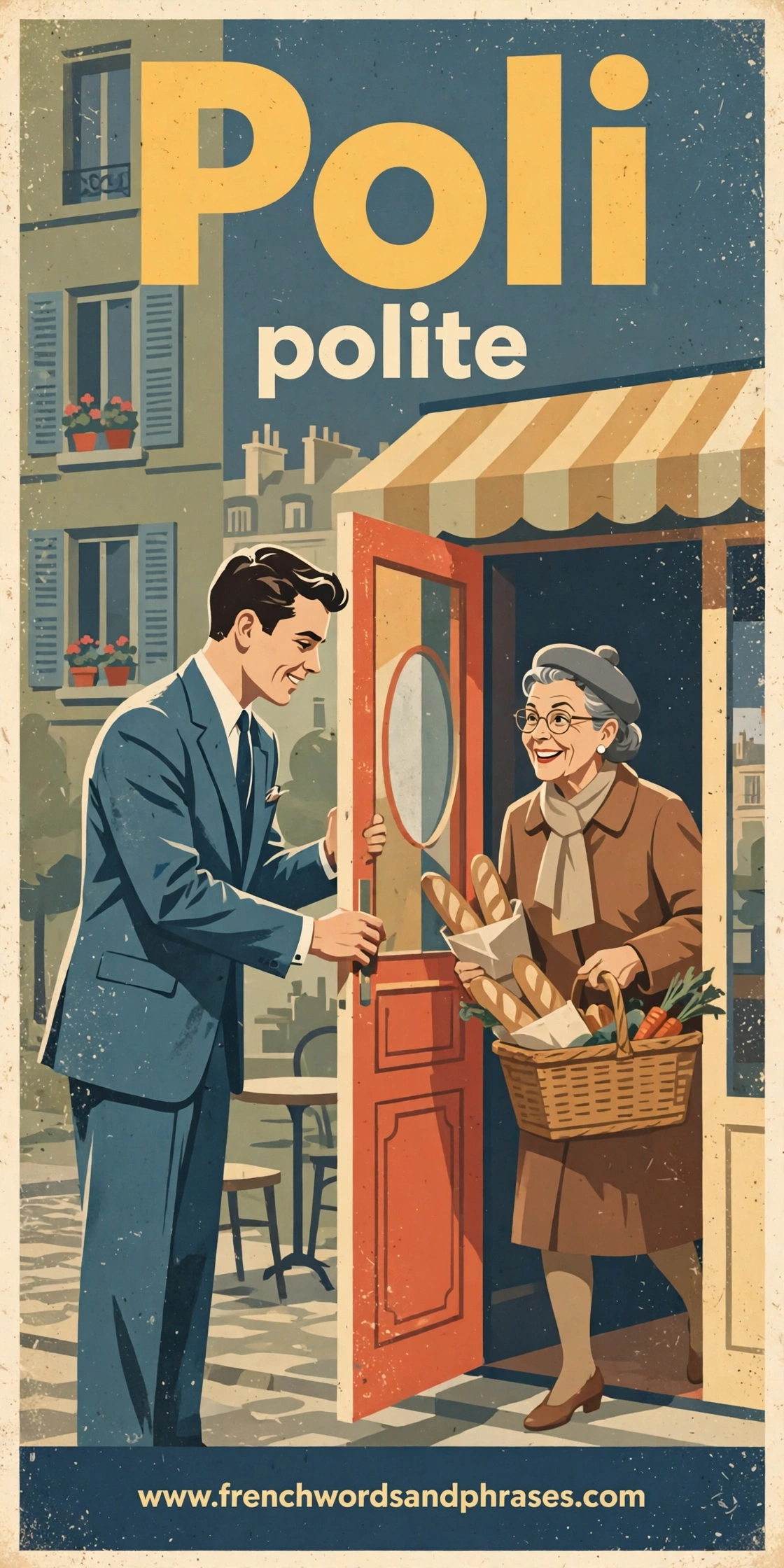
A small boy pushes open the door of a village bakery, bell ringing overhead. Before he even looks at the cakes, he says it, clear as a bell himself: « Bonjour, madame ! » The baker smiles the smile French adults keep for this exact moment. He is poli — and in France, that is noticed, and remembered.
In this guide, you’ll learn what poli means in English, how it builds its four neat forms, why it also describes polished wood, and how the little rituals of bonjour make it one of the hardest-working words in French childhood. Explore French examples, English translations, and practice quizzes.
Understanding the French Adjective Poli
Poli is a French adjective of quality — the adjective of good manners. It is short and regular: add -e for the feminine, -s for the plural. It leads a double life, because for wood, stone and metal the very same word means polished.
It means polite — well-mannered, courteous. Un enfant poli, a polite child; un sourire poli, a polite smile; une réponse polie, a polite reply. And then, in the workshop, it turns around: un bois poli, polished wood; une pierre polie, a polished stone. French sees the link clearly — good manners are a kind of polish on a person.
Type: Adjective of quality — manners (and surfaces)
Answers the question: What is he or she like? — polite
Changes form: Yes — poli, polie, polis, polies
English equivalents: Polite; (of a surface) polished.
One important usage detail: poli stands AFTER the noun — un enfant poli. Watch the context to know which poli you have met: with people and replies it means polite; with wood, stone and furniture it means polished.
Experience the Word
Poli is the adjective of the bakery doorway — the first social word a French child is taught to perform, and the one adults judge fastest.
Imagine entering any small shop in France and saying nothing. The temperature drops a degree. Now replay it with a clear « bonjour, madame » — and watch the room warm. That tiny ritual is poli in action, and the French never tire of rewarding it.
You have not just described good manners. You have named the polish that lets French daily life glide.
How to Use Poli in French: Complete Guide
Let’s explore how poli works in French, beginning with the whole word on one card.
Poli at a Glance
Before the details, here is the whole word on one card.
The Whole Word on One Card
Meaning, type, position and forms — poli in four lines.
| Point | Poli |
|---|---|
| Meaning | polite |
| Type | adjective of quality — manners |
| Usual position | after the noun — un enfant poli |
| Form | poli / polie / polis / polies |
Example
C’est un garçon poli.
He’s a polite boy.
The Four Forms of Poli
Poli is as regular as an adjective gets: -e for the feminine, -s for the plural, and both together for the feminine plural.
| Form | Poli | Example |
|---|---|---|
| Masculine singular | poli | un élève poli — a polite pupil |
| Feminine singular | polie | une élève polie — a polite pupil |
| Masculine plural | polis | des élèves polis — polite pupils |
| Feminine plural | polies | des réponses polies — polite replies |
Example
Elle écrit toujours des réponses polies.
She always writes polite replies.
Quick Quiz 1
Which form of poli goes with élève when the pupil is a girl?
Reveal the answer
polie
Une élève polie.
A polite pupil.
Where Poli Goes: After the Noun
Poli follows the noun like most French adjectives. It also lives in the pattern rester poli — to stay polite, whatever happens.
| Pattern | Example |
|---|---|
| noun + poli | un enfant poli — a polite child |
| After être | il est poli — he is polite |
| rester poli | il reste poli — he stays polite |
| Before the noun | un poli enfant — never; poli goes after |
Example
Même en colère, il reste poli.
Even when angry, he stays polite.
More Polite: Comparing with Poli
Poli compares the regular way, with plus, moins and aussi — and the superlative keeps the agreement: le plus poli, la plus polie.
| Degree | Example |
|---|---|
| As polite as | aussi poli que — as polite as |
| More polite | plus poli — plus poli que son frère |
| Less polite | moins poli — less polite |
| The politest (masc.) | le plus poli — le plus poli de la classe |
| The politest (fem.) | la plus polie — la plus polie de la classe |
Example
C’est l’enfant le plus poli de la classe.
He’s the politest child in the class.
Quick Quiz 2
How do you say ‘the politest girl in the class’ — la plus poli or la plus polie?
Reveal the answer
la plus polie
The superlative agrees like the adjective itself.
La plus polie de la classe — the politest in the class.
Everyday Expressions with Poli
Poli turns up wherever French greets, thanks and takes its leave — and it brings its family: the adverb poliment and the noun la politesse.
| Expression | In English |
|---|---|
| être poli | to be polite — sois poli avec la dame |
| rester poli | to stay polite |
| un sourire poli | a polite smile |
| une réponse polie | a polite reply |
| poliment | politely — the adverb |
| la politesse | politeness — the noun |
Example
Il a répondu poliment, avec un sourire.
He answered politely, with a smile.
Poli and Its Neighbours
French owns a whole shelf of manners words. Poli is the everyday classic taught to every child; its neighbours are grander, warmer — or waiting at the rude end of the shelf.
| French | In English |
|---|---|
| courtois | courteous |
| bien élevé | well brought up |
| respectueux | respectful |
| aimable | kind, pleasant |
| impoli | impolite — the opposite |
| grossier | rude, crude |
Example
Un accueil courtois et poli, comme toujours.
A courteous, polite welcome, as always.
Quick Quiz 3
What does la politesse mean?
Reveal the answer
Politeness — the noun of the family.
La politesse ouvre toutes les portes.
Politeness opens every door.
Poli Moments: Politeness in Daily Life
Poli performs in the smallest scenes of the French day: a greeting, a signature, a seat given up on the bus. A tour of the moments it describes.
| Moment | Example |
|---|---|
| In the bakery | un enfant poli dit bonjour — a polite child says hello |
| In a letter | une formule polie à la fin — a polite sign-off at the end |
| On the bus | un garçon poli cède sa place — a polite boy gives up his seat |
| On the phone | un ton poli — a polite tone |
Example
Le garçon poli a cédé sa place à une dame âgée.
The polite boy gave up his seat to an elderly lady.
Watch Out: The Traps Around Poli
Three traps wait around this short word — the police, the polished table, and the t that English wants to add.
| Trap | The truth |
|---|---|
| poli = police | no — la police is the police force; poli means polite, or polished |
| un meuble poli | polished furniture, not polite furniture — with things, poli means polished |
| polite with a t | the French feminine is polie, never ‘polite’ — that t belongs to English |
| malpoli | a real word: a familiar synonym of impoli, written as one word |
Example
Cette table polie brille comme un miroir.
This polished table shines like a mirror.
Quick Quiz 4
How do you say ‘polite replies’ — des réponses poli or des réponses polies?
Reveal the answer
des réponses polies
Feminine plural takes -es.
Des réponses polies — polite replies.
Poli in Everyday French: Real-Life Examples
Now that you know the word, let’s see how poli appears in everyday French.
Example 1 — In the bakery
L’enfant poli dit : « Bonjour, madame ! »
The polite child says: ‘Hello, madam!’
Example 2 — On the bus
Le garçon poli a cédé sa place à une dame âgée.
The polite boy gave up his seat to an elderly lady.
Example 3 — At school
Les élèves polis disent merci à la maîtresse.
The polite pupils say thank you to the teacher.
Example 4 — A polite smile
Elle a fait un sourire poli et elle est partie.
She gave a polite smile and left.
Example 5 — Staying polite
Il reste poli même quand il n’est pas d’accord.
He stays polite even when he disagrees.
Example 6 — A compliment
Vos enfants sont très polis, félicitations.
Your children are very polite, congratulations.
Beyond Translation: The Meaning of Poli
English says polite for the meaning of poli — and English quietly agrees with French about the metaphor, since it also speaks of polished manners. In French the link is one single word: the child and the tabletop are both poli, both smoothed until they shine.
Politeness in France is not decoration: it is the bonjour at the door, the merci at the counter, the au revoir on the way out.
Master poli and its rituals, and half the social machinery of French daily life starts running in your favour.
How to Remember the French Adjective Poli
Remember it this way: Poli is short and neat, like good manners themselves: poli, polie, polis, polies — just add -e for her and -s when there are several.
- You build the family in four tidy steps — poli, polie, polis, polies.
- You put it after the noun — un enfant poli — and keep it after être and rester.
- You hear its double life: polite for people, polished for wood and stone.
The key idea is poli means polite — feminine polie — and for wood and stone it means polished.
Test Your Knowledge of Poli
Let’s see how much you’ve learned. Try answering these questions before revealing the answers.
Question 1
What does poli mean?
Reveal the answer
Polite — and, for surfaces, polished.
Question 2
What are the forms of poli?
Reveal the answer
poli, polie, polis, polies — add -e for the feminine and -s for the plural.
Question 3
Translate: a polite child.
Reveal the answer
Un enfant poli.
Question 4
What is the French noun for politeness?
Reveal the answer
La politesse
La politesse est importante.
Politeness is important.
Question 5
Complete the sentence:
Même fâché, il reste ______.
Reveal the answer
poli
Même fâché, il reste poli.
Even when annoyed, he stays polite.
Your Final Challenge
Can You Use It?
How would you say this in French?
“The polite boy gave up his seat on the bus.”
Reveal the answer
Le garçon poli a cédé sa place dans le bus.
The polite boy gave up his seat on the bus.
A little French. A little curiosity. A richer everyday life.
LEARN FRENCH ONE WORD AT A TIME