A French Word to Live By
Translate Timide to English
/ti.mid/
Timide means shy.
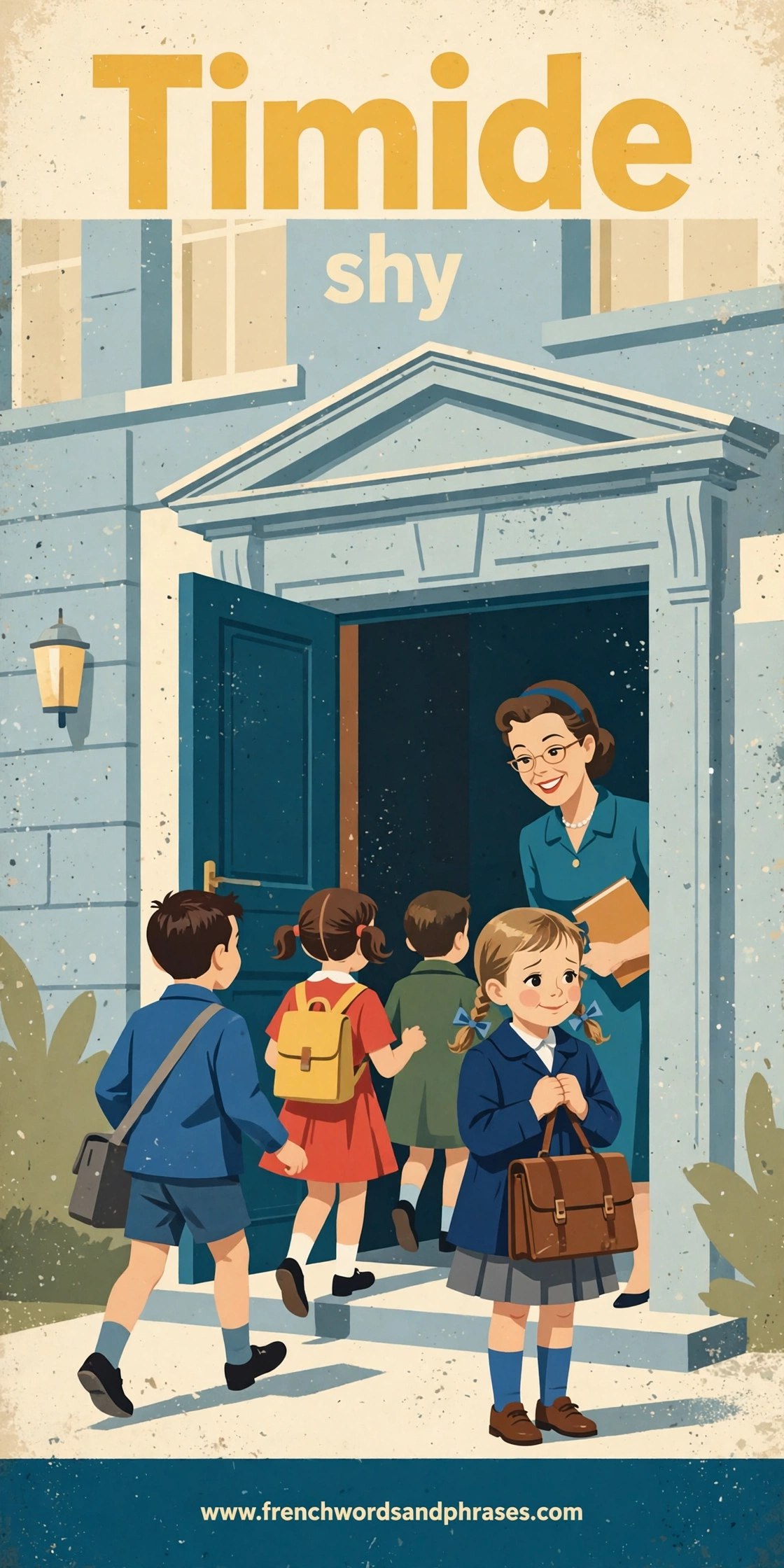
At the back of a classroom in Nantes, a new pupil studies her desk while the teacher smiles: « Elle est un peu timide, donnez-lui le temps. » By June, she is telling the class a story — and the word has quietly left her.
In this guide, you’ll learn what timide means in English, why it is spelled the same for boys and girls, the gentle phrase un peu timide, and how French separates being shy from being ashamed. Explore French examples, English translations, and practice quizzes.
Understanding the French Adjective Timide
Timide is a French adjective of quality — the adjective of shyness. It already ends in -e, so masculine and feminine are spelled the same; only the plural adds -s.
It means shy — quiet in new company, slow to speak, happier at the edge of the group until the group becomes familiar. French treats timide gently: it is a description of tempo, not a defect. Un enfant timide is a child who needs time, and the adverb timidement paints the manner: elle a levé la main timidement, she raised her hand timidly.
Type: Adjective of quality — shyness
Answers the question: What is he/she like? — shy
Changes form: Only for the plural — timide, timides; masculine and feminine are spelled the same
English equivalents: Shy; timid; bashful.
One important usage detail: timide describes a temperament, and French keeps it separate from shame — avoir honte means to be ashamed, a different feeling entirely. A shy child is timide; a child caught stealing is honteux. Do not mix them.
Experience the Word
Timide is the adjective of the edge of the photograph — the one standing half a step behind, smiling with the eyes first.
Imagine the first day at a new school in Lille: the timide pupil says almost nothing before lunch, and tells her mother everything by dinner. Shyness in French is not silence; it is speech that is still warming up.
You have not just labelled a person. You have promised to give them time.
How to Use Timide in French: Complete Guide
Let’s explore how timide works in French, beginning with the whole word on one card.
Timide at a Glance
Before the details, here is the whole word on one card.
The Whole Word on One Card
Meaning, type, position and forms — timide in four lines.
| Point | Timide |
|---|---|
| Meaning | shy |
| Type | adjective of quality — temperament |
| Usual position | after the noun, or after être — un enfant timide |
| Form | timide / timide / timides / timides — only the plural changes |
Example
C’est un enfant timide.
He’s a shy child.
The Forms of Timide
Timide agrees in number only: add -s for the plural, and the feminine needs no change because the word already ends in -e.
| Form | Timide | Example |
|---|---|---|
| Masculine singular | timide | un garçon timide — a shy boy |
| Feminine singular | timide | une fille timide — a shy girl |
| Masculine plural | timides | des garçons timides — shy boys |
| Feminine plural | timides | des filles timides — shy girls |
Example
Les deux sœurs sont assez timides.
The two sisters are quite shy.
Quick Quiz 1
Which form of timide goes with filles (feminine plural) — timide or timides?
Reveal the answer
timides
Des filles timides.
Shy girls.
Where Timide Goes: After the Noun, and After Être
Timide follows the noun, and its most common home is after être, describing a person’s temperament. Softening adverbs — un peu, très, assez — slide in front of it.
| Pattern | Example |
|---|---|
| noun + timide | un élève timide — a shy pupil |
| After être | elle est timide — she is shy |
| Softened | un peu timide — a little shy |
| Before the noun | un timide élève — never in everyday French; timide goes after |
Example
Il est un peu timide avec les inconnus.
He is a little shy with strangers.
More Shy: Comparing with Timide
Timide compares the regular way, with plus, moins and aussi — and the superlative keeps the agreement.
| Degree | Example |
|---|---|
| As shy as | aussi timide que — as shy as |
| More shy | plus timide — plus timide que sa sœur |
| Less shy | moins timide — less shy |
| The shyest (sing.) | le plus timide — le plus timide de la classe |
| The shyest (plural) | les plus timides — les plus timides du groupe |
Example
C’est l’élève le plus timide de la classe.
He’s the shyest pupil in the class.
Quick Quiz 2
What is the noun for shyness — la timidité or la timidesse?
Reveal the answer
La timidité
Il a vaincu sa timidité.
He overcame his shyness.
Everyday Expressions with Timide
Timide turns up in classrooms, at parties, and in one gentle encouragement the French give their children.
| Expression | In English |
|---|---|
| un peu timide | a little shy |
| ne sois pas timide | don’t be shy — help yourself, come in |
| un sourire timide | a shy smile |
| timidement | timidly, shyly — the adverb |
| vaincre sa timidité | to overcome one’s shyness |
| la timidité | shyness — the noun |
Example
Ne sois pas timide, sers-toi !
Don’t be shy, help yourself!
Timide and Its Neighbours
French separates the quiet temperaments with care. Timide is the shy one; its neighbours are reserved, wild, or ashamed — three very different neighbours.
| French | In English |
|---|---|
| réservé | reserved, quiet — a close cousin |
| sauvage | unsociable, ‘wild’ — joking, of a very shy person |
| honteux | ashamed, shameful — not shy at all |
| extraverti | outgoing, extrovert — the opposite |
| bavard | chatty, talkative — the far end of the scale |
| confiant | confident, self-assured |
Example
Elle est réservée, un peu timide avec les inconnus.
She is reserved, a little shy with strangers.
Quick Quiz 3
Does timide mean shy or ashamed?
Reveal the answer
Shy — ashamed is honteux, or avoir honte.
Elle est timide, elle n’a pas honte.
She is shy, she is not ashamed.
Timide Moments: Shyness in Daily Life
Timide appears wherever someone new meets a group: the classroom, the party, the office, the stage. A tour of its tender moments.
| Moment | Example |
|---|---|
| At school | l’élève timide lève la main — the shy pupil raises his hand |
| At a party | un invité timide près de la porte — a shy guest near the door |
| At work | une collègue timide en réunion — a shy colleague in meetings |
| On stage | un acteur timide avant le spectacle — a shy actor before the show |
Example
L’invité timide a fini la soirée en racontant des histoires.
The shy guest ended the evening telling stories.
Watch Out: The Traps Around Timide
Three traps wait here — the shame confusion, the phantom feminine, and the animal at the party.
| Trap | The truth |
|---|---|
| timide = ashamed | no — timide is temperament; shame is honte / honteux |
| timidée | the feminine is simply timide — the word already ends in -e |
| sauvage for a shy guest | calling someone sauvage is a joke among friends only — it literally calls them wild and unsociable |
| timidité spelling | the noun is la timidité, with -ité — vaincre sa timidité |
Example
Timide au début, elle est devenue bavarde en juin.
Shy at first, she became chatty by June.
Quick Quiz 4
How do you say ‘a shy girl’ — une fille timidée or une fille timide?
Reveal the answer
une fille timide
Timide is spelled the same for girls and boys.
Une fille timide — a shy girl.
Timide in Everyday French: Real-Life Examples
Now that you know the word, let’s see how timide appears in everyday French.
Example 1 — At school
Le nouvel élève est un peu timide.
The new pupil is a little shy.
Example 2 — At a party
Ne sois pas timide, viens danser !
Don’t be shy, come and dance!
Example 3 — A shy smile
Elle a répondu avec un sourire timide.
She answered with a shy smile.
Example 4 — About a brother
Mon frère est timide, mais très gentil.
My brother is shy, but very kind.
Example 5 — Growing out of it
Enfant, j’étais timide ; maintenant, je suis bavard.
As a child, I was shy; now, I’m chatty.
Example 6 — Encouragement
Ne sois pas timide, sers-toi, il y a du gâteau.
Don’t be shy, help yourself, there’s cake.
Beyond Translation: The Meaning of Timide
English says shy for the meaning of timide — a word English shares through Latin timidus, afraid. But where English ‘timid’ can sound like a criticism, French timide is usually said with warmth: it asks the world to wait a moment.
Its favourite companion is un peu — un peu timide — shyness measured gently, in small doses.
And its kindest expression is an invitation, not a label: ne sois pas timide — don’t be shy — said over cake, at doors, at the edge of dance floors, all over France.
How to Remember the French Adjective Timide
Remember it this way: Timide ends in -e already, so boys and girls wear the same spelling — it only adds an -s when the shy ones arrive in a group.
- You see one spelling for him and for her — timide, timide — and only the plural adds -s.
- You soften it the French way: un peu timide, a little shy.
- You keep shame out of it: shy is timide, ashamed is honteux.
The key idea is timide means shy, is spelled the same for masculine and feminine, and ne sois pas timide means don’t be shy.
Test Your Knowledge of Timide
Let’s see how much you’ve learned. Try answering these questions before revealing the answers.
Question 1
What does timide mean?
Reveal the answer
Shy — also timid, bashful.
Question 2
What are the forms of timide?
Reveal the answer
timide, timide, timides, timides — only the plural changes.
Question 3
Translate: don’t be shy, help yourself!
Reveal the answer
Ne sois pas timide, sers-toi !
Question 4
Timide or honteux — which one means ashamed?
Reveal the answer
Honteux — timide means shy, a temperament, not a shame.
Question 5
Complete the sentence:
Le nouvel élève est un peu ______.
Reveal the answer
timide
Le nouvel élève est un peu timide.
The new pupil is a little shy.
Your Final Challenge
Can You Use It?
How would you say this in French?
“Don’t be shy, come and dance — she was shy at first, but not any more.”
Reveal the answer
Ne sois pas timide, viens danser — elle était timide au début, mais plus maintenant.
Don’t be shy, come and dance — she was shy at first, but not any more.
A little French. A little curiosity. A richer everyday life.
LEARN FRENCH ONE WORD AT A TIME