A French Word to Live By
Translate Ça ne marche pas to English
/sa nə maʁʃ pa/
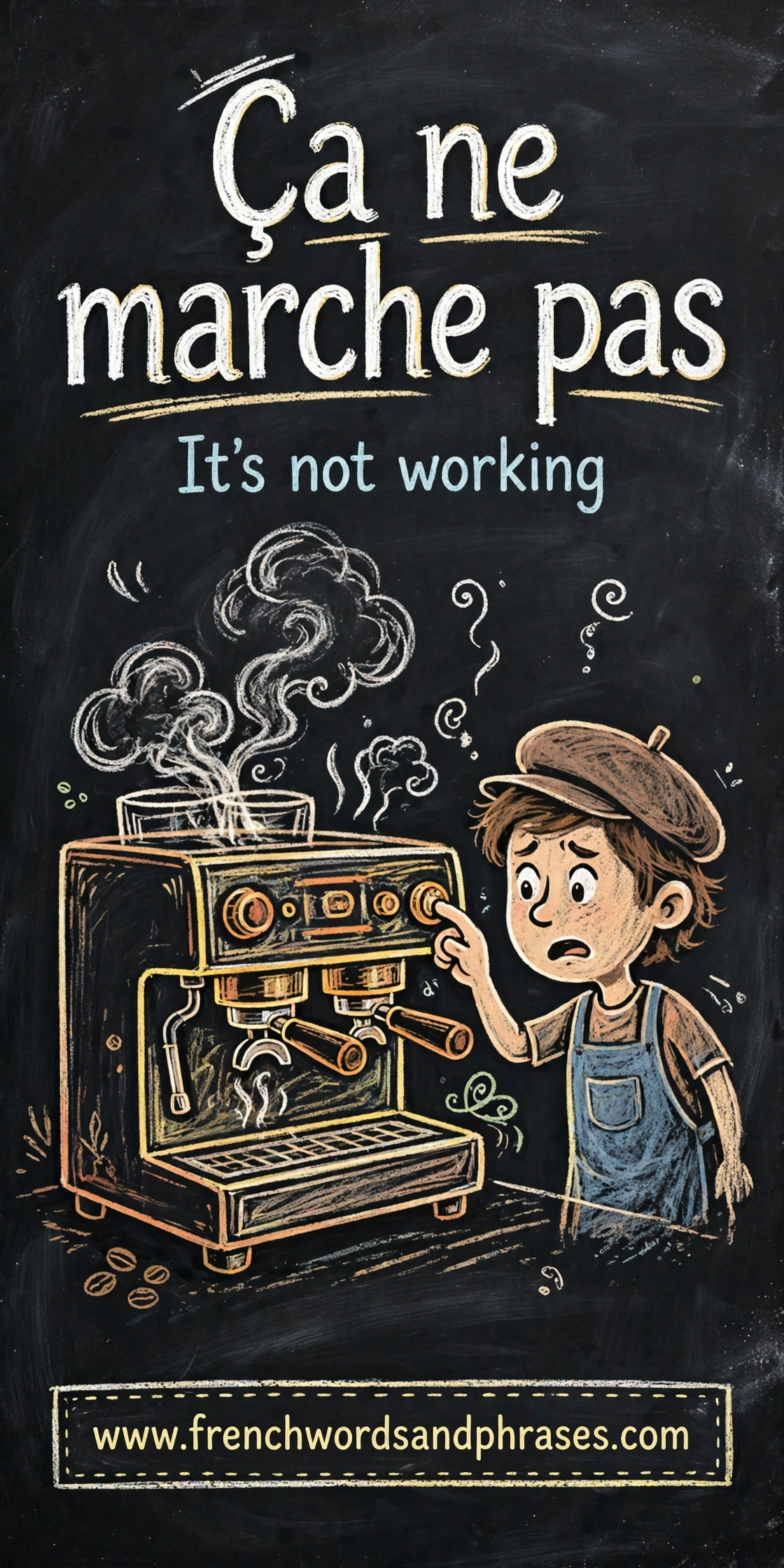
Ça ne marche pas means It’s not working.
The coffee machine blinks, gurgles, and gives up. You press the button again — nothing. In offices and kitchens across France, the same small sigh escapes, half complaint, half diagnosis: Ça ne marche pas.
Let’s explore how ça ne marche pas works in French, beginning with the whole phrase on one card.
Understanding the French Phrase Ça ne marche pas
Ça ne marche pas is a French everyday phrase built on the verb marcher, which means both to walk and to work, to function. With the negative ne … pas wrapped around it, it is the standard report that a machine, a plan or a system has failed.
It means it’s not working — said over dead printers, frozen phones and coffee machines on strike. The magic is in marcher: French machines do not ‘work’ like English ones, they walk. When they walk, they function; when they stop walking, ça ne marche pas.
Type: Everyday phrase — marcher (to walk / to function) inside the ne … pas negative
Answers the need: Reporting that a machine, device, plan or arrangement has failed
Register: Neutral and everyday — homes, offices, shops and help desks
Strength: Everyday — from a stubborn zip to a whole computer system
One important usage detail: the same phrase turns positive with delight — ça marche ! means both ‘it works!’ and ‘deal / OK!’ when agreeing a plan. The little ne … pas is the whole difference between celebration and complaint.
Experience the Word
Ça ne marche pas is the first sentence of every repair story in France — said to machines, to partners, and finally, with hope, to the person who can fix them.
Imagine the archaeology of a broken morning: the alarm, the kettle, the car. Each failure gets the same four words, and somehow naming it in French makes the breakdown feel shared — the machine has stopped walking, and you are simply reporting its strike.
The phrase also covers plans: a scheme that falls apart, a trick that fails, a story nobody believes — all of them, in French, stop walking.
How to Use Ça ne marche pas in French: Complete Guide
Let’s explore how ça ne marche pas works in French, beginning with the whole phrase on one card.
Ça ne marche pas at a Glance
The Whole Phrase on One Card
Real meaning, literal building blocks, English twin and register — ça ne marche pas in five lines.
| Point | Ça ne marche pas |
|---|---|
| What it really means | it’s not working — the machine, plan or system has failed |
| Word for word | that not walks not (ça + ne … pas around marche, walks/works) |
| English equivalent | it’s not working / it doesn’t work |
| Register | neutral and everyday — safe everywhere |
| Use it for | dead devices, broken plans, failed tricks, frozen screens |
Example
L’imprimante ? Ça ne marche pas depuis hier.
The printer? It hasn’t been working since yesterday.
Word by Word: Building the Breakdown
Four pieces — a pointing word, a two-part ‘not’, and a verb that walks.
| Word | Literal meaning | Its job in the phrase |
|---|---|---|
| ça | that / it | the pointing word — it gestures at the machine or the plan without naming it |
| ne … pas | not | the French negative in two halves, wrapped around the verb like a sandwich |
| marche | walks / works | the present tense of marcher — to walk, and by extension to function |
Example
Ça ne marche pas, ce robinet fuit depuis ce matin.
It’s not working, this tap has been leaking since this morning.
Quick Quiz 1
Marcher means ‘to walk’. Why does a broken lift ne marche pas — not walk?
Reveal the answer
Because French extends walking to functioning — a machine that ‘walks’ is a machine that runs. When it stops walking, it stops working.
L’ascenseur ne marche pas, prenons l’escalier.
The lift isn’t working, let’s take the stairs.
When You Say It: The Failure Moments
Ça ne marche pas belongs to the seconds after the third press of the button.
| Situation | Example |
|---|---|
| A dead appliance | le four ne marche plus — the oven isn’t working any more |
| A frozen screen | ça ne marche pas, l’écran est bloqué — it’s not working, the screen is frozen |
| A failed plan | ton plan ne marche pas, il faut autre chose — your plan isn’t working, we need something else |
| At the help desk | excusez-moi, la machine à café ne marche pas — excuse me, the coffee machine isn’t working |
| A trick that flops | ça ne marche pas avec moi, ton histoire — that doesn’t work with me, your story |
Example
J’ai tout essayé, ça ne marche pas du tout.
I’ve tried everything, it’s not working at all.
Make It Yours: Bending the Breakdown
The phrase flexes — stop, never, question, or name the machine.
| Form | French | In English |
|---|---|---|
| It stopped working | ça ne marche plus | it’s not working any more |
| It never works | ça ne marche jamais | it never works |
| Naming the machine | la wifi ne marche pas | the Wi-Fi isn’t working |
| Asking the question | ça marche ? | does it work? / is that OK? |
| The celebration | ça marche ! | it works! / deal! |
| For arrangements | ça marche pour moi | that works for me |
Example
On se retrouve à midi ? — Ça marche pour moi.
Shall we meet at noon? — That works for me.
Quick Quiz 2
Your colleague proposes meeting at noon and you agree happily. What do you say — ça ne marche pas or ça marche?
Reveal the answer
Ça marche — without the negative, the phrase doubles as ‘deal, that works for me’.
À midi chez Paul ? Ça marche !
At noon at Paul’s? Deal!
Everyday Expressions: Building on the Machine
Marcher grows a whole family of working frames — learn these and every breakdown reports itself.
| Frame | In English |
|---|---|
| ça ne marche plus | it’s stopped working |
| ça ne marche pas du tout | it’s not working at all |
| ça marche ! | it works! / deal! |
| ça marche pour moi | that works for me |
| faire marcher | to get (something) working / to run |
| marcher bien / mal | to work well / badly |
Example
Tu sais faire marcher ce vieux projecteur ?
Do you know how to get this old projector working?
Close Cousins: The Other Failure Reports
French grades its breakdowns — each cousin reports a different depth of disaster.
| Expression | The difference |
|---|---|
| c’est en panne | it’s broken down — the machine is officially out of action, stronger than ne marche pas |
| ça ne fonctionne pas | it doesn’t function — the formal, technical twin, at home in manuals |
| hors service | out of order — the written sign on the machine itself |
| c’est cassé | it’s broken — something is physically snapped or smashed |
| ça bugge | it’s glitching — familiar, for software only |
Example
La photocopieuse est en panne, encore une fois.
The photocopier has broken down, yet again.
Quick Quiz 3
A sign on the drinks machine says hors service. Is the machine working?
Reveal the answer
No — hors service is the written ‘out of order’, the official cousin of ça ne marche pas.
Hors service depuis lundi, la machine !
Out of order since Monday, that machine!
Ça ne marche pas and Its Neighbours
The marcher family at a glance — walking, working and agreeing.
| French | In English |
|---|---|
| ça marche | it works / deal |
| ça ne marche pas | it’s not working |
| ça ne marche plus | it’s stopped working |
| le bébé marche | the baby is walking |
| ça marche pour moi | that works for me |
| en panne | broken down |
Example
Le bébé marche déjà, et la poussette ne marche plus !
The baby is already walking, and the pushchair isn’t working any more!
Watch Out: The Traps Around Ça ne marche pas
Three traps wait around this phrase — step round them.
| Trap | The truth |
|---|---|
| Hearing ‘walking’ everywhere | marcher means walk for legs and work for machines — the subject tells you which |
| Losing half the negative | the negative is a sandwich: ne before the verb, pas after — ça ne marche pas, never ‘ça marche pas’ in careful French |
| Missing the ‘deal!’ sense | ça marche ! with a smile and no negative agrees a plan — it is not reporting a repair |
| Translating ‘work’ as travail | travailler is human work, a job; machines marchent — they never ‘travaillent’ |
Example
Mon vélo ne marche pas, mais mon plan pour demain, ça marche.
My bike isn’t working, but my plan for tomorrow — that works.
Quick Quiz 4
True or false: ça ne marche plus and ça ne marche pas mean exactly the same.
Reveal the answer
False — plus adds a small history: it worked before and has stopped. Pas alone just reports the failure.
Ça marchait hier, ça ne marche plus aujourd’hui.
It worked yesterday, it’s not working any more today.
Ça ne marche pas in Everyday French: Real-Life Examples
Now that you know the word, let’s see how ça ne marche pas appears in everyday French.
Example 1 — The printer
L’imprimante ne marche pas, et le rapport est pour midi.
The printer isn’t working, and the report is due at noon.
Example 2 — The coffee machine
Ça ne marche pas ce matin, on va au café d’en face.
It’s not working this morning, we’re going to the café across the street.
Example 3 — The phone call
Je t’entends très mal, mon téléphone ne marche pas bien.
I can hardly hear you, my phone isn’t working properly.
Example 4 — The failed plan
On a essayé ton idée, mais ça ne marche pas.
We tried your idea, but it’s not working.
Example 5 — The good news
Ça y est, ça marche ! Le moteur tourne !
That’s it, it works! The engine is running!
Example 6 — The arrangement
Jeudi à dix heures, ça marche pour toi ?
Thursday at ten, does that work for you?
Beyond Translation: The Meaning of Ça ne marche pas
French machines walk, and the metaphor is older than machines: marcher has meant ‘to proceed, to go forward’ for centuries, so anything that proceeds — a business, a plan, a love affair — can marcher. When English asks whether something ‘works’, it thinks of labour. When French asks whether something marche, it thinks of a journey continuing. A broken machine, in French, is simply one that has stopped mid-road.
How to Remember the French Phrase Ça ne marche pas
Remember it this way: Ça ne marche pas reports a machine that has stopped walking — legs for people, walking for everything else.
- You picture the machine with little legs, stopped mid-road — that picture is the grammar.
- You keep the negative in its sandwich: ne before, pas after, the verb warm in the middle.
- You flip it for joy: drop the negative and ça marche ! means it works — or deal!
The key idea is ça ne marche pas means it’s not working — marcher means to walk, and for machines, to function.
Test Your Knowledge of Ça ne marche pas
Let’s see how much you’ve learned. Try answering these questions before revealing the answers.
Question 1
What does ça ne marche pas mean?
Reveal the answer
It’s not working — the machine, plan or system has failed.
Question 2
Why does French use marcher, to walk, for machines?
Reveal the answer
Because marcher also means to proceed, to function — a machine that walks is a machine that runs.
Question 3
How do you say ‘it’s stopped working’?
Reveal the answer
Ça ne marche plus — plus replaces pas and adds the history: it worked before.
Question 4
Your friend suggests Friday and you agree. What does ça marche ! mean there?
Reveal the answer
Deal! / That works for me! — without the negative, the phrase agrees a plan.
Question 5
Complete the sentence:
La wifi ______ marche pas ce matin. (The Wi-Fi isn’t working this morning.)
Reveal the answer
ne — La wifi ne marche pas ce matin.
Your Final Challenge
Can You Use It?
How would you say this in French?
“The printer isn’t working, and the report is due at noon.”
Reveal the answer
L’imprimante ne marche pas, et le rapport est pour midi.
The printer isn’t working, and the report is due at noon.
A little French. A little curiosity. A richer everyday life.
LEARN FRENCH ONE WORD AT A TIME