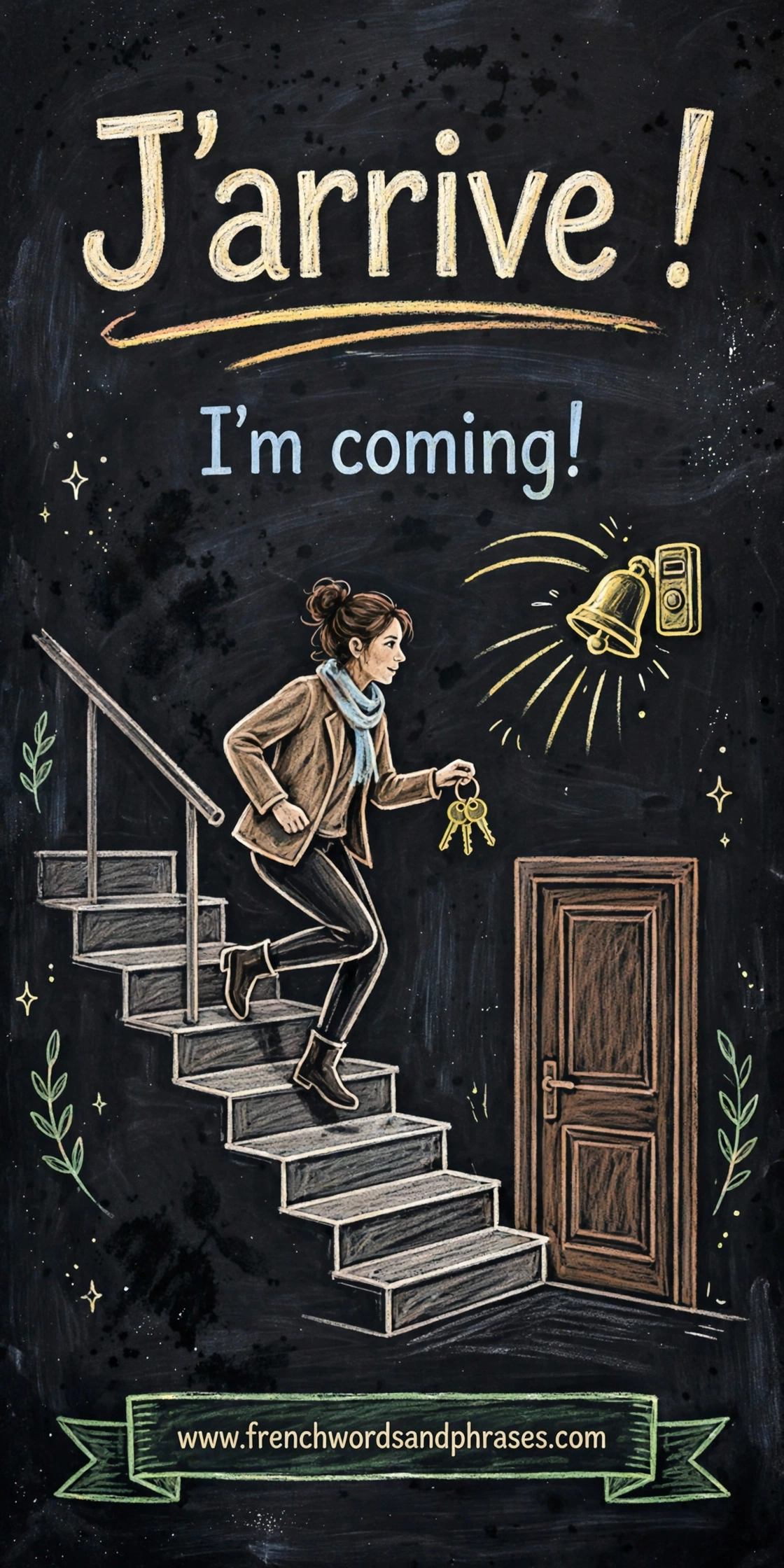
A French Word to Live By
Translate J’arrive to English
/ʒa.ʁiv/
J’arrive means I’m coming.
The doorbell rings in a little apartment in Bordeaux. You are still pulling on your shoes, your keys are hiding somewhere, and your friend is waiting downstairs. You lean over the banister and call out the two words every French household knows by heart: J’arrive !
Let’s explore how j’arrive works in French, beginning with the whole phrase on one card.
Understanding the French Phrase J’arrive
J’arrive is a French everyday phrase — the present tense of the verb arriver (to arrive) used as a promise: not ‘I have arrived’, but ‘I am coming, right now’. It is the standard reply when someone is waiting for you.
It means I’m coming! — called out when you are on your way to the door, down the stairs, or out of the office. English ‘I’m coming’ and French j’arrive do the same job, but French builds it from the verb arriver, to arrive: in French you do not say you are coming, you say you are arriving.
Type: Everyday phrase — present tense of arriver used as a promise
Answers the need: Telling someone who is waiting that you are on your way to them
Register: Neutral and friendly — said to family, friends and colleagues alike
Strength: Everyday — doorbells, phone calls, office doors, station platforms
One important usage detail: j’arrive is a promise about the next few seconds or minutes, not a travel report. If you are still twenty minutes away, a French speaker adds the time — j’arrive dans vingt minutes — or switches to je suis en route, I’m on my way.
Experience the Word
J’arrive is the soundtrack of French doorways — called down stairwells, across gardens and into telephones a hundred times a day.
Imagine a friend ringing from downstairs. You could explain everything — the shoes, the keys, the bag. Or you can call out two syllables of pure reassurance: j’arrive ! Everything else can wait until you are face to face.
The phrase carries a small promise inside it: I have heard you, I am moving, do not leave without me.
How to Use J’arrive in French: Complete Guide
Let’s explore how j’arrive works in French, beginning with the whole phrase on one card.
J’arrive at a Glance
The Whole Phrase on One Card
Real meaning, literal building blocks, English twin and register — j’arrive in five lines.
| Point | J’arrive |
|---|---|
| What it really means | I’m coming! — said while you are on your way to the person waiting |
| Word for word | I arrive (je + arrive, from the verb arriver) |
| English equivalent | I’m coming! / I’ll be right there! |
| Register | neutral and warm — safe everywhere |
| Use it for | doorbells, phone calls, ‘dinner’s ready!’, a friend waiting outside |
Example
J’arrive, j’arrive, ne pars pas sans moi !
I’m coming, I’m coming, don’t leave without me!
Word by Word: Building the Promise
Two small pieces — a squashed pronoun and a present tense doing the work of a promise.
| Word | Literal meaning | Its job in the phrase |
|---|---|---|
| j’ | I | je squeezed into j’ because the next word starts with a vowel sound |
| arrive | arrive / am arriving | the present tense of arriver — French announces an arrival, not a coming |
Example
Tu m’appelles ? J’arrive tout de suite.
You’re calling me? I’m coming right away.
Quick Quiz 1
Why does je become j’ in j’arrive?
Reveal the answer
Because arrive starts with a vowel sound — French squeezes je into j’ so the words flow together.
J’arrive, descends m’ouvrir !
I’m coming, come down and let me in!
When You Say It: The Waiting Moments
J’arrive belongs to the seconds when someone is waiting and you are moving.
| Situation | Example |
|---|---|
| The doorbell rings | j’arrive ! — I’m coming! |
| Dinner is ready | vous venez ? — j’arrive ! — are you coming? — I’m coming! |
| A friend calls from downstairs | descends, je suis en bas — j’arrive ! — come down, I’m downstairs — I’m coming! |
| Your boss asks for you | on m’attend ? j’arrive tout de suite — they’re waiting for me? I’m coming right away |
| Running for the group photo | attendez-moi, j’arrive ! — wait for me, I’m coming! |
Example
On t’attend depuis dix minutes — j’arrive, j’arrive !
We’ve been waiting for you for ten minutes — I’m coming, I’m coming!
Make It Yours: Bending the Promise
The promise stretches — add urgency, add a time, or make it a group arrival.
| Form | French | In English |
|---|---|---|
| With urgency | j’arrive tout de suite | I’m coming right away |
| With a time | j’arrive dans cinq minutes | I’ll be there in five minutes |
| Almost there | j’arrive, je suis à deux minutes | I’m coming, I’m two minutes away |
| For a group | on arrive ! | we’re coming! |
| Held up | j’arrive, je suis juste derrière toi | I’m coming, I’m right behind you |
| Softened | j’arrive dans un petit moment | I’ll be there in a little while |
Example
Partez pas sans nous, on arrive !
Don’t leave without us, we’re coming!
Quick Quiz 2
Your train gets in at six and your friend asks where you are at five past. Which reply promises too much — j’arrive or j’arrive dans vingt minutes?
Reveal the answer
Plain j’arrive promises too much — it means you are seconds away. With twenty minutes to go, name the time.
J’arrive dans vingt minutes, commence sans moi.
I’ll be there in twenty minutes, start without me.
Everyday Expressions: Building on the Arrival
Arriver grows a whole family of everyday frames — learn these and doorways everywhere open.
| Frame | In English |
|---|---|
| j’arrive tout de suite | I’m coming right away |
| j’arrive dans cinq minutes | I’ll be there in five minutes |
| on arrive, on arrive ! | we’re coming, we’re coming! |
| j’arrive, ne quitte pas | I’m coming, don’t hang up |
| ça arrive | it happens / it’s on its way |
| j’y arrive pas | I can’t manage it / I can’t do it |
Example
Ne quitte pas, j’arrive avec les clés.
Don’t hang up, I’m coming with the keys.
Close Cousins: The Other Ways to Say You’re Coming
French has a small crowd of ‘I’m coming’ phrases — each with its own shade.
| Expression | The difference |
|---|---|
| je viens | I’m coming — built on venir (to come); just as common, slightly more literal |
| je suis en route | I’m on my way — for the journey itself, not the final seconds |
| me voilà | here I am — said at the moment you appear, not before |
| j’y vais | I’m off / I’m going now — announces a departure, not an arrival |
| je descends | I’m coming down — for stairs, lifts and hillsides |
Example
Me voilà ! J’arrive à peine et tu pars déjà ?
Here I am! I’ve only just arrived and you’re already leaving?
Quick Quiz 3
You step through the door and your friend finally sees you. J’arrive or me voilà?
Reveal the answer
Me voilà — j’arrive is the promise before you appear; me voilà is the announcement as you do.
Me voilà, enfin !
Here I am, at last!
J’arrive and Its Neighbours
The arriver family at a glance — arrivals, happenings and managings.
| French | In English |
|---|---|
| j’arrive | I’m coming! |
| on arrive | we’re coming! |
| ça arrive | it happens |
| ça m’arrive souvent | it often happens to me |
| j’y arrive | I can manage it / I can do it |
| tu y arrives ? | are you managing? / can you do it? |
Example
Tu y arrives avec ce paquet ? — Oui, j’y arrive.
Are you managing with that parcel? — Yes, I can manage.
Watch Out: The Traps Around J’arrive
Three traps wait around this tiny phrase — step round them.
| Trap | The truth |
|---|---|
| Translating ‘I’m coming’ word for word | French never says ‘je suis venant’ — the arrival verb does the job: j’arrive |
| Using it for a long journey | j’arrive promises seconds or a few minutes; for a journey, say je suis en route |
| Forgetting the apostrophe | je + arrive always contracts to j’arrive — the apostrophe is not optional |
| Confusing it with ‘ça arrive’ | ça arrive means ‘it happens’ — same verb, different world |
Example
Je suis en route, j’arrive dans dix minutes.
I’m on my way, I’ll be there in ten minutes.
Quick Quiz 4
True or false: j’arrive is the past tense — ‘I arrived’.
Reveal the answer
False — it is the present tense used as a promise. ‘I arrived’ would be je suis arrivé(e).
J’arrive ! — Je suis arrivé il y a une heure.
I’m coming! — I arrived an hour ago.
J’arrive in Everyday French: Real-Life Examples
Now that you know the word, let’s see how j’arrive appears in everyday French.
Example 1 — The doorbell
J’arrive ! Donne-moi une seconde pour trouver mes clés.
I’m coming! Give me a second to find my keys.
Example 2 — On the phone
Tu es devant la gare ? J’arrive, je traverse la place.
You’re in front of the station? I’m coming, I’m crossing the square.
Example 3 — Dinner time
À table ! — J’arrive, je me lave les mains.
Dinner’s ready! — I’m coming, I’m washing my hands.
Example 4 — At the office
La réunion commence, on n’attend plus que toi. — J’arrive tout de suite.
The meeting is starting, we’re only waiting for you. — I’m coming right away.
Example 5 — Running late
Commencez sans moi, j’arrive dans cinq minutes.
Start without me, I’ll be there in five minutes.
Example 6 — The group chat
On arrive dans dix minutes, gardez-nous une table.
We’ll be there in ten minutes, keep us a table.
Beyond Translation: The Meaning of J’arrive
French builds ‘I’m coming’ out of arriving, and the choice is quietly philosophical: the person waiting does not care about your journey, only about your arrival. J’arrive speaks from the waiter’s point of view — the moment that matters is the moment you appear. English watches the traveller; French watches the door.
How to Remember the French Phrase J’arrive
Remember it this way: J’arrive is the voice from the stairwell — you are not describing a journey, you are promising an arrival.
- You hear arriver and think of the door — the phrase lives at doorways, real and metaphorical.
- You say it while moving — shoes half on, keys in hand, already halfway there.
- You add tout de suite when the promise needs muscle: j’arrive tout de suite, I’m coming right away.
The key idea is j’arrive means I’m coming — the present tense of arriver, used as a promise to someone who is waiting.
Test Your Knowledge of J’arrive
Let’s see how much you’ve learned. Try answering these questions before revealing the answers.
Question 1
What does j’arrive mean?
Reveal the answer
I’m coming! — said to someone who is waiting for you.
Question 2
Why j’ and not je?
Reveal the answer
Because arrive starts with a vowel sound — je contracts to j’ before a vowel.
Question 3
How do you say ‘I’m coming right away’?
Reveal the answer
J’arrive tout de suite — tout de suite adds the urgency.
Question 4
Your friend is still on the motorway, twenty minutes away. What should she say instead of plain j’arrive?
Reveal the answer
J’arrive dans vingt minutes — or je suis en route. Plain j’arrive promises you are seconds away.
Question 5
Complete the sentence:
On t’attend en bas, ______ ! (We’re waiting for you downstairs, I’m coming!)
Reveal the answer
J’arrive — On t’attend en bas, j’arrive !
Your Final Challenge
Can You Use It?
How would you say this in French?
“I’m coming, don’t leave without me!”
Reveal the answer
J’arrive, ne pars pas sans moi !
I’m coming, don’t leave without me!
A little French. A little curiosity. A richer everyday life.
LEARN FRENCH ONE WORD AT A TIME