A French Word to Live By
How to Conjugate Conduire in French
/kɔ̃.dɥiʁ/
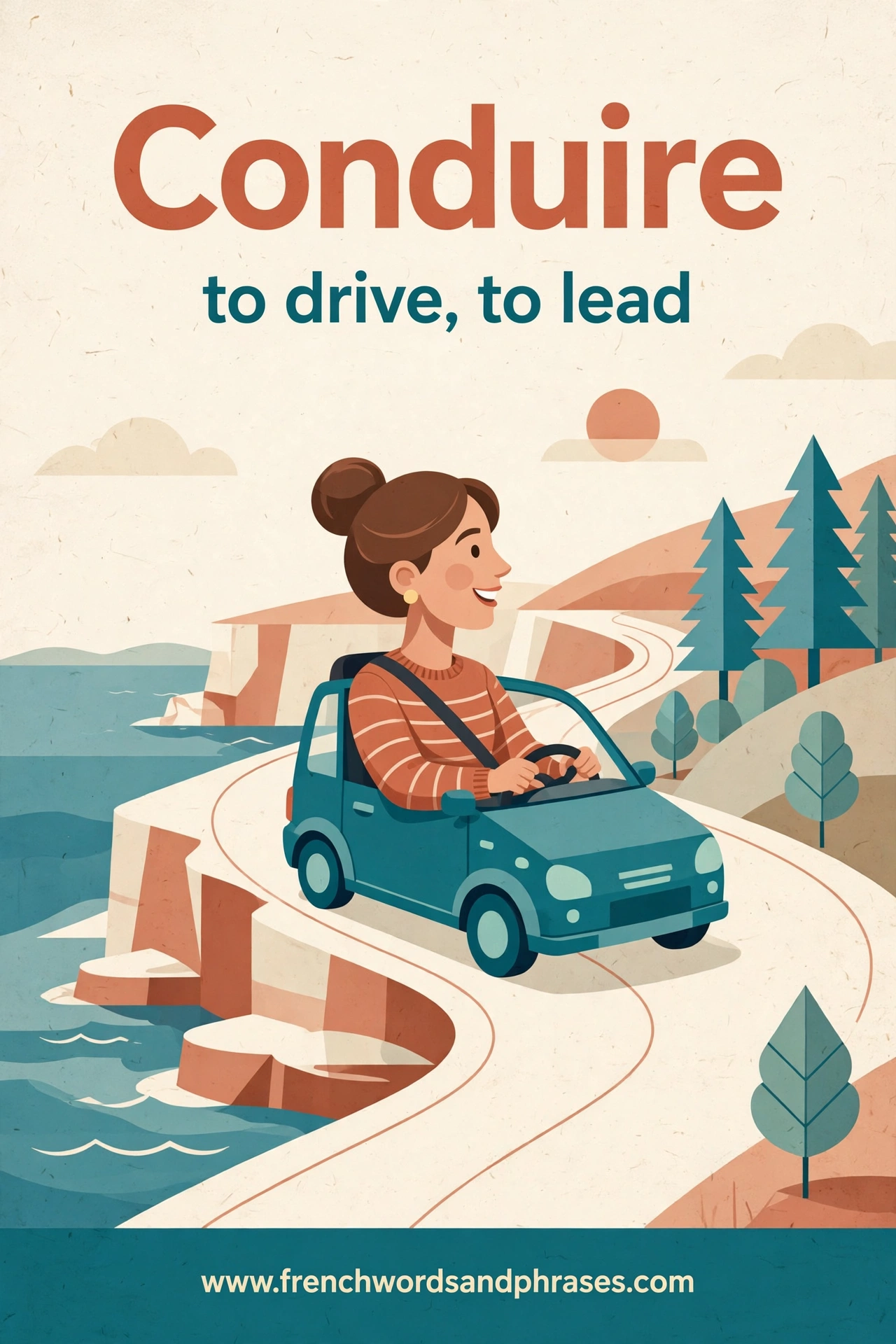
Conduire means to drive — and to lead.
A car on a coast road, a guide leading walkers up a mountain path, a mother leading her child by the hand — conduire is the verb of being in charge of the journey, whether the vehicle has wheels or legs.
In this guide, you’ll learn how to conjugate conduire in all the major French tenses and moods. Explore complete conjugation tables, French examples, English translations, and practice quizzes.
Understanding the French Verb Conduire
Conduire is a regular French verb belonging to the third group of verbs, those ending in -uire.
It means to drive, to lead. It is commonly used for driving cars, leading groups and guided tours, taking children to school, and results that lead somewhere: cette habitude conduit au désastre, that habit leads to disaster.
Verb classification: Third group (-uire)
Auxiliary verb: Avoir
Past participle: conduit
Present participle: conduisant
English equivalents: To drive, to lead, to guide, to take someone somewhere.
One important detail: conduire takes people and vehicles TO places with à — elle conduit les enfants à l’école. Roads also lead: cette route conduit à la mer. And turned back on yourself, se conduire means to behave: il se conduit bien, he behaves well — the English word conduct is hiding inside.
Experience the Word
Conduire is the verb of the person at the wheel — or at the front of the group — the one everyone else trusts to know the way.
Imagine a summer evening in Provence. You drive the little white road between lavender fields, windows down, the whole car smelling of warm herbs, while your passengers doze and trust you completely.
You are not just travelling. You are leading the journey itself.
How to Conjugate Conduire: Complete French Conjugation Guide
Let’s explore every major conjugation of conduire, beginning with the indicative mood.
How to Conjugate Conduire in the Indicative Mood
The indicative mood is used to express facts, observations, actions, and events.
How to Conjugate Conduire in the Present Tense (Présent)
Used for actions happening now, habitual actions, and general truths.
| Subject | Conjugation |
|---|---|
| je | conduis |
| tu | conduis |
| il / elle | conduit |
| nous | conduisons |
| vous | conduisez |
| ils / elles | conduisent |
Example
Mon père conduit la voiture jusqu’à Lyon.
My father is driving the car to Lyon.
Quick Quiz 1
Complete the sentence:
Nous ______ jusqu’à la mer.
Reveal the answer
conduisons
Nous conduisons jusqu’à la mer.
We are driving to the sea.
How to Conjugate Conduire in the Passé Composé
Used for completed actions in the past. Conduire takes the auxiliary verb avoir.
| Subject | Conjugation |
|---|---|
| j’ | ai conduit |
| tu | as conduit |
| il / elle | a conduit |
| nous | avons conduit |
| vous | avez conduit |
| ils / elles | ont conduit |
Example
Elle a conduit les enfants à l’école.
She drove the children to school.
How to Conjugate Conduire in the Imparfait (Imperfect Tense)
Used for habitual past actions, descriptions, and ongoing situations in the past.
| Subject | Conjugation |
|---|---|
| je | conduisais |
| tu | conduisais |
| il / elle | conduisait |
| nous | conduisions |
| vous | conduisiez |
| ils / elles | conduisaient |
Example
Chaque été, nous conduisions jusqu’en Provence.
Every summer, we used to drive down to Provence.
Quick Quiz 2
Choose the correct form:
She drove for six hours.
Elle ______ pendant six heures. (a conduit / a conduite)
Reveal the answer
a conduit
Elle a conduit pendant six heures.
With avoir, the participle conduit does not change for a following object — and conduite is the noun, behaviour.
How to Conjugate Conduire in the Plus-que-parfait
Used to describe an action that had already been completed before another past event.
| Subject | Conjugation |
|---|---|
| j’ | avais conduit |
| tu | avais conduit |
| il / elle | avait conduit |
| nous | avions conduit |
| vous | aviez conduit |
| ils / elles | avaient conduit |
Example
Il avait conduit toute la nuit sans s’arrêter.
He had driven all night without stopping.
How to Conjugate Conduire in the Passé Simple
Primarily used in formal writing, literature, and historical narratives. It is rarely used in everyday conversation.
| Subject | Conjugation |
|---|---|
| je | conduisis |
| tu | conduisis |
| il / elle | conduisit |
| nous | conduisîmes |
| vous | conduisîtes |
| ils / elles | conduisirent |
Example
Le guide conduisit le groupe jusqu’au sommet.
The guide led the group to the summit.
How to Conjugate Conduire in the Passé Antérieur
A literary tense used to express an action completed immediately before another past action, generally in the passé simple.
| Subject | Conjugation |
|---|---|
| j’ | eus conduit |
| tu | eus conduit |
| il / elle | eut conduit |
| nous | eûmes conduit |
| vous | eûtes conduit |
| ils / elles | eurent conduit |
Example
Quand il eut conduit ses invités à la porte, il rentra.
When he had seen his guests to the door, he went back in.
How to Conjugate Conduire in the Future Tense (Futur Simple)
Used to describe actions that will take place in the future.
| Subject | Conjugation |
|---|---|
| je | conduirai |
| tu | conduiras |
| il / elle | conduira |
| nous | conduirons |
| vous | conduirez |
| ils / elles | conduiront |
Example
Demain, tu conduiras pour la première fois.
Tomorrow, you will drive for the first time.
How to Conjugate Conduire in the Futur Antérieur (Future Perfect)
Used for an action that will have been completed before a particular point in the future.
| Subject | Conjugation |
|---|---|
| j’ | aurai conduit |
| tu | auras conduit |
| il / elle | aura conduit |
| nous | aurons conduit |
| vous | aurez conduit |
| ils / elles | auront conduit |
Example
À ce rythme, elle aura conduit mille kilomètres cette semaine.
At this rate, she will have driven a thousand kilometres this week.
How to Conjugate Conduire in the Near Future (Futur Proche)
Used to describe something that is going to happen soon. Formed with aller + infinitive.
| Subject | Conjugation |
|---|---|
| je | vais conduire |
| tu | vas conduire |
| il / elle | va conduire |
| nous | allons conduire |
| vous | allez conduire |
| ils / elles | vont conduire |
Example
Attention, il va conduire sous la pluie.
Careful, he is going to drive in the rain.
How to Conjugate Conduire in the Conditional Mood
The conditional mood expresses what would happen under certain circumstances. It is also frequently used to make polite requests or express wishes.
How to Conjugate Conduire in the Present Conditional
| Subject | Conjugation |
|---|---|
| je | conduirais |
| tu | conduirais |
| il / elle | conduirait |
| nous | conduirions |
| vous | conduiriez |
| ils / elles | conduiraient |
Example
Avec plus d’expérience, je conduirais la nuit.
With more experience, I would drive at night.
How to Conjugate Conduire in the Past Conditional
| Subject | Conjugation |
|---|---|
| j’ | aurais conduit |
| tu | aurais conduit |
| il / elle | aurait conduit |
| nous | aurions conduit |
| vous | auriez conduit |
| ils / elles | auraient conduit |
Example
Sans la neige, nous aurions conduit jusqu’au village.
Without the snow, we would have driven to the village.
Conduire in the Literary Past Conditional Form
This less common literary form uses the imperfect subjunctive of avoir.
| Subject | Conjugation |
|---|---|
| j’ | eusse conduit |
| tu | eusses conduit |
| il / elle | eût conduit |
| nous | eussions conduit |
| vous | eussiez conduit |
| ils / elles | eussent conduit |
Example
Il eût conduit la troupe entière à la victoire.
He would have led the whole troop to victory.
How to Conjugate Conduire in the Subjunctive Mood
The subjunctive is used to express wishes, emotions, doubts, necessity, and uncertainty. It frequently follows expressions such as il faut que (it is necessary that) or bien que (although).
How to Conjugate Conduire in the Present Subjunctive
| Subject | Conjugation |
|---|---|
| que je | conduise |
| que tu | conduises |
| qu’il / qu’elle | conduise |
| que nous | conduisions |
| que vous | conduisiez |
| qu’ils / qu’elles | conduisent |
Example
Il faut que tu conduises prudemment.
You must drive carefully.
Quick Quiz 3
Complete the sentence using the subjunctive:
Il faut que vous ______ prudemment.
Reveal the answer
conduisiez
Il faut que vous conduisiez prudemment.
You must drive carefully.
How to Conjugate Conduire in the Imperfect Subjunctive
A literary tense, rarely encountered in modern spoken French.
| Subject | Conjugation |
|---|---|
| que je | conduisse |
| que tu | conduisses |
| qu’il / qu’elle | conduisît |
| que nous | conduissions |
| que vous | conduissiez |
| qu’ils / qu’elles | conduissent |
Example
Je craignais qu’elle conduisît trop vite.
I feared she might drive too fast.
How to Conjugate Conduire in the Pluperfect Subjunctive
A literary construction used to express an action completed before another past action.
| Subject | Conjugation |
|---|---|
| que j’ | eusse conduit |
| que tu | eusses conduit |
| qu’il / qu’elle | eût conduit |
| que nous | eussions conduit |
| que vous | eussiez conduit |
| qu’ils / qu’elles | eussent conduit |
Example
Il regrettait que nous eussions conduit si loin.
He regretted that we had driven so far.
How to Conjugate Conduire in the Past Subjunctive
| Subject | Conjugation |
|---|---|
| que j’ | aie conduit |
| que tu | aies conduit |
| qu’il / qu’elle | ait conduit |
| que nous | ayons conduit |
| que vous | ayez conduit |
| qu’ils / qu’elles | aient conduit |
Example
Je suis content que tu aies conduit sans problème.
I am glad you drove without any problem.
How to Conjugate Conduire in the Imperative
The imperative is used to give commands, instructions, invitations, or suggestions. Subject pronouns are omitted.
How to Conjugate Conduire in the Present Imperative
| Person | Conjugation |
|---|---|
| (tu) | conduis |
| (nous) | conduisons |
| (vous) | conduisez |
Example
Conduis lentement sur cette route !
Drive slowly on this road!
Quick Quiz 4
How would you say Drive slowly (tu form)?
Reveal the answer
Conduis lentement !
French Participles of Conduire
Participles are verb forms that can be used in compound tenses and other grammatical constructions.
Present Participle of Conduire
conduisant
En conduisant, elle écoute toujours la radio.
While driving, she always listens to the radio.
Past Participle of Conduire
conduit
Conduit par un chauffeur expérimenté, le car arriva à l’heure.
Driven by an experienced driver, the coach arrived on time.
Conduire in Everyday French: Real-Life Examples
Now that you know the conjugations, let’s see how conduire appears in everyday French.
Example 1 — Present
Je conduis tous les jours pour aller travailler.
I drive every day to get to work.
Example 2 — Passé composé
Hier, il a conduit pendant six heures.
Yesterday, he drove for six hours.
Example 3 — Imparfait
Autrefois, on conduisait sans ceinture.
In the old days, people drove without seatbelts.
Example 4 — Future
Nous conduirons jusqu’à la mer.
We will drive to the sea.
Example 5 — Conditional
Je conduirais bien une vieille voiture française.
I would love to drive an old French car.
Example 6 — Imperative
Conduisez prudemment !
Drive carefully!
Beyond Translation: The Meaning of Conduire
English splits drive and lead into two verbs; French conduire keeps them as one gesture — the driver leads the car, the guide leads the group, the road leads to the sea.
And its reflexive is pure politeness.
Se conduire bien is to behave well — to conduct yourself. English borrowed the idea wholesale: conduct, conductor, conduit all come from this same leading hand.
How to Remember the French Verb Conduire
Remember it this way: Conduire is about at the wheel — conduire à, drive and lead.
- One stem everywhere: conduis- — je conduis, nous conduisons, ils conduisent.
- Conduire quelqu’un à — to take someone TO a place: the à is part of the journey.
- Se conduire bien — to behave well; the same verb drives cars and conduct.
The key idea is at the wheel — conduire à, drive and lead.
Test Your Knowledge of Conduire
Let’s see how much you’ve learned. Try answering these questions before revealing the answers.
Question 1
How do you say She drove the children to school in French?
Reveal the answer
Elle a conduit les enfants à l’école.
Question 2
What does il se conduit bien mean?
Reveal the answer
He behaves well — se conduire is to conduct yourself.
Question 3
Translate: We used to drive down to Provence every summer.
Reveal the answer
Chaque été, nous conduisions jusqu’en Provence.
Question 4
What is the past participle of conduire?
Reveal the answer
Conduit.
Question 5
Complete the sentence:
Il faut que tu ______ prudemment.
Reveal the answer
conduises
Il faut que tu conduises prudemment.
You must drive carefully.
Your Final Challenge
Can You Use It?
How would you say this in French?
This evening, I am the one driving, and I will drive slowly.
Reveal the answer
Ce soir, c’est moi qui conduis, et je conduirai lentement.
This evening, I am the one driving, and I will drive slowly.
A little French. A little curiosity. A richer everyday life.
LEARN FRENCH ONE WORD AT A TIME