A French Word to Live By
How to Conjugate Pendre in French
/pɑ̃dʁ/
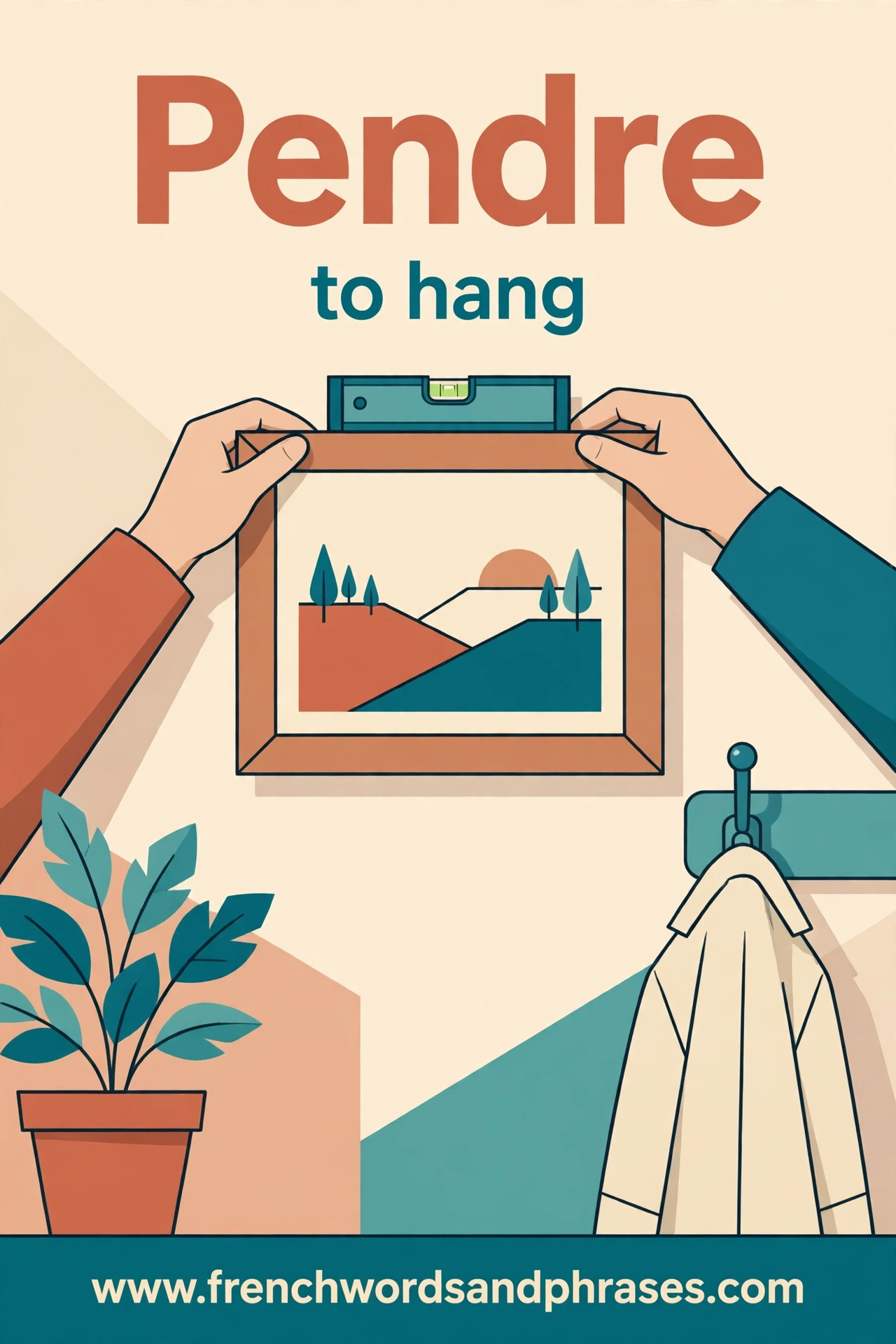
Pendre means to hang or to suspend.
A picture waiting for its nail, washing waiting for its line, a lamp above a table — pendre is the verb of everything that hangs, and of the hands that hang it there.
In this guide, you’ll learn how to conjugate pendre in all the major French tenses and moods. Explore complete conjugation tables, French examples, English translations, and practice quizzes.
Understanding the French Verb Pendre
Pendre is a regular French verb belonging to the third group of verbs, those ending in -re.
It means to hang, to suspend. It is commonly used for hanging pictures, curtains, clothes and lamps, for things dangling (une branche qui pend), and in the crémaillère idiom for moving into a new home.
Verb classification: Third group (-re)
Auxiliary verb: Avoir
Past participle: pendu
Present participle: pendant
English equivalents: To hang, to hang up, to hang down; to dangle.
One important detail: pendre works in both directions, like étendre. You pendez the picture on the wall; then the picture pend au mur — it hangs there. And France’s happiest housewarming tradition hides in this verb: pendre la crémaillère, to hang the pot-hook — in other words, to throw a housewarming party.
Experience the Word
Pendre is the verb of the nail and the hook — the small moment when an object leaves your hands and trusts the wall.
Imagine the first evening in a new flat in Nantes. Boxes everywhere, and one picture — the picture — finally level above the sofa. You step back, hammer still in hand. The flat is a home.
Nothing is built or bought. Something simply hangs — and the room is finished.
How to Conjugate Pendre: Complete French Conjugation Guide
Let’s explore every major conjugation of pendre, beginning with the indicative mood.
How to Conjugate Pendre in the Indicative Mood
The indicative mood is used to express facts, observations, actions, and events.
How to Conjugate Pendre in the Present Tense (Présent)
Used for actions happening now, habitual actions, and general truths.
| Subject | Conjugation |
|---|---|
| je | pends |
| tu | pends |
| il / elle | pend |
| nous | pendons |
| vous | pendez |
| ils / elles | pendent |
Example
Il pend le tableau au-dessus du canapé.
He is hanging the picture above the sofa.
Quick Quiz 1
Complete the sentence:
La lampe ______ au-dessus de la table.
Reveal the answer
pend
La lampe pend au-dessus de la table.
The lamp hangs above the table.
How to Conjugate Pendre in the Passé Composé
Used for completed actions in the past. Pendre takes the auxiliary verb avoir.
| Subject | Conjugation |
|---|---|
| j’ | ai pendu |
| tu | as pendu |
| il / elle | a pendu |
| nous | avons pendu |
| vous | avez pendu |
| ils / elles | ont pendu |
Example
Nous avons pendu les rideaux hier.
We hung the curtains yesterday.
How to Conjugate Pendre in the Imparfait (Imperfect Tense)
Used for habitual past actions, descriptions, and ongoing situations in the past.
| Subject | Conjugation |
|---|---|
| je | pendais |
| tu | pendais |
| il / elle | pendait |
| nous | pendions |
| vous | pendiez |
| ils / elles | pendaient |
Example
Une lampe pendait au-dessus de la table.
A lamp used to hang above the table.
Quick Quiz 2
Choose the correct form:
I hung the curtains.
J’______ les rideaux. (ai pendu / suis pendu)
Reveal the answer
ai pendu
J’ai pendu les rideaux.
Pendre takes avoir.
How to Conjugate Pendre in the Plus-que-parfait
Used to describe an action that had already been completed before another past event.
| Subject | Conjugation |
|---|---|
| j’ | avais pendu |
| tu | avais pendu |
| il / elle | avait pendu |
| nous | avions pendu |
| vous | aviez pendu |
| ils / elles | avaient pendu |
Example
Elle avait pendu le linge avant la pluie.
She had hung out the washing before the rain.
How to Conjugate Pendre in the Passé Simple
Primarily used in formal writing, literature, and historical narratives. It is rarely used in everyday conversation.
| Subject | Conjugation |
|---|---|
| je | pendis |
| tu | pendis |
| il / elle | pendit |
| nous | pendîmes |
| vous | pendîtes |
| ils / elles | pendirent |
Example
Il pendit le manteau à l’entrée.
He hung the coat in the hall.
How to Conjugate Pendre in the Passé Antérieur
A literary tense used to express an action completed immediately before another past action, generally in the passé simple.
| Subject | Conjugation |
|---|---|
| j’ | eus pendu |
| tu | eus pendu |
| il / elle | eut pendu |
| nous | eûmes pendu |
| vous | eûtes pendu |
| ils / elles | eurent pendu |
Example
Quand il eut pendu le tableau, il recula.
When he had hung the picture, he stepped back.
How to Conjugate Pendre in the Future Tense (Futur Simple)
Used to describe actions that will take place in the future.
| Subject | Conjugation |
|---|---|
| je | pendrai |
| tu | pendras |
| il / elle | pendra |
| nous | pendrons |
| vous | pendrez |
| ils / elles | pendront |
Example
Nous pendrons la crémaillère samedi !
We will have our housewarming party on Saturday!
How to Conjugate Pendre in the Futur Antérieur (Future Perfect)
Used for an action that will have been completed before a particular point in the future.
| Subject | Conjugation |
|---|---|
| j’ | aurai pendu |
| tu | auras pendu |
| il / elle | aura pendu |
| nous | aurons pendu |
| vous | aurez pendu |
| ils / elles | auront pendu |
Example
À ce soir, j’aurai pendu tous les rideaux.
By this evening, I will have hung all the curtains.
How to Conjugate Pendre in the Near Future (Futur Proche)
Used to describe something that is going to happen soon. Formed with aller + infinitive.
| Subject | Conjugation |
|---|---|
| je | vais pendre |
| tu | vas pendre |
| il / elle | va pendre |
| nous | allons pendre |
| vous | allez pendre |
| ils / elles | vont pendre |
Example
Elle va pendre la plante près de la fenêtre.
She is going to hang the plant near the window.
How to Conjugate Pendre in the Conditional Mood
The conditional mood expresses what would happen under certain circumstances. It is also frequently used to make polite requests or express wishes.
How to Conjugate Pendre in the Present Conditional
| Subject | Conjugation |
|---|---|
| je | pendrais |
| tu | pendrais |
| il / elle | pendrait |
| nous | pendrions |
| vous | pendriez |
| ils / elles | pendraient |
Example
Sans échelle, je ne pendrais pas ce lustre.
Without a ladder, I would not hang that chandelier.
How to Conjugate Pendre in the Past Conditional
| Subject | Conjugation |
|---|---|
| j’ | aurais pendu |
| tu | aurais pendu |
| il / elle | aurait pendu |
| nous | aurions pendu |
| vous | auriez pendu |
| ils / elles | auraient pendu |
Example
Il aurait pendu le tableau plus haut.
He would have hung the picture higher.
Pendre in the Literary Past Conditional Form
This less common literary form uses the imperfect subjunctive of avoir.
| Subject | Conjugation |
|---|---|
| j’ | eusse pendu |
| tu | eusses pendu |
| il / elle | eût pendu |
| nous | eussions pendu |
| vous | eussiez pendu |
| ils / elles | eussent pendu |
Example
Il eût pendu les rideaux avant la nuit.
He would have hung the curtains before nightfall.
How to Conjugate Pendre in the Subjunctive Mood
The subjunctive is used to express wishes, emotions, doubts, necessity, and uncertainty. It frequently follows expressions such as il faut que (it is necessary that) or bien que (although).
How to Conjugate Pendre in the Present Subjunctive
| Subject | Conjugation |
|---|---|
| que je | pende |
| que tu | pendes |
| qu’il / qu’elle | pende |
| que nous | pendions |
| que vous | pendiez |
| qu’ils / qu’elles | pendent |
Example
Il faut que tu pendes le manteau à l’entrée.
You must hang the coat in the hall.
Quick Quiz 3
Complete the sentence using the subjunctive:
Il faut que vous ______ vos manteaux.
Reveal the answer
pendiez
Il faut que vous pendiez vos manteaux.
You must hang your coats up.
How to Conjugate Pendre in the Imperfect Subjunctive
A literary tense, rarely encountered in modern spoken French.
| Subject | Conjugation |
|---|---|
| que je | pendisse |
| que tu | pendisses |
| qu’il / qu’elle | pendît |
| que nous | pendissions |
| que vous | pendissiez |
| qu’ils / qu’elles | pendissent |
Example
Je voulais qu’elle pendît le linge dehors.
I wanted her to hang the washing outside.
How to Conjugate Pendre in the Pluperfect Subjunctive
A literary construction used to express an action completed before another past action.
| Subject | Conjugation |
|---|---|
| que j’ | eusse pendu |
| que tu | eusses pendu |
| qu’il / qu’elle | eût pendu |
| que nous | eussions pendu |
| que vous | eussiez pendu |
| qu’ils / qu’elles | eussent pendu |
Example
Il regrettait que nous eussions pendu le tableau de travers.
He regretted that we had hung the picture crooked.
How to Conjugate Pendre in the Past Subjunctive
| Subject | Conjugation |
|---|---|
| que j’ | aie pendu |
| que tu | aies pendu |
| qu’il / qu’elle | ait pendu |
| que nous | ayons pendu |
| que vous | ayez pendu |
| qu’ils / qu’elles | aient pendu |
Example
Je suis content que tu aies pendu les rideaux.
I am glad you hung the curtains.
How to Conjugate Pendre in the Imperative
The imperative is used to give commands, instructions, invitations, or suggestions. Subject pronouns are omitted.
How to Conjugate Pendre in the Present Imperative
| Person | Conjugation |
|---|---|
| (tu) | pends |
| (nous) | pendons |
| (vous) | pendez |
Example
Pends ton manteau, ne le jette pas !
Hang your coat up, do not throw it down!
Quick Quiz 4
How would you say Hang your coat up (tu form)?
Reveal the answer
Pends ton manteau !
French Participles of Pendre
Participles are verb forms that can be used in compound tenses and other grammatical constructions.
Present Participle of Pendre
pendant
En pendant le tableau, il a fait un trou énorme.
While hanging the picture, he made an enormous hole.
Past Participle of Pendre
pendu
Pendu au mur depuis vingt ans, le portrait veillait.
Hung on the wall for twenty years, the portrait kept watch.
Pendre in Everyday French: Real-Life Examples
Now that you know the conjugations, let’s see how pendre appears in everyday French.
Example 1 — Present
Le tableau pend au mur du salon.
The picture is hanging on the living-room wall.
Example 2 — Passé composé
J’ai pendu les rideaux ce matin.
I hung the curtains this morning.
Example 3 — Imparfait
Les clés pendaient à un clou.
The keys used to hang on a nail.
Example 4 — Future
Nous pendrons la crémaillère en juin !
We will have the housewarming party in June!
Example 5 — Conditional
Je pendrais ce tableau ici.
I would hang this picture here.
Example 6 — Imperative
Pendez vos manteaux à l’entrée !
Hang your coats in the hall!
Beyond Translation: The Meaning of Pendre
English hang splits its past (hung for pictures, hanged for people) and so does French, quietly: pendre for things is an everyday verb of hooks and nails.
And it throws the party.
When the last picture hangs in a new home, friends arrive to pendre la crémaillère — hang the pot-hook over the fire, as new households once did. The verb of hanging became the verb of welcome.
How to Remember the French Verb Pendre
Remember it this way: Pendre is about hanging — pictures, coats and housewarmings.
- You hang it, then it hangs — je pends le tableau, le tableau pend au mur.
- Pendre la crémaillère — to have a housewarming party.
- Regular -re: je pends, il pend, past participle pendu.
The key idea is hanging — pictures, coats and housewarmings.
Test Your Knowledge of Pendre
Let’s see how much you’ve learned. Try answering these questions before revealing the answers.
Question 1
What does pendre la crémaillère mean?
Reveal the answer
To have a housewarming party — literally, to hang the pot-hook in a new home.
Question 2
How do you say The picture is hanging on the wall in French?
Reveal the answer
Le tableau pend au mur.
Question 3
Translate: We hung the curtains yesterday.
Reveal the answer
Nous avons pendu les rideaux hier.
Question 4
What is the past participle of pendre?
Reveal the answer
Pendu.
Question 5
Complete the sentence:
Il faut que tu ______ ton manteau à l’entrée.
Reveal the answer
pendes
Il faut que tu pendes ton manteau à l’entrée.
You must hang your coat in the hall.
Your Final Challenge
Can You Use It?
How would you say this in French?
On Saturday, we will have our housewarming party with all our friends.
Reveal the answer
Samedi, nous pendrons la crémaillère avec tous nos amis.
On Saturday, we will have our housewarming party with all our friends.
A little French. A little curiosity. A richer everyday life.
LEARN FRENCH ONE WORD AT A TIME