
A French Word to Live By
How to Conjugate Mordre in French
/mɔʁdʁ/
Mordre means to bite.
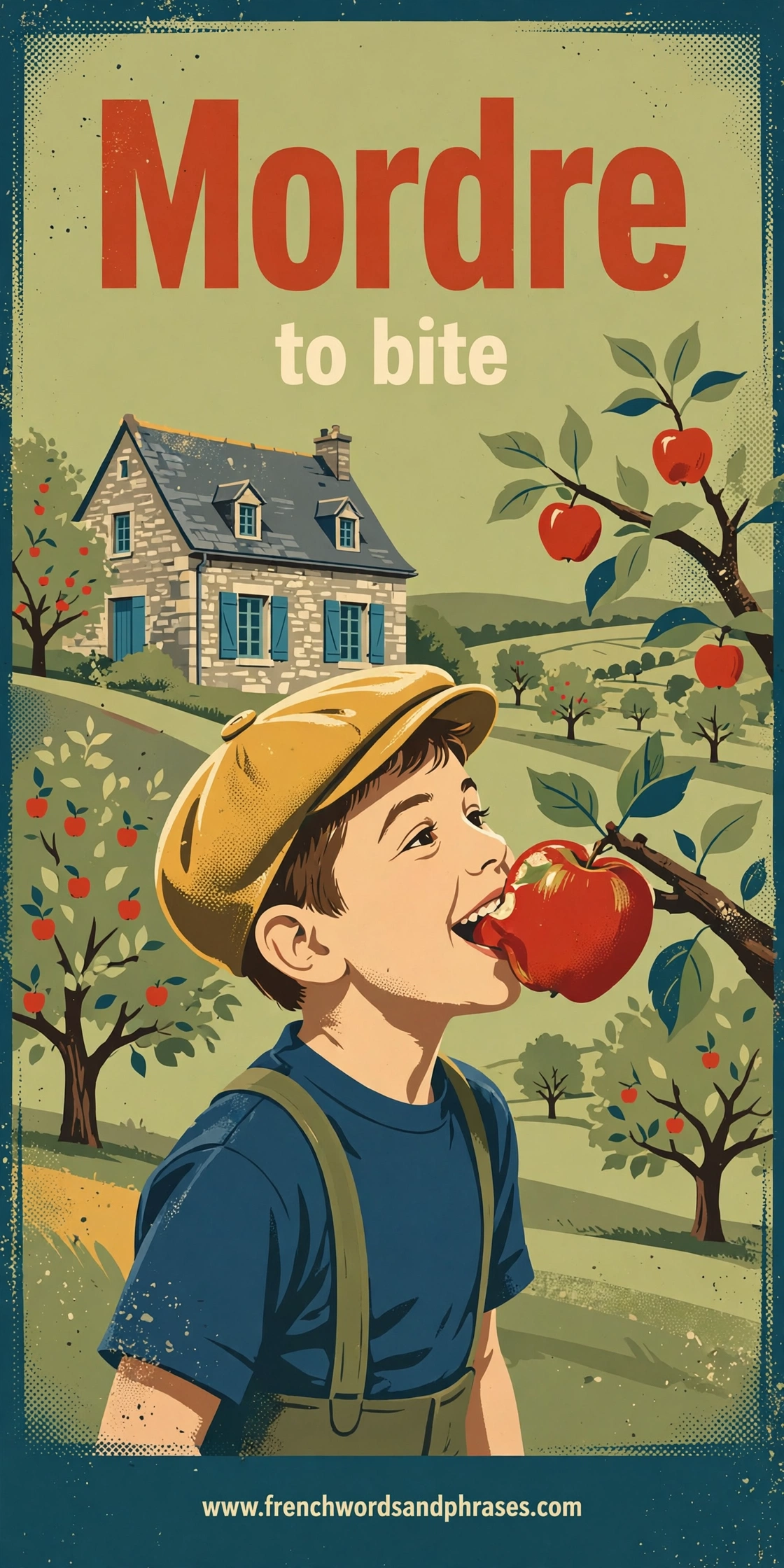
A dog guarding its bone, a child biting an apple, the cold biting your cheeks in January — mordre is the verb of teeth meeting the world.
In this guide, you’ll learn how to conjugate mordre in all the major French tenses and moods. Explore complete conjugation tables, French examples, English translations, and practice quizzes.
Understanding the French Verb Mordre
Mordre is a regular French verb belonging to the third group of verbs, those ending in -re.
It means to bite. It is commonly used for dogs and insects biting, biting into fruit and bread, winter cold biting (le froid mord), and figuratively for taking up a new passion with enthusiasm.
Verb classification: Third group (-re)
Auxiliary verb: Avoir
Past participle: mordu
Present participle: mordant
English equivalents: To bite, to bite into; (figurative) to take the bait, to get hooked.
One important detail: mordre keeps its -d- everywhere in the present — je mords, tu mords, il mord (no -t, like all regular -re verbs). Its happiest idiom is mordre à l’hameçon — to bite at the hook, to take the bait; and a learner who gets hooked on French mord into it: on dit qu’elle a mordu au français.
Experience the Word
Mordre is the verb of the decisive bite — no nibbling, no hesitation, just teeth and commitment.
Imagine an orchard in Normandy in October. You pick an apple straight from the branch, still cold, and bite: the skin cracks, the juice runs, and autumn has a taste.
You have not tasted politely. You have bitten — and the apple answered.
How to Conjugate Mordre: Complete French Conjugation Guide
Let’s explore every major conjugation of mordre, beginning with the indicative mood.
How to Conjugate Mordre in the Indicative Mood
The indicative mood is used to express facts, observations, actions, and events.
How to Conjugate Mordre in the Present Tense (Présent)
Used for actions happening now, habitual actions, and general truths.
| Subject | Conjugation |
|---|---|
| je | mords |
| tu | mords |
| il / elle | mord |
| nous | mordons |
| vous | mordez |
| ils / elles | mordent |
Example
Le chien mord rarement, mais il aboie fort.
The dog rarely bites, but it barks loudly.
Quick Quiz 1
Complete the sentence:
Les moustiques ______ ce soir.
Reveal the answer
mordent
Les moustiques mordent ce soir.
The mosquitoes are biting this evening.
How to Conjugate Mordre in the Passé Composé
Used for completed actions in the past. Mordre takes the auxiliary verb avoir.
| Subject | Conjugation |
|---|---|
| j’ | ai mordu |
| tu | as mordu |
| il / elle | a mordu |
| nous | avons mordu |
| vous | avez mordu |
| ils / elles | ont mordu |
Example
Il a mordu dans la pomme avec appétit.
He bit into the apple eagerly.
How to Conjugate Mordre in the Imparfait (Imperfect Tense)
Used for habitual past actions, descriptions, and ongoing situations in the past.
| Subject | Conjugation |
|---|---|
| je | mordais |
| tu | mordais |
| il / elle | mordait |
| nous | mordions |
| vous | mordiez |
| ils / elles | mordaient |
Example
Le froid mordait nos joues sur la montagne.
The cold used to bite our cheeks on the mountain.
Quick Quiz 2
Choose the correct form:
He took the bait.
Il ______ à l’hameçon. (a mordu / est mordu)
Reveal the answer
a mordu
Il a mordu à l’hameçon.
Mordre takes avoir.
How to Conjugate Mordre in the Plus-que-parfait
Used to describe an action that had already been completed before another past event.
| Subject | Conjugation |
|---|---|
| j’ | avais mordu |
| tu | avais mordu |
| il / elle | avait mordu |
| nous | avions mordu |
| vous | aviez mordu |
| ils / elles | avaient mordu |
Example
Le poisson avait mordu à l’hameçon deux fois.
The fish had bitten at the hook twice.
How to Conjugate Mordre in the Passé Simple
Primarily used in formal writing, literature, and historical narratives. It is rarely used in everyday conversation.
| Subject | Conjugation |
|---|---|
| je | mordis |
| tu | mordis |
| il / elle | mordit |
| nous | mordîmes |
| vous | mordîtes |
| ils / elles | mordirent |
Example
Le chien mordit le bâton et s’enfuit.
The dog bit the stick and ran off.
How to Conjugate Mordre in the Passé Antérieur
A literary tense used to express an action completed immediately before another past action, generally in the passé simple.
| Subject | Conjugation |
|---|---|
| j’ | eus mordu |
| tu | eus mordu |
| il / elle | eut mordu |
| nous | eûmes mordu |
| vous | eûtes mordu |
| ils / elles | eurent mordu |
Example
Dès que l’enfant eut mordu le citron, il grimaca.
As soon as the child had bitten the lemon, he grimaced.
How to Conjugate Mordre in the Future Tense (Futur Simple)
Used to describe actions that will take place in the future.
| Subject | Conjugation |
|---|---|
| je | mordrai |
| tu | mordras |
| il / elle | mordra |
| nous | mordrons |
| vous | mordrez |
| ils / elles | mordront |
Example
Ce chiot ne mordra plus en grandissant.
This puppy will stop biting as it grows.
How to Conjugate Mordre in the Futur Antérieur (Future Perfect)
Used for an action that will have been completed before a particular point in the future.
| Subject | Conjugation |
|---|---|
| j’ | aurai mordu |
| tu | auras mordu |
| il / elle | aura mordu |
| nous | aurons mordu |
| vous | aurez mordu |
| ils / elles | auront mordu |
Example
À la fin du repas, il aura mordu dans trois pommes.
By the end of the meal, he will have bitten into three apples.
How to Conjugate Mordre in the Near Future (Futur Proche)
Used to describe something that is going to happen soon. Formed with aller + infinitive.
| Subject | Conjugation |
|---|---|
| je | vais mordre |
| tu | vas mordre |
| il / elle | va mordre |
| nous | allons mordre |
| vous | allez mordre |
| ils / elles | vont mordre |
Example
Attention, ce chien va mordre !
Careful, that dog is going to bite!
How to Conjugate Mordre in the Conditional Mood
The conditional mood expresses what would happen under certain circumstances. It is also frequently used to make polite requests or express wishes.
How to Conjugate Mordre in the Present Conditional
| Subject | Conjugation |
|---|---|
| je | mordrais |
| tu | mordrais |
| il / elle | mordrait |
| nous | mordrions |
| vous | mordriez |
| ils / elles | mordraient |
Example
Un bon chien de garde mordrait les intrus.
A good guard dog would bite intruders.
How to Conjugate Mordre in the Past Conditional
| Subject | Conjugation |
|---|---|
| j’ | aurais mordu |
| tu | aurais mordu |
| il / elle | aurait mordu |
| nous | aurions mordu |
| vous | auriez mordu |
| ils / elles | auraient mordu |
Example
Le poisson aurait mordu avec un autre appât.
The fish would have bitten with different bait.
Mordre in the Literary Past Conditional Form
This less common literary form uses the imperfect subjunctive of avoir.
| Subject | Conjugation |
|---|---|
| j’ | eusse mordu |
| tu | eusses mordu |
| il / elle | eût mordu |
| nous | eussions mordu |
| vous | eussiez mordu |
| ils / elles | eussent mordu |
Example
Le froid eût mordu les mains des voyageurs.
The cold would have bitten the travellers’ hands.
How to Conjugate Mordre in the Subjunctive Mood
The subjunctive is used to express wishes, emotions, doubts, necessity, and uncertainty. It frequently follows expressions such as il faut que (it is necessary that) or bien que (although).
How to Conjugate Mordre in the Present Subjunctive
| Subject | Conjugation |
|---|---|
| que je | morde |
| que tu | mordes |
| qu’il / qu’elle | morde |
| que nous | mordions |
| que vous | mordiez |
| qu’ils / qu’elles | mordent |
Example
Il faut que le dentiste vérifie que tu ne mordes pas trop fort.
The dentist needs to check that you are not biting too hard.
Quick Quiz 3
Complete the sentence using the subjunctive:
Je crains que le chien ______ l’enfant.
Reveal the answer
morde
Je crains que le chien morde l’enfant.
I fear the dog may bite the child.
How to Conjugate Mordre in the Imperfect Subjunctive
A literary tense, rarely encountered in modern spoken French.
| Subject | Conjugation |
|---|---|
| que je | mordisse |
| que tu | mordisses |
| qu’il / qu’elle | mordît |
| que nous | mordissions |
| que vous | mordissiez |
| qu’ils / qu’elles | mordissent |
Example
Je craignais que le chien mordît l’enfant.
I feared the dog might bite the child.
How to Conjugate Mordre in the Pluperfect Subjunctive
A literary construction used to express an action completed before another past action.
| Subject | Conjugation |
|---|---|
| que j’ | eusse mordu |
| que tu | eusses mordu |
| qu’il / qu’elle | eût mordu |
| que nous | eussions mordu |
| que vous | eussiez mordu |
| qu’ils / qu’elles | eussent mordu |
Example
Il regrettait que le poisson n’eût pas mordu.
He regretted that the fish had not bitten.
How to Conjugate Mordre in the Past Subjunctive
| Subject | Conjugation |
|---|---|
| que j’ | aie mordu |
| que tu | aies mordu |
| qu’il / qu’elle | ait mordu |
| que nous | ayons mordu |
| que vous | ayez mordu |
| qu’ils / qu’elles | aient mordu |
Example
Je suis content que le poisson ait mordu.
I am glad the fish bit.
How to Conjugate Mordre in the Imperative
The imperative is used to give commands, instructions, invitations, or suggestions. Subject pronouns are omitted.
How to Conjugate Mordre in the Present Imperative
| Person | Conjugation |
|---|---|
| (tu) | mords |
| (nous) | mordons |
| (vous) | mordez |
Example
Mords dans la vie à pleines dents !
Bite into life with all your teeth!
Quick Quiz 4
How would you say Do not bite (tu form)?
Reveal the answer
Ne mords pas !
French Participles of Mordre
Participles are verb forms that can be used in compound tenses and other grammatical constructions.
Present Participle of Mordre
mordant
En mordant le citron, il a découvert l’acidité.
By biting the lemon, he discovered sourness.
Past Participle of Mordre
mordu
Mordu par le froid, il rentra vite.
Bitten by the cold, he hurried home.
Mordre in Everyday French: Real-Life Examples
Now that you know the conjugations, let’s see how mordre appears in everyday French.
Example 1 — Present
Mon chien ne mord jamais.
My dog never bites.
Example 2 — Passé composé
Elle a mordu dans le sandwich.
She bit into the sandwich.
Example 3 — Imparfait
Le vent mordait le visage.
The wind used to bite your face.
Example 4 — Future
Les moustiques mordront ce soir.
The mosquitoes will bite this evening.
Example 5 — Idiom
Il a mordu à l’hameçon.
He took the bait.
Example 6 — Imperative
Ne mords pas tes ongles !
Do not bite your nails!
Beyond Translation: The Meaning of Mordre
English bite stays mostly physical; French mordre bites figuratively with pleasure — you can mordre au français, get hooked on French, or mordre dans la vie, bite into life itself.
Its family is everywhere.
Une morsure is a bite wound, un morceau is a piece bitten off — which is why a piece of music is also un morceau. French hears the bite inside every portion.
How to Remember the French Verb Mordre
Remember it this way: Mordre is about the bite — dogs, apples, cold and bait.
- Present keeps the -d-: je mords, il mord — no -t, ever.
- Mordre à l’hameçon — to take the bait, hook and all.
- Past participle mordu — also an adjective: mordu de jazz, crazy about jazz.
The key idea is the bite — dogs, apples, cold and bait.
Test Your Knowledge of Mordre
Let’s see how much you’ve learned. Try answering these questions before revealing the answers.
Question 1
What does mordre à l’hameçon mean?
Reveal the answer
To take the bait — literally, to bite at the hook.
Question 2
How do you say My dog never bites in French?
Reveal the answer
Mon chien ne mord jamais.
Question 3
Translate: He bit into the apple.
Reveal the answer
Il a mordu dans la pomme.
Question 4
What is the past participle of mordre?
Reveal the answer
Mordu.
Question 5
Complete the sentence:
Attention, ce chien va ______ !
Reveal the answer
mordre
Attention, ce chien va mordre !
Careful, that dog is going to bite!
Your Final Challenge
Can You Use It?
How would you say this in French?
Bite into life with all your teeth, like into an autumn apple.
Reveal the answer
Mords dans la vie à pleines dents, comme dans une pomme d’automne.
Bite into life with all your teeth, like into an autumn apple.
A little French. A little curiosity. A richer everyday life.
LEARN FRENCH ONE WORD AT A TIME




