
A French Word to Live By
How to Conjugate Fondre in French
/fɔ̃dʁ/
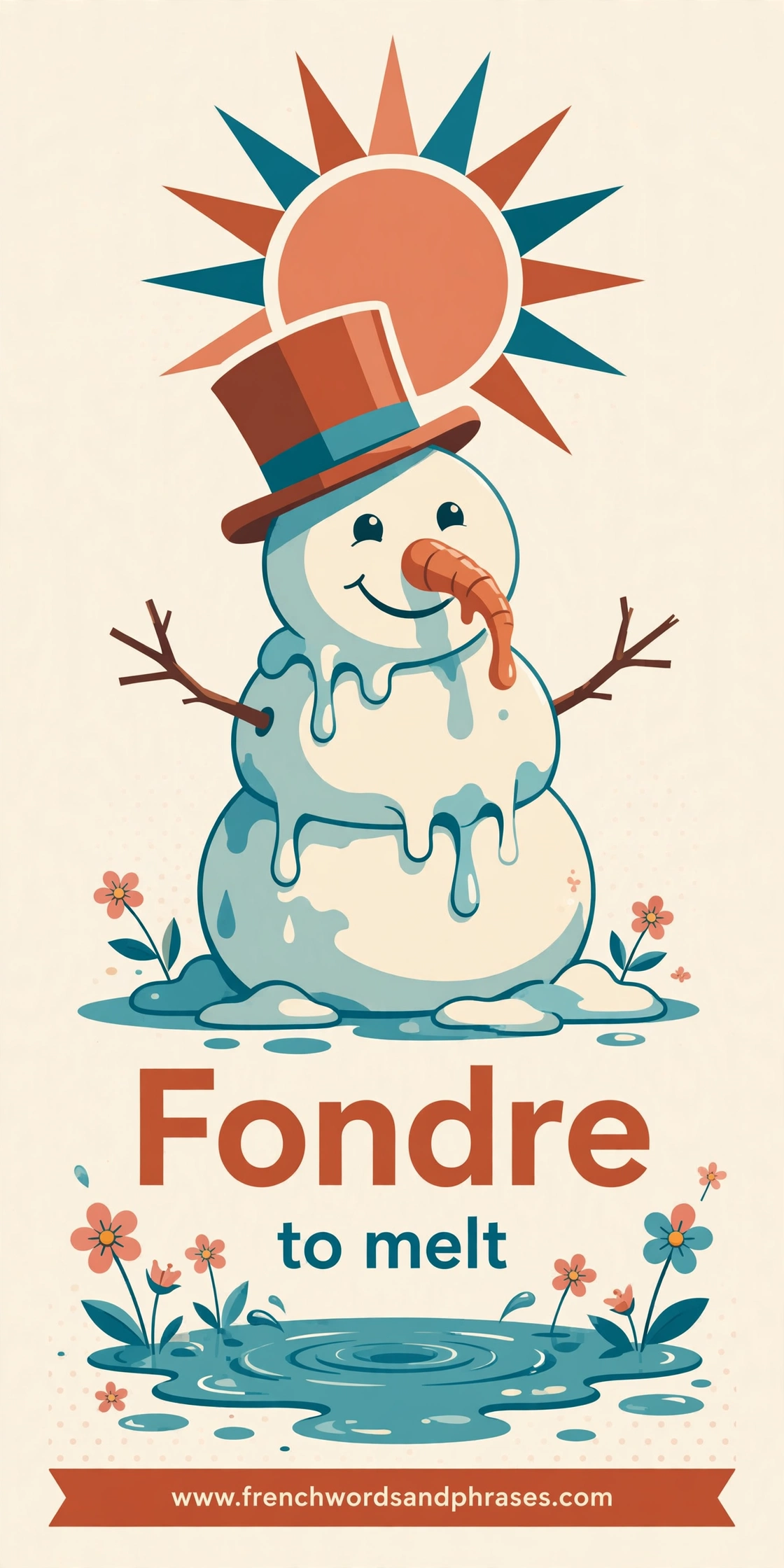
Fondre means to melt.
Snow under the spring sun, butter in a warm pan, chocolate on the tongue — fondre is the verb of solids quietly becoming liquid, and of a few other disappearances just as complete.
In this guide, you’ll learn how to conjugate fondre in all the major French tenses and moods. Explore complete conjugation tables, French examples, English translations, and practice quizzes.
Understanding the French Verb Fondre
Fondre is a regular French verb belonging to the third group of verbs, those ending in -re.
It means to melt. It is commonly used for snow, ice, butter and metal melting, sugar dissolving, crowds melting away, and savings melting — les économies fondent — faster than anyone would like.
Verb classification: Third group (-re)
Auxiliary verb: Avoir
Past participle: fondu
Present participle: fondant
English equivalents: To melt, to dissolve; to swoop down (fondre sur); to burst out (fondre en larmes).
One important detail: fondre melts things and melts by itself with the same form — le soleil fond la neige and la neige fond. Watch its two famous journeys: fondre en larmes, to burst into tears, and fondre sur, to swoop down on, like a hawk on its prey.
Experience the Word
Fondre is the verb of transformation by warmth — the moment something solid gives up its shape and flows.
Imagine the first morning of spring in the Alps. The icicles drip, the snowfields shrink hour by hour, and by evening a new stream is running down the lane that was ice at breakfast.
Nothing has vanished. It has melted — changed state, not existence.
How to Conjugate Fondre: Complete French Conjugation Guide
Let’s explore every major conjugation of fondre, beginning with the indicative mood.
How to Conjugate Fondre in the Indicative Mood
The indicative mood is used to express facts, observations, actions, and events.
How to Conjugate Fondre in the Present Tense (Présent)
Used for actions happening now, habitual actions, and general truths.
| Subject | Conjugation |
|---|---|
| je | fonds |
| tu | fonds |
| il / elle | fond |
| nous | fondons |
| vous | fondez |
| ils / elles | fondent |
Example
La neige fond au soleil.
The snow is melting in the sun.
Quick Quiz 1
Complete the sentence:
Les glaçons ______ dans les verres.
Reveal the answer
fondent
Les glaçons fondent dans les verres.
The ice cubes are melting in the glasses.
How to Conjugate Fondre in the Passé Composé
Used for completed actions in the past. Fondre takes the auxiliary verb avoir.
| Subject | Conjugation |
|---|---|
| j’ | ai fondu |
| tu | as fondu |
| il / elle | a fondu |
| nous | avons fondu |
| vous | avez fondu |
| ils / elles | ont fondu |
Example
Le beurre a fondu dans la poêle.
The butter melted in the pan.
How to Conjugate Fondre in the Imparfait (Imperfect Tense)
Used for habitual past actions, descriptions, and ongoing situations in the past.
| Subject | Conjugation |
|---|---|
| je | fondais |
| tu | fondais |
| il / elle | fondait |
| nous | fondions |
| vous | fondiez |
| ils / elles | fondaient |
Example
Les glaçons fondaient lentement dans les verres.
The ice cubes were slowly melting in the glasses.
Quick Quiz 2
Choose the correct form:
She burst into tears.
Elle ______ en larmes. (a fondu / est fondue)
Reveal the answer
a fondu
Elle a fondu en larmes.
Fondre takes avoir.
How to Conjugate Fondre in the Plus-que-parfait
Used to describe an action that had already been completed before another past event.
| Subject | Conjugation |
|---|---|
| j’ | avais fondu |
| tu | avais fondu |
| il / elle | avait fondu |
| nous | avions fondu |
| vous | aviez fondu |
| ils / elles | avaient fondu |
Example
La glace avait fondu avant notre arrivée.
The ice had melted before we arrived.
How to Conjugate Fondre in the Passé Simple
Primarily used in formal writing, literature, and historical narratives. It is rarely used in everyday conversation.
| Subject | Conjugation |
|---|---|
| je | fondis |
| tu | fondis |
| il / elle | fondit |
| nous | fondîmes |
| vous | fondîtes |
| ils / elles | fondirent |
Example
Le métal fondit dans le four ardent.
The metal melted in the burning furnace.
How to Conjugate Fondre in the Passé Antérieur
A literary tense used to express an action completed immediately before another past action, generally in the passé simple.
| Subject | Conjugation |
|---|---|
| j’ | eus fondu |
| tu | eus fondu |
| il / elle | eut fondu |
| nous | eûmes fondu |
| vous | eûtes fondu |
| ils / elles | eurent fondu |
Example
Quand la neige eut fondu, le chemin reparut.
When the snow had melted, the path reappeared.
How to Conjugate Fondre in the Future Tense (Futur Simple)
Used to describe actions that will take place in the future.
| Subject | Conjugation |
|---|---|
| je | fondrai |
| tu | fondras |
| il / elle | fondra |
| nous | fondrons |
| vous | fondrez |
| ils / elles | fondront |
Example
Ce chocolat fondra dans la bouche.
This chocolate will melt in the mouth.
How to Conjugate Fondre in the Futur Antérieur (Future Perfect)
Used for an action that will have been completed before a particular point in the future.
| Subject | Conjugation |
|---|---|
| j’ | aurai fondu |
| tu | auras fondu |
| il / elle | aura fondu |
| nous | aurons fondu |
| vous | aurez fondu |
| ils / elles | auront fondu |
Example
À midi, tout aura fondu.
By noon, everything will have melted.
How to Conjugate Fondre in the Near Future (Futur Proche)
Used to describe something that is going to happen soon. Formed with aller + infinitive.
| Subject | Conjugation |
|---|---|
| je | vais fondre |
| tu | vas fondre |
| il / elle | va fondre |
| nous | allons fondre |
| vous | allez fondre |
| ils / elles | vont fondre |
Example
La glace va fondre, dépêche-toi !
The ice cream is going to melt, hurry up!
How to Conjugate Fondre in the Conditional Mood
The conditional mood expresses what would happen under certain circumstances. It is also frequently used to make polite requests or express wishes.
How to Conjugate Fondre in the Present Conditional
| Subject | Conjugation |
|---|---|
| je | fondrais |
| tu | fondrais |
| il / elle | fondrait |
| nous | fondrions |
| vous | fondriez |
| ils / elles | fondraient |
Example
Sans froid, la patinoire fondrait.
Without cold, the ice rink would melt.
How to Conjugate Fondre in the Past Conditional
| Subject | Conjugation |
|---|---|
| j’ | aurais fondu |
| tu | aurais fondu |
| il / elle | aurait fondu |
| nous | aurions fondu |
| vous | auriez fondu |
| ils / elles | auraient fondu |
Example
Le beurre aurait fondu trop vite au soleil.
The butter would have melted too fast in the sun.
Fondre in the Literary Past Conditional Form
This less common literary form uses the imperfect subjunctive of avoir.
| Subject | Conjugation |
|---|---|
| j’ | eusse fondu |
| tu | eusses fondu |
| il / elle | eût fondu |
| nous | eussions fondu |
| vous | eussiez fondu |
| ils / elles | eussent fondu |
Example
La neige eût fondu en un jour de printemps.
The snow would have melted in one spring day.
How to Conjugate Fondre in the Subjunctive Mood
The subjunctive is used to express wishes, emotions, doubts, necessity, and uncertainty. It frequently follows expressions such as il faut que (it is necessary that) or bien que (although).
How to Conjugate Fondre in the Present Subjunctive
| Subject | Conjugation |
|---|---|
| que je | fonde |
| que tu | fondes |
| qu’il / qu’elle | fonde |
| que nous | fondions |
| que vous | fondiez |
| qu’ils / qu’elles | fondent |
Example
Il faut que le chocolat fonde lentement.
The chocolate must melt slowly.
Quick Quiz 3
Complete the sentence using the subjunctive:
Il faut que la neige ______ avant samedi.
Reveal the answer
fonde
Il faut que la neige fonde avant samedi.
The snow must melt before Saturday.
How to Conjugate Fondre in the Imperfect Subjunctive
A literary tense, rarely encountered in modern spoken French.
| Subject | Conjugation |
|---|---|
| que je | fondisse |
| que tu | fondisses |
| qu’il / qu’elle | fondît |
| que nous | fondissions |
| que vous | fondissiez |
| qu’ils / qu’elles | fondissent |
Example
Je craignais que la glace fondît.
I feared the ice might melt.
How to Conjugate Fondre in the Pluperfect Subjunctive
A literary construction used to express an action completed before another past action.
| Subject | Conjugation |
|---|---|
| que j’ | eusse fondu |
| que tu | eusses fondu |
| qu’il / qu’elle | eût fondu |
| que nous | eussions fondu |
| que vous | eussiez fondu |
| qu’ils / qu’elles | eussent fondu |
Example
Il semblait que tout eût fondu pendant la nuit.
It seemed everything had melted during the night.
How to Conjugate Fondre in the Past Subjunctive
| Subject | Conjugation |
|---|---|
| que j’ | aie fondu |
| que tu | aies fondu |
| qu’il / qu’elle | ait fondu |
| que nous | ayons fondu |
| que vous | ayez fondu |
| qu’ils / qu’elles | aient fondu |
Example
Je suis étonné que la neige ait déjà fondu.
I am surprised the snow has already melted.
How to Conjugate Fondre in the Imperative
The imperative is used to give commands, instructions, invitations, or suggestions. Subject pronouns are omitted.
How to Conjugate Fondre in the Present Imperative
| Person | Conjugation |
|---|---|
| (tu) | fonds |
| (nous) | fondons |
| (vous) | fondez |
Example
Fonds le beurre à feu doux !
Melt the butter over a low heat!
Quick Quiz 4
How would you say Melt the butter (tu form)?
Reveal the answer
Fonds le beurre !
French Participles of Fondre
Participles are verb forms that can be used in compound tenses and other grammatical constructions.
Present Participle of Fondre
fondant
En fondant, la neige découvrait les premières fleurs.
As it melted, the snow uncovered the first flowers.
Past Participle of Fondre
fondu
Le chocolat, une fois fondu, parfumait la cuisine.
The chocolate, once melted, perfumed the kitchen.
Fondre in Everyday French: Real-Life Examples
Now that you know the conjugations, let’s see how fondre appears in everyday French.
Example 1 — Present
Le beurre fond dans la poêle chaude.
The butter is melting in the hot pan.
Example 2 — Passé composé
La neige a fondu en deux jours.
The snow melted in two days.
Example 3 — Imparfait
Ses économies fondaient chaque mois.
His savings used to melt away every month.
Example 4 — Future
La glace fondra au soleil.
The ice will melt in the sun.
Example 5 — Burst into tears
Elle a fondu en larmes.
She burst into tears.
Example 6 — Swoop
L’aigle fond sur sa proie.
The eagle swoops down on its prey.
Beyond Translation: The Meaning of Fondre
English melt is mostly kitchen and weather; French fondre melts hearts, savings, crowds and resistance too — fondre d’amour, to melt with love.
And it gives French its tenderest participle.
Fondant — melting — names both a cake that melts in the mouth and a look that melts the heart. When French wants softness, it reaches for fondre.
How to Remember the French Verb Fondre
Remember it this way: Fondre is about melting — snow, butter, hearts and savings.
- Fondre melts and is melted with one form — la neige fond, le soleil fond la neige.
- Fondre en larmes — to burst into tears; fondre sur — to swoop down on.
- Regular -re: je fonds, il fond, past participle fondu.
The key idea is melting — snow, butter, hearts and savings.
Test Your Knowledge of Fondre
Let’s see how much you’ve learned. Try answering these questions before revealing the answers.
Question 1
What does fondre en larmes mean?
Reveal the answer
To burst into tears — to melt into tears.
Question 2
How do you say The butter is melting in French?
Reveal the answer
Le beurre fond.
Question 3
Translate: The snow melted in two days.
Reveal the answer
La neige a fondu en deux jours.
Question 4
What is the past participle of fondre?
Reveal the answer
Fondu.
Question 5
Complete the sentence:
Il faut que le chocolat ______ lentement.
Reveal the answer
fonde
Il faut que le chocolat fonde lentement.
The chocolate must melt slowly.
Your Final Challenge
Can You Use It?
How would you say this in French?
In spring, the snow melts and the streams sing.
Reveal the answer
Au printemps, la neige fond et les ruisseaux chantent.
In spring, the snow melts and the streams sing.
A little French. A little curiosity. A richer everyday life.
LEARN FRENCH ONE WORD AT A TIME




