
A French Word to Live By
Translate Zéphyr to English
/ze.fiʁ/
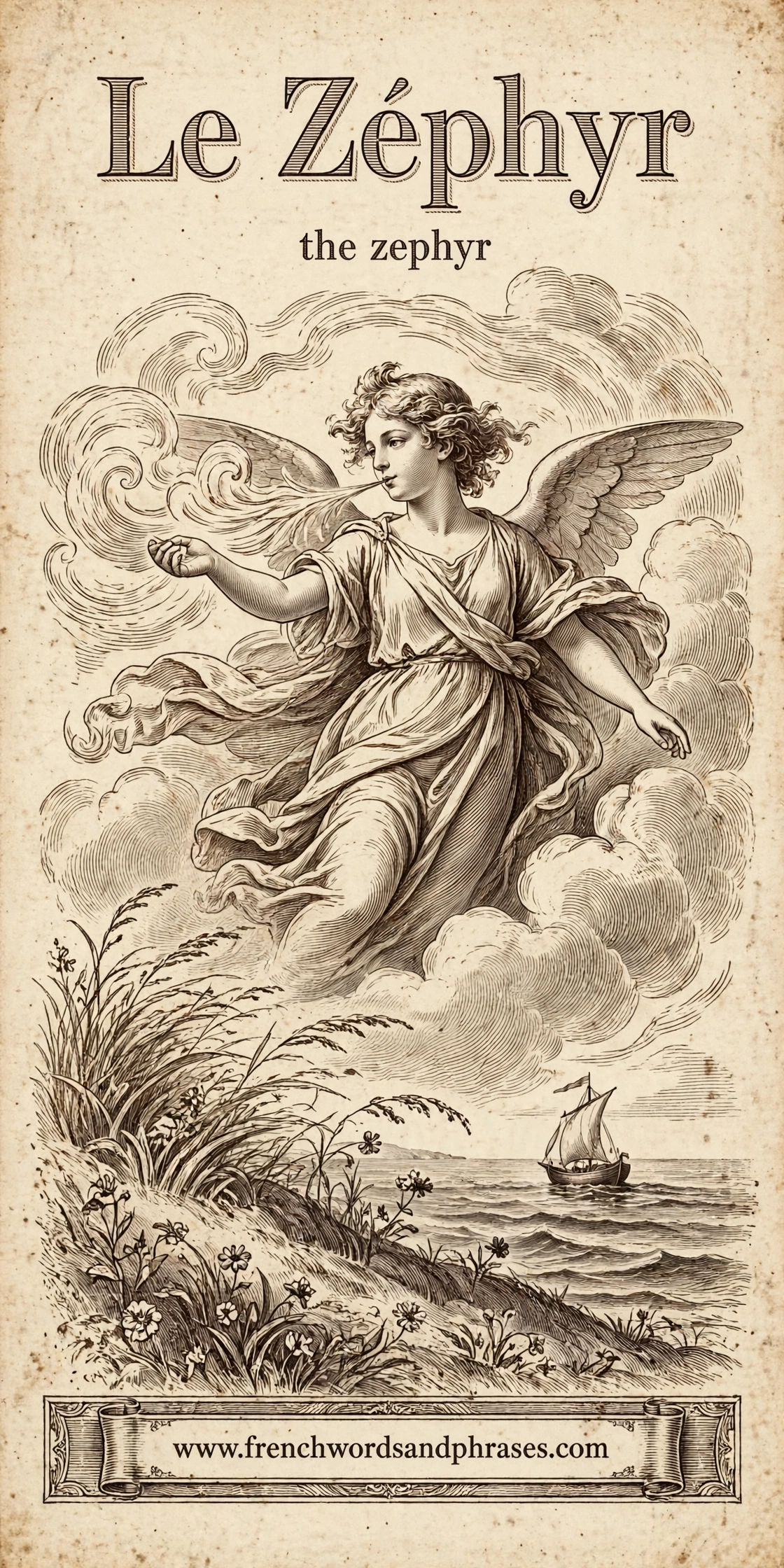
Le zéphyr means the zephyr.
A summer evening in the garden: the heat lifts, the curtains stir, and something soft passes through the leaves without a sound. The poets had a name for that gentlest of winds — le zéphyr.
In this guide, you’ll learn what zéphyr means in English, how to use it with its articles, how to form its plural, and how it appears in everyday French. Explore French examples, English translations, and practice quizzes.
Understanding the French Noun Zéphyr
Zéphyr is a masculine French noun. It is learned together with its article: le zéphyr, un zéphyr. It is a literary, poetic word — the name French poetry gives to the soft west wind.
It means a zephyr — a soft, gentle breeze, especially the mild west wind of spring and summer evenings. You will not hear it in a weather forecast; you will find it in poems, novels and songs: un doux zéphyr, a sweet zephyr, le zéphyr du soir, the evening zephyr, le souffle du zéphyr, the breath of the zephyr. It is the wind at its kindest — a caress, never a storm.
Gender: Masculine
Definite article: le — le zéphyr (the zephyr)
Indefinite article: un — un zéphyr (a zephyr)
Plural: les zéphyrs
English equivalents: A zephyr; a soft, gentle breeze.
One important usage detail: zéphyr belongs to literature, not to the météo. For everyday wind, French says le vent, and for a light breeze, la brise. Reaching for zéphyr is a deliberate, poetic choice — it turns a breeze into a character, the gentle god of the west wind still breathing through the poem.
Experience the Word
Zéphyr is more than a breeze. It is the kindest moment of the air — the wind reduced to a sigh, moving the grass without bending it.
Imagine the terrace at dusk: candles lit, the first cool breath crossing the garden, napkins trembling once and settling — le zéphyr du soir has arrived, on time as always.
You have not just felt a wind. You have been touched by the gentlest god of Greek myth.
How to Use Zéphyr in French: Complete Guide
Let’s explore how zéphyr works in French, beginning with its articles.
Zéphyr with the Definite Article (Le, Les)
Used for the breeze of the poem or the evening — the one the writer is pointing at.
| Number | French |
|---|---|
| Singular | le zéphyr |
| Plural | les zéphyrs |
Example
Le zéphyr du soir rafraîchit le jardin.
The evening zephyr cools the garden.
Zéphyr with the Indefinite Article (Un, Des)
Used for one soft breath of wind among the stillness — un zéphyr passes, and the leaves answer.
| Number | French |
|---|---|
| Singular | un zéphyr |
| Plural | des zéphyrs |
Example
Un léger zéphyr fait trembler les rideaux.
A light zephyr makes the curtains tremble.
The Zéphyr, the Gentle Wind
Softness, evening and the west — the words that define the poet’s wind.
| French | In English |
|---|---|
| un vent doux | a gentle wind |
| la brise du soir | the evening breeze |
| le souffle léger | the light breath |
| le vent d’ouest | the west wind |
| la poésie du zéphyr | the poetry of the zephyr |
Example
Le vent d’ouest apporte le zéphyr du printemps.
The west wind brings the zephyr of spring.
Quick Quiz 1
From which direction does the zéphyr blow?
Reveal the answer
From the west — Zéphyr was the Greek god of the west wind.
Le zéphyr est le vent doux de l’ouest.
The zephyr is the gentle wind of the west.
The Plural of Zéphyr
Zéphyr adds an -s in the plural — les zéphyrs — a form found mostly in poetry, where gentle winds travel in company.
| Number | French |
|---|---|
| Singular | le zéphyr |
| Plural | les zéphyrs |
Example
Les zéphyrs du printemps caressent les fleurs.
The zephyrs of spring caress the flowers.
Zéphyr with Possessive Adjectives (Mon, Ton, Son…)
Possessives agree with the noun, not with the owner — and zéphyr is masculine, so it takes mon, ton, son.
| Owner | French |
|---|---|
| my | mon zéphyr |
| your (tu) | ton zéphyr |
| his / her | son zéphyr |
| our | notre zéphyr |
| your (vous) | votre zéphyr |
| their | leur zéphyr |
Example
Le poète attend son zéphyr du soir.
The poet waits for his evening zephyr.
Quick Quiz 2
Complete the sentence:
Le jardin respire sous ______ zéphyr léger.
Reveal the answer
un
Le jardin respire sous un zéphyr léger.
The garden breathes under a light zephyr.
Zéphyr with Demonstrative Adjectives (Ce, Ces)
Used to point: this gentle wind here, those gentle winds there.
| Number | French |
|---|---|
| Singular | ce zéphyr |
| Plural | ces zéphyrs |
Example
Ce zéphyr annonce la fin de la chaleur.
This zephyr announces the end of the heat.
Zéphyr with Adjectives
Adjectives agree with zéphyr, masculine — and they are all adjectives of softness: doux, léger, tiède.
| Adjective | With Zéphyr |
|---|---|
| doux (gentle, soft) | un doux zéphyr |
| léger (light) | un zéphyr léger |
| tiède (mild, lukewarm) | un zéphyr tiède |
| printanier (spring-like) | le zéphyr printanier |
| caressant (caressing) | un zéphyr caressant |
Example
Un doux zéphyr traverse la prairie.
A gentle zephyr crosses the meadow.
Quick Quiz 3
Complete the sentence:
Un ______ zéphyr agite les feuilles. (gentle)
Reveal the answer
doux
Un doux zéphyr agite les feuilles.
A gentle zephyr stirs the leaves.
Everyday Expressions with Zéphyr
In poems and fine prose, these are the zéphyr phrases — literature, not forecasts.
| Expression | In English |
|---|---|
| un doux zéphyr | a gentle zephyr |
| le zéphyr du soir | the evening zephyr |
| le souffle du zéphyr | the breath of the zephyr |
| le zéphyr printanier | the spring zephyr |
| porté par le zéphyr | carried by the zephyr |
| léger comme un zéphyr | light as a zephyr |
Example
Le souffle du zéphyr fait danser les herbes.
The breath of the zephyr makes the grasses dance.
Words from the Same Family as Zéphyr
Winds, breath and the god behind the word — the family of zéphyr.
| French | In English |
|---|---|
| le vent | the wind |
| la brise | the breeze |
| le souffle | the breath, the gust |
| Zéphyr | Zephyrus, Greek god of the west wind |
| l’ouest | the west |
| le mistral | the mistral (the zephyr’s violent cousin) |
Example
La brise est quotidienne, le zéphyr est poétique.
The breeze is everyday, the zephyr is poetic.
Quick Quiz 4
What is the difference between la brise and le zéphyr?
Reveal the answer
La brise is the everyday word for a light breeze; le zéphyr is its poetic, literary name.
Le marin parle de brise, le poète de zéphyr.
The sailor speaks of a breeze, the poet of a zephyr.
Zéphyr in Everyday French: Real-Life Examples
Now that you know the word, let’s see how zéphyr appears in everyday French.
Example 1 — In a poem
Un doux zéphyr caresse les blés mûrs.
A gentle zephyr caresses the ripe wheat.
Example 2 — In the evening
Le zéphyr du soir apporte un peu de fraîcheur.
The evening zephyr brings a little coolness.
Example 3 — In a novel
Elle ouvrit la fenêtre et sentit le zéphyr sur son visage.
She opened the window and felt the zephyr on her face.
Example 4 — In spring
Le zéphyr printanier joue dans les cerisiers en fleurs.
The spring zephyr plays in the flowering cherry trees.
Example 5 — On the coast
Le vent d’ouest, doux comme un zéphyr, calme la mer.
The west wind, gentle as a zephyr, calms the sea.
Example 6 — In a letter
Ici, le soir, un léger zéphyr rend la chaleur douce.
Here, in the evening, a light zephyr makes the heat gentle.
Beyond Translation: The Meaning of Zéphyr
Behind the word stands a god: Zéphyr — Zephyrus to the Greeks — the west wind, the kindest of the wind gods, who brought spring and carried flowers on his breath. French poets adopted him early, and the word never left the language’s high register: to write zéphyr is to quote three thousand years of poetry in one breath.
To say zéphyr is to make the wind gentle enough to have a name.
It evokes Botticelli’s spring, verses learned at school, summer evenings when the air finally moves — the moment weather becomes tenderness.
How to Remember the French Noun Zéphyr
Remember it this way: Zéphyr is the soft west breeze — masculine, with le and un, and it lives in poetry, not in forecasts.
- You name the god — Zéphyr, dieu du vent d’ouest.
- You soften the wind — un doux zéphyr, jamais une tempête.
- You choose the register — la brise au quotidien, le zéphyr en poésie.
The key idea is le zéphyr for the poet, la brise for every day.
Test Your Knowledge of Zéphyr
Let’s see how much you’ve learned. Try answering these questions before revealing the answers.
Question 1
Is zéphyr masculine or feminine?
Reveal the answer
Masculine — le zéphyr, un zéphyr.
Question 2
What kind of wind is a zéphyr?
Reveal the answer
A soft, gentle breeze — the mild west wind of poetry.
Question 3
Translate: A gentle zephyr stirs the leaves.
Reveal the answer
Un doux zéphyr agite les feuilles.
Question 4
Who was Zéphyr in Greek myth?
Reveal the answer
The god of the west wind — the gentlest of the wind gods.
Question 5
Complete the sentence:
______ zéphyr du soir rafraîchit la terrasse. (The)
Reveal the answer
Le
Le zéphyr du soir rafraîchit la terrasse.
The evening zephyr cools the terrace.
Your Final Challenge
Can You Use It?
How would you say this in French?
“In the evening, a gentle zephyr cools the garden.”
Reveal the answer
Le soir, un doux zéphyr rafraîchit le jardin.
In the evening, a gentle zephyr cools the garden.
A little French. A little curiosity. A richer everyday life.
LEARN FRENCH ONE WORD AT A TIME




