A French Word to Live By
Translate Zeste to English
/zɛst/
Le zeste means the zest.
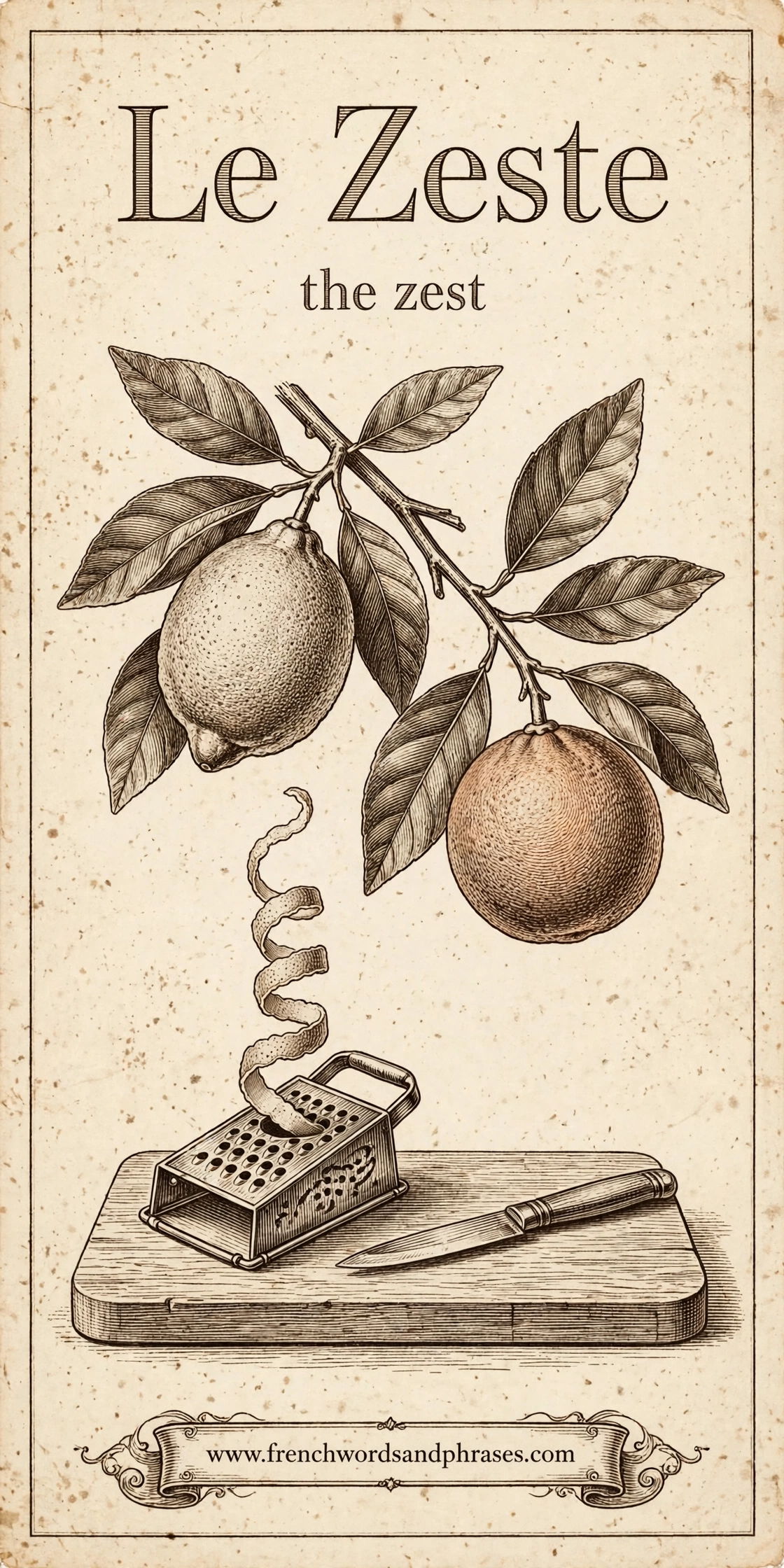
The pastry chef bends over the lemon, grater in hand, and a fine gold snow begins to fall over the tart. One pass, two passes — the whole kitchen suddenly smells of sunshine. That fragrant snow is le zeste.
In this guide, you’ll learn what zeste means in English, how to use it with its articles, how to form its plural, and how it appears in everyday French. Explore French examples, English translations, and practice quizzes.
Understanding the French Noun Zeste
Zeste is a masculine French noun. It is learned together with its article: le zeste, un zeste. Small word, powerful perfume: a little zeste goes a very long way.
It means zest — the fragrant outer skin of a citrus fruit, the coloured part only, full of scented oils: le zeste de citron, lemon zest, le zeste d’orange, orange zest. Cooks grate it — râper un zeste — over cakes, creams and cocktails. And French loves the word so much that it uses it for people too: un zeste d’humour, a touch of humour, un zeste de folie, a hint of madness — the little extra that wakes everything up.
Gender: Masculine
Definite article: le — le zeste (the zest)
Indefinite article: un — un zeste (a zest)
Plural: les zestes
English equivalents: Zest; a touch, a hint (figurative).
One important usage detail: un zeste de is the cook’s measure and the writer’s measure at once. In the kitchen, un zeste de citron is a strip or a grating of peel; in conversation, un zeste d’ironie is just a touch of irony. In both cases it means a small amount with a big effect — never a large quantity.
Experience the Word
Zeste is more than a peel. It is concentration itself — the whole lemon’s perfume packed into its thinnest layer.
Imagine the first grating over a warm cake: the oils rise in the steam, the kitchen brightens, and everyone drifts in to ask what smells so good.
You have not just peeled a fruit. You have added the spark.
How to Use Zeste in French: Complete Guide
Let’s explore how zeste works in French, beginning with its articles.
Zeste with the Definite Article (Le, Les)
Used for the zest in front of you — the one perfuming the cream, the one on the board.
| Number | French |
|---|---|
| Singular | le zeste |
| Plural | les zestes |
Example
Le zeste parfume délicatement la crème.
The zest delicately flavours the cream.
Zeste with the Indefinite Article (Un, Des)
Used for one zest you add, grate or ask for — a small amount with a big effect.
| Number | French |
|---|---|
| Singular | un zeste |
| Plural | des zestes |
Example
Ajoute un zeste de citron au gâteau.
Add a little lemon zest to the cake.
Zeste in the Kitchen
Lemons, oranges and graters — the words of the fragrant peel.
| French | In English |
|---|---|
| le zeste de citron | lemon zest |
| le zeste d’orange | orange zest |
| râper le zeste | to grate the zest |
| un zeste de vanille | a touch of vanilla |
| la pâtisserie | pastry-making, the cake shop |
Example
Elle râpe le zeste d’une orange bio.
She grates the zest of an organic orange.
Quick Quiz 1
What does râper le zeste mean?
Reveal the answer
To grate the zest — to rub the peel on a grater to release its perfume.
Râpe le zeste avant de presser le citron.
Grate the zest before squeezing the lemon.
The Plural of Zeste
Zeste adds an -s in the plural — les zestes, often candied and shining on cakes.
| Number | French |
|---|---|
| Singular | le zeste |
| Plural | les zestes |
Example
Les zestes confits décorent le gâteau de Noël.
Candied zests decorate the Christmas cake.
Zeste with Possessive Adjectives (Mon, Ton, Son…)
Possessives agree with the noun, not with the owner — and zeste is masculine, so it takes mon, ton, son.
| Owner | French |
|---|---|
| my | mon zeste |
| your (tu) | ton zeste |
| his / her | son zeste |
| our | notre zeste |
| your (vous) | votre zeste |
| their | leur zeste |
Example
Chaque pâtissier a son zeste préféré, citron ou orange.
Every pastry chef has his favourite zest, lemon or orange.
Quick Quiz 2
Complete the sentence:
Elle prépare ______ zeste de citron pour la tarte.
Reveal the answer
son
Elle prépare son zeste de citron pour la tarte.
She prepares her lemon zest for the tart.
Zeste with Demonstrative Adjectives (Ce, Ces)
Used to point: this zest here, those zests there.
| Number | French |
|---|---|
| Singular | ce zeste |
| Plural | ces zestes |
Example
Ce zeste d’orange est très parfumé.
This orange zest is very fragrant.
Zeste with Adjectives
Adjectives agree with zeste, masculine — frais, râpé, confit.
| Adjective | With Zeste |
|---|---|
| frais (fresh) | un zeste frais |
| râpé (grated) | le zeste râpé |
| confit (candied) | un zeste confit |
| fin (fine, thin) | un zeste fin |
| parfumé (fragrant) | un zeste parfumé |
Example
Un zeste confit décore chaque part de gâteau.
A candied zest decorates each slice of cake.
Quick Quiz 3
Complete the sentence:
Des zestes ______ brillent sur le gâteau. (candied)
Reveal the answer
confits
Des zestes confits brillent sur le gâteau.
Candied zests shine on the cake.
Everyday Expressions with Zeste
In the kitchen and in conversation, these are the zeste phrases of daily life.
| Expression | In English |
|---|---|
| un zeste de citron | a lemon zest |
| râper un zeste | to grate a zest |
| un zeste d’humour | a touch of humour |
| un zeste de folie | a hint of madness |
| ajouter un zeste de… | to add a touch of… |
| le zeste confit | candied peel |
Example
Son discours avait un zeste d’humour très agréable.
His speech had a very pleasant touch of humour.
Words from the Same Family as Zeste
Citrus, graters and peels — the words that travel with zeste in the kitchen.
| French | In English |
|---|---|
| le citron | the lemon |
| l’orange | the orange |
| la râpe | the grater |
| le zesteur | the zester (the tool) |
| parfumer | to flavour, to perfume |
| l’écorce | the peel, the rind |
Example
Le zesteur râpe seulement la partie colorée de l’écorce.
The zester grates only the coloured part of the peel.
Quick Quiz 4
In a conversation, what is un zeste de folie?
Reveal the answer
A hint of madness — a small, delightful touch of craziness.
Il faut un zeste de folie pour tenter ce voyage.
You need a hint of madness to attempt that journey.
Zeste in Everyday French: Real-Life Examples
Now that you know the word, let’s see how zeste appears in everyday French.
Example 1 — In the kitchen
Râpe le zeste du citron avant de le presser.
Grate the lemon zest before squeezing it.
Example 2 — Baking
Ce gâteau au zeste d’orange est un délice.
This orange-zest cake is a delight.
Example 3 — At the market
Choisis des citrons bio pour le zeste.
Choose organic lemons for the zest.
Example 4 — In a cocktail
Le barman ajoute un zeste de citron vert au verre.
The bartender adds a twist of lime zest to the glass.
Example 5 — Talking style
Il raconte tout avec un zeste d’ironie.
He tells everything with a touch of irony.
Example 6 — A compliment
Ton plat a ce petit zeste qui change tout.
Your dish has that little zest that changes everything.
Beyond Translation: The Meaning of Zeste
French cooking is an art of small intensities — a pinch of salt, a turn of the pepper mill, and above all the zeste, the thinnest possible slice of a fruit carrying the strongest possible perfume.
To say zeste is to praise the power of a little.
It evokes the lemon groves of Menton, candied peels in Christmas cakes, the pastry chef’s grater moving like a violin bow — and the French habit of asking, in food and in life, for just un zeste de plus.
How to Remember the French Noun Zeste
Remember it this way: Zeste is the zest — masculine, with le and un, the fragrant skin of citrus fruit.
- You grate it — je râpe le zeste du citron.
- You flavour the cake — un zeste d’orange dans la pâte.
- You add the spark — un zeste d’humour, un zeste de folie.
The key idea is le zeste de citron in the kitchen, un zeste d’humour in conversation.
Test Your Knowledge of Zeste
Let’s see how much you’ve learned. Try answering these questions before revealing the answers.
Question 1
Is zeste masculine or feminine?
Reveal the answer
Masculine — le zeste, un zeste.
Question 2
How do you say lemon zest in French?
Reveal the answer
Le zeste de citron.
Question 3
Translate: She grates the zest of an orange.
Reveal the answer
Elle râpe le zeste d’une orange.
Question 4
What is un zeste de folie?
Reveal the answer
A hint of madness — a small touch of craziness.
Question 5
Complete the sentence:
Ajoute un ______ de citron au gâteau.
Reveal the answer
zeste
Ajoute un zeste de citron au gâteau.
Add a little lemon zest to the cake.
Your Final Challenge
Can You Use It?
How would you say this in French?
“Add a little lemon zest to the cake.”
Reveal the answer
Ajoutez un peu de zeste de citron au gâteau.
Add a little lemon zest to the cake.
A little French. A little curiosity. A richer everyday life.
LEARN FRENCH ONE WORD AT A TIME