A French Word to Live By
Translate C’est ma faute to English
/sɛ ma fot/
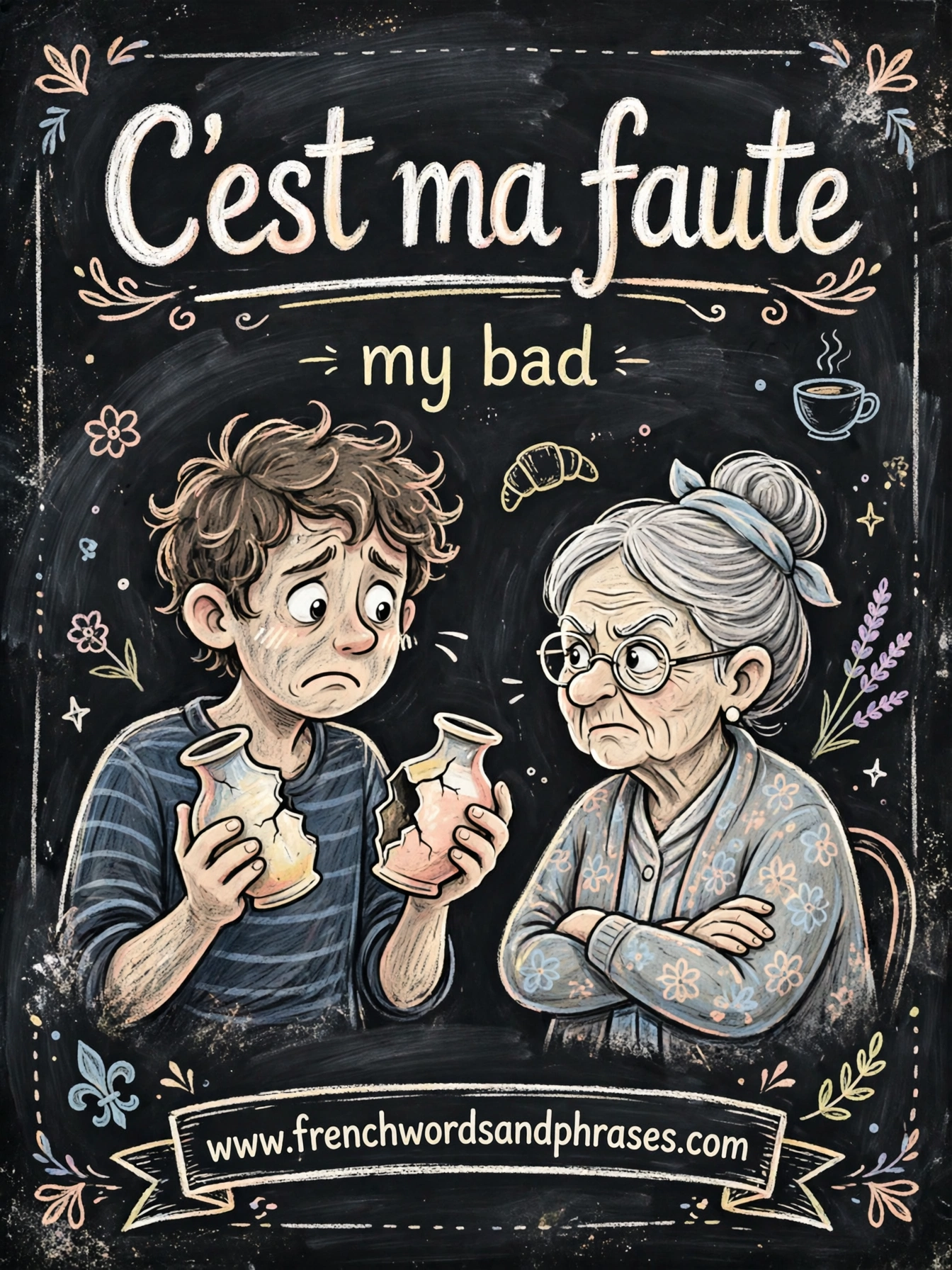
C’est ma faute means my bad — it’s my fault.
The vase was three hundred years old, a family treasure, and now it is in four pieces on your friend’s hallway floor — because you turned around with your bag on your shoulder. There is no dog to blame and no earthquake to hide behind. You take a breath and say the bravest short sentence in French: « C’est ma faute. »
Let’s explore how c’est ma faute works in French, beginning with the whole phrase on one card.
Understanding the French Phrase C’est ma faute
C’est ma faute is a French admission formula — c’est (it is) plus ma faute (my fault). Faute is a busy feminine noun: a mistake, a fault, a foul in sport, even a spelling error (une faute d’orthographe). The phrase takes ownership of whichever faute is on the floor.
It means it’s my fault — my bad. No excuses, no fog, no blame shared around the room: c’est ma faute puts the mistake squarely on the speaker. It is short, it is honest, and it ends arguments about blame before they start.
Type: An admission formula — c’est plus ma faute, taking ownership
Answers the need: Admitting a mistake cleanly, without excuses or blame-shifting
Register: Neutral and honest — works in every setting, from playground to boardroom
Strength: Full ownership — entièrement makes it total, un peu shares it a little
One important usage detail: faute is feminine, so it is ma faute, never mon faute. You will also hear c’est de ma faute in the street — it is widespread, but the clean standard form drops the de: c’est ma faute. And pair it with pardon to soften the landing: pardon, c’est ma faute.
Experience the Word
C’est ma faute is the sound of a grown-up — three words that trade a small moment of shame for a large amount of trust.
Imagine a five-a-side football match: your bad pass, their goal. Hands up before anyone speaks: « Le but, c’est ma faute. » The game moves on; nobody argues with honesty.
French culture respects the clean admission. Say it quickly, say it plainly, and the mistake is already half forgiven.
How to Use C’est ma faute in French: Complete Guide
Let’s explore how c’est ma faute works in French, beginning with the whole phrase on one card.
C’est ma faute at a Glance
The Whole Phrase on One Card
Real meaning, literal build, English twin and register — c’est ma faute in five lines.
| Point | C’est ma faute |
|---|---|
| What it really means | it’s my fault — I take the blame |
| Word for word | it is my fault |
| English equivalent | my bad / it’s my fault / that one’s on me |
| Register | neutral and honest — safe everywhere |
| Use it for | admitting mistakes and ending arguments about blame |
Example
Pardon, c’est ma faute, je suis désolé.
Sorry, it’s my fault, I apologise.
Word by Word: Building the Admission
Three small pieces — a pointer, a possessive that must be feminine, and one hard-working noun.
| Word | Literal meaning | Its job in the phrase |
|---|---|---|
| c’ | it (short for ce) | points at the situation — the breakage, the error, the mess |
| est | is | from être, to be — the plain statement of fact |
| ma | my | the feminine possessive — because faute is a feminine noun |
| faute | a fault, a mistake | the error itself — also a foul in sport and a spelling mistake |
Example
Le retard, c’est ma faute.
The delay is my fault.
Quick Quiz 1
Why is it ma faute and not mon faute?
Reveal the answer
Because faute is feminine — the possessive matches the noun, not the speaker: ma faute for everyone.
C’est ma faute, à moi seul.
It’s my fault, mine alone.
When You Say It: The Owning-Up Moments
C’est ma faute fires at moments like these — something went wrong, and the trail leads to you.
| Situation | Example |
|---|---|
| A forgotten meeting | j’ai oublié la réunion, c’est ma faute — I forgot the meeting, it’s my fault |
| A breakage at a friend’s house | j’ai cassé ton vase, c’est ma faute — I broke your vase, it’s my fault |
| A wrong turn | on a raté la sortie, c’est ma faute, je regardais la carte — we missed the exit, my fault, I was reading the map |
| A burnt dinner | le rôti est brûlé, c’est ma faute — the roast is burnt, it’s my fault |
| An email to the wrong person | je me suis trompé d’adresse, c’est ma faute — I used the wrong address, my fault |
Example
C’est ma faute, on recommence.
It’s my fault, let’s start again.
Make It Yours: Pointing, Denying and Sharing
The possessive rotates — handle ta faute with care — and the phrase denies, totals and shares.
| Form | French | In English |
|---|---|---|
| Mine | c’est ma faute | it’s my fault |
| His / hers | c’est sa faute | it’s his / her fault |
| Yours (accusation!) | c’est ta faute | it’s your fault — handle with care |
| The denial | ce n’est pas ma faute | it’s not my fault |
| Total ownership | c’est entièrement ma faute | it’s entirely my fault |
| Comforting someone else | ce n’est pas ta faute | it’s not your fault |
Example
Ce n’est pas ta faute, ne t’inquiète pas.
It’s not your fault, don’t worry.
Quick Quiz 2
How do you say “it’s not my fault”?
Reveal the answer
Ce n’est pas ma faute — the ne… pas wraps around est, and the ownership is refused.
Ce n’est pas ma faute, je n’étais pas là.
It’s not my fault, I wasn’t there.
Everyday Expressions: Building on the Phrase
C’est ma faute slots into these everyday frames — each one ready to use as it stands.
| Frame | In English |
|---|---|
| pardon, c’est ma faute | sorry, it’s my fault |
| c’est ma faute, j’ai oublié | my fault, I forgot |
| c’est ma faute, je suis désolé | it’s my fault, I’m sorry |
| c’est ma faute, je répare | my fault, I’ll fix it |
| ce n’est pas ta faute | it’s not your fault (the comforting twin) |
Example
C’est ma faute, je répare tout de suite.
It’s my fault, I’ll fix it right away.
Close Cousins: The Other Ways to Say Sorry
French apology has several gears — c’est ma faute names the blame; its cousins express regret, lightness or the act itself.
| Expression | The difference |
|---|---|
| c’est ma faute | it’s my fault — names the blame and takes it |
| je suis désolé | I’m sorry — expresses regret, without assigning blame |
| excuse-moi | excuse me — the lightest gear, for small bumps |
| j’ai fait une erreur | I made a mistake — describes the act, cooler and more factual |
| c’est de ma faute | the street variant with de — widely heard, but the tidy standard drops it |
| ce n’est pas grave | it’s no big deal — the forgiving answer this phrase hopes to hear |
Example
Je suis désolé, c’est ma faute.
I’m sorry, it’s my fault.
Quick Quiz 3
Which cousin names the blame — je suis désolé or c’est ma faute?
Reveal the answer
C’est ma faute — je suis désolé expresses regret; c’est ma faute points at the error and takes ownership of it.
C’est ma faute, pas la tienne.
It’s my fault, not yours.
C’est ma faute and Its Neighbours
The apology shelf around the phrase — admissions at one end, denials at the other.
| French | In English |
|---|---|
| pardon | sorry (the softener that opens) |
| c’est ma faute | it’s my fault (the admission) |
| je suis désolé | I’m sorry (the regret) |
| ce n’est pas grave | it’s no big deal (the forgiveness it earns) |
| ce n’est pas ma faute | it’s not my fault (the denial) |
| ce n’est pas moi | it wasn’t me (the full escape hatch) |
Example
Pardon, c’est ma faute. — Ce n’est pas grave.
Sorry, it’s my fault. — It’s no big deal.
Watch Out: The Traps Around C’est ma faute
The traps: the wrong possessive, the extra de, and a faute that turns into furniture.
| Trap | The truth |
|---|---|
| saying mon faute | faute is feminine — ma faute, whoever is speaking |
| adding de out of habit | c’est de ma faute is heard everywhere, but the clean standard is c’est ma faute |
| pointing with c’est ta faute | it accuses — said coldly it starts fights; tone decides whether it teases or wounds |
| meeting faute on a football pitch | une faute is also a foul — the referee’s whistle kind of fault |
| confusing faute with fauteuil | une faute is a mistake; un fauteuil is an armchair — very different confessions |
Example
Une faute d’orthographe dans mon message, c’est ma faute !
A spelling mistake in my message — my fault!
Quick Quiz 4
What is une faute d’orthographe?
Reveal the answer
A spelling mistake — faute covers mistakes of every kind, not just breakages.
Il y a une faute d’orthographe dans ce mot.
There’s a spelling mistake in this word.
C’est ma faute in Everyday French: Real-Life Examples
Now that you know the word, let’s see how c’est ma faute appears in everyday French.
Example Example 1 — A forgotten meeting
J’ai oublié la réunion, c’est ma faute.
I forgot the meeting, it’s my fault.
Example Example 2 — A broken vase
J’ai cassé ton vase, c’est ma faute, je suis désolé.
I broke your vase, it’s my fault, I’m sorry.
Example Example 3 — A wrong turn
On a raté la sortie, c’est ma faute, je regardais la carte.
We missed the exit, it’s my fault, I was reading the map.
Example Example 4 — A burnt dinner
Le rôti est brûlé, c’est ma faute.
The roast is burnt, it’s my fault.
Example Example 5 — On the football pitch
Le but, c’est ma faute, j’ai perdu le ballon.
The goal is my fault, I lost the ball.
Example Example 6 — The wrong inbox
Je me suis trompé d’adresse, c’est ma faute.
I sent it to the wrong address, it’s my fault.
Beyond Translation: The Meaning of C’est ma faute
Faute descends from the Latin fallere — to trip, to fail, to slip. The word has kept its honesty for two thousand years: a faute is where someone stumbled, and c’est ma faute points at the stumble without decoration.
To say c’est ma faute is to trade a moment of shame for a reputation.
Every French speaker learns early that the quickest way out of a mistake is straight through it: three words, hands up, and the room relaxes — because blame, once owned, has nowhere left to go.
How to Remember the French Phrase C’est ma faute
Remember it this way: Remember it this way: C’est ma faute puts the mistake in your own hands — ma because faute is feminine, no de, no excuses.
- You match the noun, not yourself — faute is feminine, so everyone says ma faute.
- You drop the de — c’est ma faute is the clean standard form.
- You pair it with pardon — pardon, c’est ma faute lands softly and ends the argument.
The key idea is c’est ma faute means it’s my fault — the clean, quick way to own a mistake.
Test Your Knowledge of C’est ma faute
Let’s see how much you’ve learned. Try answering these questions before revealing the answers.
Question 1
What does c’est ma faute mean?
Reveal the answer
It’s my fault — my bad. The speaker takes full ownership of the mistake.
Question 2
Why is it ma faute and not mon faute?
Reveal the answer
Because faute is a feminine noun — the possessive agrees with the thing owned, not with the owner.
Question 3
How do you say ‘it’s not my fault’?
Reveal the answer
Ce n’est pas ma faute — ne… pas wraps around est.
Question 4
What does une faute d’orthographe mean?
Reveal the answer
A spelling mistake — faute covers mistakes, faults and fouls of every kind.
Question 5
Complete the sentence:
Pardon, c’est ma ______. (Sorry, it’s my fault.)
Reveal the answer
faute
Pardon, c’est ma faute.
Sorry, it’s my fault.
Your Final Challenge
Can You Use It?
How would you say this in French?
“How would you say this in French?”
Reveal the answer
C’est ma faute, je suis vraiment désolé.
It’s my fault, I’m really sorry.
A little French. A little curiosity. A richer everyday life.
LEARN FRENCH ONE WORD AT A TIME