A French Word to Live By
Translate Tiens bon to English
/tjɛ̃ bɔ̃/
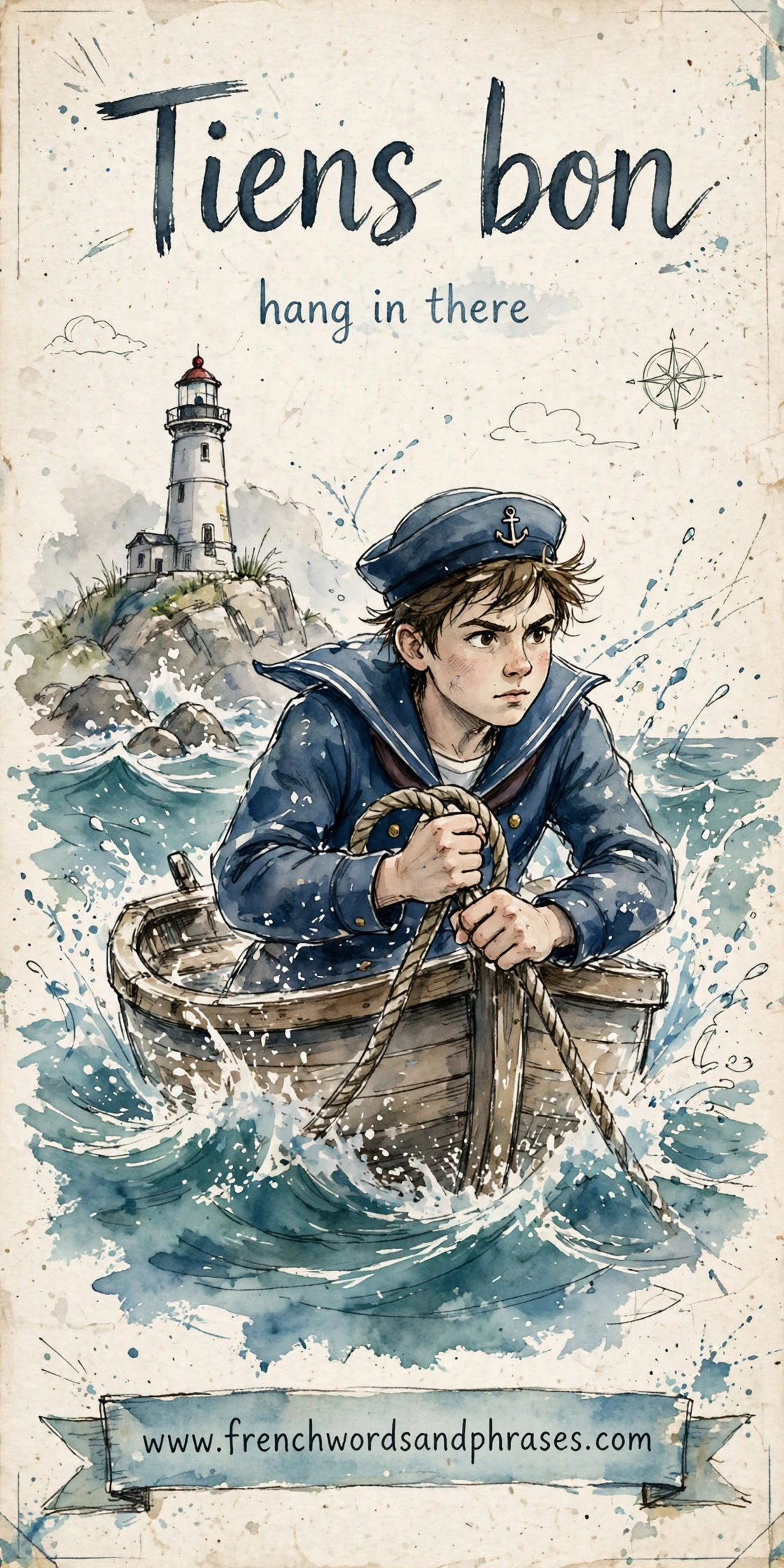
Tiens bon means hang in there — hold on, don’t give up.
The runner’s legs are burning at kilometre thirty-eight, the crowd is thinning, and rain has started to fall on the empty road. From the pavement, one voice rises above the rest — yours: « Tiens bon ! » Two small words, and somehow her stride steadies.
Let’s explore how tiens bon works in French, beginning with the whole phrase on one card.
Understanding the French Phrase Tiens bon
Tiens bon is a French imperative phrase — a shout of encouragement built from tenir (to hold) plus bon, used here in the sense of ‘firm’. It is the tu form; to a stranger, an elder or a crowd, it becomes tenez bon.
It means hang in there — hold on, keep going, do not give up. The picture is physical: something is pulling at you — tiredness, pain, bad luck — and you hold on tight and refuse to be moved. French reaches for this phrase whenever life gets heavy.
Type: Imperative phrase — encouragement built on tenir (to hold)
Answers the need: Keeping someone going — through pain, effort or a hard time
Register: Warm and everyday — tu form here; tenez bon for vous and crowds
Strength: Strong medicine — for real difficulty, not for small delays
One important usage detail: bon never changes in this phrase. It is not describing a person, it is part of the verb’s machinery — so it is tiens bon for a woman, a man, anyone. Writing ‘tiens bonne’ is a classic mistake.
Experience the Word
Tiens bon is two words of pure rope — something thrown to a person who is slipping.
Imagine a fisherman off the Brittany coast in a rising sea, both hands on the wheel, waves over the bow. On the radio, his brother’s voice: « Tiens bon, j’arrive. » Hold on, I’m coming. That is the whole phrase in one scene.
French encouragement is physical. To say tiens bon is to lend someone your grip.
How to Use Tiens bon in French: Complete Guide
Let’s explore how tiens bon works in French, beginning with the whole phrase on one card.
Tiens bon at a Glance
The Whole Phrase on One Card
Real meaning, literal picture, English twin and register — tiens bon in five lines.
| Point | Tiens bon |
|---|---|
| What it really means | hang in there — hold on, don’t give up |
| Word for word | hold firm (tiens = hold, bon = firm, steady) |
| English equivalent | hang in there / hold on / stay strong |
| Register | warm, everyday — tu form; tenez bon for vous |
| Use it for | illness, effort, grief, exams — any long hard stretch |
Example
Tiens bon, c’est presque fini.
Hang in there, it’s nearly over.
Word by Word: The Grip and the Firmness
Two words only — a hand, and the order to keep it closed.
| Word | Literal meaning | Its job in the phrase |
|---|---|---|
| tiens | hold | the tu imperative of tenir — the grip itself |
| bon | good — here: firm, steady | it describes the hold, not the person, and it never changes |
| tiens bon (together) | hold firm | one single gesture — the two words are never separated |
Example
Tiens bon encore un peu, on arrive.
Hold on a little longer, we’re coming.
Quick Quiz 1
Does bon change if you say tiens bon to a woman?
Reveal the answer
No — bon is part of the verb’s machinery here and never changes.
Tiens bon, Marie, tu y es presque.
Hang in there, Marie, you’re almost there.
When You Say It: The Holding-On Moments
Tiens bon appears wherever something is heavy and the end is not yet in sight.
| Situation | Example |
|---|---|
| A friend in hospital | tiens bon, les médecins sont optimistes — hang in there, the doctors are hopeful |
| The last kilometre of a race | tiens bon, plus que deux kilomètres ! — hold on, only two kilometres to go! |
| Exam week | tiens bon, les examens finissent vendredi — hang in there, the exams end on Friday |
| A colleague at breaking point | tiens bon, on finit ce projet ensemble — hold on, we’ll finish this project together |
| A storm at sea | tiens bon, le port est tout près — hold on, the harbour is very close |
Example
Tiens bon jusqu’à la fin, je suis fier de toi.
Hang in there to the end, I’m proud of you.
Make It Yours: One Rope, Many Hands
Only the verb changes shape — the encouragement works for one person, a crowd, or yourself.
| Form | French | In English |
|---|---|---|
| Tu (friend, child) | tiens bon | hang in there |
| Vous / a crowd | tenez bon | hang in there |
| A little longer | tiens bon encore un peu | hold on a little longer |
| To the very end | tiens bon jusqu’au bout | hold on to the very end |
| Statement — I form | je tiens bon | I’m holding on |
| Statement — we form | on tient bon | we’re holding on |
Example
Tenez bon, mes amis, l’aide arrive.
Hold on, my friends, help is coming.
Quick Quiz 2
How do you shout tiens bon to a whole crowd?
Reveal the answer
Tenez bon — the vous imperative of tenir, used for groups and polite singulars alike.
Tenez bon, le train arrive dans cinq minutes.
Hold on, the train arrives in five minutes.
Everyday Expressions: Building on the Phrase
Tiens bon slots into these everyday frames — each one ready to use as it stands.
| Frame | In English |
|---|---|
| tiens bon, c’est presque fini | hang in there, it’s nearly finished |
| tiens bon encore cinq minutes | hold on for five more minutes |
| tiens bon, je suis là | hang in there, I’m here |
| tiens bon jusqu’au bout | hold on right to the end |
| tiens bon, ça va passer | hang in there, this will pass |
Example
Tiens bon, ça va passer, je reste avec toi.
Hang in there, this will pass, I’m staying with you.
Close Cousins: The Other Ways to Say Hold On
French encouragement comes in several strengths — tiens bon is the classic; its cousins differ in urgency.
| Expression | The difference |
|---|---|
| tiens bon | the classic — hold firm through a hard stretch |
| accroche-toi | cling on! — more physical and urgent, literally grab hold (vous: accrochez-vous) |
| courage ! | courage! — one word of support, shouted or whispered |
| ne lâche pas | don’t let go — focuses on the hands, not the heart |
| ça va aller | it’ll be OK — a promise about the future, not an order to hold |
Example
Accroche-toi, la vague arrive !
Hold on tight, the wave is coming!
Quick Quiz 3
Which cousin literally tells someone to grab hold — tiens bon or accroche-toi?
Reveal the answer
Accroche-toi — s’accrocher means to cling or grab on; it is the urgent, physical cousin.
Accroche-toi à la rampe !
Hold on to the handrail!
Tiens bon and Its Neighbours
The endurance shelf around the phrase — and the opposite advice at the end.
| French | In English |
|---|---|
| tiens bon | hang in there |
| ne t’inquiète pas | don’t worry (for fear, not endurance) |
| prends ton temps | take your time (the slow-down cousin) |
| continue ! | keep going! (movement, not grip) |
| je n’en peux plus | I can’t take any more (the cry this phrase answers) |
| laisse tomber | let it go (the opposite advice — sometimes the right one) |
Example
Je n’en peux plus. — Si, tiens bon !
I can’t go on. — Yes you can, hang in there!
Watch Out: The Traps Around Tiens bon
The traps: changing bon, and the other lives of the word tiens.
| Trap | The truth |
|---|---|
| changing bon | tiens bonne does not exist — bon is fixed inside the phrase, for everyone |
| confusing it with tiens ! | tiens ! alone means ‘here!’ (handing something over) or ‘hey!’ — bon is what turns it into encouragement |
| using tiens bien instead | tiens bien la rampe means hold the handrail properly — a safety instruction, not moral support |
| shouting it at small troubles | for a two-minute wait it sounds over-dramatic — save it for real difficulty |
Example
Tiens, ton café. Et tiens bon pour cet après-midi.
Here, your coffee. And hang in there this afternoon.
Quick Quiz 4
Spot the mistake: “Tiens bonne, ma sœur.“
Reveal the answer
Bon never changes — it belongs to the verb, not to the person.
Tiens bon, ma sœur.
Hang in there, sis.
Tiens bon in Everyday French: Real-Life Examples
Now that you know the word, let’s see how tiens bon appears in everyday French.
Example Example 1 — At the hospital
Tiens bon, papa, l’opération est demain.
Hang in there, Dad, the operation is tomorrow.
Example Example 2 — Marathon day
Tiens bon, plus que trois kilomètres !
Hang in there, only three kilometres to go!
Example Example 3 — A text at midnight
Tiens bon, je pense à toi.
Hang in there, I’m thinking of you.
Example Example 4 — Exam week
Tiens bon, après vendredi, c’est fini.
Hang in there, after Friday it’s over.
Example Example 5 — On a boat
Tiens bon, la tempête se calme.
Hold on, the storm is calming down.
Example Example 6 — A long recovery
Tiens bon, chaque jour tu es plus fort.
Hang in there, every day you’re stronger.
Beyond Translation: The Meaning of Tiens bon
English hangs in there; French holds firm. The difference is a whole philosophy: English pictures a person dangling, French pictures a person gripping — feet planted, hands closed, refusing to move.
To say tiens bon is to tell someone their own strength is enough.
That is why you hear it everywhere difficulty lives in France: hospital corridors, mountain paths, picket lines, family kitchens at 2 a.m. Two words, and nobody is carrying the load alone.
How to Remember the French Phrase Tiens bon
Remember it this way: Remember it this way: Tiens bon is a rope thrown in two words — hold firm, and do not let go.
- You feel the grip — tenir is to hold, and bon is the firmness of the hold.
- You never change bon — it belongs to the verb, not to the man or woman you are cheering.
- You switch only the verb for a crowd — tenez bon carries the same rope to everyone.
The key idea is tiens bon means hang in there — hold firm, with bon fixed and tenez for vous.
Test Your Knowledge of Tiens bon
Let’s see how much you’ve learned. Try answering these questions before revealing the answers.
Question 1
What does tiens bon mean?
Reveal the answer
Hang in there — hold on, keep going, don’t give up.
Question 2
How do you say it to a group of people?
Reveal the answer
Tenez bon — the vous imperative of tenir.
Question 3
Translate: Hang in there, it’s nearly over.
Reveal the answer
Tiens bon, c’est presque fini.
Question 4
Why is ‘tiens bonne’ wrong when speaking to a woman?
Reveal the answer
Bon is part of the fixed phrase — it describes the hold, not the person, so it never changes.
Question 5
Complete the sentence:
______ bon, plus que deux kilomètres ! (Hang in there, only two kilometres to go!)
Reveal the answer
Tiens
Tiens bon, plus que deux kilomètres !
Hang in there, only two kilometres to go!
Your Final Challenge
Can You Use It?
How would you say this in French?
“How would you say this in French?”
Reveal the answer
Tiens bon, tu y es presque.
Hang in there, you’re almost there.
A little French. A little curiosity. A richer everyday life.
LEARN FRENCH ONE WORD AT A TIME