A French Word to Live By
Translate Quand on parle du loup to English
/kɑ̃.t‿ɔ̃ paʁl dy lu/
Quand on parle du loup means speak of the devil.
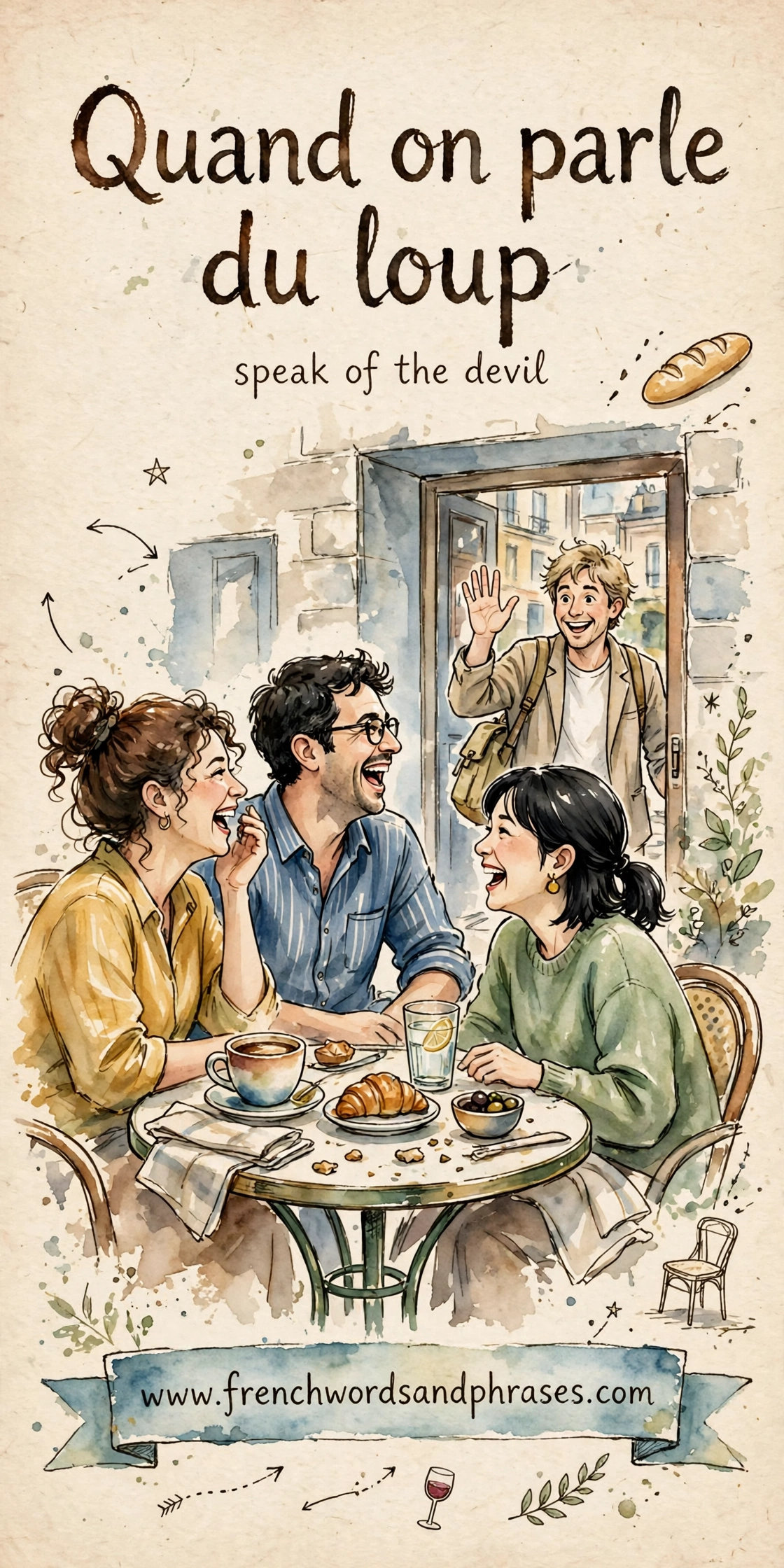
At the café, you are telling your sister about your neighbour, Monsieur Fabre — his garden, his cat, his loud Sunday singing. At that exact moment, the door opens and Monsieur Fabre walks in. Your sister grins and delivers the line French keeps for this precise second: « Quand on parle du loup… »
Let’s explore how quand on parle du loup works in French, beginning with the whole phrase on one card.
Understanding the French Phrase Quand on parle du loup
Quand on parle du loup is a French set phrase — the short form of the old proverb quand on parle du loup, on en voit la queue (when you speak of the wolf, you see its tail). You say it at the moment the person being talked about unexpectedly appears.
It means speak of the devil — the exact French twin of the English phrase, playful in the same way. There is nothing sinister in it: the wolf, like the devil, is simply the one who seems to arrive because he was mentioned. Said with a smile, it welcomes the newcomer and closes the conversation that was about them.
Type: Set phrase — the short form of a proverb (quand on parle du loup, on en voit la queue)
Answers the need: Marking the comic moment when the person discussed walks in
Register: Neutral, warm and playful — always with a smile
Strength: Light — a joke of timing, never an accusation
One important usage detail: the phrase is said to, or in front of, the arriving person, usually left hanging with a smile — « Quand on parle du loup… » — and the newcomer answers with a laugh or « Vous parliez de moi ? » It only works at the moment of arrival; it is not a way to start gossip about someone absent.
Experience the Word
Quand on parle du loup is French for the universe’s favourite joke — mention someone, and the door opens.
Imagine an office kitchen: three colleagues wondering where Karim is, whether he is still on holiday, what he will say about the new schedule. The door swings open — Karim, suitcase still in hand. One sentence covers the laughter: quand on parle du loup.
Every language marks this moment. English summons the devil; French summons the wolf — and both arrive smiling.
How to Use Quand on parle du loup in French: Complete Guide
Let’s explore how quand on parle du loup works in French, beginning with the whole phrase on one card.
Quand on parle du loup at a Glance
The Whole Phrase on One Card
Real meaning, literal picture, English twin and register — quand on parle du loup in five lines.
| Point | Quand on parle du loup |
|---|---|
| What it really means | speak of the devil — the person we were just mentioning has arrived |
| Word for word | when one speaks of the wolf |
| English equivalent | speak of the devil (and he appears) |
| Register | neutral and playful — warm, never hostile |
| Use it for | the exact moment the talked-about person walks in |
Example
On parlait de toi — et quand on parle du loup… te voilà !
We were talking about you — and speak of the devil… here you are!
Word by Word: Building the Picture
Five small pieces — take them one by one and the proverb builds itself.
| Word | Literal meaning | Its job in the phrase |
|---|---|---|
| quand | when | sets the scene — the moment of speaking |
| on | we / one / you | the indefinite speaker — anyone who was talking |
| parle | speaks, is speaking | from parler, to speak — the mentioning itself |
| du | of the (de + le) | introduces the one being spoken of |
| loup | wolf | the star of the proverb — pronounced /lu/, the p is silent |
Example
Quand on parle du loup, le voilà qui arrive.
Speak of the devil — here he comes.
Quick Quiz 1
How is loup pronounced — and which letter stays silent?
Reveal the answer
/lu/ — the p is silent. Loup sounds exactly like ‘lou’.
Quand on parle du loup, on rit.
Speak of the devil, everyone laughs.
When You Say It: The Arrival Moments
Quand on parle du loup fires at moments like these — the timing is the whole joke.
| Situation | Example |
|---|---|
| A friend walks in | quand on parle du loup, on disait justement que… — speak of the devil, we were just saying that… |
| A colleague returns | tiens, quand on parle du loup ! — well, speak of the devil! |
| Family at the door | on parlait de toi, quand on parle du loup — we were talking about you, speak of the devil |
| On a video call | il se connecte — quand on parle du loup ! — he’s joining — speak of the devil! |
| The boss arrives | chut, quand on parle du loup… — shh, speak of the devil… |
Example
Tiens, quand on parle du loup, entre, on t’attendait !
Well, speak of the devil, come in, we were expecting you!
Make It Yours: Short, Full and Followed Up
The phrase stretches from three trailing dots to the full old proverb — choose your length.
| Form | French | In English |
|---|---|---|
| Short form (the most common) | quand on parle du loup… | speak of the devil… |
| Full proverb | quand on parle du loup, on en voit la queue | when you speak of the wolf, you see its tail |
| With tiens | tiens, quand on parle du loup ! | well — speak of the devil! |
| The follow-up | on parlait justement de toi | we were just talking about you |
| Two arrivals (playful) | quand on parle des loups… | speaking of the wolves… |
Example
Quand on parle du loup, on en voit la queue !
When you speak of the wolf, you see its tail!
Quick Quiz 2
How does the full proverb end — what do you see of the wolf?
Reveal the answer
Its tail — on en voit la queue: first the tail appears, then the wolf.
On parlait de lui, et quand on parle du loup, on en voit la queue.
We were talking about him, and speak of the devil…
Everyday Expressions: Building on the Phrase
Quand on parle du loup slots into these everyday frames — each one ready to use as it stands.
| Frame | In English |
|---|---|
| quand on parle du loup, le voilà | speak of the devil, here he is |
| on parlait de toi à l’instant | we were talking about you just now |
| tu tombes bien, on parlait de toi | perfect timing, we were talking about you |
| quand on parle du loup… assieds-toi ! | speak of the devil… sit down! |
| et hop, quand on parle du loup | and just like that — speak of the devil |
Example
Tu tombes bien : quand on parle du loup, on a besoin de toi.
Perfect timing: speak of the devil, we need you.
Close Cousins: The Other Arrival Lines
French has several ways to greet an arrival — quand on parle du loup is the one that needs a conversation before it.
| Expression | The difference |
|---|---|
| quand on parle du loup | the person mentioned walks in — timing is everything |
| tiens, te voilà ! | oh, here you are! — simple surprise at an arrival, no conversation needed |
| on parlait justement de toi | we were just talking about you — the explanation, said to the newcomer |
| en parlant de… | speaking of… — moves a conversation to a new topic, no arrival involved |
| le monde est petit | it’s a small world — for chance meetings, not arrivals mid-conversation |
Example
En parlant de vacances, tu pars quand ?
Speaking of holidays, when are you leaving?
Quick Quiz 3
You bump into an old friend in a tiny village abroad. Quand on parle du loup or le monde est petit?
Reveal the answer
Le monde est petit — a chance meeting; the wolf needs someone you were just talking about to walk in.
Toi, ici ? Le monde est petit !
You, here? It’s a small world!
Quand on parle du loup and Its Neighbours
The wolf family around the phrase — French keeps a whole pack of loup idioms.
| French | In English |
|---|---|
| avoir une faim de loup | to be ravenous — wolf-hungry |
| connu comme le loup blanc | known by everyone — the famous white wolf |
| hurler avec les loups | to run with the pack — to follow the crowd’s opinion |
| entre chien et loup | at dusk — the hour when you cannot tell a dog from a wolf |
| se jeter dans la gueule du loup | to walk into the lion’s den — into the wolf’s mouth |
| quand on parle du loup | speak of the devil |
Example
Après la randonnée, on avait une faim de loup.
After the hike, we were ravenous.
Watch Out: The Traps Around Quand on parle du loup
The traps: the silent p, the timing, and mistaking a warm joke for an insult.
| Trap | The truth |
|---|---|
| the silent p | loup is pronounced /lu/ — sounding the p marks you out at once |
| tone | it is a warm joke, not an insult — the devil and the wolf are both teasing; deliver it smiling |
| timing | it needs the arrival — said about someone who never comes, the phrase falls flat |
| queue in the full proverb | la queue is the tail here — queue also means a line of people: same word, another life |
Example
Il entre, tout le monde sourit : quand on parle du loup !
He walks in, everyone smiles: speak of the devil!
Quick Quiz 4
True or false: quand on parle du loup is an insult to the person arriving.
Reveal the answer
False — it is a warm, playful welcome; the wolf, like the devil, is pure teasing.
Quand on parle du loup — bienvenue, assieds-toi !
Speak of the devil — welcome, sit down!
Quand on parle du loup in Everyday French: Real-Life Examples
Now that you know the word, let’s see how quand on parle du loup appears in everyday French.
Example Example 1 — A café door
On parlait de toi — quand on parle du loup, te voilà !
We were talking about you — speak of the devil, here you are!
Example Example 2 — An office return
Tiens, quand on parle du loup, bon retour parmi nous !
Well, speak of the devil, welcome back!
Example Example 3 — A video call
Ah, il se connecte — quand on parle du loup !
Ah, he’s joining — speak of the devil!
Example Example 4 — A family lunch
On se demandait où tu étais : quand on parle du loup !
We were wondering where you were: speak of the devil!
Example Example 5 — A neighbour in the street
Quand on parle du loup, bonjour monsieur Fabre !
Speak of the devil, hello Mr Fabre!
Example Example 6 — A classroom
Chut, la maîtresse arrive — quand on parle du loup…
Shh, the teacher is coming — speak of the devil…
Beyond Translation: The Meaning of Quand on parle du loup
The wolf haunted French fields and French stories for centuries — in proverbs, in La Fontaine’s fables, in the beast that emptied winter villages. To name the wolf was to summon it; the proverb simply noticed that people, too, seem to arrive when named.
To say quand on parle du loup is to turn an awkward moment into a shared laugh.
The conversation about the newcomer ends the second they appear — and the phrase ends it gracefully, with everyone, the wolf included, smiling.
How to Remember the French Phrase Quand on parle du loup
Remember it this way: Remember it this way: Quand on parle du loup is the door opening — the person you named walks in.
- You watch the door — the phrase lives in timing: mention, then arrival.
- You can complete the proverb — speaking of the wolf, on en voit la queue, you see its tail.
- You let the p sleep — loup is pronounced /lu/, and it is always a joke, never an insult.
The key idea is quand on parle du loup means speak of the devil — said smiling, the moment the person walks in.
Test Your Knowledge of Quand on parle du loup
Let’s see how much you’ve learned. Try answering these questions before revealing the answers.
Question 1
What does quand on parle du loup mean?
Reveal the answer
Speak of the devil — said when the person you were just talking about unexpectedly appears.
Question 2
How does the full proverb end?
Reveal the answer
On en voit la queue — ‘you see its tail’: quand on parle du loup, on en voit la queue.
Question 3
How do you pronounce loup?
Reveal the answer
/lu/ — the p is silent, like the p in the English ‘coup’.
Question 4
When exactly do you say this phrase?
Reveal the answer
At the moment of arrival — when the person being talked about walks in. Without the arrival, the joke has no timing.
Question 5
Complete the sentence:
On parlait de toi… quand on parle du ______ ! (We were talking about you… speak of the devil!)
Reveal the answer
loup
On parlait de toi… quand on parle du loup !
We were talking about you… speak of the devil!
Your Final Challenge
Can You Use It?
How would you say this in French?
“How would you say this in French?”
Reveal the answer
Tiens, quand on parle du loup, te voilà !
Well, speak of the devil, here you are!
A little French. A little curiosity. A richer everyday life.
LEARN FRENCH ONE WORD AT A TIME