A French Word to Live By
How to Conjugate Sonner in French
/sɔ.ne/
Sonner means to ring, to sound, or to strike.
Bells over a village, a telephone in the hallway, the school bell at the end of the day — sound is how a place tells you what time it is. In French, all of that ringing is sonner.
In this guide, you’ll learn how to conjugate sonner in all the major French tenses and moods. Explore complete conjugation tables, French examples, English translations, and practice quizzes.
Understanding the French Verb Sonner
Sonner is a regular French verb belonging to the first group of verbs, those ending in -er.
It means to ring, to sound, or to strike (of a clock). It is commonly used for bells ringing, a telephone or doorbell sounding, a clock striking the hour, and — with a direct object — ringing for someone: sonner le domestique.
Verb classification: First group (-er)
Auxiliary verb: Avoir or être, depending on the construction
Past participle: sonné
Present participle: sonnant
English equivalents: To ring, to sound, to strike, to ring for someone.
One important detail: sonner usually takes avoir — les cloches ont sonné (the bells rang), midi a sonné (noon struck). But in older and literary French, être marks the state once the hour has struck — l’heure est sonnée depuis longtemps (the hour struck long ago), as in the letters of Madame de Sévigné. The tables on this page use avoir, the auxiliary of everyday French.
Experience the Word
Sonner is the sound of a place keeping time — the bell that ends the lesson, the clock that opens the day.
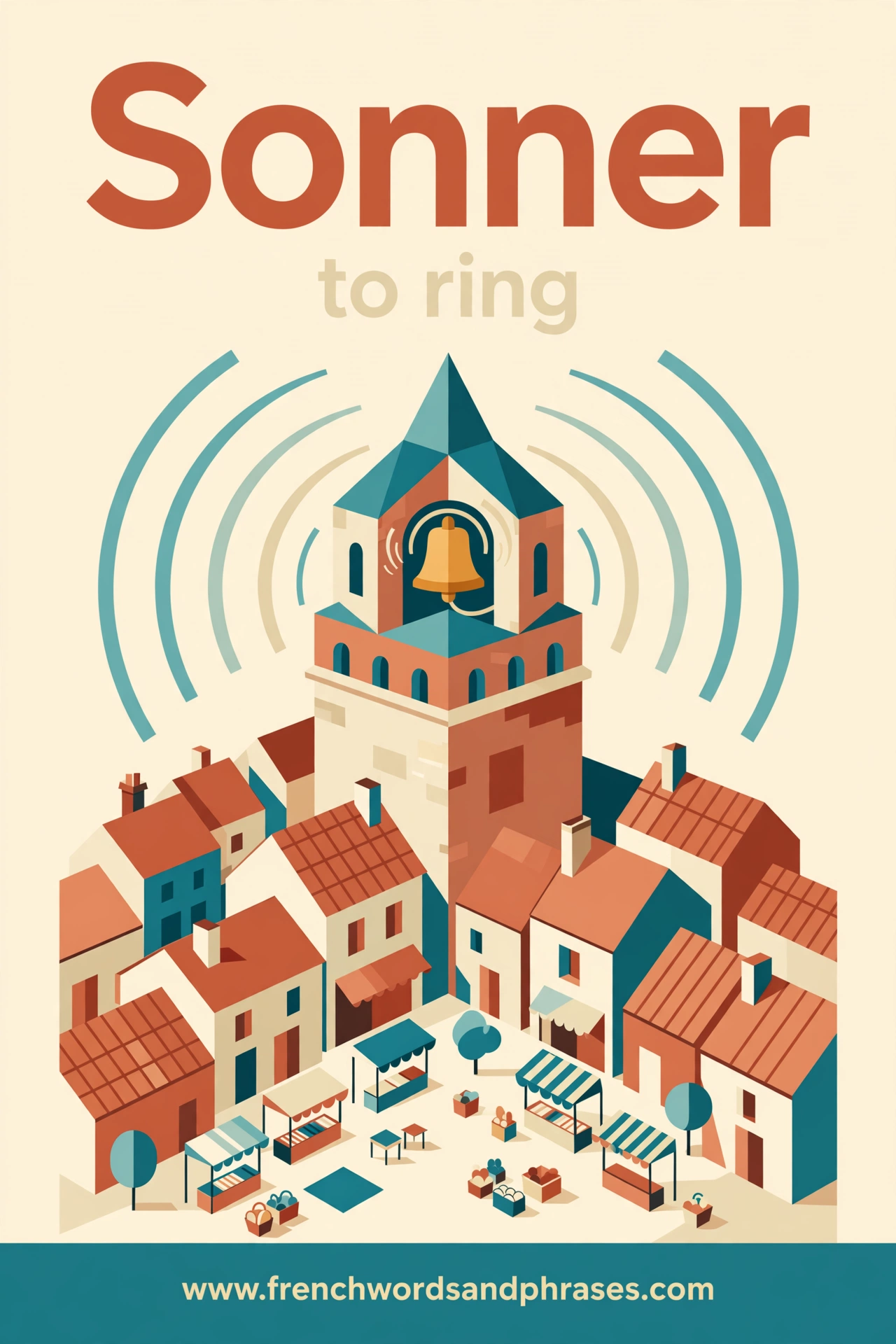
Imagine a small town on a Sunday morning. The church bells ring out over the rooftops, the baker opens his shutters, and the whole square seems to wake up at once to the sound.
You have not just heard a noise. You have heard the hour itself.
How to Conjugate Sonner: Complete French Conjugation Guide
Let’s explore every major conjugation of sonner, beginning with the indicative mood.
How to Conjugate Sonner in the Indicative Mood
The indicative mood is used to express facts, observations, actions, and events.
How to Conjugate Sonner in the Present Tense (Présent)
Used for actions happening now, habitual actions, and general truths.
| Subject | Conjugation |
|---|---|
| je | sonne |
| tu | sonnes |
| il / elle | sonne |
| nous | sonnons |
| vous | sonnez |
| ils / elles | sonnent |
Example
Les cloches sonnent à toute volée.
The bells are ringing out loud.
Quick Quiz 1
Complete the sentence:
Les cloches ______ à toute volée.
Reveal the answer
sonnent
Les cloches sonnent à toute volée.
The bells are ringing out loud.
How to Conjugate Sonner in the Passé Composé
Used for completed actions in the past. Sonner takes the auxiliary verb avoir or être, depending on the construction.
| Subject | Conjugation |
|---|---|
| j’ | ai sonné |
| tu | as sonné |
| il / elle | a sonné |
| nous | avons sonné |
| vous | avez sonné |
| ils / elles | ont sonné |
Example
La cloche a sonné trois fois.
The bell rang three times.
How to Conjugate Sonner in the Imparfait (Imperfect Tense)
Used for habitual past actions, descriptions, and ongoing situations in the past.
| Subject | Conjugation |
|---|---|
| je | sonnais |
| tu | sonnais |
| il / elle | sonnait |
| nous | sonnions |
| vous | sonniez |
| ils / elles | sonnaient |
Example
Quand il était petit, le réveil sonnait à six heures.
When he was little, the alarm clock rang at six o’clock.
Quick Quiz 2
Choose the correct form:
Noon struck at the village church tower.
Midi ______ au clocher du village. (a sonné / est sonné)
Reveal the answer
a sonné
Midi a sonné au clocher du village.
Sonner marks the act of striking, so it takes avoir in everyday French.
How to Conjugate Sonner in the Plus-que-parfait
Used to describe an action that had already been completed before another past event.
| Subject | Conjugation |
|---|---|
| j’ | avais sonné |
| tu | avais sonné |
| il / elle | avait sonné |
| nous | avions sonné |
| vous | aviez sonné |
| ils / elles | avaient sonné |
Example
Le téléphone avait sonné toute la matinée.
The telephone had rung all morning.
How to Conjugate Sonner in the Passé Simple
Primarily used in formal writing, literature, and historical narratives. It is rarely used in everyday conversation.
| Subject | Conjugation |
|---|---|
| je | sonnai |
| tu | sonnas |
| il / elle | sonna |
| nous | sonnâmes |
| vous | sonnâtes |
| ils / elles | sonnèrent |
Example
À minuit, la vieille horloge sonna douze coups.
At midnight, the old clock struck twelve.
How to Conjugate Sonner in the Passé Antérieur
A literary tense used to express an action completed immediately before another past action, generally in the passé simple.
| Subject | Conjugation |
|---|---|
| j’ | eus sonné |
| tu | eus sonné |
| il / elle | eut sonné |
| nous | eûmes sonné |
| vous | eûtes sonné |
| ils / elles | eurent sonné |
Example
Dès qu’il eut sonné, la porte s’ouvrit.
As soon as he had rung, the door opened.
How to Conjugate Sonner in the Future Tense (Futur Simple)
Used to describe actions that will take place in the future.
| Subject | Conjugation |
|---|---|
| je | sonnerai |
| tu | sonneras |
| il / elle | sonnera |
| nous | sonnerons |
| vous | sonnerez |
| ils / elles | sonneront |
Example
Les cloches sonneront pour la fête.
The bells will ring for the festival.
How to Conjugate Sonner in the Futur Antérieur (Future Perfect)
Used for an action that will have been completed before a particular point in the future.
| Subject | Conjugation |
|---|---|
| j’ | aurai sonné |
| tu | auras sonné |
| il / elle | aura sonné |
| nous | aurons sonné |
| vous | aurez sonné |
| ils / elles | auront sonné |
Example
À huit heures, le réveil aura sonné depuis longtemps.
By eight o’clock, the alarm will have rung long ago.
How to Conjugate Sonner in the Near Future (Futur Proche)
Used to describe something that is going to happen soon. Formed with aller + infinitive.
| Subject | Conjugation |
|---|---|
| je | vais sonner |
| tu | vas sonner |
| il / elle | va sonner |
| nous | allons sonner |
| vous | allez sonner |
| ils / elles | vont sonner |
Example
Le facteur va sonner dans une minute.
The postman is going to ring in a minute.
How to Conjugate Sonner in the Conditional Mood
The conditional mood expresses what would happen under certain circumstances. It is also frequently used to make polite requests or express wishes.
How to Conjugate Sonner in the Present Conditional
| Subject | Conjugation |
|---|---|
| je | sonnerais |
| tu | sonnerais |
| il / elle | sonnerait |
| nous | sonnerions |
| vous | sonneriez |
| ils / elles | sonneraient |
Example
Le téléphone sonnerait encore s’il n’était pas en panne.
The telephone would still ring if it were not broken.
How to Conjugate Sonner in the Past Conditional
| Subject | Conjugation |
|---|---|
| j’ | aurais sonné |
| tu | aurais sonné |
| il / elle | aurait sonné |
| nous | aurions sonné |
| vous | auriez sonné |
| ils / elles | auraient sonné |
Example
Le réveil aurait sonné si je l’avais mis.
The alarm would have rung if I had set it.
Sonner in the Literary Past Conditional Form
This less common literary form uses the imperfect subjunctive of avoir or être, depending on the construction.
| Subject | Conjugation |
|---|---|
| j’ | eusse sonné |
| tu | eusses sonné |
| il / elle | eût sonné |
| nous | eussions sonné |
| vous | eussiez sonné |
| ils / elles | eussent sonné |
Example
La cloche eût sonné plus tôt si l’on avait tiré la corde.
The bell would have rung earlier if someone had pulled the rope.
How to Conjugate Sonner in the Subjunctive Mood
The subjunctive is used to express wishes, emotions, doubts, necessity, and uncertainty. It frequently follows expressions such as il faut que (it is necessary that) or bien que (although).
How to Conjugate Sonner in the Present Subjunctive
| Subject | Conjugation |
|---|---|
| que je | sonne |
| que tu | sonnes |
| qu’il / qu’elle | sonne |
| que nous | sonnions |
| que vous | sonniez |
| qu’ils / qu’elles | sonnent |
Example
Il faut que le téléphone sonne plus fort.
The telephone needs to ring louder.
Quick Quiz 3
Complete the sentence using the subjunctive:
Il faut que le téléphone ______ plus fort.
Reveal the answer
sonne
Il faut que le téléphone sonne plus fort.
The telephone needs to ring louder.
How to Conjugate Sonner in the Imperfect Subjunctive
A literary tense, rarely encountered in modern spoken French.
| Subject | Conjugation |
|---|---|
| que je | sonnasse |
| que tu | sonnasses |
| qu’il / qu’elle | sonnât |
| que nous | sonnassions |
| que vous | sonnassiez |
| qu’ils / qu’elles | sonnassent |
Example
Il voulait que la cloche sonnât à l’heure exacte.
He wanted the bell to ring at the exact hour.
How to Conjugate Sonner in the Pluperfect Subjunctive
A literary construction used to express an action completed before another past action.
| Subject | Conjugation |
|---|---|
| que j’ | eusse sonné |
| que tu | eusses sonné |
| qu’il / qu’elle | eût sonné |
| que nous | eussions sonné |
| que vous | eussiez sonné |
| qu’ils / qu’elles | eussent sonné |
Example
Il doutait que le réveil eût sonné à temps.
He doubted that the alarm had rung on time.
How to Conjugate Sonner in the Past Subjunctive
| Subject | Conjugation |
|---|---|
| que j’ | aie sonné |
| que tu | aies sonné |
| qu’il / qu’elle | ait sonné |
| que nous | ayons sonné |
| que vous | ayez sonné |
| qu’ils / qu’elles | aient sonné |
Example
Je suis surprise que le téléphone ait sonné si tôt.
I am surprised the telephone rang so early.
How to Conjugate Sonner in the Imperative
The imperative is used to give commands, instructions, invitations, or suggestions. Subject pronouns are omitted.
How to Conjugate Sonner in the Present Imperative
| Person | Conjugation |
|---|---|
| (tu) | sonne |
| (nous) | sonnons |
| (vous) | sonnez |
Example
Sonne la cloche, la fête commence !
Ring the bell, the festival is starting!
Quick Quiz 4
How would you say Ring the bell, using the tu form?
Reveal the answer
Sonne la cloche !
French Participles of Sonner
Participles are verb forms that can be used in compound tenses and other grammatical constructions.
Present Participle of Sonner
sonnant
En sonnant, la cloche réveilla tout le village.
Ringing, the bell woke the whole village.
Past Participle of Sonner
sonné
L’heure est sonnée depuis longtemps : il faut partir.
The hour struck long ago: we must leave.
Sonner in Everyday French: Real-Life Examples
Now that you know the conjugations, let’s see how sonner appears in everyday French.
Example 1 — Present
Le téléphone sonne dans le couloir.
The telephone is ringing in the hallway.
Example 2 — Passé composé — avoir
Midi a sonné au clocher du village.
Noon struck at the village church tower.
Example 3 — Passé composé — être
L’heure est sonnée : il est temps de rentrer.
The hour has struck: it is time to go home.
Example 4 — Imparfait
Le réveil sonnait chaque matin à sept heures.
The alarm rang every morning at seven o’clock.
Example 5 — Future
Les cloches sonneront à Noël.
The bells will ring at Christmas.
Example 6 — Conditional
Le téléphone sonnerait encore si la batterie n’était pas vide.
The telephone would still ring if the battery were not flat.
Beyond Translation: The Meaning of Sonner
English splits the work — ring, sound, strike — but French gives it all to sonner, and the clock does the rest: midi a sonné is simply ‘it is noon, struck’.
And sonner keeps its old second voice.
With avoir you tell the act — l’heure a sonné; with être you tell the state after it — l’heure est sonnée. Modern French lives almost entirely with avoir, but the old form still rings in books and letters.
How to Remember the French Verb Sonner
Remember it this way: Sonner is about ringing and sounding — avoir for the act, être for the state in older French.
- You ring something, or something rings — les cloches ont sonné: auxiliary avoir.
- The clock strikes the hour — midi a sonné.
- In older and literary French, the state after the strike takes être — l’heure est sonnée.
The key idea is ringing and sounding — avoir for the act, être for the state in older French.
Test Your Knowledge of Sonner
Let’s see how much you’ve learned. Try answering these questions before revealing the answers.
Question 1
When does sonner take être, and when does it take avoir?
Reveal the answer
Avoir for the act of ringing or striking — les cloches ont sonné, midi a sonné. Être in older and literary French for the state once the hour has struck — l’heure est sonnée.
Question 2
How do you say The bells will ring in French?
Reveal the answer
Les cloches sonneront.
Question 3
Translate: The bell rang three times.
Reveal the answer
La cloche a sonné trois fois.
Question 4
What is the past participle of sonner?
Reveal the answer
Sonné.
Question 5
Complete the sentence:
Le réveil ______ sonné si je l’avais mis.
Reveal the answer
aurait
Le réveil aurait sonné si je l’avais mis.
The alarm would have rung if I had set it.
Your Final Challenge
Can You Use It?
How would you say this in French?
At midnight, the bells struck twelve over the sleeping village.
Reveal the answer
À minuit, les cloches ont sonné douze coups sur le village endormi.
At midnight, the bells struck twelve over the sleeping village.
A little French. A little curiosity. A richer everyday life.
LEARN FRENCH ONE WORD AT A TIME