
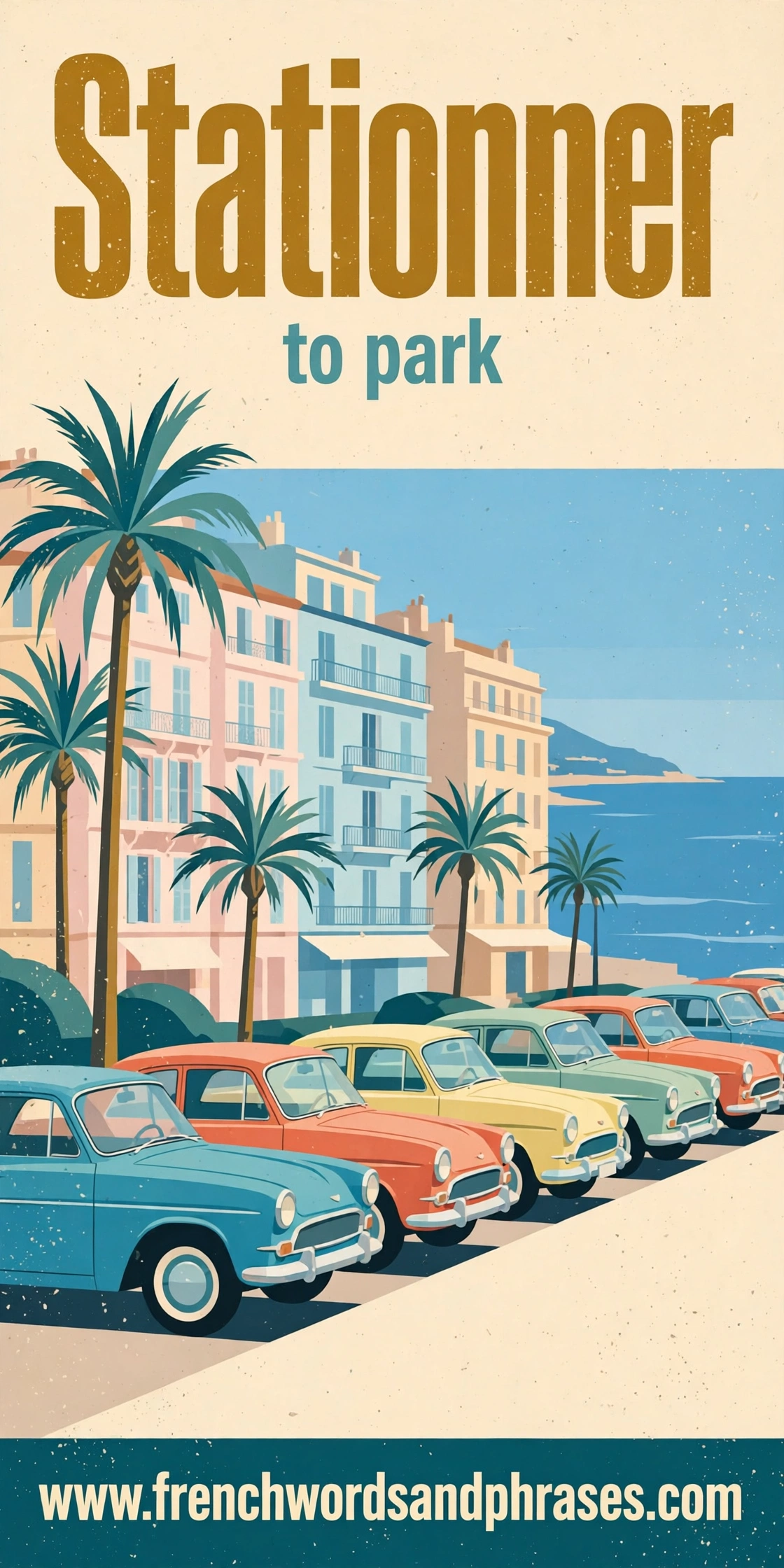
A French Word to Live By
How to Conjugate Stationner in French
/sta.sjɔ.ne/
Stationner means to park, to stop, or to stand in one place.
A car at the kerb, a bus waiting at the station, soldiers posted on a square — everything that waits in one place is stationner. It is the verb of pausing, of staying put for a while.
In this guide, you’ll learn how to conjugate stationner in all the major French tenses and moods. Explore complete conjugation tables, French examples, English translations, and practice quizzes.
Understanding the French Verb Stationner
Stationner is a regular French verb belonging to the first group of verbs, those ending in -er.
It means to park, to stop, or to stand (in one place). It is commonly used for vehicles parked along a street — défense de stationner (no parking) — and for people or troops based in one place. In familiar French it can also take a direct object: stationner sa voiture (to park one’s car).
Verb classification: First group (-er)
Auxiliary verb: Avoir or être, depending on the construction
Past participle: stationné
Present participle: stationnant
English equivalents: To park, to stop, to stand, to be stationed.
One important detail: stationner usually takes avoir — les voitures ont stationné longtemps (the cars parked there for a long time). With être it marks the state that results — les voitures sont stationnées depuis longtemps (the cars have been parked there for a long time) — a use Littré accepts, though some grammarians criticise it. Watch out: une voiture stationnée is often just an adjective, ‘a parked car’, not a compound tense at all. The tables on this page use avoir, the auxiliary of everyday French.
Experience the Word
Stationner is the verb of waiting in place — the car at the kerb, the bus at the stop, the long pause before the journey resumes.
Imagine a market morning in a small town. Cars line the square, a delivery van waits by the bakery, and a sign on the corner reads défense de stationner — no parking, though everyone has parked anyway.
You have not just stopped. You have stayed put — for a while.
How to Conjugate Stationner: Complete French Conjugation Guide
Let’s explore every major conjugation of stationner, beginning with the indicative mood.
How to Conjugate Stationner in the Indicative Mood
The indicative mood is used to express facts, observations, actions, and events.
How to Conjugate Stationner in the Present Tense (Présent)
Used for actions happening now, habitual actions, and general truths.
| Subject | Conjugation |
|---|---|
| je | stationne |
| tu | stationnes |
| il / elle | stationne |
| nous | stationnons |
| vous | stationnez |
| ils / elles | stationnent |
Example
Les voitures stationnent le long du trottoir.
The cars are parked along the pavement.
Quick Quiz 1
Complete the sentence:
Les voitures ______ le long du trottoir.
Reveal the answer
stationnent
Les voitures stationnent le long du trottoir.
The cars are parked along the pavement.
How to Conjugate Stationner in the Passé Composé
Used for completed actions in the past. Stationner takes the auxiliary verb avoir or être, depending on the construction.
| Subject | Conjugation |
|---|---|
| j’ | ai stationné |
| tu | as stationné |
| il / elle | a stationné |
| nous | avons stationné |
| vous | avez stationné |
| ils / elles | ont stationné |
Example
Le bus a stationné dix minutes devant la gare.
The bus stopped for ten minutes in front of the station.
How to Conjugate Stationner in the Imparfait (Imperfect Tense)
Used for habitual past actions, descriptions, and ongoing situations in the past.
| Subject | Conjugation |
|---|---|
| je | stationnais |
| tu | stationnais |
| il / elle | stationnait |
| nous | stationnions |
| vous | stationniez |
| ils / elles | stationnaient |
Example
Le camion stationnait chaque matin devant la boulangerie.
The lorry used to park every morning in front of the bakery.
Quick Quiz 2
Choose the correct form:
We parked near the market.
Nous ______ près du marché. (avons stationné / sommes stationnés)
Reveal the answer
avons stationné
Nous avons stationné près du marché.
Stationner marks the action of parking, so it takes avoir in everyday French.
How to Conjugate Stationner in the Plus-que-parfait
Used to describe an action that had already been completed before another past event.
| Subject | Conjugation |
|---|---|
| j’ | avais stationné |
| tu | avais stationné |
| il / elle | avait stationné |
| nous | avions stationné |
| vous | aviez stationné |
| ils / elles | avaient stationné |
Example
La voiture avait stationné toute la nuit sous les arbres.
The car had been parked all night under the trees.
How to Conjugate Stationner in the Passé Simple
Primarily used in formal writing, literature, and historical narratives. It is rarely used in everyday conversation.
| Subject | Conjugation |
|---|---|
| je | stationnai |
| tu | stationnas |
| il / elle | stationna |
| nous | stationnâmes |
| vous | stationnâtes |
| ils / elles | stationnèrent |
Example
Le régiment stationna deux jours dans la vallée.
The regiment stopped for two days in the valley.
How to Conjugate Stationner in the Passé Antérieur
A literary tense used to express an action completed immediately before another past action, generally in the passé simple.
| Subject | Conjugation |
|---|---|
| j’ | eus stationné |
| tu | eus stationné |
| il / elle | eut stationné |
| nous | eûmes stationné |
| vous | eûtes stationné |
| ils / elles | eurent stationné |
Example
Dès qu’il eut stationné, le conducteur coupa le moteur.
As soon as he had parked, the driver switched off the engine.
How to Conjugate Stationner in the Future Tense (Futur Simple)
Used to describe actions that will take place in the future.
| Subject | Conjugation |
|---|---|
| je | stationnerai |
| tu | stationneras |
| il / elle | stationnera |
| nous | stationnerons |
| vous | stationnerez |
| ils / elles | stationneront |
Example
Nous stationnerons près de la plage.
We will park near the beach.
How to Conjugate Stationner in the Futur Antérieur (Future Perfect)
Used for an action that will have been completed before a particular point in the future.
| Subject | Conjugation |
|---|---|
| j’ | aurai stationné |
| tu | auras stationné |
| il / elle | aura stationné |
| nous | aurons stationné |
| vous | aurez stationné |
| ils / elles | auront stationné |
Example
À midi, le car aura stationné depuis trois heures.
By noon, the coach will have been parked for three hours.
How to Conjugate Stationner in the Near Future (Futur Proche)
Used to describe something that is going to happen soon. Formed with aller + infinitive.
| Subject | Conjugation |
|---|---|
| je | vais stationner |
| tu | vas stationner |
| il / elle | va stationner |
| nous | allons stationner |
| vous | allez stationner |
| ils / elles | vont stationner |
Example
Je vais stationner juste devant la pharmacie.
I am going to park right in front of the chemist’s.
How to Conjugate Stationner in the Conditional Mood
The conditional mood expresses what would happen under certain circumstances. It is also frequently used to make polite requests or express wishes.
How to Conjugate Stationner in the Present Conditional
| Subject | Conjugation |
|---|---|
| je | stationnerais |
| tu | stationnerais |
| il / elle | stationnerait |
| nous | stationnerions |
| vous | stationneriez |
| ils / elles | stationneraient |
Example
Le bus stationnerait ici s’il n’y avait pas d’interdiction.
The bus would park here if there were no ban.
How to Conjugate Stationner in the Past Conditional
| Subject | Conjugation |
|---|---|
| j’ | aurais stationné |
| tu | aurais stationné |
| il / elle | aurait stationné |
| nous | aurions stationné |
| vous | auriez stationné |
| ils / elles | auraient stationné |
Example
Il aurait stationné plus près s’il avait pu.
He would have parked closer if he had been able to.
Stationner in the Literary Past Conditional Form
This less common literary form uses the imperfect subjunctive of avoir or être, depending on the construction.
| Subject | Conjugation |
|---|---|
| j’ | eusse stationné |
| tu | eusses stationné |
| il / elle | eût stationné |
| nous | eussions stationné |
| vous | eussiez stationné |
| ils / elles | eussent stationné |
Example
Le régiment eût stationné plus longtemps si l’ordre était arrivé.
The regiment would have stopped longer if the order had arrived.
How to Conjugate Stationner in the Subjunctive Mood
The subjunctive is used to express wishes, emotions, doubts, necessity, and uncertainty. It frequently follows expressions such as il faut que (it is necessary that) or bien que (although).
How to Conjugate Stationner in the Present Subjunctive
| Subject | Conjugation |
|---|---|
| que je | stationne |
| que tu | stationnes |
| qu’il / qu’elle | stationne |
| que nous | stationnions |
| que vous | stationniez |
| qu’ils / qu’elles | stationnent |
Example
Il faut que tu stationnes ailleurs.
You need to park elsewhere.
Quick Quiz 3
Complete the sentence using the subjunctive:
Il faut que tu ______ ailleurs.
Reveal the answer
stationnes
Il faut que tu stationnes ailleurs.
You need to park elsewhere.
How to Conjugate Stationner in the Imperfect Subjunctive
A literary tense, rarely encountered in modern spoken French.
| Subject | Conjugation |
|---|---|
| que je | stationnasse |
| que tu | stationnasses |
| qu’il / qu’elle | stationnât |
| que nous | stationnassions |
| que vous | stationnassiez |
| qu’ils / qu’elles | stationnassent |
Example
Il voulait que le bus stationnât devant l’école.
He wanted the bus to stop in front of the school.
How to Conjugate Stationner in the Pluperfect Subjunctive
A literary construction used to express an action completed before another past action.
| Subject | Conjugation |
|---|---|
| que j’ | eusse stationné |
| que tu | eusses stationné |
| qu’il / qu’elle | eût stationné |
| que nous | eussions stationné |
| que vous | eussiez stationné |
| qu’ils / qu’elles | eussent stationné |
Example
Il doutait que le camion eût stationné ici.
He doubted that the lorry had parked here.
How to Conjugate Stationner in the Past Subjunctive
| Subject | Conjugation |
|---|---|
| que j’ | aie stationné |
| que tu | aies stationné |
| qu’il / qu’elle | ait stationné |
| que nous | ayons stationné |
| que vous | ayez stationné |
| qu’ils / qu’elles | aient stationné |
Example
Je suis content que tu aies stationné à l’ombre.
I am glad you parked in the shade.
How to Conjugate Stationner in the Imperative
The imperative is used to give commands, instructions, invitations, or suggestions. Subject pronouns are omitted.
How to Conjugate Stationner in the Present Imperative
| Person | Conjugation |
|---|---|
| (tu) | stationne |
| (nous) | stationnons |
| (vous) | stationnez |
Example
Stationne ici, c’est autorisé !
Park here, it is allowed!
Quick Quiz 4
How would you say Park here, using the tu form?
Reveal the answer
Stationne ici !
French Participles of Stationner
Participles are verb forms that can be used in compound tenses and other grammatical constructions.
Present Participle of Stationner
stationnant
En stationnant en double file, il bloquait la rue.
By parking in a double row, he was blocking the street.
Past Participle of Stationner
stationné
Les voitures sont stationnées depuis longtemps le long de la rue.
The cars have been parked along the street for a long time.
Stationner in Everyday French: Real-Life Examples
Now that you know the conjugations, let’s see how stationner appears in everyday French.
Example 1 — Present
Défense de stationner devant la grille.
No parking in front of the gate.
Example 2 — Passé composé — avoir
Nous avons stationné près du marché.
We parked near the market.
Example 3 — Passé composé — être
Une caravane est stationnée dans notre rue depuis une semaine.
A caravan has been parked in our street for a week.
Example 4 — Imparfait
Les soldats stationnaient dans la cour du château.
The soldiers were stationed in the castle courtyard.
Example 5 — Future
Vous stationnerez dans le parking souterrain.
You will park in the underground car park.
Example 6 — Conditional
Je stationnerais ici si c’était permis.
I would park here if it were allowed.
Beyond Translation: The Meaning of Stationner
English says ‘park’ where French says stationner, but the French verb is wider: it is any staying in one place — a car, a bus, a regiment. And it hides a small trap: une voiture stationnée is usually an adjective, ‘a parked car’, not a compound tense.
And stationner keeps the old action-state split.
With avoir you tell the act of stopping — les voitures ont stationné longtemps; with être you tell the state that followed — les voitures sont stationnées depuis longtemps. Modern French uses avoir for the verb itself and keeps être for the adjective.
How to Remember the French Verb Stationner
Remember it this way: Stationner is about parking and stopping in one place — avoir for the act, être for the state that follows.
- You park or stop somewhere — nous avons stationné: auxiliary avoir.
- You describe a car that has been there a while with être — les voitures sont stationnées depuis longtemps.
- Une voiture stationnée is an adjective, ‘a parked car’ — not a compound tense.
The key idea is parking and stopping in one place — avoir for the act, être for the state that follows.
Test Your Knowledge of Stationner
Let’s see how much you’ve learned. Try answering these questions before revealing the answers.
Question 1
When does stationner take être, and when does it take avoir?
Reveal the answer
Avoir for the action of parking or stopping — les voitures ont stationné longtemps. Être for the state that results — les voitures sont stationnées depuis longtemps.
Question 2
How do you say We will park near the beach in French?
Reveal the answer
Nous stationnerons près de la plage.
Question 3
Translate: The bus stopped for ten minutes in front of the station.
Reveal the answer
Le bus a stationné dix minutes devant la gare.
Question 4
What is the past participle of stationner?
Reveal the answer
Stationné.
Question 5
Complete the sentence:
Il faut que tu ______ ailleurs.
Reveal the answer
stationnes
Il faut que tu stationnes ailleurs.
You need to park elsewhere.
Your Final Challenge
Can You Use It?
How would you say this in French?
We parked the car in the shade, then set off on foot towards the market.
Reveal the answer
Nous avons stationné la voiture à l’ombre, puis nous sommes partis à pied vers le marché.
We parked the car in the shade, then set off on foot towards the market.
A little French. A little curiosity. A richer everyday life.
LEARN FRENCH ONE WORD AT A TIME




