
A French Word to Live By
How to Conjugate Empirer in French
/ɑ̃.pi.ʁe/
Empirer means to get worse, or to make worse.
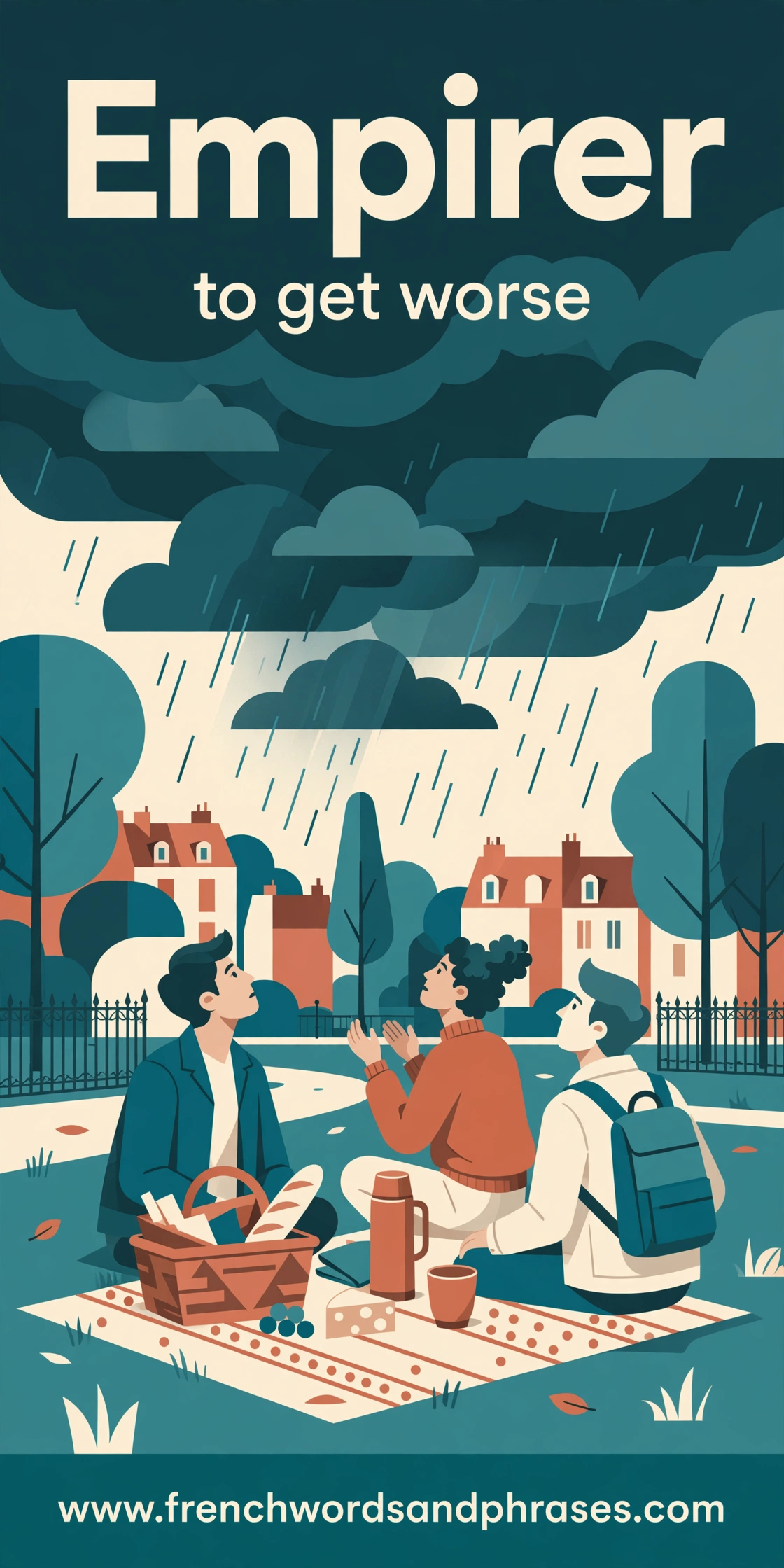
A cough that will not go away, rain that gets heavier hour by hour, a small problem left alone until it is a big one — empirer is the verb of things sliding downhill.
In this guide, you’ll learn how to conjugate empirer in all the major French tenses and moods. Explore complete conjugation tables, French examples, English translations, and practice quizzes.
Understanding the French Verb Empirer
Empirer is a regular French verb belonging to the first group of verbs, those ending in -er.
It means to get worse, or to make worse. It is commonly used for health, weather, situations and problems that deteriorate, and transitively for making a bad situation worse.
Verb classification: First group (-er)
Auxiliary verb: Avoir or être, depending on the construction
Past participle: empiré
Present participle: empirant
English equivalents: To get worse, to worsen, to make worse.
One important detail: empirer normally takes avoir, whether it means getting worse or making something worse: la situation a empiré (the situation got worse), tu as empiré les choses (you made things worse). In older, literary French you may meet être for the resulting state — tout est empiré, everything is worse — but modern French overwhelmingly uses avoir, and the tables on this page do the same.
Experience the Word
Empirer is the verb nobody wants to hear from a doctor, a mechanic or a weather forecast — the slope that only goes one way.
Imagine a small leak above a kitchen ceiling. In March it is a faint brown ring. Nobody calls the plumber. By June the ring is a stain, by September the plaster is soft, and one morning it gives way.
The leak did not stay small. Left alone, it got worse.
How to Conjugate Empirer: Complete French Conjugation Guide
Let’s explore every major conjugation of empirer, beginning with the indicative mood.
How to Conjugate Empirer in the Indicative Mood
The indicative mood is used to express facts, observations, actions, and events.
How to Conjugate Empirer in the Present Tense (Présent)
Used for actions happening now, habitual actions, and general truths.
| Subject | Conjugation |
|---|---|
| je | empire |
| tu | empires |
| il / elle | empire |
| nous | empirons |
| vous | empirez |
| ils / elles | empirent |
Example
Son état empire de jour en jour.
His condition is getting worse day by day.
Quick Quiz 1
Complete the sentence:
Les choses ______ depuis son départ.
Reveal the answer
empirent
Les choses empirent depuis son départ.
Things have been getting worse since he left.
How to Conjugate Empirer in the Passé Composé
Used for completed actions in the past. Empirer takes the auxiliary verb avoir or être, depending on the construction.
| Subject | Conjugation |
|---|---|
| j’ | ai empiré |
| tu | as empiré |
| il / elle | a empiré |
| nous | avons empiré |
| vous | avez empiré |
| ils / elles | ont empiré |
Example
La situation a empiré après la réunion.
The situation got worse after the meeting.
How to Conjugate Empirer in the Imparfait (Imperfect Tense)
Used for habitual past actions, descriptions, and ongoing situations in the past.
| Subject | Conjugation |
|---|---|
| je | empirais |
| tu | empirais |
| il / elle | empirait |
| nous | empirions |
| vous | empiriez |
| ils / elles | empiraient |
Example
Le temps empirait d’heure en heure.
The weather was getting worse by the hour.
Quick Quiz 2
Choose the correct form:
His cough got worse this week.
Sa toux ______ cette semaine. (a empiré / est empirée)
Reveal the answer
a empiré
Sa toux a empiré cette semaine.
Modern French uses avoir with empirer; est empirée is a literary state description.
How to Conjugate Empirer in the Plus-que-parfait
Used to describe an action that had already been completed before another past event.
| Subject | Conjugation |
|---|---|
| j’ | avais empiré |
| tu | avais empiré |
| il / elle | avait empiré |
| nous | avions empiré |
| vous | aviez empiré |
| ils / elles | avaient empiré |
Example
Le bruit avait empiré avant les travaux.
The noise had got worse before the works.
How to Conjugate Empirer in the Passé Simple
Primarily used in formal writing, literature, and historical narratives. It is rarely used in everyday conversation.
| Subject | Conjugation |
|---|---|
| je | empirai |
| tu | empiras |
| il / elle | empira |
| nous | empirâmes |
| vous | empirâtes |
| ils / elles | empirèrent |
Example
La fièvre empira pendant la nuit.
The fever got worse during the night.
How to Conjugate Empirer in the Passé Antérieur
A literary tense used to express an action completed immediately before another past action, generally in the passé simple.
| Subject | Conjugation |
|---|---|
| j’ | eus empiré |
| tu | eus empiré |
| il / elle | eut empiré |
| nous | eûmes empiré |
| vous | eûtes empiré |
| ils / elles | eurent empiré |
Example
Dès que la pluie eut empiré, ils rentrèrent.
As soon as the rain had got worse, they went back inside.
How to Conjugate Empirer in the Future Tense (Futur Simple)
Used to describe actions that will take place in the future.
| Subject | Conjugation |
|---|---|
| je | empirerai |
| tu | empireras |
| il / elle | empirera |
| nous | empirerons |
| vous | empirerez |
| ils / elles | empireront |
Example
Sans traitement, la maladie empirera.
Without treatment, the illness will get worse.
How to Conjugate Empirer in the Futur Antérieur (Future Perfect)
Used for an action that will have been completed before a particular point in the future.
| Subject | Conjugation |
|---|---|
| j’ | aurai empiré |
| tu | auras empiré |
| il / elle | aura empiré |
| nous | aurons empiré |
| vous | aurez empiré |
| ils / elles | auront empiré |
Example
À ce rythme, les choses auront empiré avant l’hiver.
At this rate, things will have got worse before winter.
How to Conjugate Empirer in the Near Future (Futur Proche)
Used to describe something that is going to happen soon. Formed with aller + infinitive.
| Subject | Conjugation |
|---|---|
| je | vais empirer |
| tu | vas empirer |
| il / elle | va empirer |
| nous | allons empirer |
| vous | allez empirer |
| ils / elles | vont empirer |
Example
Attention, le vent va empirer.
Careful, the wind is going to get worse.
How to Conjugate Empirer in the Conditional Mood
The conditional mood expresses what would happen under certain circumstances. It is also frequently used to make polite requests or express wishes.
How to Conjugate Empirer in the Present Conditional
| Subject | Conjugation |
|---|---|
| je | empirerais |
| tu | empirerais |
| il / elle | empirerait |
| nous | empirerions |
| vous | empireriez |
| ils / elles | empireraient |
Example
La situation empirerait sans votre aide.
The situation would get worse without your help.
How to Conjugate Empirer in the Past Conditional
| Subject | Conjugation |
|---|---|
| j’ | aurais empiré |
| tu | aurais empiré |
| il / elle | aurait empiré |
| nous | aurions empiré |
| vous | auriez empiré |
| ils / elles | auraient empiré |
Example
Tout aurait empiré sans l’arrivée des pompiers.
Everything would have got worse without the firefighters’ arrival.
Empirer in the Literary Past Conditional Form
This less common literary form uses the imperfect subjunctive of avoir or être, depending on the construction.
| Subject | Conjugation |
|---|---|
| j’ | eusse empiré |
| tu | eusses empiré |
| il / elle | eût empiré |
| nous | eussions empiré |
| vous | eussiez empiré |
| ils / elles | eussent empiré |
Example
Il eût empiré davantage si personne n’était intervenu.
It would have got even worse if nobody had intervened.
How to Conjugate Empirer in the Subjunctive Mood
The subjunctive is used to express wishes, emotions, doubts, necessity, and uncertainty. It frequently follows expressions such as il faut que (it is necessary that) or bien que (although).
How to Conjugate Empirer in the Present Subjunctive
| Subject | Conjugation |
|---|---|
| que je | empire |
| que tu | empires |
| qu’il / qu’elle | empire |
| que nous | empirions |
| que vous | empiriez |
| qu’ils / qu’elles | empirent |
Example
Je crains que son état empire.
I am afraid his condition will get worse.
Quick Quiz 3
Complete the sentence using the subjunctive:
Je crains que le temps ______ demain.
Reveal the answer
empire
Je crains que le temps empire demain.
I am afraid the weather will get worse tomorrow.
How to Conjugate Empirer in the Imperfect Subjunctive
A literary tense, rarely encountered in modern spoken French.
| Subject | Conjugation |
|---|---|
| que je | empirasse |
| que tu | empirasses |
| qu’il / qu’elle | empirât |
| que nous | empirassions |
| que vous | empirassiez |
| qu’ils / qu’elles | empirassent |
Example
Elle ne voulait pas que la dispute empirât.
She did not want the argument to get worse.
How to Conjugate Empirer in the Pluperfect Subjunctive
A literary construction used to express an action completed before another past action.
| Subject | Conjugation |
|---|---|
| que j’ | eusse empiré |
| que tu | eusses empiré |
| qu’il / qu’elle | eût empiré |
| que nous | eussions empiré |
| que vous | eussiez empiré |
| qu’ils / qu’elles | eussent empiré |
Example
Il regrettait que les choses eussent empiré si vite.
He regretted that things had got worse so quickly.
How to Conjugate Empirer in the Past Subjunctive
| Subject | Conjugation |
|---|---|
| que j’ | aie empiré |
| que tu | aies empiré |
| qu’il / qu’elle | ait empiré |
| que nous | ayons empiré |
| que vous | ayez empiré |
| qu’ils / qu’elles | aient empiré |
Example
Je suis désolé que la situation ait empiré.
I am sorry that the situation has got worse.
How to Conjugate Empirer in the Imperative
The imperative is used to give commands, instructions, invitations, or suggestions. Subject pronouns are omitted.
How to Conjugate Empirer in the Present Imperative
| Person | Conjugation |
|---|---|
| (tu) | empire |
| (nous) | empirons |
| (vous) | empirez |
Example
N’empire pas les choses !
Don’t make things worse!
Quick Quiz 4
How would you say Don’t make things worse! using the tu form?
Reveal the answer
N’empire pas les choses !
French Participles of Empirer
Participles are verb forms that can be used in compound tenses and other grammatical constructions.
Present Participle of Empirer
empirant
En empirant, la tempête a fermé le port.
As it got worse, the storm closed the port.
Past Participle of Empirer
empiré
En quelques jours, tout est empiré.
Within a few days, everything had got worse.
Empirer in Everyday French: Real-Life Examples
Now that you know the conjugations, let’s see how empirer appears in everyday French.
Example 1 — Present
Le trafic empire à cette heure-ci.
The traffic gets worse at this time of day.
Example 2 — Passé composé — avoir
Sa toux a empiré cette semaine.
His cough got worse this week.
Example 3 — Passé composé — être
Après la tempête, tout est empiré.
After the storm, everything is worse.
Example 4 — Imparfait
La douleur empirait le soir.
The pain got worse in the evening.
Example 5 — Future
Sans réparations, le toit empirera.
Without repairs, the roof will get worse.
Example 6 — Conditional
Tu empirerais les choses en parlant.
You would make things worse by speaking.
Beyond Translation: The Meaning of Empirer
English says get worse or worsen. French empirer is built on pire, ‘worse’ — the comparative is hiding inside the verb itself.
The modern rule is simple.
Empirer takes avoir, for getting worse and for making worse alike — la situation a empiré, tu as empiré les choses. The être you may find in old novels is the literary way of freezing the result: everything is worse now.
How to Remember the French Verb Empirer
Remember it this way: Empirer is about getting worse — avoir in modern French, être only in literary state descriptions.
- Things slide downhill — la situation a empiré: modern French uses avoir.
- You can make things worse too — tu as empiré les choses, still avoir.
- In an old novel, tout est empiré describes the finished state with être.
The key idea is getting worse — avoir in modern French, être only in literary state descriptions.
Test Your Knowledge of Empirer
Let’s see how much you’ve learned. Try answering these questions before revealing the answers.
Question 1
Which auxiliary does empirer use in modern French — and where might you see être?
Reveal the answer
Avoir — la situation a empiré. Être appears only in older, literary French for the resulting state: tout est empiré.
Question 2
How do you say the weather will get worse in French?
Reveal the answer
Le temps empirera.
Question 3
Translate: The situation got worse.
Reveal the answer
La situation a empiré.
Question 4
What is the past participle of empirer?
Reveal the answer
Empiré.
Question 5
Complete the sentence:
Si nous ne faisions rien, le problème ______.
Reveal the answer
empirerait
Si nous ne faisions rien, le problème empirerait.
If we did nothing, the problem would get worse.
Your Final Challenge
Can You Use It?
How would you say this in French?
Without help, the situation got worse in a week.
Reveal the answer
Sans aide, la situation a empiré en une semaine.
Without help, the situation got worse in a week.
A little French. A little curiosity. A richer everyday life.
LEARN FRENCH ONE WORD AT A TIME




