A French Word to Live By
How to Conjugate Enlaidir in French
/ɑ̃.lɛ.diʁ/
Enlaidir means to make ugly, or to become ugly.
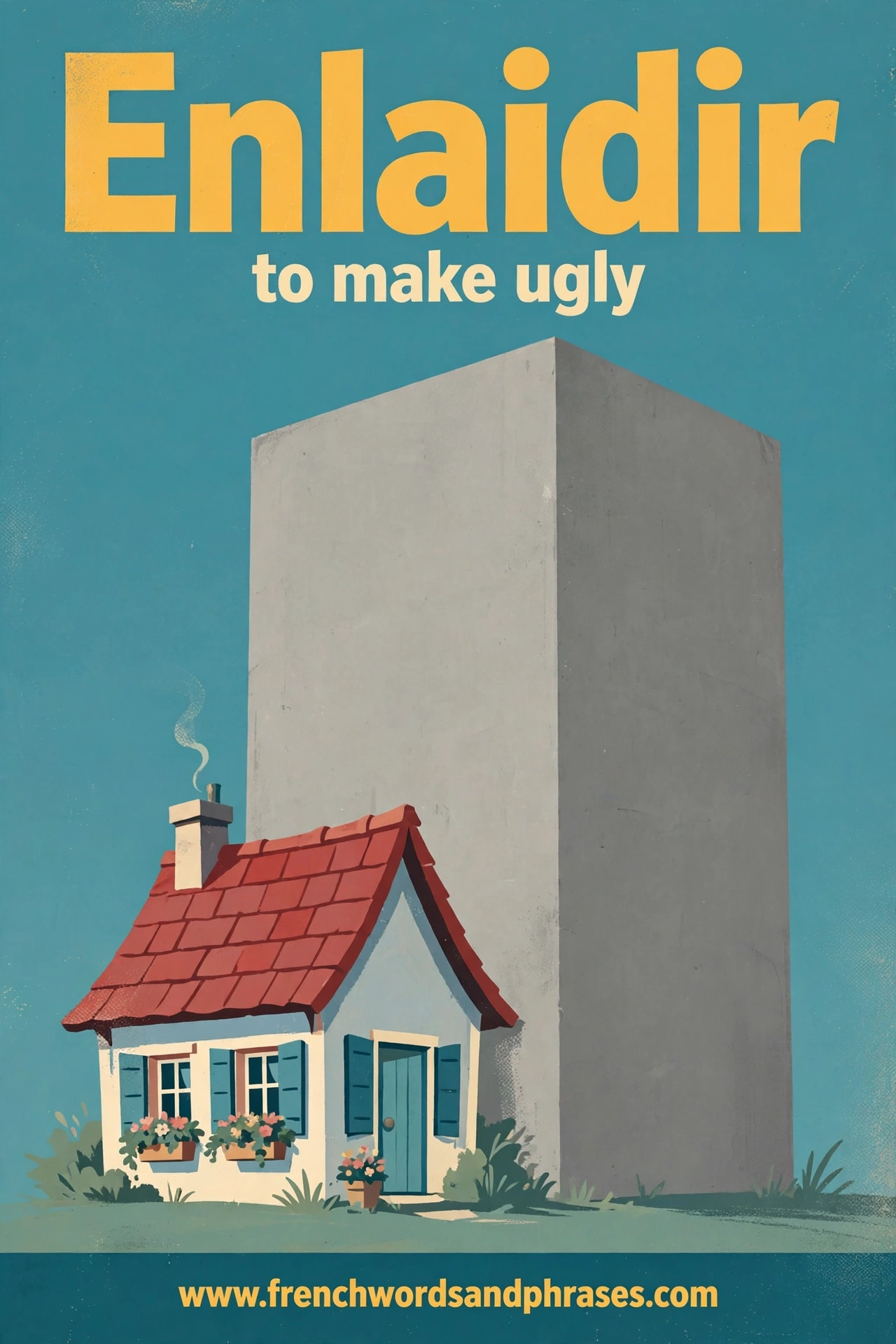
A new tower blocks the view, a poster covers the old wall, and the pretty street is not pretty any more. Making something ugly — or watching it lose its looks — is enlaidir.
In this guide, you’ll learn how to conjugate enlaidir in all the major French tenses and moods. Explore complete conjugation tables, French examples, English translations, and practice quizzes.
Understanding the French Verb Enlaidir
Enlaidir is a regular French verb belonging to the second group of verbs, those ending in -ir.
It means to make ugly, or to become ugly. It is commonly used for a building, a street or a room that is made ugly, and for a place or a person losing its looks over time.
Verb classification: Second group (-ir)
Auxiliary verb: Avoir or être, depending on the construction
Past participle: enlaidi
Present participle: enlaidissant
English equivalents: To make ugly, to become ugly.
One important detail: enlaidir works with two auxiliary verbs. When it has a direct object — making something ugly — it takes avoir: le chantier a enlaidi la rue (the building site made the street ugly). When it means becoming ugly with no object, modern French also uses avoir: le quartier a enlaidi (the neighbourhood has become uglier). Être survives in older and literary use, to describe the resulting state — la maison est enlaidie (the house stands made ugly) — where the participle behaves almost like an adjective. The tables on this page use avoir, the auxiliary of modern French.
Experience the Word
Enlaidir is the ugly twin of embellir — the verb that takes the beauty away.
Imagine a village square where someone paints the old fountain bright orange. The square was pretty yesterday; today it hurts the eyes, and everyone walking past feels the change.
You have not just painted a wall. You have made a place ugly — and everyone can see it.
How to Conjugate Enlaidir: Complete French Conjugation Guide
Let’s explore every major conjugation of enlaidir, beginning with the indicative mood.
How to Conjugate Enlaidir in the Indicative Mood
The indicative mood is used to express facts, observations, actions, and events.
How to Conjugate Enlaidir in the Present Tense (Présent)
Used for actions happening now, habitual actions, and general truths.
| Subject | Conjugation |
|---|---|
| je | enlaidis |
| tu | enlaidis |
| il / elle | enlaidit |
| nous | enlaidissons |
| vous | enlaidissez |
| ils / elles | enlaidissent |
Example
Cette affiche enlaidit la rue.
This poster makes the street ugly.
Quick Quiz 1
Complete the sentence:
Nous ______ le parc avec ce panneau.
Reveal the answer
enlaidissons
Nous enlaidissons le parc avec ce panneau.
We are making the park ugly with this sign.
How to Conjugate Enlaidir in the Passé Composé
Used for completed actions in the past. Enlaidir takes the auxiliary verb avoir or être, depending on the construction.
| Subject | Conjugation |
|---|---|
| j’ | ai enlaidi |
| tu | as enlaidi |
| il / elle | a enlaidi |
| nous | avons enlaidi |
| vous | avez enlaidi |
| ils / elles | ont enlaidi |
Example
La vieille usine a enlaidi le quartier.
The old factory made the neighbourhood ugly.
How to Conjugate Enlaidir in the Imparfait (Imperfect Tense)
Used for habitual past actions, descriptions, and ongoing situations in the past.
| Subject | Conjugation |
|---|---|
| je | enlaidissais |
| tu | enlaidissais |
| il / elle | enlaidissait |
| nous | enlaidissions |
| vous | enlaidissiez |
| ils / elles | enlaidissaient |
Example
La rue enlaidissait d’année en année.
The street was getting uglier year by year.
Quick Quiz 2
Choose the correct form:
The neighbourhood has become ugly.
Le quartier ______ . (a enlaidi / est enlaidi)
Reveal the answer
a enlaidi
Le quartier a enlaidi.
In modern French, the change takes avoir; être belongs to the older state form.
How to Conjugate Enlaidir in the Plus-que-parfait
Used to describe an action that had already been completed before another past event.
| Subject | Conjugation |
|---|---|
| j’ | avais enlaidi |
| tu | avais enlaidi |
| il / elle | avait enlaidi |
| nous | avions enlaidi |
| vous | aviez enlaidi |
| ils / elles | avaient enlaidi |
Example
Le village avait enlaidi depuis la construction de la route.
The village had become uglier since the road was built.
How to Conjugate Enlaidir in the Passé Simple
Primarily used in formal writing, literature, and historical narratives. It is rarely used in everyday conversation.
| Subject | Conjugation |
|---|---|
| je | enlaidis |
| tu | enlaidis |
| il / elle | enlaidit |
| nous | enlaidîmes |
| vous | enlaidîtes |
| ils / elles | enlaidirent |
Example
L’incendie enlaidit la maison pour toujours.
The fire made the house ugly for good.
How to Conjugate Enlaidir in the Passé Antérieur
A literary tense used to express an action completed immediately before another past action, generally in the passé simple.
| Subject | Conjugation |
|---|---|
| j’ | eus enlaidi |
| tu | eus enlaidi |
| il / elle | eut enlaidi |
| nous | eûmes enlaidi |
| vous | eûtes enlaidi |
| ils / elles | eurent enlaidi |
Example
Dès qu’il eut enlaidi la façade, il voulut tout refaire.
As soon as he had made the facade ugly, he wanted to redo everything.
How to Conjugate Enlaidir in the Future Tense (Futur Simple)
Used to describe actions that will take place in the future.
| Subject | Conjugation |
|---|---|
| je | enlaidirai |
| tu | enlaidiras |
| il / elle | enlaidira |
| nous | enlaidirons |
| vous | enlaidirez |
| ils / elles | enlaidiront |
Example
Si on construit cette tour, elle enlaidira la ville.
If they build this tower, it will make the town ugly.
How to Conjugate Enlaidir in the Futur Antérieur (Future Perfect)
Used for an action that will have been completed before a particular point in the future.
| Subject | Conjugation |
|---|---|
| j’ | aurai enlaidi |
| tu | auras enlaidi |
| il / elle | aura enlaidi |
| nous | aurons enlaidi |
| vous | aurez enlaidi |
| ils / elles | auront enlaidi |
Example
Dans dix ans, le chantier aura enlaidi tout le paysage.
In ten years, the building site will have made the whole landscape ugly.
How to Conjugate Enlaidir in the Near Future (Futur Proche)
Used to describe something that is going to happen soon. Formed with aller + infinitive.
| Subject | Conjugation |
|---|---|
| je | vais enlaidir |
| tu | vas enlaidir |
| il / elle | va enlaidir |
| nous | allons enlaidir |
| vous | allez enlaidir |
| ils / elles | vont enlaidir |
Example
Il va enlaidir sa chambre avec ces posters.
He is going to make his bedroom ugly with those posters.
How to Conjugate Enlaidir in the Conditional Mood
The conditional mood expresses what would happen under certain circumstances. It is also frequently used to make polite requests or express wishes.
How to Conjugate Enlaidir in the Present Conditional
| Subject | Conjugation |
|---|---|
| je | enlaidirais |
| tu | enlaidirais |
| il / elle | enlaidirait |
| nous | enlaidirions |
| vous | enlaidiriez |
| ils / elles | enlaidiraient |
Example
Sans les arbres, ce parc enlaidirait vite.
Without the trees, this park would quickly become ugly.
How to Conjugate Enlaidir in the Past Conditional
| Subject | Conjugation |
|---|---|
| j’ | aurais enlaidi |
| tu | aurais enlaidi |
| il / elle | aurait enlaidi |
| nous | aurions enlaidi |
| vous | auriez enlaidi |
| ils / elles | auraient enlaidi |
Example
J’aurais enlaidi le salon avec ce tapis.
I would have made the living room ugly with that rug.
Enlaidir in the Literary Past Conditional Form
This less common literary form uses the imperfect subjunctive of avoir or être, depending on the construction.
| Subject | Conjugation |
|---|---|
| j’ | eusse enlaidi |
| tu | eusses enlaidi |
| il / elle | eût enlaidi |
| nous | eussions enlaidi |
| vous | eussiez enlaidi |
| ils / elles | eussent enlaidi |
Example
Elle eût enlaidi le tableau si elle avait continué.
She would have made the painting ugly if she had continued.
How to Conjugate Enlaidir in the Subjunctive Mood
The subjunctive is used to express wishes, emotions, doubts, necessity, and uncertainty. It frequently follows expressions such as il faut que (it is necessary that) or bien que (although).
How to Conjugate Enlaidir in the Present Subjunctive
| Subject | Conjugation |
|---|---|
| que je | enlaidisse |
| que tu | enlaidisses |
| qu’il / qu’elle | enlaidisse |
| que nous | enlaidissions |
| que vous | enlaidissiez |
| qu’ils / qu’elles | enlaidissent |
Example
Il faut que ce projet n’enlaidisse pas le village.
The project must not make the village ugly.
Quick Quiz 3
Complete the sentence using the subjunctive:
Il faut que le chantier n’______ pas la rue.
Reveal the answer
enlaidisse
Il faut que le chantier n’enlaidisse pas la rue.
The building site must not make the street ugly.
How to Conjugate Enlaidir in the Imperfect Subjunctive
A literary tense, rarely encountered in modern spoken French.
| Subject | Conjugation |
|---|---|
| que je | enlaidisse |
| que tu | enlaidisses |
| qu’il / qu’elle | enlaidît |
| que nous | enlaidissions |
| que vous | enlaidissiez |
| qu’ils / qu’elles | enlaidissent |
Example
Il voulait que la maison n’enlaidît pas le paysage.
He wanted the house not to make the landscape ugly.
How to Conjugate Enlaidir in the Pluperfect Subjunctive
A literary construction used to express an action completed before another past action.
| Subject | Conjugation |
|---|---|
| que j’ | eusse enlaidi |
| que tu | eusses enlaidi |
| qu’il / qu’elle | eût enlaidi |
| que nous | eussions enlaidi |
| que vous | eussiez enlaidi |
| qu’ils / qu’elles | eussent enlaidi |
Example
Il regrettait que le chantier eût enlaidi la colline.
He regretted that the building site had made the hill ugly.
How to Conjugate Enlaidir in the Past Subjunctive
| Subject | Conjugation |
|---|---|
| que j’ | aie enlaidi |
| que tu | aies enlaidi |
| qu’il / qu’elle | ait enlaidi |
| que nous | ayons enlaidi |
| que vous | ayez enlaidi |
| qu’ils / qu’elles | aient enlaidi |
Example
Je suis triste que le temps ait enlaidi cette belle maison.
I am sad that time has made this beautiful house ugly.
How to Conjugate Enlaidir in the Imperative
The imperative is used to give commands, instructions, invitations, or suggestions. Subject pronouns are omitted.
How to Conjugate Enlaidir in the Present Imperative
| Person | Conjugation |
|---|---|
| (tu) | enlaidis |
| (nous) | enlaidissons |
| (vous) | enlaidissez |
Example
N’enlaidis pas la chambre avec ces affiches !
Don’t make the bedroom ugly with those posters!
Quick Quiz 4
How would you say Don’t make the garden ugly, using the tu form?
Reveal the answer
N’enlaidis pas le jardin !
French Participles of Enlaidir
Participles are verb forms that can be used in compound tenses and other grammatical constructions.
Present Participle of Enlaidir
enlaidissant
En enlaidissant la rue, le chantier a fait fuir les touristes.
By making the street ugly, the building site drove the tourists away.
Past Participle of Enlaidir
enlaidi
La maison est enlaidie depuis la construction du garage.
The house has been made ugly since the garage was built.
Enlaidir in Everyday French: Real-Life Examples
Now that you know the conjugations, let’s see how enlaidir appears in everyday French.
Example 1 — Present
Ce panneau enlaidit le jardin.
That sign makes the garden ugly.
Example 2 — Passé composé — avoir
Le chantier a enlaidi toute la rue.
The building site made the whole street ugly.
Example 3 — Passé composé — être (older use)
La vieille maison est enlaidie par la pluie.
The old house is made ugly by the rain.
Example 4 — Imparfait
Le quartier enlaidissait peu à peu.
The neighbourhood was getting uglier little by little.
Example 5 — Future
Sans soin, le jardin enlaidira vite.
Without care, the garden will quickly become ugly.
Example 6 — Conditional
Elle enlaidirait sa chambre avec ces rideaux.
She would make her bedroom ugly with those curtains.
Beyond Translation: The Meaning of Enlaidir
English has to choose between ‘make ugly’ and ‘become ugly’; French lets enlaidir do both jobs with one word. It is the mirror image of embellir, its beautiful twin: one adds beauty, the other takes it away.
And enlaidir carries a quiet lesson about French auxiliaries.
The change itself — becoming ugly — takes avoir in modern French: le quartier a enlaidi. Only the finished state, the ugliness already in place, still takes être in older French: la maison est enlaidie. Watch whether the verb is doing something or describing a state, and the auxiliary follows.
How to Remember the French Verb Enlaidir
Remember it this way: Enlaidir is about making something ugly — or becoming ugly, with avoir in modern French.
- You make something ugly, with a direct object — le chantier a enlaidi la rue: auxiliary avoir.
- Something becomes ugly on its own — le quartier a enlaidi: modern French still uses avoir.
- Only the finished state, in older French, takes être — la maison est enlaidie.
The key idea is making something ugly — or becoming ugly, with avoir in modern French.
Test Your Knowledge of Enlaidir
Let’s see how much you’ve learned. Try answering these questions before revealing the answers.
Question 1
When does enlaidir take être?
Reveal the answer
Only in older or literary use, to describe the resulting state — la maison est enlaidie. In modern French the change takes avoir: le quartier a enlaidi.
Question 2
How do you say It will make the town ugly in French?
Reveal the answer
Elle enlaidira la ville.
Question 3
Translate: The building site made the street ugly.
Reveal the answer
Le chantier a enlaidi la rue.
Question 4
What is the past participle of enlaidir?
Reveal the answer
Enlaidi.
Question 5
Complete the sentence:
Si tu construis ce mur, tu ______ la cour.
Reveal the answer
enlaidiras
Si tu construis ce mur, tu enlaidiras la cour.
If you build this wall, you will make the courtyard ugly.
Your Final Challenge
Can You Use It?
How would you say this in French?
This tower would make the whole village ugly.
Reveal the answer
Cette tour enlaidirait tout le village.
This tower would make the whole village ugly.
A little French. A little curiosity. A richer everyday life.
LEARN FRENCH ONE WORD AT A TIME