A French Word to Live By
How to Conjugate Dégeler in French
/de.ʒə.le/
Dégeler means to thaw (out), to defrost, or to unfreeze.
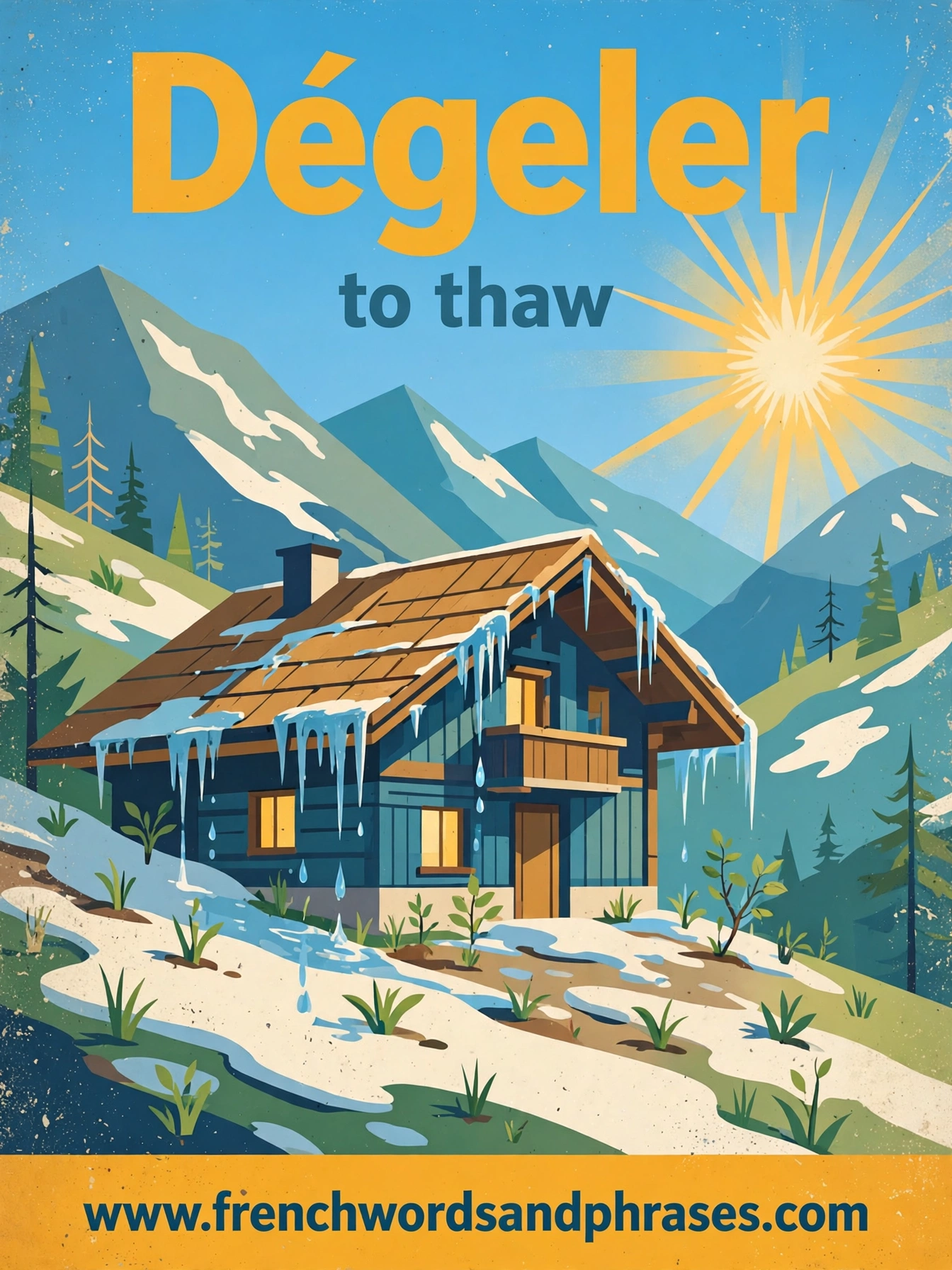
Winter loosens its grip. The river starts moving again, the windscreen clears, the frozen pipes wake up. In French, that slow return to liquid life is dégeler.
In this guide, you’ll learn how to conjugate dégeler in all the major French tenses and moods. Explore complete conjugation tables, French examples, English translations, and practice quizzes.
Understanding the French Verb Dégeler
Dégeler is a regular French verb belonging to the first group of verbs, those ending in -er.
It means to thaw (out), to defrost, or to unfreeze. It is commonly used for ice and snow melting, for frozen pipes and windscreens thawing, and — with a direct object — for defrosting food or unfreezing something.
Verb classification: First group (-er)
Auxiliary verb: Avoir or être, depending on the construction
Past participle: dégelé
Present participle: dégelant
English equivalents: To thaw (out), to defrost, to unfreeze.
One important detail: dégeler is a spelling-change -eler verb — the e before the l becomes è when the next syllable is silent: je dégèle, nous dégelons, ils dégèlent, and je dégèlerai in the future. It also works with two auxiliary verbs. In everyday French it takes avoir — for the action of thawing and for defrosting something: la rivière a dégelé, j’ai dégelé le pare-brise. The auxiliary être appears when the finished state is in view: les tuyaux sont dégelés (the pipes are thawed out). The tables on this page use avoir, the everyday auxiliary.
Experience the Word
Dégeler is the verb of the first mild day — when the world stops being hard and starts moving again.
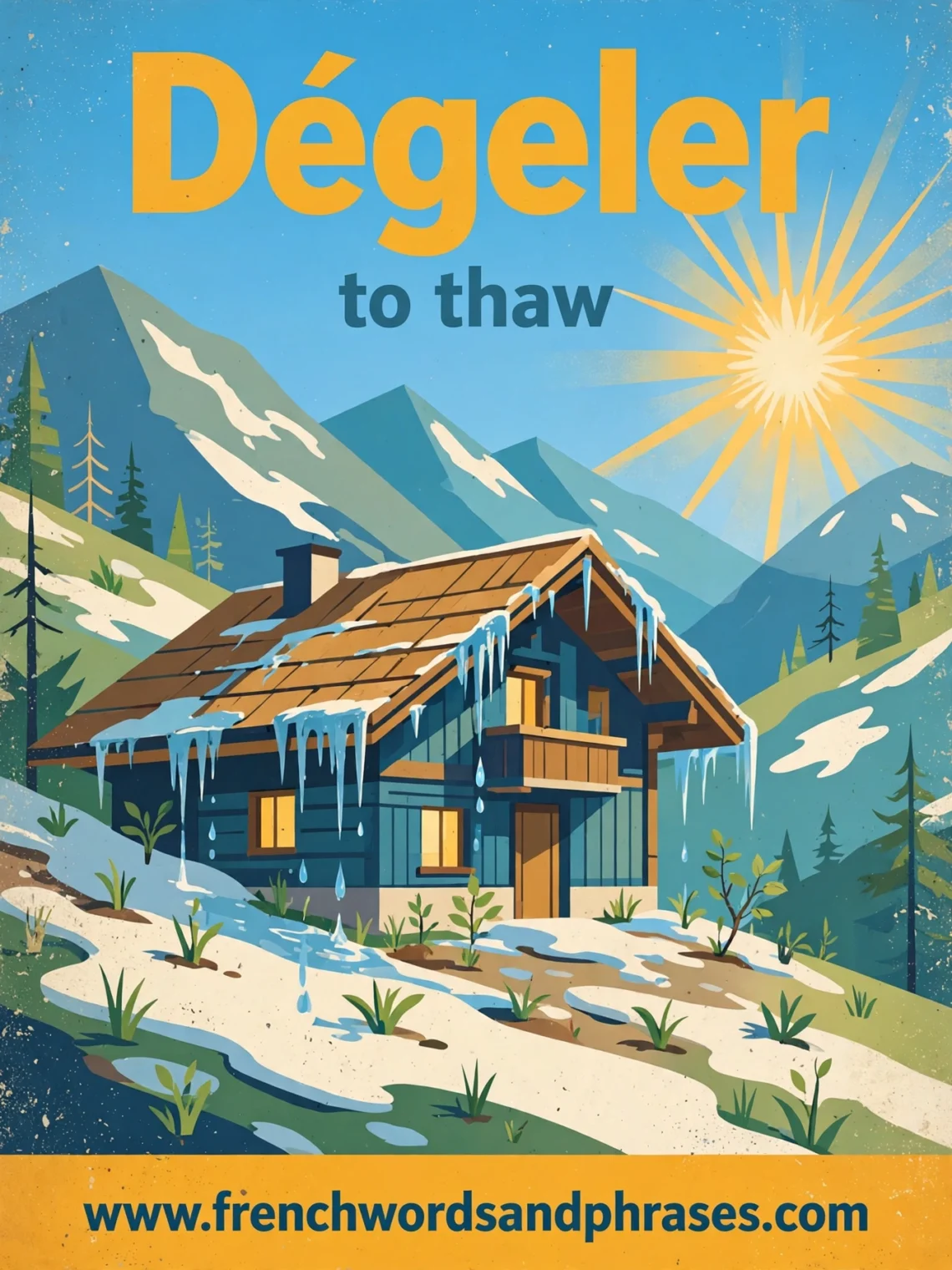
Imagine a February morning in the mountains. The sun climbs over the ridge, the ice on the windowsill begins to drip, and by noon the river is running free again.
Nothing has been added. Something frozen has simply come back to life.
How to Conjugate Dégeler: Complete French Conjugation Guide
Let’s explore every major conjugation of dégeler, beginning with the indicative mood.
How to Conjugate Dégeler in the Indicative Mood
The indicative mood is used to express facts, observations, actions, and events.
How to Conjugate Dégeler in the Present Tense (Présent)
Used for actions happening now, habitual actions, and general truths.
| Subject | Conjugation |
|---|---|
| je | dégèle |
| tu | dégèles |
| il / elle | dégèle |
| nous | dégelons |
| vous | dégelez |
| ils / elles | dégèlent |
Example
Le soleil dégèle la neige sur le toit.
The sun is thawing the snow on the roof.
Quick Quiz 1
Complete the sentence:
Nous ______ le congélateur ce week-end.
Reveal the answer
dégelons
Nous dégelons le congélateur ce week-end.
We are defrosting the freezer this weekend.
How to Conjugate Dégeler in the Passé Composé
Used for completed actions in the past. Dégeler takes the auxiliary verb avoir or être, depending on the construction.
| Subject | Conjugation |
|---|---|
| j’ | ai dégelé |
| tu | as dégelé |
| il / elle | a dégelé |
| nous | avons dégelé |
| vous | avez dégelé |
| ils / elles | ont dégelé |
Example
La rivière a dégelé pendant la nuit.
The river thawed during the night.
How to Conjugate Dégeler in the Imparfait (Imperfect Tense)
Used for habitual past actions, descriptions, and ongoing situations in the past.
| Subject | Conjugation |
|---|---|
| je | dégelais |
| tu | dégelais |
| il / elle | dégelait |
| nous | dégelions |
| vous | dégeliez |
| ils / elles | dégelaient |
Example
En mars, la neige dégelait chaque après-midi.
In March, the snow thawed every afternoon.
Quick Quiz 2
Choose the correct form:
The pipes have thawed out.
Les tuyaux ______ . (ont dégelé / sont dégelés)
Reveal the answer
sont dégelés
Les tuyaux sont dégelés.
Here the finished state is in view, so dégeler takes être — and dégelés agrees with les tuyaux.
How to Conjugate Dégeler in the Plus-que-parfait
Used to describe an action that had already been completed before another past event.
| Subject | Conjugation |
|---|---|
| j’ | avais dégelé |
| tu | avais dégelé |
| il / elle | avait dégelé |
| nous | avions dégelé |
| vous | aviez dégelé |
| ils / elles | avaient dégelé |
Example
Le pare-brise avait déjà dégelé quand je suis parti.
The windscreen had already thawed when I left.
How to Conjugate Dégeler in the Passé Simple
Primarily used in formal writing, literature, and historical narratives. It is rarely used in everyday conversation.
| Subject | Conjugation |
|---|---|
| je | dégelai |
| tu | dégelas |
| il / elle | dégela |
| nous | dégelâmes |
| vous | dégelâtes |
| ils / elles | dégelèrent |
Example
Le vent du sud dégela la rivière en une journée.
The south wind thawed the river in a single day.
How to Conjugate Dégeler in the Passé Antérieur
A literary tense used to express an action completed immediately before another past action, generally in the passé simple.
| Subject | Conjugation |
|---|---|
| j’ | eus dégelé |
| tu | eus dégelé |
| il / elle | eut dégelé |
| nous | eûmes dégelé |
| vous | eûtes dégelé |
| ils / elles | eurent dégelé |
Example
Dès qu’il eut dégelé le congélateur, il rangea les courses.
As soon as he had defrosted the freezer, he put the shopping away.
How to Conjugate Dégeler in the Future Tense (Futur Simple)
Used to describe actions that will take place in the future.
| Subject | Conjugation |
|---|---|
| je | dégèlerai |
| tu | dégèleras |
| il / elle | dégèlera |
| nous | dégèlerons |
| vous | dégèlerez |
| ils / elles | dégèleront |
Example
Demain, la neige dégèlera sous le soleil.
Tomorrow, the snow will thaw in the sun.
How to Conjugate Dégeler in the Futur Antérieur (Future Perfect)
Used for an action that will have been completed before a particular point in the future.
| Subject | Conjugation |
|---|---|
| j’ | aurai dégelé |
| tu | auras dégelé |
| il / elle | aura dégelé |
| nous | aurons dégelé |
| vous | aurez dégelé |
| ils / elles | auront dégelé |
Example
À midi, le soleil aura dégelé le chemin.
By noon, the sun will have thawed the path.
How to Conjugate Dégeler in the Near Future (Futur Proche)
Used to describe something that is going to happen soon. Formed with aller + infinitive.
| Subject | Conjugation |
|---|---|
| je | vais dégeler |
| tu | vas dégeler |
| il / elle | va dégeler |
| nous | allons dégeler |
| vous | allez dégeler |
| ils / elles | vont dégeler |
Example
Je vais dégeler le pain pour le petit déjeuner.
I am going to defrost the bread for breakfast.
How to Conjugate Dégeler in the Conditional Mood
The conditional mood expresses what would happen under certain circumstances. It is also frequently used to make polite requests or express wishes.
How to Conjugate Dégeler in the Present Conditional
| Subject | Conjugation |
|---|---|
| je | dégèlerais |
| tu | dégèlerais |
| il / elle | dégèlerait |
| nous | dégèlerions |
| vous | dégèleriez |
| ils / elles | dégèleraient |
Example
Le lac dégèlerait plus vite avec un peu de soleil.
The lake would thaw faster with a bit of sun.
How to Conjugate Dégeler in the Past Conditional
| Subject | Conjugation |
|---|---|
| j’ | aurais dégelé |
| tu | aurais dégelé |
| il / elle | aurait dégelé |
| nous | aurions dégelé |
| vous | auriez dégelé |
| ils / elles | auraient dégelé |
Example
J’aurais dégelé le pare-brise si j’avais eu le temps.
I would have defrosted the windscreen if I had had the time.
Dégeler in the Literary Past Conditional Form
This less common literary form uses the imperfect subjunctive of avoir or être, depending on the construction.
| Subject | Conjugation |
|---|---|
| j’ | eusse dégelé |
| tu | eusses dégelé |
| il / elle | eût dégelé |
| nous | eussions dégelé |
| vous | eussiez dégelé |
| ils / elles | eussent dégelé |
Example
Il eût dégelé les tuyaux avant la nuit s’il avait pu.
He would have thawed the pipes before nightfall if he had been able to.
How to Conjugate Dégeler in the Subjunctive Mood
The subjunctive is used to express wishes, emotions, doubts, necessity, and uncertainty. It frequently follows expressions such as il faut que (it is necessary that) or bien que (although).
How to Conjugate Dégeler in the Present Subjunctive
| Subject | Conjugation |
|---|---|
| que je | dégèle |
| que tu | dégèles |
| qu’il / qu’elle | dégèle |
| que nous | dégelions |
| que vous | dégeliez |
| qu’ils / qu’elles | dégèlent |
Example
Il faut que le congélateur dégèle avant ce soir.
The freezer needs to thaw before tonight.
Quick Quiz 3
Complete the sentence using the subjunctive:
Il faut que le congélateur ______ avant ce soir.
Reveal the answer
dégèle
Il faut que le congélateur dégèle avant ce soir.
The freezer needs to thaw before tonight.
How to Conjugate Dégeler in the Imperfect Subjunctive
A literary tense, rarely encountered in modern spoken French.
| Subject | Conjugation |
|---|---|
| que je | dégelasse |
| que tu | dégelasses |
| qu’il / qu’elle | dégelât |
| que nous | dégelassions |
| que vous | dégelassiez |
| qu’ils / qu’elles | dégelassent |
Example
Il souhaitait que la rivière dégelât plus tôt.
He wished the river would thaw earlier.
How to Conjugate Dégeler in the Pluperfect Subjunctive
A literary construction used to express an action completed before another past action.
| Subject | Conjugation |
|---|---|
| que j’ | eusse dégelé |
| que tu | eusses dégelé |
| qu’il / qu’elle | eût dégelé |
| que nous | eussions dégelé |
| que vous | eussiez dégelé |
| qu’ils / qu’elles | eussent dégelé |
Example
Il regrettait que le lac n’eût pas dégelé avant le départ.
He regretted that the lake had not thawed before departure.
How to Conjugate Dégeler in the Past Subjunctive
| Subject | Conjugation |
|---|---|
| que j’ | aie dégelé |
| que tu | aies dégelé |
| qu’il / qu’elle | ait dégelé |
| que nous | ayons dégelé |
| que vous | ayez dégelé |
| qu’ils / qu’elles | aient dégelé |
Example
Je suis content que le pare-brise ait dégelé.
I am glad the windscreen has thawed.
How to Conjugate Dégeler in the Imperative
The imperative is used to give commands, instructions, invitations, or suggestions. Subject pronouns are omitted.
How to Conjugate Dégeler in the Present Imperative
| Person | Conjugation |
|---|---|
| (tu) | dégèle |
| (nous) | dégelons |
| (vous) | dégelez |
Example
Dégèle le pain avant le dîner !
Defrost the bread before dinner!
Quick Quiz 4
How would you say Defrost the bread, using the tu form?
Reveal the answer
Dégèle le pain !
French Participles of Dégeler
Participles are verb forms that can be used in compound tenses and other grammatical constructions.
Present Participle of Dégeler
dégelant
En dégelant, la neige forme des flaques sur le trottoir.
As it thaws, the snow forms puddles on the pavement.
Past Participle of Dégeler
dégelé
Ce matin, les tuyaux sont dégelés.
This morning, the pipes are thawed out.
Dégeler in Everyday French: Real-Life Examples
Now that you know the conjugations, let’s see how dégeler appears in everyday French.
Example 1 — Present
Le soleil dégèle la neige.
The sun is thawing the snow.
Example 2 — Passé composé — avoir
La rivière a dégelé en une nuit.
The river thawed in a single night.
Example 3 — Passé composé — être
Les tuyaux sont dégelés depuis ce matin.
The pipes have been thawed out since this morning.
Example 4 — Imparfait
La neige dégelait doucement au soleil.
The snow was thawing gently in the sun.
Example 5 — Future
Le lac dégèlera en avril.
The lake will thaw in April.
Example 6 — Conditional
Je dégèlerais le congélateur ce week-end.
I would defrost the freezer this weekend.
Beyond Translation: The Meaning of Dégeler
English splits the work between thaw, defrost and unfreeze, but French keeps one verb for all of it — dégeler covers the river, the windscreen and the loaf of bread alike.
And it keeps its little spelling secret.
Watch the è appear and disappear: je dégèle, but nous dégelons. The accent is the only thing that changes — the meaning stays exactly the same.
How to Remember the French Verb Dégeler
Remember it this way: Dégeler is about thawing — avoir for the action, être for the finished state.
- You watch the ice turn back to water — la rivière dégèle: the accent moves to è in je dégèle.
- You tell the story of what thawed — la rivière a dégelé: auxiliary avoir for the action.
- You describe the finished state — les tuyaux sont dégelés: auxiliary être, and the participle agrees.
The key idea is thawing — avoir for the action, être for the finished state.
Test Your Knowledge of Dégeler
Let’s see how much you’ve learned. Try answering these questions before revealing the answers.
Question 1
When does dégeler take avoir, and when does it take être?
Reveal the answer
Avoir for the action of thawing and for defrosting something — la rivière a dégelé, j’ai dégelé le pare-brise. Être when the finished state is in view — les tuyaux sont dégelés.
Question 2
How do you say I will thaw in French?
Reveal the answer
Je dégèlerai.
Question 3
Translate: The river thawed during the night.
Reveal the answer
La rivière a dégelé pendant la nuit.
Question 4
What is the present participle of dégeler?
Reveal the answer
Dégelant.
Question 5
Complete the sentence:
En mars, la neige ______ chaque après-midi.
Reveal the answer
dégelait
En mars, la neige dégelait chaque après-midi.
In March, the snow thawed every afternoon.
Your Final Challenge
Can You Use It?
How would you say this in French?
Tomorrow, the sun will thaw the snow on the roof.
Reveal the answer
Demain, le soleil dégèlera la neige sur le toit.
Tomorrow, the sun will thaw the snow on the roof.
A little French. A little curiosity. A richer everyday life.
LEARN FRENCH ONE WORD AT A TIME