
A French Word to Live By
How to Conjugate Décroître in French
/de.kʁwatʁ/
Décroître means to decrease, to diminish, or to wane.
A river sinking after the flood, a fever easing in the night, the days shortening as autumn comes — some things grow, and some things quietly become less. In French, that becoming-less is décroître.
In this guide, you’ll learn how to conjugate décroître in all the major French tenses and moods. Explore complete conjugation tables, French examples, English translations, and practice quizzes.
Understanding the French Verb Décroître
Décroître is an irregular French verb belonging to the third group of verbs, those ending in -oître.
It means to decrease, to diminish, or to wane. It is the verb of falling water (its noun, la décrue, is the official word for a river going down after a flood), of fevers dropping, of the moon waning — la lune décroissante — and of the days shortening in autumn.
Verb classification: Third group (irregular -oître verb)
Auxiliary verb: Avoir or être, depending on the construction
Past participle: décru
Present participle: décroissant
English equivalents: To decrease, to diminish, to decline, to wane, to go down.
One important detail: décroître is conjugated with avoir in modern French — la rivière a décru cette nuit (the river went down in the night). Older French also used être to stress the resulting state — la rivière est décrue — but the dictionaries are blunt about it: that construction is hardly in use any more. The tables on this page use avoir. And watch the spelling: the past participle décru takes no circumflex, unlike crû from croître.
Experience the Word
Décroître is the quiet opposite of growing — the verb of things gently becoming less, without drama and without noise.
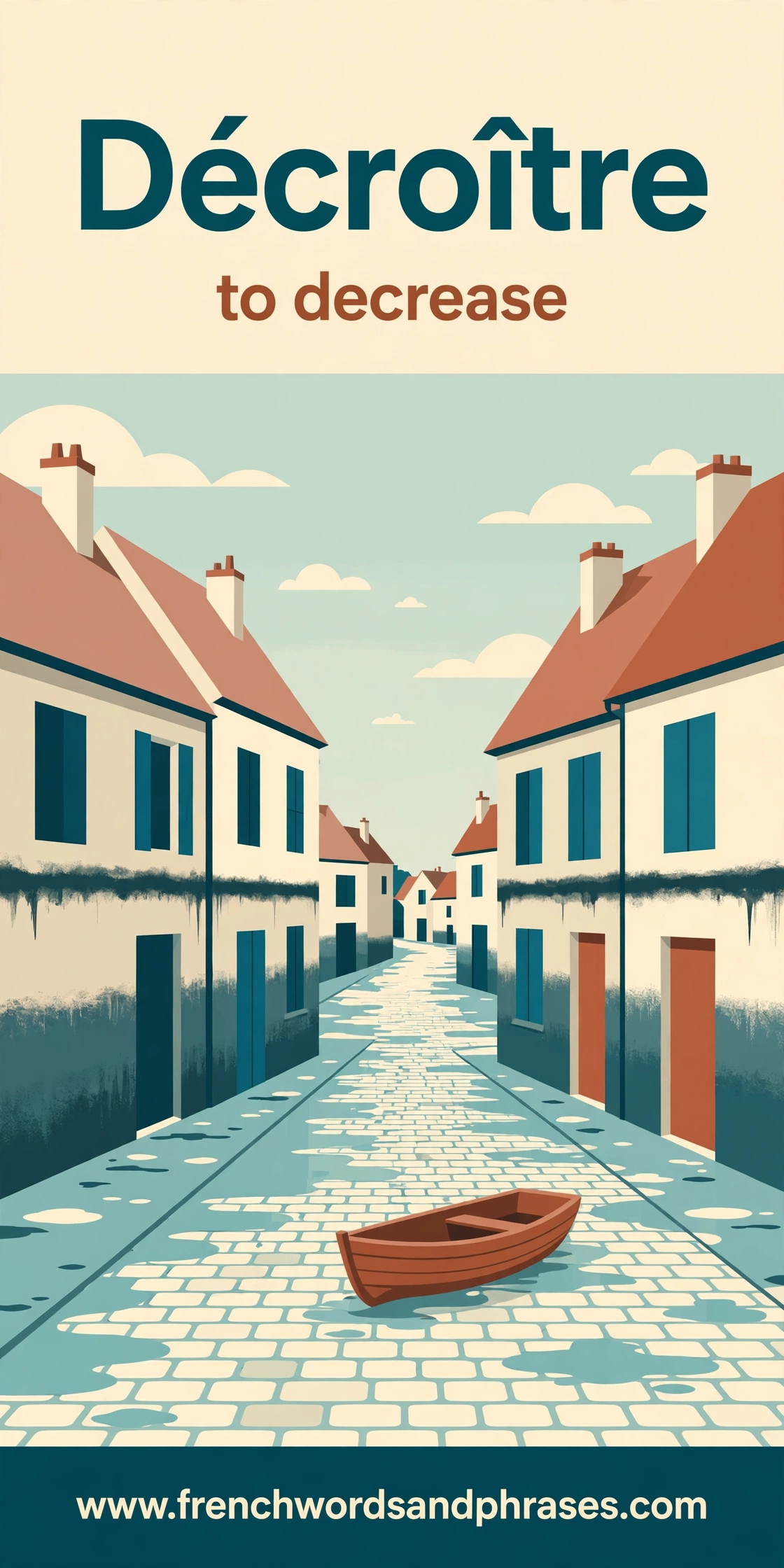
Imagine a flooded river in late spring. The water has covered the towpath for a week; then one morning a stone step appears, then another, and the ducks reclaim their bank.
Nothing was taken away. The river simply went down, on its own.
How to Conjugate Décroître: Complete French Conjugation Guide
Let’s explore every major conjugation of décroître, beginning with the indicative mood.
How to Conjugate Décroître in the Indicative Mood
The indicative mood is used to express facts, observations, actions, and events.
How to Conjugate Décroître in the Present Tense (Présent)
Used for actions happening now, habitual actions, and general truths.
| Subject | Conjugation |
|---|---|
| je | décrois |
| tu | décrois |
| il / elle | décroît |
| nous | décroissons |
| vous | décroissez |
| ils / elles | décroissent |
Example
En automne, les jours décroissent.
In autumn, the days grow shorter.
Quick Quiz 1
Complete the sentence:
La lune ______ après la pleine lune.
Reveal the answer
décroît
La lune décroît après la pleine lune.
The moon wanes after the full moon.
How to Conjugate Décroître in the Passé Composé
Used for completed actions in the past. Décroître takes the auxiliary verb avoir or être, depending on the construction.
| Subject | Conjugation |
|---|---|
| j’ | ai décru |
| tu | as décru |
| il / elle | a décru |
| nous | avons décru |
| vous | avez décru |
| ils / elles | ont décru |
Example
La rivière a décru pendant la nuit.
The river went down during the night.
How to Conjugate Décroître in the Imparfait (Imperfect Tense)
Used for habitual past actions, descriptions, and ongoing situations in the past.
| Subject | Conjugation |
|---|---|
| je | décroissais |
| tu | décroissais |
| il / elle | décroissait |
| nous | décroissions |
| vous | décroissiez |
| ils / elles | décroissaient |
Example
La fièvre décroissait lentement.
The fever was slowly dropping.
Quick Quiz 2
Choose the correct form:
The river went down during the night.
La rivière ______ pendant la nuit. (a décru / est décrue)
Reveal the answer
a décru
La rivière a décru pendant la nuit.
Modern French conjugates décroître with avoir; est décrue is the old form for the resulting state and is hardly used today.
How to Conjugate Décroître in the Plus-que-parfait
Used to describe an action that had already been completed before another past event.
| Subject | Conjugation |
|---|---|
| j’ | avais décru |
| tu | avais décru |
| il / elle | avait décru |
| nous | avions décru |
| vous | aviez décru |
| ils / elles | avaient décru |
Example
Les eaux avaient décru quand nous sommes revenus.
The waters had gone down when we came back.
How to Conjugate Décroître in the Passé Simple
Primarily used in formal writing, literature, and historical narratives. It is rarely used in everyday conversation.
| Subject | Conjugation |
|---|---|
| je | décrus |
| tu | décrus |
| il / elle | décrut |
| nous | décrûmes |
| vous | décrûtes |
| ils / elles | décrurent |
Example
Le bruit décrut peu à peu dans la salle.
The noise gradually died down in the room.
How to Conjugate Décroître in the Passé Antérieur
A literary tense used to express an action completed immediately before another past action, generally in the passé simple.
| Subject | Conjugation |
|---|---|
| j’ | eus décru |
| tu | eus décru |
| il / elle | eut décru |
| nous | eûmes décru |
| vous | eûtes décru |
| ils / elles | eurent décru |
Example
Dès que la fièvre eut décru, l’enfant se rendormit.
As soon as the fever had dropped, the child fell back asleep.
How to Conjugate Décroître in the Future Tense (Futur Simple)
Used to describe actions that will take place in the future.
| Subject | Conjugation |
|---|---|
| je | décroîtrai |
| tu | décroîtras |
| il / elle | décroîtra |
| nous | décroîtrons |
| vous | décroîtrez |
| ils / elles | décroîtront |
Example
Avec le froid, la rivière décroîtra encore.
With the cold, the river will go down further.
How to Conjugate Décroître in the Futur Antérieur (Future Perfect)
Used for an action that will have been completed before a particular point in the future.
| Subject | Conjugation |
|---|---|
| j’ | aurai décru |
| tu | auras décru |
| il / elle | aura décru |
| nous | aurons décru |
| vous | aurez décru |
| ils / elles | auront décru |
Example
Demain, les eaux auront décru d’un mètre.
Tomorrow, the waters will have gone down by a metre.
How to Conjugate Décroître in the Near Future (Futur Proche)
Used to describe something that is going to happen soon. Formed with aller + infinitive.
| Subject | Conjugation |
|---|---|
| je | vais décroître |
| tu | vas décroître |
| il / elle | va décroître |
| nous | allons décroître |
| vous | allez décroître |
| ils / elles | vont décroître |
Example
La fièvre va décroître, ne t’inquiète pas.
The fever is going to drop, do not worry.
How to Conjugate Décroître in the Conditional Mood
The conditional mood expresses what would happen under certain circumstances. It is also frequently used to make polite requests or express wishes.
How to Conjugate Décroître in the Present Conditional
| Subject | Conjugation |
|---|---|
| je | décroîtrais |
| tu | décroîtrais |
| il / elle | décroîtrait |
| nous | décroîtrions |
| vous | décroîtriez |
| ils / elles | décroîtraient |
Example
Sans pluie, le niveau décroîtrait plus vite.
Without rain, the level would fall faster.
How to Conjugate Décroître in the Past Conditional
| Subject | Conjugation |
|---|---|
| j’ | aurais décru |
| tu | aurais décru |
| il / elle | aurait décru |
| nous | aurions décru |
| vous | auriez décru |
| ils / elles | auraient décru |
Example
La fièvre aurait décru plus tôt avec ce médicament.
The fever would have dropped sooner with this medicine.
Décroître in the Literary Past Conditional Form
This less common literary form uses the imperfect subjunctive of avoir or être, depending on the construction.
| Subject | Conjugation |
|---|---|
| j’ | eusse décru |
| tu | eusses décru |
| il / elle | eût décru |
| nous | eussions décru |
| vous | eussiez décru |
| ils / elles | eussent décru |
Example
Le vent eût décru avant la nuit si l’orage était passé.
The wind would have died down before night if the storm had passed.
How to Conjugate Décroître in the Subjunctive Mood
The subjunctive is used to express wishes, emotions, doubts, necessity, and uncertainty. It frequently follows expressions such as il faut que (it is necessary that) or bien que (although).
How to Conjugate Décroître in the Present Subjunctive
| Subject | Conjugation |
|---|---|
| que je | décroisse |
| que tu | décroisses |
| qu’il / qu’elle | décroisse |
| que nous | décroissions |
| que vous | décroissiez |
| qu’ils / qu’elles | décroissent |
Example
Il faut que la fièvre décroisse avant demain.
The fever must drop before tomorrow.
Quick Quiz 3
Complete the sentence using the subjunctive:
Il faut que la fièvre ______ avant demain.
Reveal the answer
décroisse
Il faut que la fièvre décroisse avant demain.
The fever must drop before tomorrow.
How to Conjugate Décroître in the Imperfect Subjunctive
A literary tense, rarely encountered in modern spoken French.
| Subject | Conjugation |
|---|---|
| que je | décrusse |
| que tu | décrusses |
| qu’il / qu’elle | décrût |
| que nous | décrussions |
| que vous | décrussiez |
| qu’ils / qu’elles | décrussent |
Example
On attendait que les eaux décrussent avant de traverser.
We waited for the waters to go down before crossing.
How to Conjugate Décroître in the Pluperfect Subjunctive
A literary construction used to express an action completed before another past action.
| Subject | Conjugation |
|---|---|
| que j’ | eusse décru |
| que tu | eusses décru |
| qu’il / qu’elle | eût décru |
| que nous | eussions décru |
| que vous | eussiez décru |
| qu’ils / qu’elles | eussent décru |
Example
Il espérait que la fièvre eût décru avant le matin.
He hoped that the fever had dropped before morning.
How to Conjugate Décroître in the Past Subjunctive
| Subject | Conjugation |
|---|---|
| que j’ | aie décru |
| que tu | aies décru |
| qu’il / qu’elle | ait décru |
| que nous | ayons décru |
| que vous | ayez décru |
| qu’ils / qu’elles | aient décru |
Example
Je suis content que le bruit ait décru.
I am glad the noise has died down.
How to Conjugate Décroître in the Imperative
The imperative is used to give commands, instructions, invitations, or suggestions. Subject pronouns are omitted.
How to Conjugate Décroître in the Present Imperative
| Person | Conjugation |
|---|---|
| (tu) | décrois |
| (nous) | décroissons |
| (vous) | décroissez |
Example
Décrois vite, petite fièvre !
Drop quickly, little fever!
Quick Quiz 4
How would you say Wane, using the tu form, to the moon?
Reveal the answer
Décrois !
French Participles of Décroître
Participles are verb forms that can be used in compound tenses and other grammatical constructions.
Present Participle of Décroître
décroissant
En décroissant, la lune éclairait moins la vallée.
As it waned, the moon lit the valley less.
Past Participle of Décroître
décru
Depuis peu, la rivière est décrue.
The river has gone down recently.
Décroître in Everyday French: Real-Life Examples
Now that you know the conjugations, let’s see how décroître appears in everyday French.
Example 1 — Present
Ses forces décroissent de jour en jour.
His strength is diminishing day by day.
Example 2 — Passé composé — avoir
En novembre, les jours ont bien décru.
In November, the days have really shortened.
Example 3 — Passé composé — être (old-fashioned)
Les eaux sont décrues, on peut traverser.
The waters have gone down, we can cross.
Example 4 — Imparfait
Le vent décroissait à la tombée de la nuit.
The wind used to die down at nightfall.
Example 5 — Future
La fièvre décroîtra dès ce soir.
The fever will drop from this evening.
Example 6 — Conditional
Le bruit décroîtrait si la fenêtre était fermée.
The noise would diminish if the window were shut.
Beyond Translation: The Meaning of Décroître
English scatters this idea across decrease, diminish, wane and go down; French décroître gathers it into a single graceful verb, the mirror image of croître, to grow.
Décroître is the verb of the turning point.
The flood, the fever and the summer all reach their height and then, almost politely, begin to become less — les eaux ont décru, with avoir, as the dictionaries insist today; the eaux sont décrues of older books is a state portrait nobody paints any more.
How to Remember the French Verb Décroître
Remember it this way: Décroître is about dwindling down — avoir in today’s French; être décrue survives only in old books.
- Modern French uses avoir — la rivière a décru (the river went down).
- Être — la rivière est décrue — stressed the resulting state in older French and is now hardly used.
- Mind the participle: décru, with no circumflex — unlike crû.
The key idea is dwindling down — avoir in today’s French; être décrue survives only in old books.
Test Your Knowledge of Décroître
Let’s see how much you’ve learned. Try answering these questions before revealing the answers.
Question 1
When does décroître take avoir, and when was être used with it?
Reveal the answer
Avoir is the auxiliary of modern French — la rivière a décru. Être stressed the resulting state in older French — la rivière est décrue — but that construction is hardly in use any more.
Question 2
How do you say the fever will drop in French?
Reveal the answer
La fièvre décroîtra.
Question 3
Translate: The river went down during the night.
Reveal the answer
La rivière a décru pendant la nuit.
Question 4
What is the past participle of décroître?
Reveal the answer
Décru — with no circumflex.
Question 5
Complete the sentence:
En automne, les jours ______ peu à peu.
Reveal the answer
décroissent
En automne, les jours décroissent peu à peu.
In autumn, the days grow shorter little by little.
Your Final Challenge
Can You Use It?
How would you say this in French?
The fever dropped during the night.
Reveal the answer
La fièvre a décru pendant la nuit.
The fever dropped during the night.
A little French. A little curiosity. A richer everyday life.
LEARN FRENCH ONE WORD AT A TIME




