A French Word to Live By
How to Conjugate Crever in French
/kʁə.ve/
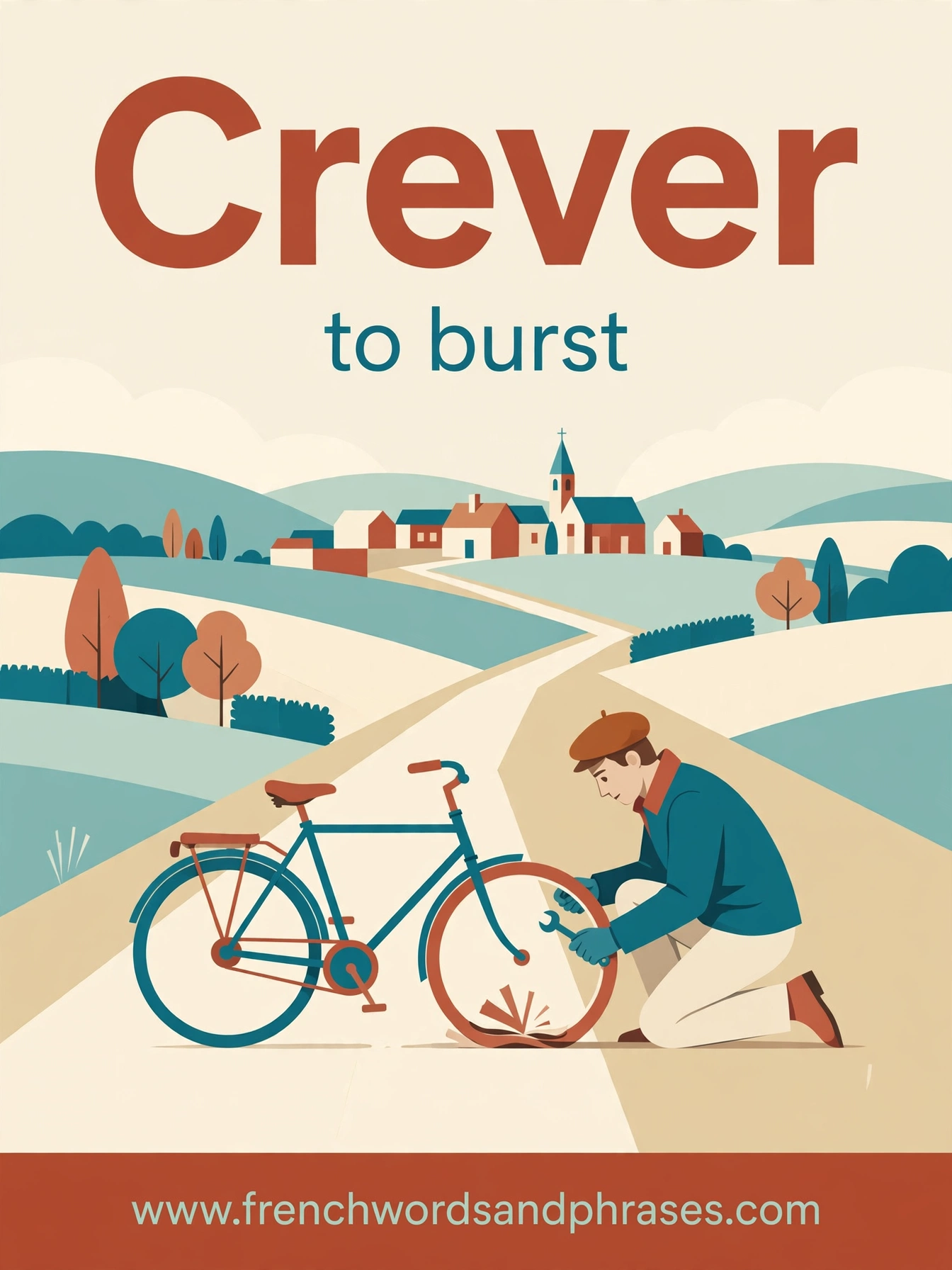
Crever means to burst, to puncture, or to split open.
A bicycle tyre on a country road, a balloon blown up once too often, a cloud heavy with rain — some things hold, and hold, and then suddenly give way. In French, that sudden giving way is crever.
In this guide, you’ll learn how to conjugate crever in all the major French tenses and moods. Explore complete conjugation tables, French examples, English translations, and practice quizzes.
Understanding the French Verb Crever
Crever is a regular French verb belonging to the first group of verbs, those ending in -er.
It means to burst, to puncture, or to split open. It is used for tyres, balloons, bubbles and pipes that burst, and for a cloud that bursts into rain. In everyday slang it also means to be worn out — être crevé — and, with de, to be dying for something: crever de faim, crever de chaud.
Verb classification: First group (-er)
Auxiliary verb: Avoir or être, depending on the construction
Past participle: crevé
Present participle: crevant
English equivalents: To burst, to puncture, to pop, to split open.
One important detail: crever is conjugated with avoir when it describes the action of bursting — le pneu a crevé (the tyre burst). You will also meet être with the participle — le pneu est crevé — but there crevé works as an adjective describing the resulting state, not as the auxiliary of the event; the same adjective appears in the slang je suis crevé (I’m exhausted). The tables on this page use avoir. Note too the stem change: the mute e becomes è in je crève and in the future, je crèverai.
Experience the Word
Crever is the verb of the sudden pop — the moment pressure wins and something gives way all at once.
Imagine cycling home at dusk when a sharp stone bites into your front tyre. One loud bang, a wobbling wheel, and your ride home has just become a long walk.
You have not just stopped. Your tyre has burst — and the evening has changed.
How to Conjugate Crever: Complete French Conjugation Guide
Let’s explore every major conjugation of crever, beginning with the indicative mood.
How to Conjugate Crever in the Indicative Mood
The indicative mood is used to express facts, observations, actions, and events.
How to Conjugate Crever in the Present Tense (Présent)
Used for actions happening now, habitual actions, and general truths.
| Subject | Conjugation |
|---|---|
| je | crève |
| tu | crèves |
| il / elle | crève |
| nous | crevons |
| vous | crevez |
| ils / elles | crèvent |
Example
Le ballon crève si tu le gonfles trop.
The balloon bursts if you blow it up too much.
Quick Quiz 1
Complete the sentence:
Les enfants ______ de rire devant le clown.
Reveal the answer
crèvent
Les enfants crèvent de rire devant le clown.
The children are bursting with laughter at the clown.
How to Conjugate Crever in the Passé Composé
Used for completed actions in the past. Crever takes the auxiliary verb avoir or être, depending on the construction.
| Subject | Conjugation |
|---|---|
| j’ | ai crevé |
| tu | as crevé |
| il / elle | a crevé |
| nous | avons crevé |
| vous | avez crevé |
| ils / elles | ont crevé |
Example
Le pneu a crevé sur la route de campagne.
The tyre burst on the country road.
How to Conjugate Crever in the Imparfait (Imperfect Tense)
Used for habitual past actions, descriptions, and ongoing situations in the past.
| Subject | Conjugation |
|---|---|
| je | crevais |
| tu | crevais |
| il / elle | crevait |
| nous | crevions |
| vous | creviez |
| ils / elles | crevaient |
Example
Les vieux tuyaux crevaient à chaque gel.
The old pipes used to burst at every freeze.
Quick Quiz 2
Choose the correct form:
The tyre burst on the motorway.
Le pneu ______ sur l’autoroute. (a crevé / est crevé)
Reveal the answer
a crevé
Le pneu a crevé sur l’autoroute.
The bursting is an action, so crever takes avoir; est crevé would describe the state of the tyre afterwards.
How to Conjugate Crever in the Plus-que-parfait
Used to describe an action that had already been completed before another past event.
| Subject | Conjugation |
|---|---|
| j’ | avais crevé |
| tu | avais crevé |
| il / elle | avait crevé |
| nous | avions crevé |
| vous | aviez crevé |
| ils / elles | avaient crevé |
Example
La poche avait crevé avant notre arrivée.
The bag had split before we arrived.
How to Conjugate Crever in the Passé Simple
Primarily used in formal writing, literature, and historical narratives. It is rarely used in everyday conversation.
| Subject | Conjugation |
|---|---|
| je | crevai |
| tu | crevas |
| il / elle | creva |
| nous | crevâmes |
| vous | crevâtes |
| ils / elles | crevèrent |
Example
Soudain, le ballon creva et tout le monde sursauta.
Suddenly, the balloon burst and everyone jumped.
How to Conjugate Crever in the Passé Antérieur
A literary tense used to express an action completed immediately before another past action, generally in the passé simple.
| Subject | Conjugation |
|---|---|
| j’ | eus crevé |
| tu | eus crevé |
| il / elle | eut crevé |
| nous | eûmes crevé |
| vous | eûtes crevé |
| ils / elles | eurent crevé |
Example
Dès que le nuage eut crevé, la pluie tomba d’un coup.
As soon as the cloud had burst, the rain fell all at once.
How to Conjugate Crever in the Future Tense (Futur Simple)
Used to describe actions that will take place in the future.
| Subject | Conjugation |
|---|---|
| je | crèverai |
| tu | crèveras |
| il / elle | crèvera |
| nous | crèverons |
| vous | crèverez |
| ils / elles | crèveront |
Example
Si tu roules sur ce clou, ton pneu crèvera.
If you ride over that nail, your tyre will burst.
How to Conjugate Crever in the Futur Antérieur (Future Perfect)
Used for an action that will have been completed before a particular point in the future.
| Subject | Conjugation |
|---|---|
| j’ | aurai crevé |
| tu | auras crevé |
| il / elle | aura crevé |
| nous | aurons crevé |
| vous | aurez crevé |
| ils / elles | auront crevé |
Example
À ce rythme, les ballons auront tous crevé avant la fin de la fête.
At this rate, the balloons will all have burst before the end of the party.
How to Conjugate Crever in the Near Future (Futur Proche)
Used to describe something that is going to happen soon. Formed with aller + infinitive.
| Subject | Conjugation |
|---|---|
| je | vais crever |
| tu | vas crever |
| il / elle | va crever |
| nous | allons crever |
| vous | allez crever |
| ils / elles | vont crever |
Example
Attention, ce tuyau va crever !
Careful, that pipe is going to burst!
How to Conjugate Crever in the Conditional Mood
The conditional mood expresses what would happen under certain circumstances. It is also frequently used to make polite requests or express wishes.
How to Conjugate Crever in the Present Conditional
| Subject | Conjugation |
|---|---|
| je | crèverais |
| tu | crèverais |
| il / elle | crèverait |
| nous | crèverions |
| vous | crèveriez |
| ils / elles | crèveraient |
Example
À ta place, je crèverais de faim avant midi.
In your place, I would be starving by noon.
How to Conjugate Crever in the Past Conditional
| Subject | Conjugation |
|---|---|
| j’ | aurais crevé |
| tu | aurais crevé |
| il / elle | aurait crevé |
| nous | aurions crevé |
| vous | auriez crevé |
| ils / elles | auraient crevé |
Example
Le pneu aurait crevé de toute façon, il était trop usé.
The tyre would have burst anyway, it was too worn.
Crever in the Literary Past Conditional Form
This less common literary form uses the imperfect subjunctive of avoir or être, depending on the construction.
| Subject | Conjugation |
|---|---|
| j’ | eusse crevé |
| tu | eusses crevé |
| il / elle | eût crevé |
| nous | eussions crevé |
| vous | eussiez crevé |
| ils / elles | eussent crevé |
Example
Le ballon eût crevé si l’enfant avait continué à le gonfler.
The balloon would have burst if the child had kept blowing it up.
How to Conjugate Crever in the Subjunctive Mood
The subjunctive is used to express wishes, emotions, doubts, necessity, and uncertainty. It frequently follows expressions such as il faut que (it is necessary that) or bien que (although).
How to Conjugate Crever in the Present Subjunctive
| Subject | Conjugation |
|---|---|
| que je | crève |
| que tu | crèves |
| qu’il / qu’elle | crève |
| que nous | crevions |
| que vous | creviez |
| qu’ils / qu’elles | crèvent |
Example
Il est possible que la bulle crève au moindre contact.
It is possible that the bubble will burst at the slightest touch.
Quick Quiz 3
Complete the sentence using the subjunctive:
Je doute que ce ballon ______ si facilement.
Reveal the answer
crève
Je doute que ce ballon crève si facilement.
I doubt that this balloon will burst so easily.
How to Conjugate Crever in the Imperfect Subjunctive
A literary tense, rarely encountered in modern spoken French.
| Subject | Conjugation |
|---|---|
| que je | crevasse |
| que tu | crevasses |
| qu’il / qu’elle | crevât |
| que nous | crevassions |
| que vous | crevassiez |
| qu’ils / qu’elles | crevassent |
Example
Il craignait que le tuyau crevât pendant la nuit.
He feared that the pipe would burst during the night.
How to Conjugate Crever in the Pluperfect Subjunctive
A literary construction used to express an action completed before another past action.
| Subject | Conjugation |
|---|---|
| que j’ | eusse crevé |
| que tu | eusses crevé |
| qu’il / qu’elle | eût crevé |
| que nous | eussions crevé |
| que vous | eussiez crevé |
| qu’ils / qu’elles | eussent crevé |
Example
Je regrettais que le pneu eût crevé si loin de la maison.
I regretted that the tyre had burst so far from home.
How to Conjugate Crever in the Past Subjunctive
| Subject | Conjugation |
|---|---|
| que j’ | aie crevé |
| que tu | aies crevé |
| qu’il / qu’elle | ait crevé |
| que nous | ayons crevé |
| que vous | ayez crevé |
| qu’ils / qu’elles | aient crevé |
Example
Je suis désolé que ton pneu ait crevé en route.
I am sorry that your tyre burst on the way.
How to Conjugate Crever in the Imperative
The imperative is used to give commands, instructions, invitations, or suggestions. Subject pronouns are omitted.
How to Conjugate Crever in the Present Imperative
| Person | Conjugation |
|---|---|
| (tu) | crève |
| (nous) | crevons |
| (vous) | crevez |
Example
Crève le ballon, la fête est finie !
Pop the balloon, the party is over!
Quick Quiz 4
How would you say Pop it, using the tu form?
Reveal the answer
Crève-le !
French Participles of Crever
Participles are verb forms that can be used in compound tenses and other grammatical constructions.
Present Participle of Crever
crevant
En crevant, le pneu a fait un bruit sec.
As it burst, the tyre made a sharp noise.
Past Participle of Crever
crevé
Après vingt kilomètres de marche, je suis crevé.
After twenty kilometres of walking, I am exhausted.
Crever in Everyday French: Real-Life Examples
Now that you know the conjugations, let’s see how crever appears in everyday French.
Example 1 — Present
Ce vieux tuyau crève chaque hiver.
This old pipe bursts every winter.
Example 2 — Passé composé — avoir
Nous avons crevé deux fois cet été.
We had two punctures this summer.
Example 3 — Passé composé — être (state)
Après la randonnée, ils sont crevés.
After the hike, they are exhausted.
Example 4 — Imparfait
Les ballons crevaient les uns après les autres.
The balloons were bursting one after another.
Example 5 — Future
Ne t’inquiète pas, le pneu ne crèvera pas.
Do not worry, the tyre will not burst.
Example 6 — Conditional
Je crèverais de chaud dans cette pièce.
I would die of heat in this room.
Beyond Translation: The Meaning of Crever
English splits this idea between burst, pop and puncture; French crever covers them all, and then walks into slang, where a burst person — je suis crevé — is simply worn out.
Crever is a small lesson in how French recycles a participle.
The bursting takes avoir — le pneu a crevé — while the state left behind wears être like an adjective: un pneu crevé, a flat tyre, and un homme crevé, a shattered man.
How to Remember the French Verb Crever
Remember it this way: Crever is about bursting open — avoir for the burst itself, être only for the state it leaves behind.
- The burst itself takes avoir — le pneu a crevé (the tyre burst).
- With être, crevé is an adjective for the state afterwards — un pneu crevé, and slang je suis crevé (I’m exhausted).
- Watch the stem: mute e becomes è — je crève, je crèverai.
The key idea is bursting open — avoir for the burst itself, être only for the state it leaves behind.
Test Your Knowledge of Crever
Let’s see how much you’ve learned. Try answering these questions before revealing the answers.
Question 1
When does crever take avoir, and when do you see être with crevé?
Reveal the answer
Avoir for the action of bursting — le pneu a crevé. Être appears when crevé is an adjective describing the resulting state — le pneu est crevé, je suis crevé (I’m exhausted).
Question 2
How do you say my tyre will burst in French?
Reveal the answer
Mon pneu crèvera.
Question 3
Translate: The balloon burst during the party.
Reveal the answer
Le ballon a crevé pendant la fête.
Question 4
What is the past participle of crever?
Reveal the answer
Crevé.
Question 5
Complete the sentence:
Si tu gonfles trop ce ballon, il ______.
Reveal the answer
crèvera
Si tu gonfles trop ce ballon, il crèvera.
If you blow up this balloon too much, it will burst.
Your Final Challenge
Can You Use It?
How would you say this in French?
The balloon burst during the party.
Reveal the answer
Le ballon a crevé pendant la fête.
The balloon burst during the party.
A little French. A little curiosity. A richer everyday life.
LEARN FRENCH ONE WORD AT A TIME