A French Word to Live By
Translate Quel to English
/kɛl/
Quel means which.
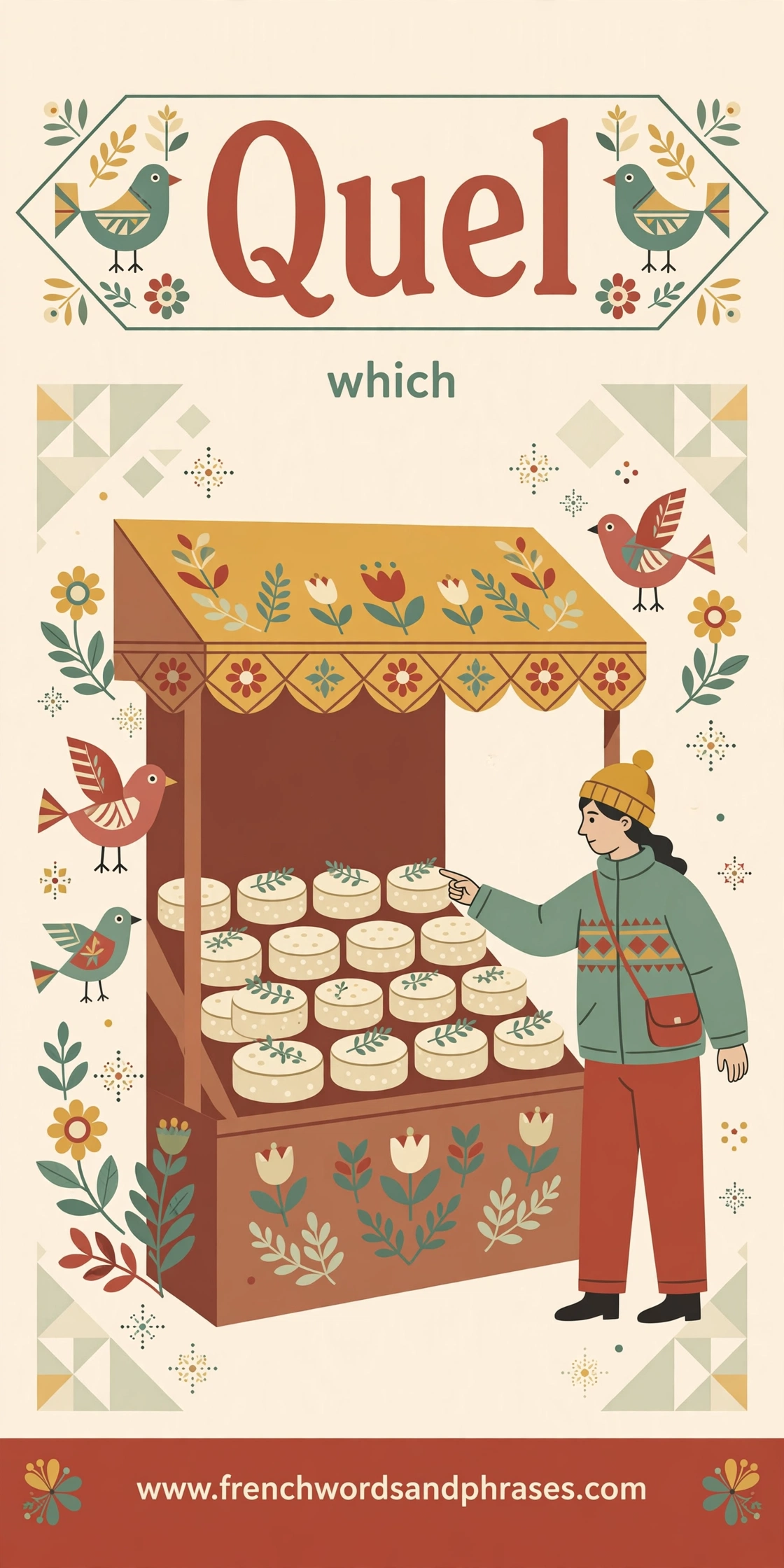
At the market, the cheese seller lifts two golden wheels and smiles. « Quel fromage vous voulez, madame ? » — Which cheese would you like, madam? Quel is the French question word for choosing: which one, what kind — the word that turns a shelf full of possibilities into a decision.
Let’s explore how quel works in French, beginning with the whole word on one card.
Understanding the French Pronoun Quel
Quel is a French interrogative word with two lives: as a determiner it stands before a noun (quel livre ? — which book?), and as a pronoun-style question word it rides with être (quel est ton nom ? — what is your name?). That is why this page sits in both the pronoun and the determiner families. It agrees with its noun in gender and number: quel, quelle, quels, quelles.
It means which or what. The picture it paints is a hand hovering over a row of choices: quel train (which train), quelle heure (what time), quels livres (which books). Quel never chooses for you — it simply holds the shelf up and asks you to point.
Type: Interrogative determiner and pronoun — asks for a choice
Answers the question: Quel ? / Quelle ? — Which? / What? (Answer: this one, that one)
What follows it: A noun (quel jour ?), or être + noun (quel est ton avis ?)
Watch the pair: quel (which — with a noun, or with être) vs lequel (which one — stands alone): quel livre ? / lequel ?
One important usage detail: quel is also the great exclaimer of French. With an exclamation mark it stops asking and starts marvelling: Quel beau jour ! (What a beautiful day!), Quelle chance ! (What luck!) — same word, pure feeling.
Experience the Word
Quel is the word of the open shelf — it loves a choice, and it waits, hand raised, for you to make one.
Imagine a child in a bookshop, turning slowly between towers of stories: quel livre, quel livre ? — which book, which book? Every reader knows that happy dizziness; quel is its name.
You have not just asked a question. You have laid out the whole shelf — and asked the world to choose.
How to Use Quel in French: Complete Guide
Let’s explore how quel works in French, beginning with the whole word on one card.
Quel at a Glance
The Whole Word on One Card
Meaning, job, grid and lives — quel in four lines.
| Point | Quel |
|---|---|
| Meaning | which / what |
| Job | interrogative — asks the listener to choose or identify |
| The grid | quel (m. sg.) — quelle (f. sg.) — quels (m. pl.) — quelles (f. pl.) |
| Its two lives | before a noun (quel livre ?) and with être (quel est ton nom ?) |
Example
Quel livre tu lis en ce moment ?
Which book are you reading at the moment?
The Pattern in Action: Choosing from the Shelf
Quel connects a question to a noun — and the noun’s gender and number shape the word itself.
| Pattern | Example |
|---|---|
| quel + masculine noun | quel âge as-tu ? — how old are you? (literally: what age have you?) |
| quelle + feminine noun | quelle heure est-il ? — what time is it? |
| quel + être + noun | quel est ton plat préféré ? — what is your favourite dish? |
| quels / quelles + plural noun | quels films tu aimes ? — which films do you like? |
Example
Quelles fleurs tu préfères, les roses ou les tulipes ?
Which flowers do you prefer, roses or tulips?
Quick Quiz 1
“What time is it?” — quel heure or quelle heure?
Reveal the answer
quelle heure — heure is feminine, so quel becomes quelle.
Quelle heure est-il, s’il te plaît ?
What time is it, please?
The Tricky Bit: Quel Agrees — and Quel Is Not Lequel
Quel has two habits to learn: it copies its noun’s gender and number, and it never works alone.
| Situation | How it works |
|---|---|
| agreement with the noun | quel jour, quelle nuit, quels jours, quelles nuits — the noun decides the form |
| quel + noun, always together | quel stands with its noun: quel train part à midi ? |
| no noun? switch to lequel | — Tu veux un café. — Lequel ? — the pronoun lequel stands alone |
| quel + être for identity | quel est ton nom ?, quelle est ta ville ? — asking what something is |
Example
Quel est le nom de cette rue ?
What is the name of this street?
Where It Goes: In Front of Its Noun
Quel leads its noun like a guide — at the front of the question, or just before être.
| Position / pattern | Example |
|---|---|
| question opener + noun | quel bus va au centre ? — which bus goes to the centre? |
| quel + être + noun | quelle est la capitale de l’Espagne ? — what is the capital of Spain? |
| in an indirect question | je ne sais pas quel train prendre — I do not know which train to take |
| as an exclamation, still before the noun | quel beau jardin ! — what a beautiful garden! |
Example
Dis-moi quel chemin tu as pris.
Tell me which path you took.
Quick Quiz 2
A friend says “I bought a cheese.” You ask “which one?” — quel ? or lequel ?
Reveal the answer
lequel — with no noun to carry it, quel cannot stand alone; lequel does the job.
— J’ai acheté un fromage. — Lequel ?
— I bought a cheese. — Which one?
Everyday Expressions with Quel
Quel runs the small questions of every day — time, age, weather, choices.
| Expression | In English |
|---|---|
| quelle heure est-il ? | what time is it? |
| quel âge as-tu ? | how old are you? |
| quel temps fait-il ? | what is the weather like? |
| quel jour sommes-nous ? | what day is it today? |
| quelle chance ! | what luck! |
Example
Quel temps fait-il chez toi en hiver ?
What is the weather like where you live in winter?
Close Cousins: Quel, Lequel, Qui, Que
Four question words at the market stall — each asks about a different thing.
| Word | The difference |
|---|---|
| quel | which / what — with a noun or être: quel livre ?, quel est ton nom ? |
| lequel | which one — the pronoun, stands alone: lequel tu veux ? |
| qui | who — asks about a person: qui vient ? |
| que / quoi | what — asks about a thing or an action: que fais-tu ?, tu fais quoi ? |
Example
Qui vient, et quel gâteau vous apportez ?
Who is coming, and which cake are you bringing?
Quick Quiz 3
Which cousin asks about a person — quel or qui?
Reveal the answer
qui — qui asks who; quel asks which thing.
Qui est ce monsieur, et quel est son nom ?
Who is this gentleman, and what is his name?
Quel and Its Neighbours
The question shelf: the interrogative family that quel belongs to.
| French | In English |
|---|---|
| qui | who |
| que / quoi | what |
| quel | which / what |
| lequel | which one |
| combien | how much / how many |
Example
Combien de fromages, et lesquels tu choisis ?
How many cheeses, and which ones are you choosing?
Watch Out: The Traps Around Quel
The traps: the lonely quel, the forgotten agreement, and quel doing the wrong ‘what’.
| Trap | The truth |
|---|---|
| using quel alone for ‘which one?’ | quel needs its noun (or être); alone, the word is lequel |
| forgetting agreement | quelle heure, quels livres, quelles idées — quel copies the noun every time |
| translating ‘what do you do?’ with quel | actions take que: que fais-tu ? — quel only names or chooses a noun |
| missing the exclamation use | quel + noun + ! = what a…!: quel beau jour ! — no question is being asked |
Example
Quel beau matin pour une promenade !
What a beautiful morning for a walk!
Quick Quiz 4
Complete: ______ est la capitale de la France ? (What is the capital of France?)
Reveal the answer
Quelle — capitale is feminine, and quel + être agrees with it.
Quelle est la capitale de la France ?
What is the capital of France?
Quel in Everyday French: Real-Life Examples
Now that you know the word, let’s see how quel appears in everyday French.
Example Example 1 — Time
Quelle heure est-il ? Le train part bientôt.
What time is it? The train leaves soon.
Example Example 2 — Age
Quel âge a ton petit frère ?
How old is your little brother?
Example Example 3 — Weather
Quel temps fait-il aujourd’hui à Nice ?
What is the weather like in Nice today?
Example Example 4 — Choosing
Quels parfums vous avez, monsieur ?
Which flavours do you have, sir?
Example Example 5 — Exclaiming
Quelle belle vue sur la mer !
What a beautiful view of the sea!
Example Example 6 — Plans
Je ne sais pas quel jour choisir pour la fête.
I do not know which day to choose for the party.
Beyond Translation: The Meaning of Quel
English splits the work between ‘which’ and ‘what’; French hands both to quel and lets the noun beside it decide. And quel has a second soul: cried out with an exclamation mark — Quel courage ! Quelle patience ! — it stops asking questions altogether and simply admires.
To say quel is to hold up the whole shelf and ask: this one? that one? — or to gasp at the one already chosen.
Few words work both sides of the counter like quel: the shopper’s question and the poet’s cry in a single syllable.
How to Remember the French Pronoun Quel
Remember it this way: Remember it this way: Quel always travels with a noun (or with être) — and it copies that noun’s gender and number.
- You match the noun — quel train, quelle heure, quels films, quelles fleurs.
- You keep it company — no noun, no quel: alone, the word becomes lequel.
- You listen for the punctuation — quel… ? asks, quel… ! admires.
The key idea is quel means which / what — it agrees with its noun (quel, quelle, quels, quelles) and never stands alone; lequel does that job.
Test Your Knowledge of Quel
Let’s see how much you’ve learned. Try answering these questions before revealing the answers.
Question 1
What does quel mean?
Reveal the answer
Which / what — it asks the listener to choose or identify a noun.
Question 2
What are the four forms of quel?
Reveal the answer
Quel, quelle, quels, quelles — chosen by the gender and number of the noun.
Question 3
Translate: What time is it?
Reveal the answer
Quelle heure est-il ?
Question 4
What is the difference between quel livre ? and lequel ?
Reveal the answer
Quel travels with its noun; lequel stands alone — quel livre ? (which book?), lequel ? (which one?).
Question 5
Complete the sentence:
______ âge as-tu ? (How old are you?)
Reveal the answer
Quel
Quel âge as-tu ?
How old are you?
Your Final Challenge
Can You Use It?
How would you say this in French?
“How would you say this in French?”
Reveal the answer
Quel fromage tu recommandes ?
Which cheese do you recommend?
A little French. A little curiosity. A richer everyday life.
LEARN FRENCH ONE WORD AT A TIME