
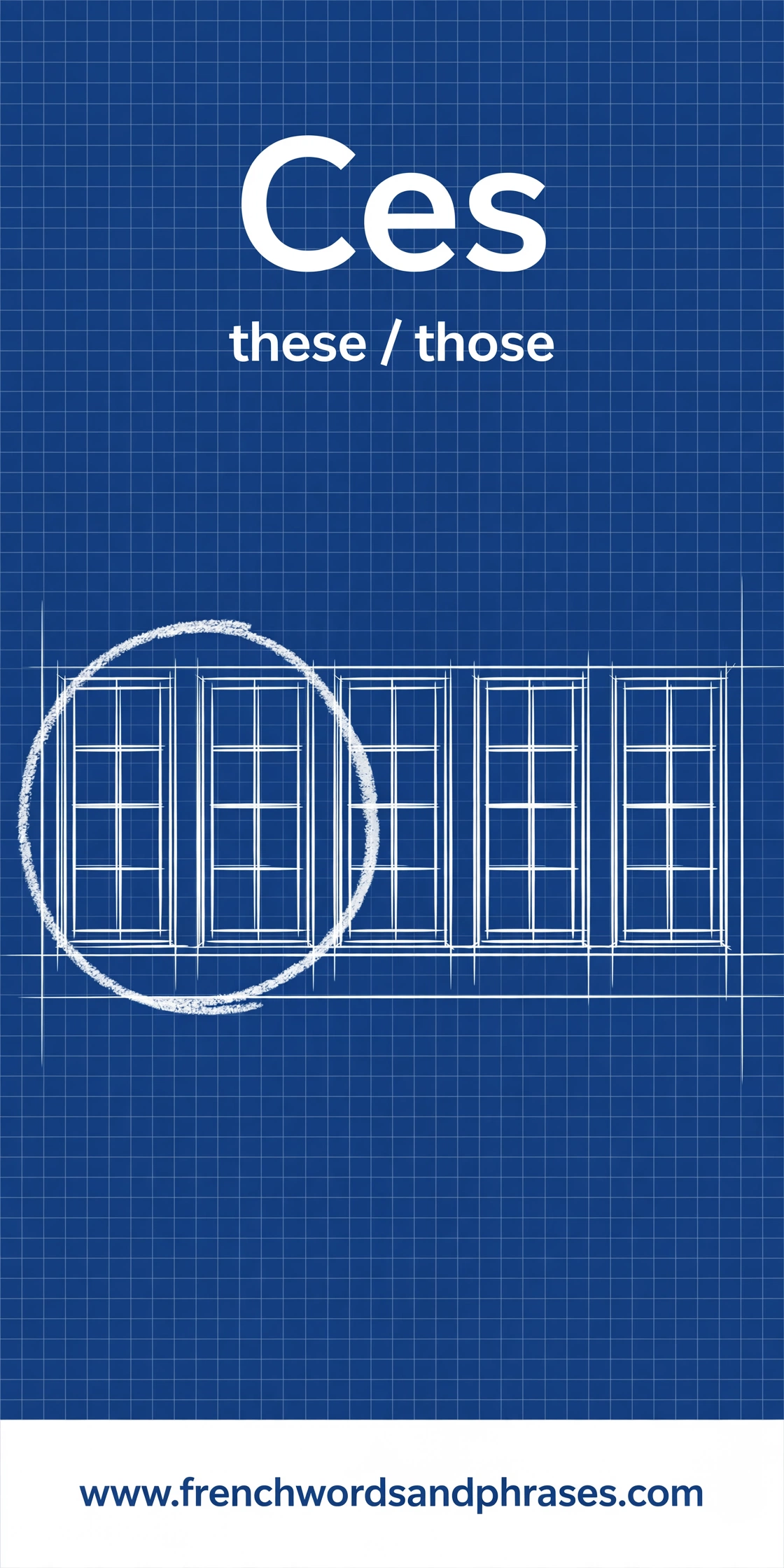
A French Word to Live By
Translate Ces to English
/se/
Ces means these / those.
A baker lifts a tray of golden croissants from the oven and sets it on the counter, still steaming. « Ces croissants sont pour la vitrine » — these croissants are for the window. Ces is the French demonstrative determiner for plurals: it stands before any plural noun and points, saying these ones, those ones, the very ones in front of us.
Let’s explore how ces works in French, beginning with the whole word on one card.
Understanding the French Determiner Ces
Ces is a French demonstrative determiner — the plural form, for masculine and feminine nouns alike. It stands before a plural noun and points it out: ces livres, ces femmes. It completes the family ce / cet / cette / ces.
It means these or those. The picture it paints is an open hand sweeping over a row of things: not some books, not the books in general, but ces livres — these books, the ones right here. Add -ci to the noun for the nearer set and -là for the farther: ces livres-ci, ces livres-là.
Type: Demonstrative determiner — plural, both genders
Answers the question: Lesquels ? / Lesquelles ? — Which ones? (Answer: these, the ones I am pointing at)
What follows it: A plural noun: ces livres, ces idées, ces enfants
Watch the pair: ces (these — pointing) vs ses (his/her — owning): same sound /se/, opposite jobs
One important usage detail: ces and ses are perfect homophones — both pronounced /se/. Only the meaning separates them: ces points at things you can see, ses ties things to an owner. In writing, the choice is a test of whether you understood the sentence.
Experience the Word
Ces is the determiner of the open hand — it gathers a whole row of things into one gesture.
Imagine a gardener walking the rows at dawn with a basket on her arm: ces tomates pour aujourd’hui, ces herbes pour la soupe, ces fleurs pour la table — these tomatoes, these herbs, these flowers, a morning’s harvest named by pointing.
You have not just counted things. You have swept them into view — ces makes a crowd of nouns stand up and be noticed.
How to Use Ces in French: Complete Guide
Let’s explore how ces works in French, beginning with the whole word on one card.
Ces at a Glance
The Whole Word on One Card
Meaning, job, family and signal — ces in four lines.
| Point | Ces |
|---|---|
| Meaning | these / those |
| Job | demonstrative determiner — points out specific plural nouns |
| The full family | ce (masc. sg.) — cet (masc. sg. before a vowel) — cette (fem. sg.) — ces (plural) |
| What it signals | these ones here — add -ci or -là to the noun for near or far |
Example
Ces pommes viennent de notre verger.
These apples come from our orchard.
The Pattern in Action: Pointing at a Row of Things
Ces connects plural nouns to a gesture — the things are present, visible, or fresh in the conversation.
| Pattern | Example |
|---|---|
| things in front of you | ces fleurs sont magnifiques — these flowers are magnificent |
| near vs far, with -ci / -là | ces clés-ci sont à moi, ces clés-là sont à Paul — these keys are mine, those keys are Paul’s |
| people being pointed out | ces enfants jouent dans la cour — these children are playing in the courtyard |
| a stretch of time | ces jours-ci, il fait très chaud — these days, it is very hot |
Example
Ces vieilles photos racontent toute une vie.
These old photos tell a whole life story.
Quick Quiz 1
How do you sharpen ces livres into “THOSE books (over there)”?
Reveal the answer
Add -là to the noun — ces livres-là; -ci gives the nearer set, ces livres-ci.
Je prends ces livres-ci, pas ces livres-là.
I will take these books, not those books.
The Tricky Bit: Ces Points, Ses Owns
Ces and ses are the classic French confusion — one sound, /se/, and two completely different jobs.
| Word | How it works |
|---|---|
| ces — pointing | these/those, the ones you can see: ces chaussures sont neuves — these shoes are new |
| ses — owning | his/her, belonging to one person: ses chaussures sont neuves — his shoes are new |
| the replacement test | swap in ‘these’: if the sentence still works, it is ces; if it needs ‘his/her’, it is ses |
| the owner test | ses always answers ‘whose?’ about one owner — son/sa in the plural: son livre, ses livres |
Example
Ces gants sont à Marie : ce sont ses gants préférés.
These gloves are Marie’s: they are her favourite gloves.
Where It Goes: Directly Before the Plural Noun
Ces takes the front seat of the plural noun phrase; the -ci and -là tags ride at the very end of the noun.
| Position / pattern | Example |
|---|---|
| directly before the noun | ces livres, ces femmes — ces leads, the plural noun follows |
| before an adjective + noun | ces petits chiens — these little dogs |
| -ci / -là attached to the noun | ces jours-ci (these days), ces gens-là (those people) |
| one form for both genders | ces garçons, ces filles — ces never changes for gender, only number matters |
Example
Ces grands arbres donnent de l’ombre tout l’été.
These tall trees give shade all summer.
Quick Quiz 2
“Paul is putting away HIS books” — Paul range ces livres or Paul range ses livres?
Reveal the answer
ses livres — the books belong to Paul, so the possessive ses; ces would point at books in view.
Paul range ses livres sur l’étagère.
Paul puts his books away on the shelf.
Everyday Expressions with Ces
Ces fills the phrases of the present moment — days, people and things at hand.
| Expression | In English |
|---|---|
| ces jours-ci | these days |
| ces temps-ci | these days / lately |
| ces gens-là | those people |
| tous ces… | all these… |
| ces derniers jours | these last few days |
Example
Ces jours-ci, les soirées sont douces.
These days, the evenings are mild.
Close Cousins: Ces, Ses, Les, Ceux
Four neighbours before plural nouns — pointing, owning, defining, replacing.
| Word | The difference |
|---|---|
| ses | the possessive — his/her things: ses livres (his books), ownership not pointing |
| les | the plain article ‘the’: les livres — known things, no gesture needed |
| ceux / celles | the pronouns — they replace the noun: ceux-ci sont lourds (these ones are heavy) |
| ces | the pointing determiner before a plural noun: ces livres sont lourds (these books are heavy) |
Example
Les livres de Paul sont lourds ; ces livres-ci sont les siens.
Paul’s books are heavy; these books here are his.
Quick Quiz 3
You point at two heavy suitcases and say “these ones are heavy”. Do you use ces or celles-ci?
Reveal the answer
celles-ci — with no noun after it, the pronoun takes over; ces must be followed by its noun.
Celles-ci sont lourdes.
These ones are heavy.
Ces and Its Neighbours
The pointing shelf: the whole demonstrative family, with the possessive plurals next door — mind the sound-alikes.
| French | In English |
|---|---|
| ce / cet | this / that (masculine singular) |
| cette | this / that (feminine singular) |
| ces | these / those (plural) |
| mes / tes / ses | my / your / his-her (the possessive plurals) |
| nos / vos / leurs | our / your / their (the possessive plurals) |
Example
Ces enfants rangent leurs jouets avant le dîner.
These children put away their toys before dinner.
Watch Out: The Traps Around Ces
The traps: ses in ces’s clothing, ces before a singular, and ces doing a pronoun’s job.
| Trap | The truth |
|---|---|
| writing ses for ‘these’ | ses means his/her: ses livres = his books; these books = ces livres |
| using ces before a singular noun | one thing takes ce, cet or cette: ce livre, cet arbre, cette table — ces is plural only |
| using ces alone for ‘these ones’ | ces needs its noun; alone, use ceux-ci or celles-ci: ceux-ci sont prêts |
| confusing ces with c’est | c’est = it is (c’est beau); ces = these (ces fleurs) — different words, different jobs |
Example
Ces oiseaux reviennent chaque printemps.
These birds come back every spring.
Quick Quiz 4
Complete: ______ fleurs sont pour la table. (These flowers are for the table.)
Reveal the answer
Ces — the demonstrative determiner for a plural noun.
Ces fleurs sont pour la table.
These flowers are for the table.
Ces in Everyday French: Real-Life Examples
Now that you know the word, let’s see how ces appears in everyday French.
Example Example 1 — At the market
Ces fraises sont mûres et parfumées.
These strawberries are ripe and fragrant.
Example Example 2 — Choosing
Je prends ces chaussures-ci, elles sont plus solides.
I will take these shoes, they are sturdier.
Example Example 3 — People
Ces étudiants préparent un examen difficile.
These students are preparing for a difficult exam.
Example Example 4 — Time
Ces temps-ci, le travail ne manque pas.
These days, there is no shortage of work.
Example Example 5 — At home
Ces rideaux laissent entrer la lumière.
These curtains let the light in.
Example Example 6 — Nature
Ces montagnes sont couvertes de neige.
These mountains are covered with snow.
Beyond Translation: The Meaning of Ces
English points at plurals with “these” and “those” and stops there. French does the same job with ces — then quietly demands you separate it from ses, its perfect sound-twin, every time you write. Pointing and owning, one sound apart: the language makes you know what you mean.
To say ces is to sweep a hand over a row of things — these, present, gathered into one gesture.
It is the determiner of market trays and family photographs: ces croissants, ces enfants, ces étés — whole handfuls of the world, pointed at together.
How to Remember the French Determiner Ces
Remember it this way: Remember it this way: Ces is the open hand over a row of things — it points; its twin ses stays home and owns.
- You run the swap test — if ‘these’ fits, write ces; if ‘his/her’ fits, write ses.
- You keep ces plural — one thing takes ce, cet or cette; several take ces.
- You never leave ces alone — without a noun, the pronouns ceux-ci / celles-ci take over.
The key idea is ces means these / those before a plural noun — it points, while its sound-twin ses owns (his/her), and the swap test tells them apart.
Test Your Knowledge of Ces
Let’s see how much you’ve learned. Try answering these questions before revealing the answers.
Question 1
What does ces mean?
Reveal the answer
These / those — the demonstrative determiner for plural nouns of both genders.
Question 2
What is the difference between ces and ses?
Reveal the answer
Ces points (these books — ces livres); ses owns (his/her books — ses livres). They sound identical: /se/.
Question 3
Translate: These houses are very old.
Reveal the answer
Ces maisons sont très vieilles.
Question 4
How do you say ‘those days’ with ces?
Reveal the answer
Ces jours-là — the -là on the noun pushes the set farther away; ces jours-ci means these days, the near ones.
Question 5
Complete the sentence:
______ enfants jouent dans le parc. (These children are playing in the park.)
Reveal the answer
Ces
Ces enfants jouent dans le parc.
These children are playing in the park.
Your Final Challenge
Can You Use It?
How would you say this in French?
“How would you say this in French?”
Reveal the answer
Ces livres-ci sont pour toi.
These books are for you.
A little French. A little curiosity. A richer everyday life.
LEARN FRENCH ONE WORD AT A TIME




