A French Word to Live By
Translate Leur to English
/lœʁ/
Leur means their.
Two children hang their coats on the pegs by the school door, side by side, before running to the playground. « Leur maîtresse les appelle » — their teacher is calling them. Leur is the French possessive determiner for more than one owner: it stands before a noun and says this belongs to them.
Let’s explore how leur works in French, beginning with the whole word on one card.
Understanding the French Determiner Leur
Leur is a French possessive determiner — the form used when there are several owners. It stands before a singular noun of either gender: leur père, leur mère. When the noun is plural, it grows an s: leurs.
It means their. The picture it paints is a shared shelf: one house for a whole family (leur maison), many children in one class (leurs élèves). Leur counts the thing owned, never the owners — and there are always at least two of them.
Type: Possessive determiner — several owners (third person plural)
Answers the question: À qui ? — Whose? (Answer: theirs, belonging to them)
What follows it: A noun: leur maison (singular), leurs enfants (plural)
Watch the pair: leur (determiner, before a noun: leur livre) vs le leur (pronoun, alone: le leur est neuf)
One important usage detail: leur agrees with the noun it introduces, not with the owners. A family of six still says leur maison for one house, and leurs maisons only when there are several houses.
Experience the Word
Leur is the determiner of the group — parents, friends, neighbours, whole villages owning something together.
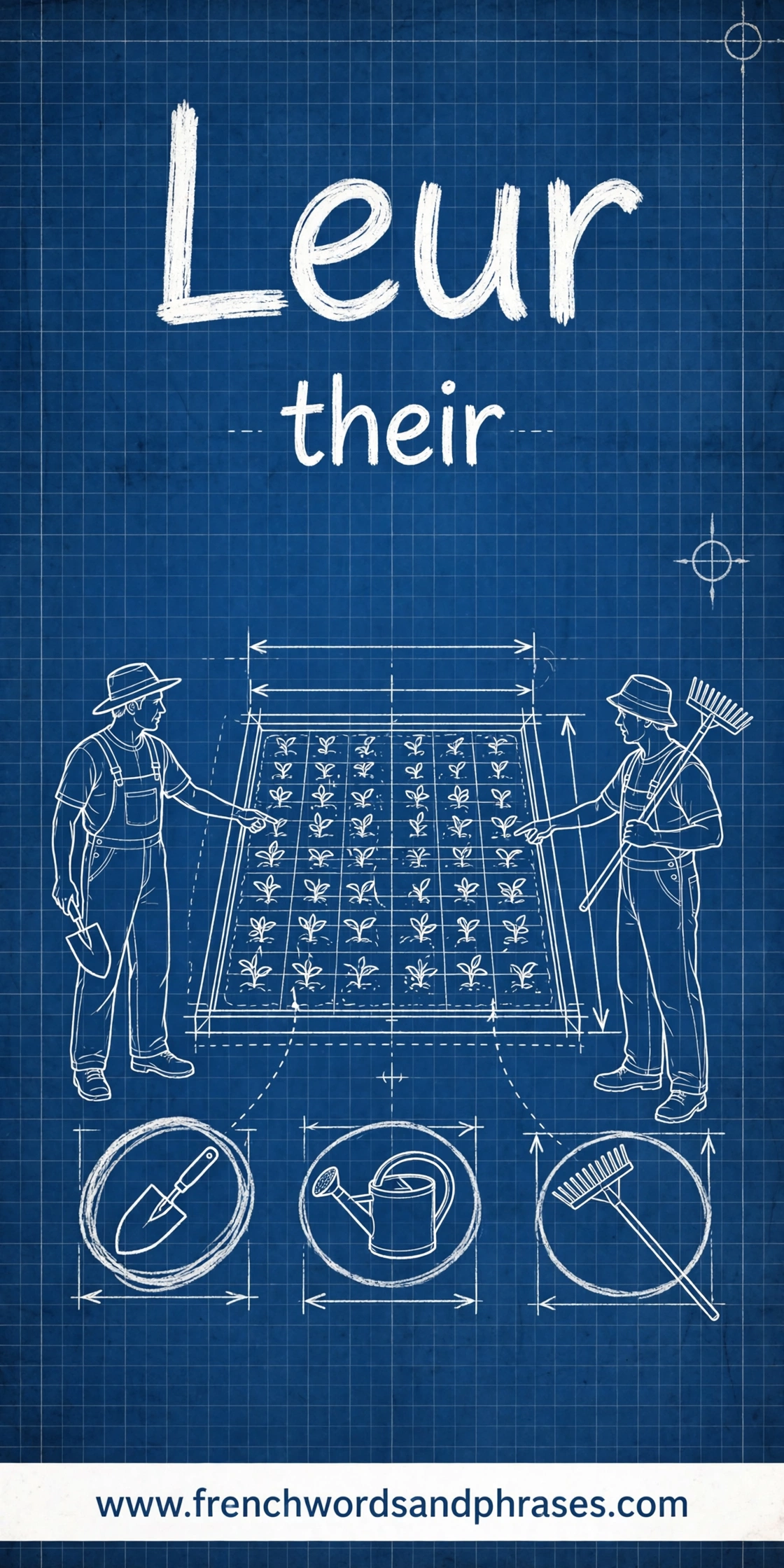
Imagine a row of houses at harvest time: leur jardin behind each fence, leurs outils by each door, leur pain on each table — the same small word, shared by everyone on the street.
You have not just said who owns the thing. You have gathered the owners into one word and let the noun decide its shape.
How to Use Leur in French: Complete Guide
Let’s explore how leur works in French, beginning with the whole word on one card.
Leur at a Glance
The Whole Word on One Card
Meaning, job, grid and pair — leur in four lines.
| Point | Leur |
|---|---|
| Meaning | their |
| Job | possessive determiner — shows that several people own the noun |
| The full grid | leur (masculine singular) — leur (feminine singular) — leurs (plural) |
| What it signals | the owners are plural; the noun decides leur or leurs |
Example
Leur jardin est plein de fleurs au printemps.
Their garden is full of flowers in spring.
The Pattern in Action: One Thing, Several Owners
Leur connects a noun to its owners — and the noun’s number, singular or plural, chooses the form.
| Pattern | Example |
|---|---|
| one thing, several owners | leur voiture est bleue — their car is blue (one car, whole family) |
| several things | leurs valises sont prêtes — their suitcases are ready |
| family words | leur fils et leur fille — their son and their daughter |
| with body parts and clothes | ils lèvent leur main — they raise their hand (each one) |
Example
Les voisins ferment leur porte à clé tous les soirs.
The neighbours lock their door every evening.
Quick Quiz 1
A couple owns one house. Is it leur maison or leurs maison?
Reveal the answer
leur maison — the s belongs to the noun, and maison is singular here.
Leur maison est au bord du lac.
Their house is by the lake.
The Tricky Bit: The Noun Wears the S, Not the Owners
English ‘their’ never changes; French leur follows the thing owned — one thing, no s; several things, s.
| Situation | What happens |
|---|---|
| singular noun, any number of owners | leur père, leur école — one father, one school, even for ten children |
| plural noun | leurs parents, leurs idées — the noun is plural, so leur becomes leurs |
| masculine and feminine singular are the same | leur fils (their son), leur fille (their daughter) — no separate feminine form |
| before a vowel, nothing changes | leur ami, leur école — leur never elides, unlike le and la |
Example
Leur fils aîné et leurs deux filles vivent à Nantes.
Their eldest son and their two daughters live in Nantes.
Where It Goes: Directly Before the Noun
Leur takes the determiner’s seat at the head of the noun phrase, and repeats before each noun.
| Position / pattern | Example |
|---|---|
| directly before the noun | leur maison, leur village — leur leads, the noun follows |
| before an adjective + noun | leur vieille maison — their old house |
| repeated before each noun | leur père et leur mère — their father and their mother |
| agreement is with the noun | leurs with a plural noun, leur with a singular one — the owners never add an s |
Example
Leur petit café se trouve au coin de la rue.
Their little café is on the corner of the street.
Quick Quiz 2
Complete: Ils ont oublié ______ parapluies. (their umbrellas)
Reveal the answer
leurs — parapluies is plural, so leur takes its s.
Ils ont oublié leurs parapluies.
They forgot their umbrellas.
Everyday Expressions with Leur
Leur appears wherever families and groups are talked about — homes, children, habits.
| Expression | In English |
|---|---|
| leur maison | their house |
| leurs enfants | their children |
| leur tour | their turn |
| de leur côté | on their side / for their part |
| leur anniversaire | their birthday |
Example
C’est leur tour de jouer.
It is their turn to play.
Close Cousins: Leur, Le leur, Son
Three possessive neighbours — who owns, how many own, and whether a noun follows.
| Word | The difference |
|---|---|
| leur / leurs | the determiner for several owners, always before a noun: leur chat, leurs chats |
| le leur / la leur / les leurs | the pronoun ‘theirs’, standing alone: ce chat est le leur — this cat is theirs |
| son / sa / ses | the determiner for ONE owner: son chat (his/her cat) — leur needs at least two owners |
| leur (object pronoun) | a different leur: je leur parle — I speak to them; it sits before the verb, not a noun |
Example
Son vélo est rouge, mais le leur est vert.
His bike is red, but theirs is green.
Quick Quiz 3
“Their house is bigger than ours” — the second ‘theirs’ in “theirs is bigger”… for “their house”, do you say leur maison or le leur maison?
Reveal the answer
leur maison — before a noun, the determiner leur; le leur is the pronoun that stands alone.
Leur maison est grande.
Their house is big.
Leur and Its Neighbours
The possessive shelf: every owner’s determiner, singular and plural.
| French | In English |
|---|---|
| mon / ma / mes | my |
| ton / ta / tes | your (one friend) |
| son / sa / ses | his / her (one owner) |
| notre / nos | our |
| votre / vos | your (formal or plural) |
| leur / leurs | their |
Example
Notre jardin est petit, mais leur jardin est immense.
Our garden is small, but their garden is huge.
Watch Out: The Traps Around Leur
The traps: the wandering s, the pronoun in the determiner’s seat, and son where a group owns.
| Trap | The truth |
|---|---|
| adding s because the owners are many | the s follows the noun: leur maison (one house, six owners), leurs maisons (several houses) |
| using le leur before a noun | le leur is a pronoun and stands alone: le leur est neuf — never ‘le leur livre’ |
| using son for a group | two or more owners take leur: les enfants et leur mère — not ‘son mère’ for the children |
| confusing determiner leur with pronoun leur | je leur écris = I write TO them (verb); leur lettre = their letter (noun) |
Example
Les étudiants ouvrent leur livre et commencent l’exercice.
The students open their book and begin the exercise.
Quick Quiz 4
Complete: Les jumeaux partagent ______ chambre. (their bedroom, one room)
Reveal the answer
leur — one room, so no s, even though the twins are two.
Les jumeaux partagent leur chambre.
The twins share their bedroom.
Leur in Everyday French: Real-Life Examples
Now that you know the word, let’s see how leur appears in everyday French.
Example Example 1 — Home
Leur maison se trouve près de la rivière.
Their house is near the river.
Example Example 2 — School
Les enfants montrent leur dessin à la maîtresse.
The children show their drawing to the teacher.
Example Example 3 — Travel
Ils ont perdu leurs billets dans le train.
They lost their tickets on the train.
Example Example 4 — Family
Leur grand-mère habite dans le même village.
Their grandmother lives in the same village.
Example Example 5 — Work
Les artisans rangent leurs outils le soir.
The craftsmen put away their tools in the evening.
Example Example 6 — A habit
Ils prennent leur café sur la terrasse.
They have their coffee on the terrace.
Beyond Translation: The Meaning of Leur
English “their” is a single, unchanging word. French splits the idea by the thing owned: leur for one treasure, leurs for many — and in doing so it quietly tells you a story about the owners too, because leur always means more than one pair of hands.
To say leur is to point at a shared possession — the noun counts, the owners gather.
It is the grammar of families and teams: leur maison, leur village, leur équipe — things held in common, named in common.
How to Remember the French Determiner Leur
Remember it this way: Remember it this way: Leur belongs to the group — and the noun, not the owners, decides whether it wears an s.
- You count the thing owned — leur maison for one, leurs maisons for several.
- You need at least two owners — one owner takes son, sa, ses instead.
- You keep le leur for standing alone — ce livre est le leur, theirs, with no noun after it.
The key idea is leur means their before a singular noun and leurs before a plural one — the agreement is with the noun owned, never with the owners.
Test Your Knowledge of Leur
Let’s see how much you’ve learned. Try answering these questions before revealing the answers.
Question 1
What does leur mean?
Reveal the answer
Their — the possessive determiner used when there are several owners.
Question 2
When does leur become leurs?
Reveal the answer
When the noun is plural — leur maison (their house), leurs maisons (their houses). The owners do not matter.
Question 3
Translate: Their children are at school.
Reveal the answer
Leurs enfants sont à l’école.
Question 4
What is the difference between leur livre and le leur?
Reveal the answer
Leur livre is the determiner with its noun (their book); le leur is the pronoun standing alone (theirs).
Question 5
Complete the sentence:
Les voisins ont vendu ______ voiture. (They sold their car — one car.)
Reveal the answer
leur
Les voisins ont vendu leur voiture.
The neighbours sold their car.
Your Final Challenge
Can You Use It?
How would you say this in French?
“How would you say this in French?”
Reveal the answer
Leur chien attend devant la porte.
Their dog is waiting in front of the door.
A little French. A little curiosity. A richer everyday life.
LEARN FRENCH ONE WORD AT A TIME