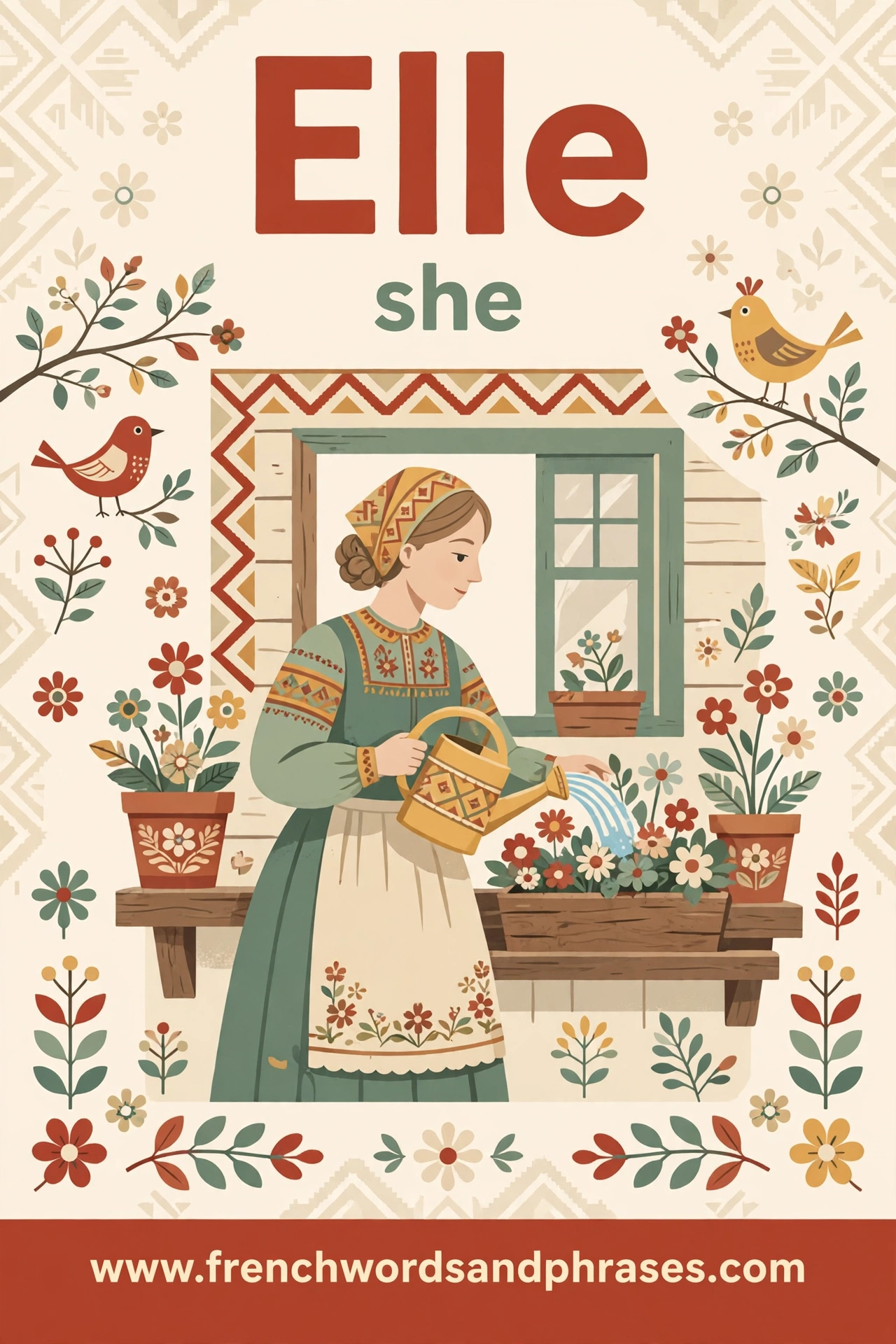
A French Word to Live By
Translate Elle to English
/ɛl/
Elle means she / it.
A young violinist tunes her instrument by an open window while the street below fills with morning sounds. « Elle joue du violon depuis l’enfance » — she has played the violin since childhood. Elle is the French subject pronoun for a woman, a girl, and every feminine noun: she acts, she speaks, she carries the sentence.
Let’s explore how elle works in French, beginning with the whole word on one card.
Understanding the French Pronoun Elle
Elle is a French subject pronoun — third person, feminine singular. It stands at the head of the verb and replaces a woman, a girl, or any feminine singular noun, so the name never has to be repeated.
It means she — and, for feminine things, it. The picture it paints is a handover: Marie parle becomes elle parle; la porte est ouverte becomes elle est ouverte. French gives every noun a gender, so even a table or a city can be an elle when it steps into the sentence as the subject.
Type: Subject pronoun — feminine singular, third person
Answers the question: Qui ? — Who? (Answer: she, the one doing the action)
What follows it: A verb in the third person singular: elle parle, elle a, elle est
Watch the pair: elle (subject — she does it) vs la (object — …her: je la vois, I see her)
One important usage detail: elle is not only for people. Any feminine noun takes it — la rivière becomes elle (elle est longue), la voiture becomes elle (elle roule vite). If the noun is feminine, its pronoun is elle.
Experience the Word
Elle is the pronoun of presence — a woman walks into the sentence and the verb turns towards her.
Imagine a grandmother at her kitchen table, telling stories while the soup simmers: elle rit, elle raconte, elle se souvient — she laughs, she tells, she remembers, and every verb follows her lead.
You have not just avoided repeating a name. You have kept her at the centre of every sentence, acting.
How to Use Elle in French: Complete Guide
Let’s explore how elle works in French, beginning with the whole word on one card.
Elle at a Glance
The Whole Word on One Card
Meaning, job, pattern and pair — elle in four lines.
| Point | Elle |
|---|---|
| Meaning | she / it (for a feminine noun) |
| Job | subject pronoun — the one who does the action |
| What it stands for | a woman, a girl, or a feminine noun: Marie → elle, la table → elle |
| Its family | il (masculine) — elle (feminine) — ils / elles (plural) |
Example
Elle ouvre la fenêtre et elle respire l’air frais.
She opens the window and breathes the fresh air.
The Pattern in Action: She Acts, It Stands
Elle connects a verb to its doer — a person first, and any feminine thing after her.
| Pattern | Example |
|---|---|
| a woman or girl | elle chante très bien — she sings very well |
| a feminine thing | la porte est lourde, elle ferme mal — the door is heavy, it closes badly |
| with être and avoir | elle est prête, elle a deux frères — she is ready, she has two brothers |
| in a question | elle vient ce soir ? — is she coming this evening? |
Example
Elle travaille dans une petite librairie près de la gare.
She works in a small bookshop near the station.
Quick Quiz 1
La chaise est dans le jardin. Which pronoun replaces la chaise as subject — il or elle?
Reveal the answer
elle — chaise is a feminine noun, so its pronoun is elle.
Elle est dans le jardin.
It is in the garden.
The Tricky Bit: Elle Acts, La Receives
Two small words for ‘she/her’ — elle stands before the verb as the doer, la slips before the verb as the receiver.
| Word | How it works |
|---|---|
| elle — subject | she does the action: elle me regarde — she looks at me |
| la — object | the action lands on her: je la regarde — I look at her |
| elle stressed, after prepositions | avec elle, chez elle, pour elle — with her, at her place, for her |
| elle-même | herself: elle l’a fait elle-même — she did it herself |
Example
Elle m’écoute, et je l’écoute aussi.
She listens to me, and I listen to her too.
Where It Goes: First, Before the Verb
As a subject, elle leads the sentence; stressed, it follows prepositions and stands at the end for emphasis.
| Position / pattern | Example |
|---|---|
| subject, before the verb | elle parle doucement — she speaks softly |
| after a preposition (stressed) | je pars avec elle — I am leaving with her |
| for emphasis, doubled | elle, elle préfère le thé — she, she prefers tea |
| c’est elle qui… | c’est elle qui a gagné — she is the one who won |
Example
C’est elle qui garde les clés de la maison.
She is the one who keeps the keys of the house.
Quick Quiz 2
“I see her” — je elle vois or je la vois?
Reveal the answer
je la vois — as the object, ‘her’ is la; elle is only the subject.
Elle arrive, je la vois.
She is arriving, I see her.
Everyday Expressions with Elle
Elle runs through daily talk — arrivals, opinions, and the famous c’est elle.
| Expression | In English |
|---|---|
| elle arrive | she is coming / she is on her way |
| elle a raison | she is right |
| c’est elle | it is her / that is her |
| elle-même | herself |
| chez elle | at her place / to her place |
Example
Elle a raison, comme toujours.
She is right, as always.
Close Cousins: Elle, Il, La, Elles
Four neighbours around one idea — gender, number, and who does what to whom.
| Word | The difference |
|---|---|
| il | the masculine subject: il parle — he speaks (or it, for a masculine noun) |
| la | the object ‘her’: je la connais — I know her; also the article ‘the’ before a feminine noun |
| elles | the plural of elle: elles parlent — they speak (all feminine) |
| elle | the feminine singular subject: elle parle — she speaks |
Example
Il la voit, elle le voit aussi.
He sees her, she sees him too.
Quick Quiz 3
Two sisters are singing. Which pronoun — elle or elles?
Reveal the answer
elles — two or more feminine subjects take the plural elles.
Elles chantent ensemble.
They sing together.
Elle and Its Neighbours
The subject shelf: the whole family elle belongs to, person by person.
| French | In English |
|---|---|
| je / tu | I / you (familiar) |
| il / elle | he, it / she, it |
| nous / vous | we / you (formal or plural) |
| ils / elles | they (masculine or mixed) / they (feminine) |
| on | one / we (in everyday speech) |
Example
Elle et lui arrivent par le même train.
She and he are arriving on the same train.
Watch Out: The Traps Around Elle
The traps: the missing subject, la in the wrong seat, and things that are secretly feminine.
| Trap | The truth |
|---|---|
| dropping the subject like in Spanish or Italian | French verbs need their subject: elle parle — never just ‘parle’ for ‘she speaks’ |
| using la as a subject | la is an object or an article; the subject is elle: elle vient, je la vois |
| saying il for a feminine thing | la voiture, la ville, la mer all take elle: elle est belle |
| confusing elle est and elles sont by ear | elle est = she is (one); elles sont = they are (several) — count the people, not just the sound |
Example
La mer est calme ce matin ; elle brille au soleil.
The sea is calm this morning; it shines in the sun.
Quick Quiz 4
Complete: Ma sœur est fatiguée, ______ dort déjà. (she is already asleep)
Reveal the answer
elle — the subject pronoun for a feminine singular person.
Ma sœur est fatiguée, elle dort déjà.
My sister is tired, she is already asleep.
Elle in Everyday French: Real-Life Examples
Now that you know the word, let’s see how elle appears in everyday French.
Example Example 1 — Morning
Elle se lève tôt et elle prépare le café.
She gets up early and makes the coffee.
Example Example 2 — Work
Elle répond aux messages avant dix heures.
She answers the messages before ten o’clock.
Example Example 3 — A thing
La soupe est chaude, elle fume encore.
The soup is hot, it is still steaming.
Example Example 4 — Opinion
Elle pense que le film est trop long.
She thinks the film is too long.
Example Example 5 — Travel
Elle prend le bus pour aller au marché.
She takes the bus to go to the market.
Example Example 6 — Family
Elle ressemble beaucoup à sa grand-mère.
She looks a lot like her grandmother.
Beyond Translation: The Meaning of Elle
English keeps one word, “she”, for women and lets things be “it”. French is more generous and more demanding: elle covers the woman at the window and the door she opens, the river and the city on its banks — every feminine noun in the language earns its pronoun.
To say elle is to give the subject her full shape — feminine, singular, and in charge of the verb.
It is a small word with a steady presence: elle ouvre, elle ferme, elle reste — she opens, she closes, she stays.
How to Remember the French Pronoun Elle
Remember it this way: Remember it this way: Elle is the subject in a skirt of grammar — feminine, singular, always the one doing the action.
- You give elle the verb — elle parle, elle est, elle a: she acts first, everything follows.
- You keep la in the other seat — je la vois (I see her), never as the subject.
- You check the noun’s gender — la table, la voiture, la mer all become elle.
The key idea is elle means she — and it for every feminine noun — as the subject of the verb; la is the object ‘her’, never the subject.
Test Your Knowledge of Elle
Let’s see how much you’ve learned. Try answering these questions before revealing the answers.
Question 1
What does elle mean?
Reveal the answer
She — and it when the subject is a feminine noun.
Question 2
What is the difference between elle and la?
Reveal the answer
Elle is the subject (elle parle — she speaks); la is the object (je la vois — I see her).
Question 3
Translate: She is reading a letter.
Reveal the answer
Elle lit une lettre.
Question 4
Which pronoun replaces la ville as a subject?
Reveal the answer
Elle — ville is feminine: la ville est grande, elle est grande.
Question 5
Complete the sentence:
______ a téléphoné ce matin. (She phoned this morning.)
Reveal the answer
Elle
Elle a téléphoné ce matin.
She phoned this morning.
Your Final Challenge
Can You Use It?
How would you say this in French?
“How would you say this in French?”
Reveal the answer
Elle chante dans le jardin.
She is singing in the garden.
A little French. A little curiosity. A richer everyday life.
LEARN FRENCH ONE WORD AT A TIME