A French Word to Live By
Translate Du to English
/dy/
Du means some.
Steam rises from a bowl of soup in a farmhouse kitchen. « Tu veux du pain avec ta soupe ? » — Do you want some bread with your soup? Du is the French word for an unmeasured helping of a masculine thing: some bread, some coffee, some time — as much as the moment needs, never counted.
Let’s explore how du works in French, beginning with the whole word on one card.
Understanding the French Determiner Du
Du is a French partitive article — the masculine singular way of saying ‘some’. It stands before masculine nouns that cannot be counted one by one: food, drink, weather, courage. The very same du is also de + le fused together, the ‘of the’ of le livre du maître.
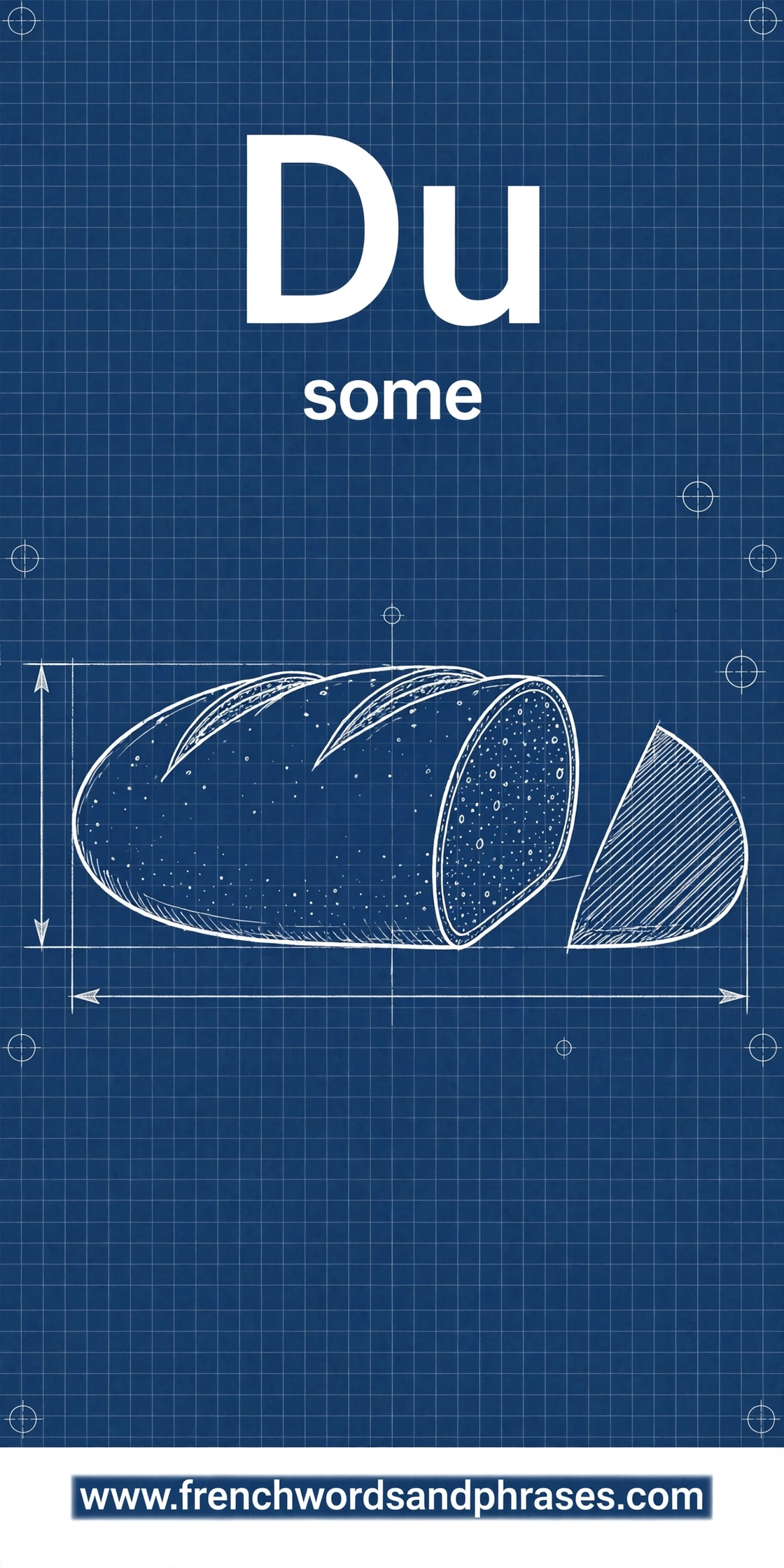
It means some — an amount, not a number. The picture it paints is a slice cut from a loaf, a cup poured from a pot: du pain, du café, du soleil. English ‘some’ often vanishes (‘I want bread’); French keeps du, because a masculine mass noun never travels without it.
Type: Partitive article — masculine singular (also the contraction de + le)
Answers the question: Combien ? — How much? (Answer: some, an uncounted amount)
What follows it: A masculine noun that is not counted: du pain, du thé, du courage
Watch the pair: du (some, an amount) vs le (the, the whole thing) — du pain = some bread, le pain = the bread / bread in general
One important usage detail: du disappears after a negative and after quantities — je ne bois pas de café (I don’t drink coffee), un kilo de pain (a kilo of bread). The little de that remains is the footprint du leaves behind.
Experience the Word
Du is the article of the kitchen table — of bread torn, coffee poured and soup ladled, where nothing is ever counted.
Imagine a winter morning in a village café: du café fumant, du pain grillé, du beurre, du soleil derrière les vitres — steaming coffee, toast, butter, sunshine behind the windows.
You have not just named a thing. You have taken a portion of it — some, enough, a helping.
How to Use Du in French: Complete Guide
Let’s explore how du works in French, beginning with the whole word on one card.
Du at a Glance
The Whole Word on One Card
Meaning, job, family and twin life — du in four lines.
| Point | Du |
|---|---|
| Meaning | some (an uncounted amount, masculine) |
| Job | partitive article — takes a portion of a mass noun |
| The family | du (m. sg.), de la (f. sg.), de l’ (before a vowel), des (plural) |
| Its twin life | du is also de + le fused: le toit du garage (the roof of the garage) |
Example
Je voudrais du fromage, s’il vous plaît.
I would like some cheese, please.
The Pattern in Action: A Portion, Not a Count
Du connects a sentence to a helping of something — food, weather, courage, or belonging.
| Pattern | Example |
|---|---|
| food and drink | il mange du pain et boit du lait — he eats bread and drinks milk |
| abstract masses | il faut du courage et du temps — you need courage and time |
| sports and instruments | ils font du vélo et elle joue du piano — they cycle and she plays the piano |
| of the (de + le) | le chien du voisin aboie — the neighbour’s dog is barking |
Example
Le matin, je bois du thé avec du miel.
In the morning, I drink tea with honey.
Quick Quiz 1
In je bois du café, are you drinking all the coffee in the world?
Reveal the answer
No — du takes a portion: some coffee, the cup in front of you.
Je bois du café, pas tout le café du monde.
I drink coffee, not all the coffee in the world.
The Tricky Bit: Du Steps Back to De
Du vanishes politely after negatives and quantities — and leaves de standing in its place.
| Situation | What happens |
|---|---|
| after a negative, du -> de | je ne veux pas de café — I don’t want any coffee |
| after a quantity, only de | beaucoup de pain, un litre de lait, assez de temps — lots of bread, a litre of milk, enough time |
| être keeps du in negatives | ce n’est pas du café, c’est du thé — it isn’t coffee, it’s tea (with être, du stays) |
| du is not ‘of’ by itself | the ‘of the’ du is de + le fused — it appears only where de meets le |
Example
Il n’y a plus de lait, mais il reste du pain.
There is no milk left, but there is still some bread.
Where It Goes: In Front of the Mass Noun
Du stands directly before its noun — unless a quantity expression takes its place.
| Position / pattern | Example |
|---|---|
| directly before the masculine noun | du pain, du riz, du sucre |
| after quantity expressions, de takes its place | une tasse de thé — a cup of tea (never ‘une tasse du thé’) |
| with faire for activities | faire du sport, faire du jardinage — to do sport, to do gardening |
| repeated before each noun | du pain et du beurre — bread and butter, each with its own du |
Example
Nous achetons du riz, du sel et du poivre.
We are buying rice, salt and pepper.
Quick Quiz 2
“A lot of time” — beaucoup du temps or beaucoup de temps?
Reveal the answer
beaucoup de temps — after a quantity word, du steps back and only de remains.
Ce travail demande beaucoup de temps.
This work takes a lot of time.
Everyday Expressions with Du
Du hides inside some of the most useful phrases in everyday French.
| Expression | In English |
|---|---|
| du matin au soir | from morning to evening |
| du coup | so, as a result (very everyday) |
| avoir du mal à | to have trouble doing something |
| pas du tout | not at all |
| du pain sur la planche | a lot of work ahead (lit. bread on the board) |
Example
Du coup, nous sommes partis plus tôt.
So, as a result, we left earlier.
Close Cousins: Du, Le, De, Un
Four small words before a masculine noun — the difference is portion, whole, or footprint.
| Word | The difference |
|---|---|
| le | the — the whole thing or the thing in general: le pain de ce boulanger (this baker’s bread) |
| de | the footprint after negatives and quantities: pas de pain, un kilo de pain |
| un | a — one whole countable thing: un pain (a loaf) vs du pain (some bread) |
| de la / des | the same ‘some’ in other shapes: de la (feminine), des (plural) |
Example
Je prends du pain, mais pas le pain rassis.
I’ll take some bread, but not the stale bread.
Quick Quiz 3
Which cousin counts one whole loaf — du or un?
Reveal the answer
un — un pain is one whole loaf; du pain is a portion of bread.
Elle achète un pain et du beurre.
She buys a loaf and some butter.
Du and Its Neighbours
The partitive shelf: ‘some’ in every shape, with the definites next door.
| French | In English |
|---|---|
| du | some (masculine singular partitive) |
| de la | some (feminine singular partitive) |
| de l’ | some (before a vowel) |
| des | some (plural partitive) |
| le / la / les | the (definite) |
Example
Il y a du pain, de la confiture et des fruits.
There is bread, jam and fruit.
Watch Out: The Traps Around Du
The traps: the dropped du, the stubborn du, and the du that means ‘of the’.
| Trap | The truth |
|---|---|
| dropping du because English drops ‘some’ | French keeps it: je veux du pain — never ‘je veux pain’ |
| keeping du after pas | the negative shrinks it: je n’ai pas de pain |
| keeping du after quantities | beaucoup de, un peu de, trop de — the de stands alone |
| confusing the two du | du pain = some bread (partitive); le livre du prof = of the (de + le) — same shape, different jobs |
Example
Il ne boit jamais de vin, seulement du jus.
He never drinks wine, only juice.
Quick Quiz 4
Complete: Je ne mange pas ______ viande. (I don’t eat meat.)
Reveal the answer
de — after pas, the partitive du becomes de.
Je ne mange pas de viande.
I don’t eat meat.
Du in Everyday French: Real-Life Examples
Now that you know the word, let’s see how du appears in everyday French.
Example Example 1 — Breakfast
Je prends du café et du pain grillé.
I have coffee and toast.
Example Example 2 — Shopping
Il nous faut du beurre et du sucre.
We need butter and sugar.
Example Example 3 — Weather
Aujourd’hui, il y a du vent et du soleil.
Today there is wind and sunshine.
Example Example 4 — Sport
Le dimanche, ils font du vélo dans la forêt.
On Sundays, they go cycling in the forest.
Example Example 5 — Courage
Il faut du courage pour changer de métier.
It takes courage to change jobs.
Example Example 6 — Music
Elle joue du piano depuis l’enfance.
She has played the piano since childhood.
Beyond Translation: The Meaning of Du
Bread in French is not a thing you count but a substance you share, and du is the knife that cuts the slice: some of it, a portion, enough for now. English measures with a word it keeps dropping; French marks every helping.
To say du is to take a part and leave the whole unspoken — the loaf stays whole in the background.
And du leads a double life: part article, part contraction, it is also de + le in disguise — so the same two letters can serve a portion of bread or point to the roof of the garage.
How to Remember the French Determiner Du
Remember it this way: Remember it this way: Du serves a portion of a masculine mass — and after pas or a quantity, it politely steps back to de.
- You picture a slice, not a count — du pain, du café, du temps.
- You shrink it after negatives and quantities — pas de pain, beaucoup de pain.
- You spot its twin — du can also be de + le: le toit du garage.
The key idea is du means some before a masculine mass noun, and it becomes de after negatives and quantity words.
Test Your Knowledge of Du
Let’s see how much you’ve learned. Try answering these questions before revealing the answers.
Question 1
What does du mean?
Reveal the answer
Some — the masculine singular partitive article, for uncounted amounts.
Question 2
What is du in le toit du garage?
Reveal the answer
De + le fused — ‘of the’: the roof of the garage.
Question 3
Translate: I would like some coffee.
Reveal the answer
Je voudrais du café.
Question 4
What happens to du after beaucoup?
Reveal the answer
It becomes de — beaucoup de café, never ‘beaucoup du café’.
Question 5
Complete the sentence:
Nous n’avons plus ______ lait. (We have no milk left.)
Reveal the answer
de
Nous n’avons plus de lait.
We have no milk left.
Your Final Challenge
Can You Use It?
How would you say this in French?
“How would you say this in French?”
Reveal the answer
Tu veux du thé ou du café ?
Do you want tea or coffee?
A little French. A little curiosity. A richer everyday life.
LEARN FRENCH ONE WORD AT A TIME