A French Word to Live By
Translate Zut to English
/zyt/
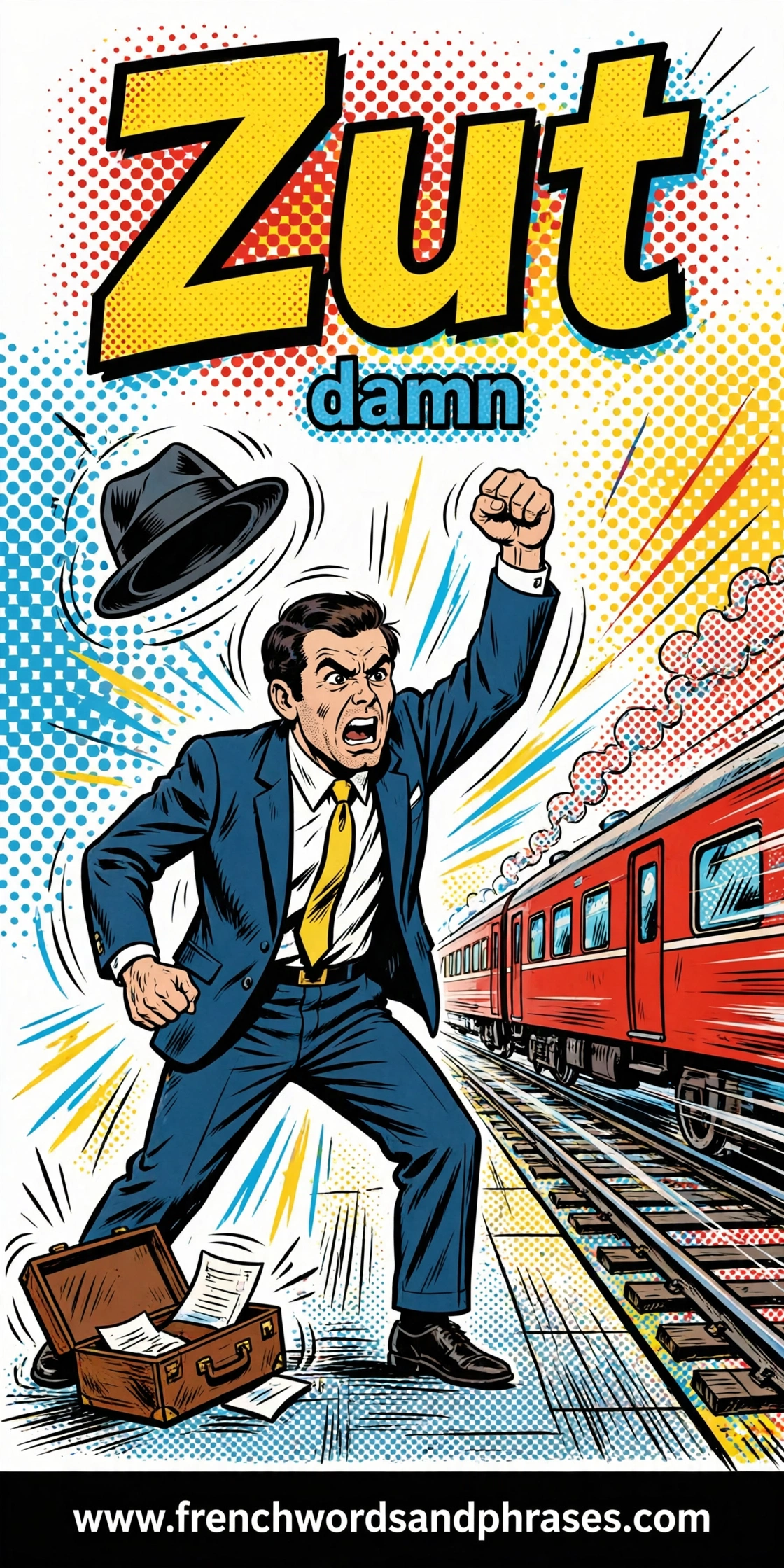
Zut means damn!.
A baker reaches for the tray, misses by a fingertip, and watches six croissants slide gracefully onto the floor. He sighs: « Zut ! Cinq secondes avant l’ouverture… » Damn! Five seconds before opening… Zut is the polite end of French annoyance — the word grandparents, teachers and bakers reach for when something small goes wrong and a real swear word would be far too much.
Let’s explore how zut works in French, beginning with the whole reaction on one card.
Understanding the French Interjection Zut
Zut is a French interjection of mild annoyance — and it is honest about what it is: a euphemism. It stands where a swear word (merde) might have gone, scrubbed clean for polite company. Its job is to let off a small puff of frustration when something minor goes wrong.
It means damn! — but the gentlest damn in the language. A missed bus, a forgotten umbrella, a dropped spoon: zut covers the little disasters of a day. It can also carry a drop of defiance — zut, je m’en fiche (drat, I do not care) — but even then it stays firmly on the polite side of the line.
Type: Interjection — reaction (mild annoyance)
Answers the need: Letting off steam at a small mishap — politely
Register: Polite and mild — a euphemism, safe with children and grandparents
Strength: Gentle — the softest curse in French; stronger versions add alors
One important usage detail: zut is a stand-in, and everyone knows it. That is exactly its charm — choosing zut instead of the real swear word signals ‘I am annoyed, but I am keeping this civilised’. It can sound slightly old-fashioned, which many speakers use deliberately, with a smile.
Experience the Word
Zut is frustration with its tie still straight — the mishap is real, but so are the manners.
Imagine the last train of the evening pulling away as you reach the platform, bag in hand: « Zut ! Le prochain est dans une heure. » The word does not change the timetable; it changes the temperature.
You have not solved the problem at all. You have marked it, mildly, and kept your dignity.
How to Use Zut in French: Complete Guide
Let’s explore how zut works in French, beginning with the whole reaction on one card.
Zut at a Glance
The Whole Reaction on One Card
Meaning, job, register and strength — zut in four lines.
| Point | Zut |
|---|---|
| Meaning | damn! / drat! — as mild as it gets |
| Job | releases a small puff of annoyance at a mishap |
| Register | polite euphemism — safe absolutely everywhere |
| Strength | gentle; zut alors adds surprise to the annoyance |
Example
Zut ! J’ai oublié mon parapluie !
Damn! I forgot my umbrella!
When You Say It: The Trigger Moments
Zut fires at life’s small disasters — nothing tragic, everything irritating.
| Situation | Example |
|---|---|
| A small mistake | zut, je me suis trompé de rue — damn, I took the wrong street |
| Forgetting something | zut ! mes clés sont restées dedans — damn! my keys are still inside |
| A minor accident | zut, j’ai renversé un peu d’eau — drat, I spilt a little water |
| Just missing something | zut, le magasin vient de fermer — damn, the shop has just closed |
| Mild defiance | zut, je le ferai demain — drat, I will do it tomorrow |
Example
Zut, le bus est parti sans nous !
Damn, the bus left without us!
Quick Quiz 1
Is zut a real swear word?
Reveal the answer
No — it is a euphemism, a polite stand-in for one. That is why it is safe everywhere.
Zut ! Le téléphone n’a plus de batterie.
Damn! The phone is out of battery.
The Reaction Question: A Sigh, a Shrug, a Zut Alors
Zut is delivered small — its power comes from how much it holds back.
| Delivery | What it does |
|---|---|
| Short, with a sigh | resigned annoyance — ‘drat’ |
| Zut alors ! | annoyance plus surprise — ‘well, damn!’ |
| Repeated: zut, zut, zut | muttering at a stubborn little problem |
| With a smile | self-mockery — laughing at your own mistake |
| Flat and quiet | defiance in miniature — ‘drat, I do not care’ |
Example
Zut alors, je n’ai plus un sou !
Well damn, I have not got a penny left!
Where It Goes: First Out of the Mouth
Zut escapes before the explanation — it opens the sentence or stands entirely alone.
| Position / pattern | Example |
|---|---|
| Standalone | zut ! — the whole reaction in one syllable |
| Opening a sentence | zut, j’ai raté le train de peu — damn, I just missed the train |
| With alors | zut alors, quelle malchance ! — well damn, what bad luck! |
| Before a decision | zut, on recommence — drat, let’s start again |
Example
Zut, il faut tout recommencer.
Damn, we have to start all over again.
Quick Quiz 2
What does zut alors add to plain zut?
Reveal the answer
Surprise — zut is annoyed; zut alors is annoyed AND taken aback.
Zut alors, déjà midi ?
Well damn, midday already?
Everyday Expressions with Zut
Zut appears in these everyday frames — small disasters, small defiances.
| Expression | In English |
|---|---|
| zut alors ! | well, damn! / good grief! |
| zut, c’est raté | drat, it failed |
| zut, je m’en fiche | drat, I do not care (mild defiance) |
| et zut ! | and drat it! (giving up, mildly) |
| zut, encore une erreur | damn, another mistake |
Example
Et zut, je laisse tomber pour aujourd’hui.
And drat it, I am giving up for today.
Close Cousins: The Politeness Ladder of Annoyance
Zut, mince and flûte are the three classic euphemisms — here is how the ladder climbs.
| Word | The difference |
|---|---|
| zut | the classic mild ‘damn’ — anywhere, anyone |
| mince | ‘shoot!’ — same family, a touch more modern and everyday |
| flûte | ‘dang!’ — the most old-fashioned and theatrical of the three |
| pff | ‘ugh’ — a sigh of annoyance rather than a word |
| merde | the real swear word — strong, and not for polite company |
Example
Mince, zut, flûte — choisis ton camp !
Shoot, damn, dang — pick your side!
Quick Quiz 3
Which word on the ladder is the real swear word — zut, flûte, or merde?
Reveal the answer
Merde — zut, mince and flûte are all polite stand-ins for it.
Zut, pas devant les enfants !
Damn — not in front of the children!
Zut and Its Neighbours
The annoyance shelf, from a sigh to a real curse.
| French | In English |
|---|---|
| pff | ugh (a sigh, barely a word) |
| zut | damn / drat (polite) |
| mince | shoot (polite, everyday) |
| flûte | dang (polite, old-fashioned) |
| merde | the real thing (strong — avoid in polite company) |
Example
Pff… zut, j’ai encore perdu mes gants.
Ugh… damn, I have lost my gloves again.
Watch Out: The Traps Around Zut
The traps: expecting force it does not have, and aiming it at real disasters.
| Trap | The truth |
|---|---|
| using zut for a serious accident | it would sound absurdly light — real trouble wants oh là là or silence |
| expecting it to sound tough | zut is deliberately soft — for force, French speakers climb the ladder |
| translating as a strong English swear | ‘drat’ or a soft ‘damn’ matches it; stronger words overshoot |
| thinking it is rude for children | it is the word children are TAUGHT to say instead of the real one |
Example
Zut, les enfants, on a manqué le début du film.
Drat, kids, we missed the start of the film.
Quick Quiz 4
A toddler drops her ice cream. Which is the reaction she has been taught — zut or the real swear word?
Reveal the answer
Zut — it exists precisely so that everyone, children included, can be annoyed politely.
Zut, ma glace est tombée !
Drat, my ice cream fell!
Zut in Everyday French: Real-Life Examples
Now that you know the word, let’s see how zut appears in everyday French.
Example Example 1 — Transport
Zut ! Le train a cinq minutes de retard.
Damn! The train is five minutes late.
Example Example 2 — Cooking
Zut, j’ai mis trop de sel.
Drat, I put in too much salt.
Example Example 3 — Weather
Zut alors, il se remet à pleuvoir !
Well damn, it is starting to rain again!
Example Example 4 — Work
Zut, l’imprimante est encore en panne.
Damn, the printer is broken again.
Example Example 5 — Shopping
Zut, il n’y a plus de pain.
Drat, there is no bread left.
Example Example 6 — Games
Zut, j’ai perdu d’un point !
Damn, I lost by one point!
Beyond Translation: The Meaning of Zut
A language reveals its manners in its euphemisms, and zut is impeccably mannered. It lets a whole society — from the toddler to the grandmother — share one small explosion of annoyance without a single genuinely rude word being spoken. Everyone hears the swear word hiding behind it; everyone politely pretends not to.
To say zut is to be annoyed in public, gracefully.
Its slight old-fashionedness has become part of the pleasure: zut is frustration wearing a bow tie.
How to Remember the French Interjection Zut
Remember it this way: Remember it this way: Zut is the bow-tie damn — real annoyance, dressed politely for any company.
- You keep it small — zut is for dropped spoons and missed buses, never real disasters.
- You add alors for surprise — zut alors is annoyed and taken aback at once.
- You remember it is a stand-in — the polite mask of a word you are choosing not to say.
The key idea is zut means a polite damn, it is a euphemism for a swear word, and zut alors adds surprise.
Test Your Knowledge of Zut
Let’s see how much you’ve learned. Try answering these questions before revealing the answers.
Question 1
What does zut mean?
Reveal the answer
Damn! / drat! — the mildest, politest annoyance in French.
Question 2
Is zut a real swear word?
Reveal the answer
No — it is a euphemism, a clean stand-in for one, safe for children and grandparents.
Question 3
Translate: Damn! I forgot my umbrella!
Reveal the answer
Zut ! J’ai oublié mon parapluie !
Question 4
What does zut alors add to zut?
Reveal the answer
Surprise — ‘well, damn!’ rather than a plain annoyed ‘drat’.
Question 5
Complete the sentence:
______ ! J’ai renversé mon café ! (Damn! I spilt my coffee!)
Reveal the answer
Zut
Zut ! J’ai renversé mon café !
Damn! I spilt my coffee!
Your Final Challenge
Can You Use It?
How would you say this in French?
“How would you say this in French?”
Reveal the answer
Zut ! J’ai oublié mon parapluie !
Damn! I forgot my umbrella!
A little French. A little curiosity. A richer everyday life.
LEARN FRENCH ONE WORD AT A TIME