A French Word to Live By
Translate Pour peu que to English
/puʁ pø kə/
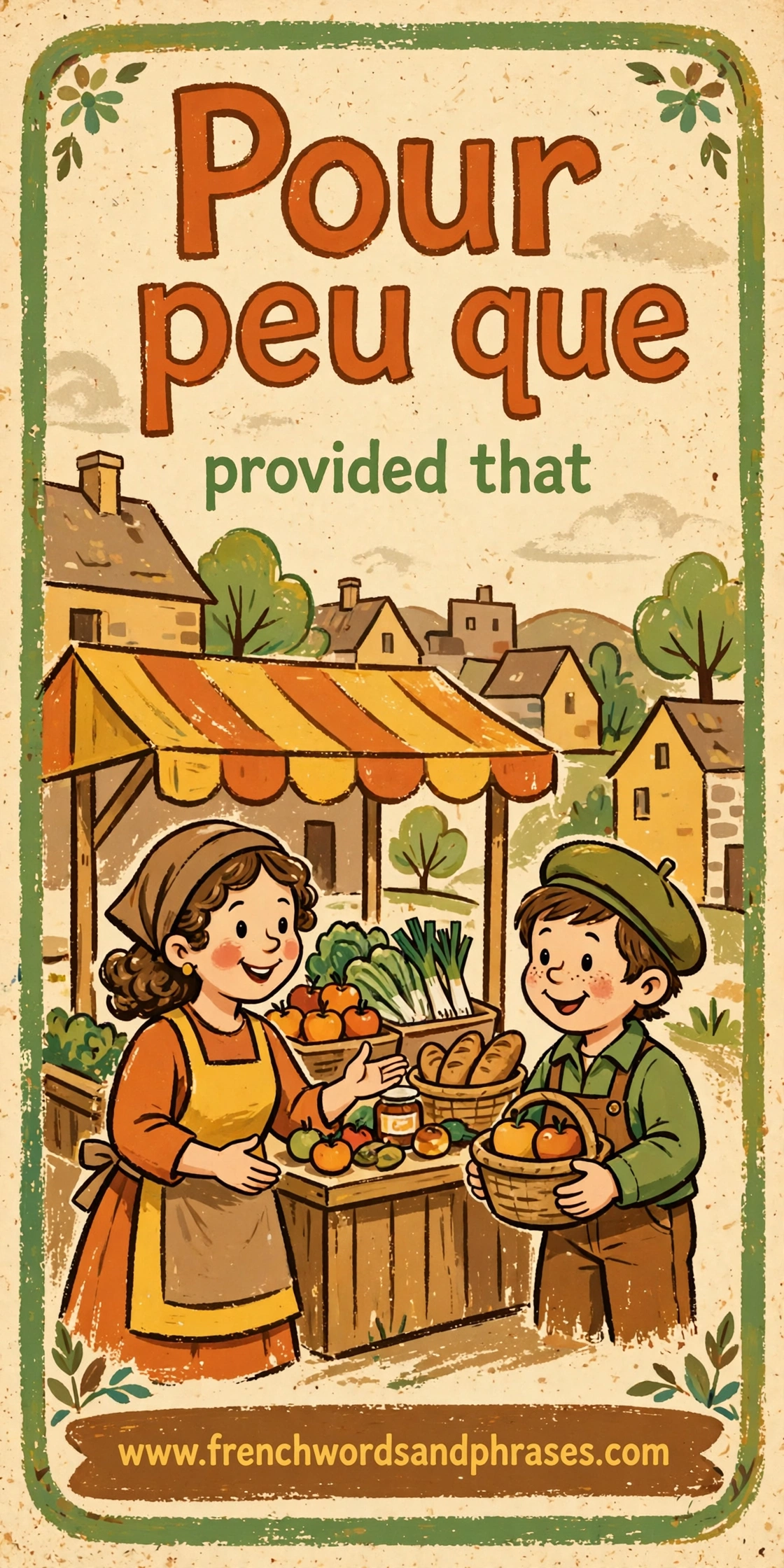
Pour peu que means provided that.
The old gardener looks at the dry flowerbeds, then at the single grey cloud crossing the valley. « Pour peu qu’il pleuve ce soir, les tomates sont sauvées. » If it rains even a little tonight, the tomatoes are saved. The smallest possible condition — and it is enough to change everything.
In this guide, you’ll learn what pour peu que means in English, how its little word peu sets the lowest possible bar for a condition, why the verb after it is always in the subjunctive, and how it differs from pourvu que and from pour peu de temps. Explore French examples, English translations, and practice quizzes.
Understanding the French Conjunction Pour peu que
Pour peu que is a French subordinating conjunction of condition — the minimal kind. It means provided that, but with a whisper inside it: if only slightly, if even a little, the condition is enough.
It means provided that — with the slightest quantity implied. After pour peu que comes a complete clause in the subjunctive: pour peu que tu travailles, tu réussiras — with even a little work on your part, you will succeed.
Type: Subordinating conjunction — condition (minimal)
Answers the question: À quelle condition ? — On what condition? (Answer: the slightest)
What follows it: A full clause: subject + verb
Mood after it: Subjunctive — always
One important usage detail: the peu is the soul of the expression. Pour peu que does not ask for much — it says the tiniest amount of rain, effort or luck will do. English often renders it ‘if only… a little’, ‘given the slightest…’, or ‘with the least bit of…’.
Experience the Word
Pour peu que is the conjunction of the small hinge — the word for doors that swing on almost nothing.
Imagine a violin maker holding a finished instrument to the light: « pour peu qu’on l’écoute, il chante tout seul » — listen to it even slightly, and it sings by itself.
You have not demanded a great condition. You have noticed how little the world needs to turn.
How to Use Pour peu que in French: Complete Guide
Let’s explore how pour peu que works in French, beginning with the whole expression on one card.
Pour peu que at a Glance
Before the details, here is the whole expression on one card.
The Whole Expression on One Card
Meaning, job, pattern and mood — pour peu que in four lines.
| Point | Pour peu que |
|---|---|
| Meaning | provided that — if even a little |
| Job | sets the smallest condition that is still enough |
| What follows | a full clause — subject + verb |
| Mood | subjunctive, always |
Example
Pour peu qu’il pleuve, le jardin revivra.
With even a little rain, the garden will come back to life.
How Pour peu que Links: The Tiny Condition First, the Result After
Pour peu que opens the sentence with its modest condition; the main clause then delivers a result far bigger than the condition deserves.
| Pattern | Example |
|---|---|
| pour peu que + clause, + result | pour peu que tu travailles, tu réussiras — with a little work, you’ll succeed |
| a weather condition | pour peu qu’il fasse beau, nous irons à la plage — if the weather is even a bit fine, we’ll go to the beach |
| a human condition | pour peu qu’on le lui demande gentiment, il accepte — ask him nicely, just a little, and he agrees |
| after the main clause | il guérira vite, pour peu qu’il se repose — he’ll recover quickly, provided he rests a bit |
Example
Pour peu que vous arriviez tôt, vous aurez de bonnes places.
Provided you arrive a little early, you’ll get good seats.
Quick Quiz 1
What does the little word peu add to pour peu que?
Reveal the answer
The idea of ‘even a little’ — the slightest amount of the condition is enough.
Pour peu qu’il pleuve.
If it rains even a little.
The Mood Question: Always the Subjunctive
A condition is a hypothesis, not a fact — and hypotheses take the subjunctive in French. After pour peu que, every verb wears it, however small the condition.
| Verb | Subjunctive forms after pour peu que |
|---|---|
| faire (weather) | qu’il fasse — pour peu qu’il fasse beau |
| travailler (to work) | que tu travailles — pour peu que tu travailles |
| être (to be) | qu’il soit, que vous soyez — pour peu qu’il soit patient |
| vouloir (to want) | que tu veuilles — pour peu que tu veuilles essayer |
Example
Pour peu qu’elle soit en forme, elle gagnera la course.
Provided she is even a little in form, she’ll win the race.
Where Pour peu que Goes: Front Door, with Elision
Pour peu que usually opens the sentence, its clause closed by a comma. Because il follows so often, you will mostly meet it elided: pour peu qu’il…
| Position | Example |
|---|---|
| Start of the sentence | pour peu qu’il pleuve ce soir, les tomates sont sauvées — if it rains even a little tonight, the tomatoes are saved |
| Comma after the clause | the small condition is set off before the big result |
| Elision before a vowel | pour peu qu’il fasse beau — que becomes qu’ |
| After the main clause | tu comprendras, pour peu que tu écoutes — you’ll understand, provided you listen a little |
Example
Pour peu qu’on lui parle doucement, le cheval s’approche.
Speak to it gently, just a little, and the horse comes closer.
Quick Quiz 2
Fix the mistake: Pour peu que tu travailles, tu réussiras — is anything wrong?
Reveal the answer
Nothing — travailler is in the subjunctive here (que tu travailles), exactly as pour peu que demands.
With a little work, you’ll succeed.
Everyday Expressions with Pour peu que
Pour peu que belongs to gardeners, cooks, teachers — everyone who knows how much can hang on how little.
| Expression | In English |
|---|---|
| pour peu qu’il pleuve | if it rains even a little |
| pour peu que tu y penses | if you give it even a little thought |
| pour peu qu’on s’y mette | if we make even a small start on it |
| pour peu qu’il soit honnête | provided he is even slightly honest |
| pour peu que ça dure | if it lasts even a little while |
Example
Pour peu qu’on s’y mette maintenant, tout sera fini ce soir.
If we make even a small start now, everything will be finished tonight.
Close Cousins: Pourvu que, À condition que, Si
The condition family is crowded. Pour peu que is the member who asks for the least — its cousins demand the condition in full.
| Word | The difference |
|---|---|
| pour peu que | ‘provided that — if even a little’ + subjunctive; the bar is set as low as it goes |
| pourvu que | ‘provided that’ + subjunctive — the full condition, no ‘little’ about it |
| à condition que | ‘on condition that’ + subjunctive — formal, contractual |
| si | ‘if’ + indicative — the everyday condition, a different mood entirely: si tu travailles, tu réussiras |
Example
Pourvu que tu viennes, et pour peu que tu restes une heure, la fête sera réussie.
Provided you come, and if you stay even an hour, the party will be a success.
Quick Quiz 3
Which cousin of pour peu que takes the indicative, not the subjunctive?
Reveal the answer
si — the ordinary ‘if’ builds its clause in the indicative.
Si tu travailles, tu réussiras.
If you work, you’ll succeed.
Pour peu que and Its Neighbours
Conditions on one side, their mirror image on the other: the word that says ‘unless the smallest thing goes wrong’.
| French | In English |
|---|---|
| pourvu que | provided that |
| à condition que | on condition that |
| du moment que | as long as / since (with the indicative) |
| à moins que | unless — the negative mirror of a condition |
| si jamais | if ever / if by any chance |
Example
Du moment qu’il est là, et pour peu qu’il aide, tout ira bien.
As long as he’s here, and if he helps even a little, all will be well.
Watch Out: The Traps Around Pour peu que
Two traps: a word-for-word translation that means nothing, and a look-alike phrase about time that has nothing to do with conditions.
| Trap | The truth |
|---|---|
| ‘for little that’ | a word-for-word translation — say ‘provided that’, ‘if even a little’, ‘with the slightest…’ |
| pour peu de temps | a different phrase entirely: ‘for a short time’ — pour peu de temps, il a plu (it rained briefly) |
| pour peu que + indicative | never: the condition is a hypothesis — pour peu qu’il fasse beau, not qu’il fait beau |
| losing the peu | pour que alone means ‘so that’ (purpose) — the peu is what makes it a minimal condition |
Example
Pour peu que le soleil se montre, nous déjeunerons dehors.
If the sun shows itself even a little, we’ll have lunch outside.
Quick Quiz 4
‘For a short time’ — pour peu que or pour peu de temps?
Reveal the answer
pour peu de temps — pour peu que introduces a condition, not a duration.
Il a neigé pour peu de temps.
It snowed for a short time.
Pour peu que in Everyday French: Real-Life Examples
Now that you know the word, let’s see how pour peu que appears in everyday French.
Example 1 — In the garden
Pour peu qu’il pleuve cette nuit, je n’arroserai pas demain.
If it rains even a little tonight, I won’t water tomorrow.
Example 2 — Studying
Pour peu que tu relises tes notes, l’examen semblera facile.
If you reread your notes even a little, the exam will seem easy.
Example 3 — Cooking
Pour peu qu’on sale la soupe, elle sera délicieuse.
With just a little salt in the soup, it will be delicious.
Example 4 — Children
Pour peu qu’on lui raconte une histoire, il s’endort.
Read him even a little story, and he falls asleep.
Example 5 — Music
Pour peu qu’elle chante doucement, toute la salle écoute.
If she sings even softly, the whole hall listens.
Example 6 — Hope
Pour peu que le vent tourne, les bateaux rentreront.
If the wind shifts even a little, the boats will come home.
Beyond Translation: The Meaning of Pour peu que
English says provided that for the meaning of pour peu que — but the French keeps the quantity in plain sight: peu, a little. The whole expression is a lesson in leverage — how small a condition can be and still move the world.
To say pour peu que is to set the bar at ankle height and watch the result clear it by a metre.
Gardeners, cooks and grandparents speak it fluently, because they know what grammars forget: most turning points are tiny — a shower, a pinch of salt, one kind word.
How to Remember the French Conjunction Pour peu que
Remember it this way: Pour peu que is the small-hinge word — the least condition that still swings the door.
- You keep the peu in view — the condition is tiny, and tiny is enough.
- You always follow it with the subjunctive — pour peu qu’il pleuve, pour peu que tu essaies.
- You never confuse it with pour peu de temps, which measures minutes, not conditions.
The key idea is pour peu que means provided that — if even a little — and always takes the subjunctive.
Test Your Knowledge of Pour peu que
Let’s see how much you’ve learned. Try answering these questions before revealing the answers.
Question 1
What does pour peu que mean?
Reveal the answer
Provided that — if even a little: the slightest amount of the condition is enough.
Question 2
Which mood follows pour peu que?
Reveal the answer
The subjunctive — always: pour peu qu’il fasse beau.
Question 3
Translate: If you listen even a little, you’ll understand.
Reveal the answer
Pour peu que tu écoutes, tu comprendras.
Question 4
What is the difference between pour peu que and pourvu que?
Reveal the answer
pour peu que asks for the slightest condition (‘if even a little’); pourvu que asks for the condition in full (‘provided that’). Both take the subjunctive.
Question 5
Complete the sentence:
Pour peu qu’il ______ (être) patient, l’enfant réussira.
Reveal the answer
soit
Pour peu qu’il soit patient, l’enfant réussira.
Provided he is even a little patient, the child will succeed.
Your Final Challenge
Can You Use It?
How would you say this in French?
“With the slightest effort, you can do it.”
Reveal the answer
Pour peu que tu fasses un effort, tu peux y arriver.
With the slightest effort, you can do it.
A little French. A little curiosity. A richer everyday life.
LEARN FRENCH ONE WORD AT A TIME