A French Word to Live By
Translate Pourvu que to English
/puʁ.vy kə/
Pourvu que means provided that.
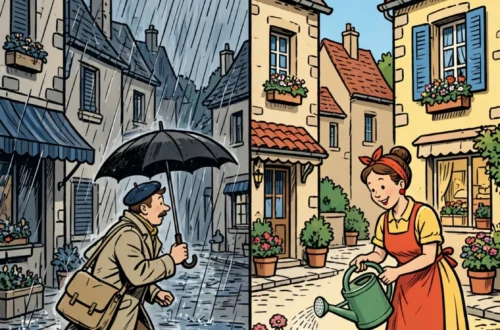
Two sisters pack the car for the sea at dawn, checking the sky through the kitchen window. « On part à six heures, pourvu qu’il ne pleuve pas. » We’ll leave at six, provided it doesn’t rain. And by the end of the day the phrase has turned into a wish whispered at the clouds: pourvu qu’il fasse beau !
In this guide, you’ll learn what pourvu que means in English, how it sets a condition the whole plan depends on, why the verb after it is always in the subjunctive, and how it doubles as a way of saying ‘let’s hope’. Explore French examples, English translations, and practice quizzes.
Understanding the French Conjunction Pourvu que
Pourvu que is a French subordinating conjunction of condition — the classic ‘provided that’. The main clause is a promise or a plan, and pourvu que names the one condition it hangs on.
It means provided that. After pourvu que comes a complete clause in the subjunctive, because the condition is not yet real — it is hoped for, required, still in the future: je te prêterai ma voiture, pourvu que tu conduises prudemment — I’ll lend you my car, provided you drive carefully.
Type: Subordinating conjunction — condition
Answers the question: À quelle condition ? — On what condition?
What follows it: A full clause: subject + verb
Mood after it: Subjunctive — always
One delightful usage detail: pourvu que can stand completely alone as a wish — Pourvu qu’il fasse beau ! Let’s hope the weather’s fine! No main clause, no condition stated: just hope, with the subjunctive still faithfully in place.
Experience the Word
Pourvu que is the conjunction of the held breath — the word a plan uses when it knows exactly what could ruin it.
Imagine a bride’s mother at the church door, watching clouds gather over the square: « pourvu qu’il ne pleuve pas avant la sortie » — and every guest hears the prayer inside the grammar.
You have not just set a condition. You have named the one thing the day depends on.
How to Use Pourvu que in French: Complete Guide
Let’s explore how pourvu que works in French, beginning with the whole word on one card.
Pourvu que at a Glance
Before the details, here is the whole word on one card.
The Whole Word on One Card
Meaning, job, pattern and mood — pourvu que in four lines.
| Point | Pourvu que |
|---|---|
| Meaning | provided that |
| Job | names the condition a plan or promise depends on |
| What follows | a full clause — subject + verb |
| Mood | subjunctive, always |
Example
Je viendrai, pourvu que je sois libre.
I’ll come, provided I’m free.
How Pourvu que Links: The Plan First, the Condition After
Pourvu que usually trails behind the main clause like a signature condition at the bottom of a contract — but it can also open the sentence, and it can even stand alone as a wish.
| Pattern | Example |
|---|---|
| plan + pourvu que + condition | je te prêterai ma voiture, pourvu que tu conduises prudemment — I’ll lend you my car, provided you drive carefully |
| condition first | pourvu qu’il ne pleuve pas, nous partirons à six heures — provided it doesn’t rain, we’ll leave at six |
| a negative condition | tu peux sortir, pourvu que tu ne rentres pas tard — you can go out, provided you don’t come home late |
| standing alone as a wish | pourvu qu’il fasse beau ! — let’s hope the weather’s fine! |
Example
Nous pique-niquerons dimanche, pourvu que le ciel soit clair.
We’ll have a picnic on Sunday, provided the sky is clear.
Quick Quiz 1
Which mood follows pourvu que?
Reveal the answer
The subjunctive — the condition is required or hoped for, not yet real.
Pourvu qu’il fasse beau !
Let’s hope the weather’s fine!
The Mood Question: Always the Subjunctive
A condition lives in the future and in doubt, so French gives it the subjunctive every time. Watch être, faire, pouvoir and venir — the four verbs pourvu que loves most.
| Verb | Subjunctive forms after pourvu que |
|---|---|
| faire (weather) | qu’il fasse — pourvu qu’il fasse beau |
| être (to be) | que tu sois, qu’il soit — pourvu que tu sois à l’heure |
| pouvoir (to be able) | que je puisse, que nous puissions — pourvu que je puisse venir |
| venir (to come) | qu’il vienne, qu’ils viennent — pourvu qu’ils viennent tous |
Example
Je serai tranquille pourvu que les enfants soient sages.
I’ll be at ease provided the children behave.
Where Pourvu que Goes: After the Plan, or Alone as a Wish
Pourvu que is at home after the main clause, setting the terms. Put first, it sounds like a warning or a prayer; left alone with an exclamation mark, it is pure hope.
| Position | Example |
|---|---|
| After the main clause | nous partirons, pourvu que tu sois prêt — we’ll leave, provided you’re ready |
| Start of the sentence | pourvu qu’il ne neige pas, la route sera belle — provided it doesn’t snow, the road will be lovely |
| Standing alone | pourvu que ça dure ! — let’s hope it lasts! |
| Elision before a vowel | pourvu qu’il vienne — que becomes qu’ |
Example
Pourvu que le train soit à l’heure, nous arriverons pour le dîner.
Provided the train is on time, we’ll arrive for dinner.
Quick Quiz 2
Fix the mistake: Je viendrai pourvu que je suis libre.
Reveal the answer
Je viendrai pourvu que je sois libre — être must be in the subjunctive after pourvu que.
I’ll come, provided I’m free.
Everyday Expressions with Pourvu que
Pourvu que is what French people say to the sky, to the timetable and to fate itself — conditions and wishes in one breath.
| Expression | In English |
|---|---|
| pourvu qu’il fasse beau ! | let’s hope the weather’s fine! |
| pourvu que tout se passe bien | provided everything goes well |
| pourvu que ça dure ! | let’s hope it lasts! |
| pourvu qu’on arrive à temps | provided we arrive in time |
| pourvu qu’il ne soit pas malade | let’s hope he isn’t ill |
Example
Le bébé dort enfin — pourvu que ça dure !
The baby is finally asleep — let’s hope it lasts!
Close Cousins: À condition que, Pour peu que, Si, À moins que
The condition family again, from the formal contract to the everyday if — pourvu que sits in the warm middle, half condition, half hope.
| Word | The difference |
|---|---|
| pourvu que | ‘provided that’ + subjunctive — a condition the speaker cares about, often a wish in disguise |
| à condition que | ‘on condition that’ + subjunctive — cooler, formal, contractual |
| pour peu que | ‘provided that — if even a little’ + subjunctive — only the slightest condition is needed |
| si | ‘if’ + indicative — the plain everyday condition, no subjunctive |
| à moins que | ‘unless’ + subjunctive — the negative twin: provided that… NOT |
Example
À condition que tu travailles, et pourvu que tu sois sérieux, tu réussiras.
On condition that you work, and provided you’re serious, you’ll succeed.
Quick Quiz 3
How do you say ‘Let’s hope it doesn’t rain!’ with pourvu que?
Reveal the answer
Pourvu qu’il ne pleuve pas ! — standing alone, pourvu que becomes a wish, subjunctive included.
Let’s hope it doesn’t rain!
Pourvu que and Its Neighbours
Around pourvu que: the cooler conditions, the hopeful synonyms, and the negative mirror that flips its meaning.
| French | In English |
|---|---|
| à condition que | on condition that |
| du moment que | as long as (with the indicative) |
| dans la mesure où | insofar as |
| espérons que | let’s hope that (with the indicative or future) |
| à moins que | unless — the opposite condition |
Example
Espérons qu’il vienne ; du moment qu’il est là, pourvu qu’il reste, tout ira bien.
Let’s hope he comes; as long as he’s here, provided he stays, all will be well.
Watch Out: The Traps Around Pourvu que
The traps: an indicative sneaking in, a condition aimed at the past, and an adjective wearing the same name.
| Trap | The truth |
|---|---|
| pourvu que + indicative | never: pourvu qu’il fait beau is wrong — say pourvu qu’il fasse beau |
| conditions about the past | pourvu que looks forward — for a settled past fact, use a different build: j’espère qu’il est arrivé |
| pourvu de | a different word: ‘provided with, equipped with’ — un hôtel pourvu d’une piscine, a hotel equipped with a pool |
| forgetting the wish use | alone with an exclamation, pourvu que is hope, not a contract: pourvu qu’elle réussisse ! |
Example
Pourvu qu’elle réussisse son examen !
Let’s hope she passes her exam!
Quick Quiz 4
‘A hotel equipped with a pool’ — is that pourvu que?
Reveal the answer
No — that’s pourvu de, an adjective meaning ‘equipped with’.
Un hôtel pourvu d’une piscine.
A hotel equipped with a pool.
Pourvu que in Everyday French: Real-Life Examples
Now that you know the word, let’s see how pourvu que appears in everyday French.
Example 1 — Weather
Nous irons à la mer pourvu qu’il ne pleuve pas.
We’ll go to the seaside provided it doesn’t rain.
Example 2 — Lending
Je te prête mon vélo, pourvu que tu le rapportes ce soir.
I’ll lend you my bike, provided you bring it back tonight.
Example 3 — A wish
Pourvu que le bébé dorme pendant le vol !
Let’s hope the baby sleeps during the flight!
Example 4 — Work
Le projet marchera pourvu que tout le monde soit d’accord.
The project will work provided everyone agrees.
Example 5 — Cooking
Le gâteau sera bon pourvu que le four soit chaud.
The cake will be good provided the oven is hot.
Example 6 — Travel
Pourvu que nous ayons assez d’essence pour la montagne !
Let’s hope we have enough fuel for the mountain!
Beyond Translation: The Meaning of Pourvu que
English says provided that for the meaning of pourvu que — a lawyer’s phrase, cool and contractual. The French word is warmer: pourvu is the past participle of pourvoir, to provide — as if the condition were a provision packed for a journey, the one thing that must be in the bag.
To say pourvu que is to pack your hope into the grammar and zip the condition shut.
And when the main clause falls away — pourvu qu’il fasse beau ! — the provision is all that remains: a condition with nothing left to condition, which is exactly what a wish is.
How to Remember the French Conjunction Pourvu que
Remember it this way: Pourvu que is the held-breath word — one condition, packed like a provision, and the whole plan hangs on it.
- You picture the plan as a packed bag — pourvu, provided: the condition is the one thing that must be inside.
- You always follow it with the subjunctive — pourvu qu’il fasse beau, pourvu que tu sois prêt.
- You remember its second life — standing alone, it stops being a condition and becomes a wish.
The key idea is pourvu que means provided that, always takes the subjunctive, and alone it means let’s hope.
Test Your Knowledge of Pourvu que
Let’s see how much you’ve learned. Try answering these questions before revealing the answers.
Question 1
What does pourvu que mean?
Reveal the answer
Provided that — it names the condition a plan or promise depends on.
Question 2
Which mood follows pourvu que?
Reveal the answer
The subjunctive — always: pourvu qu’il fasse beau.
Question 3
Translate: I’ll help you, provided that you ask politely.
Reveal the answer
Je t’aiderai, pourvu que tu demandes poliment.
Question 4
What can pourvu que do all on its own?
Reveal the answer
It can express a wish: Pourvu qu’il ne pleuve pas ! — Let’s hope it doesn’t rain!
Question 5
Complete the sentence:
Nous partirons à l’heure pourvu que tout le monde ______ (être) prêt.
Reveal the answer
soit
Nous partirons à l’heure pourvu que tout le monde soit prêt.
We’ll leave on time provided everyone is ready.
Your Final Challenge
Can You Use It?
How would you say this in French?
“I’ll lend you my car, provided that you drive carefully.”
Reveal the answer
Je te prêterai ma voiture, pourvu que tu conduises prudemment.
I’ll lend you my car, provided that you drive carefully.
A little French. A little curiosity. A richer everyday life.
LEARN FRENCH ONE WORD AT A TIME