A French Word to Live By
Translate Deuxièmement to English
/døzjɛmmɑ̃/
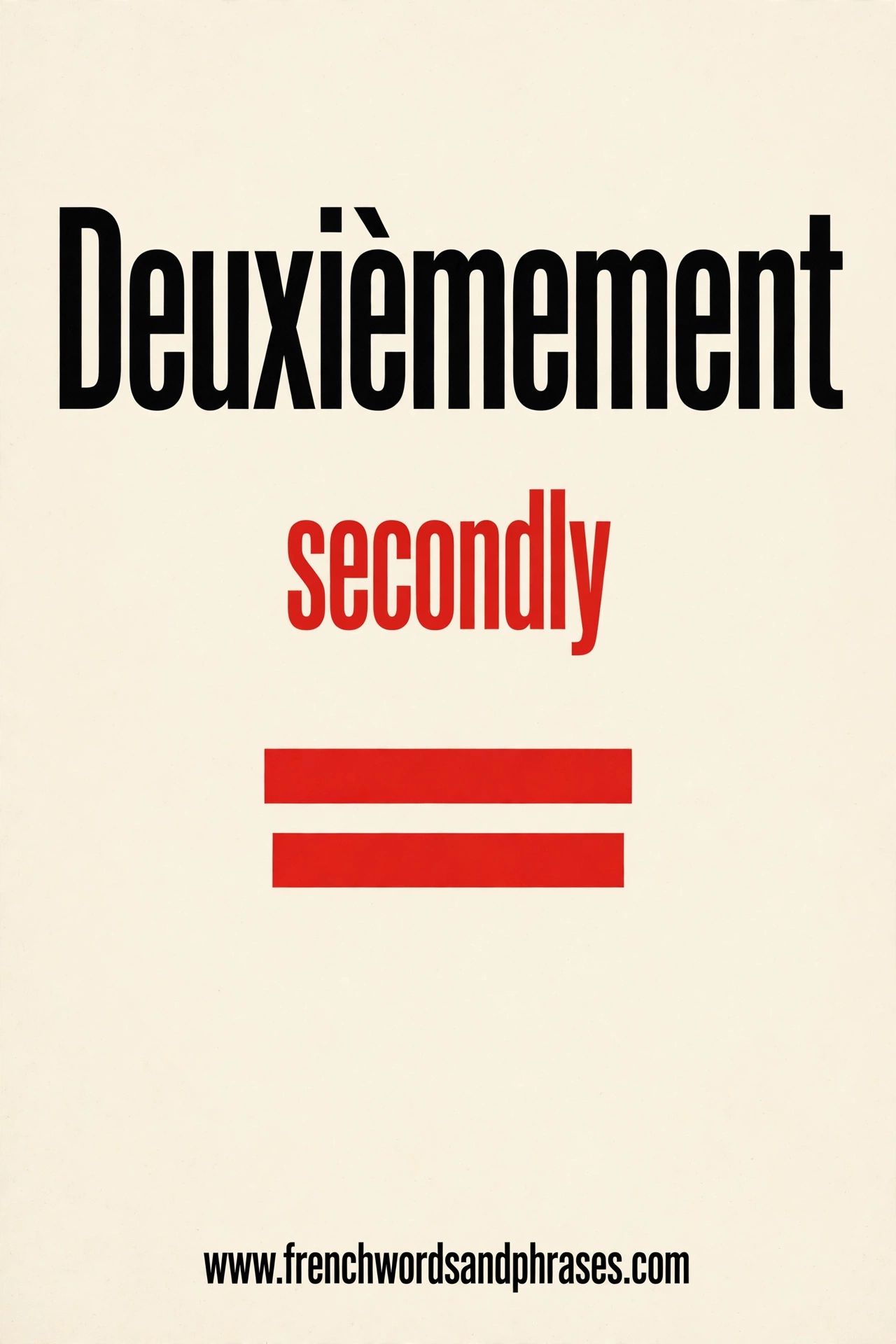
Deuxièmement means secondly.
The finger goes up again — the second one this time. « Deuxièmement… » The audience, already settled by premièrement, leans into point two: the argument is keeping its promise, one numbered step at a time.
In this guide, you’ll learn what deuxièmement means in English, how it carries the second point of a series, why — honestly — it is an adverb rather than a conjunction, and how the full staircase premièrement… deuxièmement… enfin is built. Explore French examples, English translations, and practice quizzes.
Understanding the French Conjunction Deuxièmement
Deuxièmement is, honestly, a French adverb — built from deuxième, second, with the -ment ending. Like its elder premièrement, it does a connector’s job without being a conjunction: it labels the second point of a list or argument.
It means secondly — in the second place. It only makes sense after a first point has been made: premièrement, c’est cher ; deuxièmement, c’est loin — firstly, it’s expensive; secondly, it’s far. Point two rarely travels alone.
Type: Adverb (in -ment) used as a listing connector
Job: Announces the second point of a series
It presupposes: A premièrement before it — stated or understood
What follows it: A complete statement, usually after a comma
One important usage detail: deuxièmement lives in the same organised register as premièrement — essays, speeches, formal letters, careful explanations. Spoken French usually prefers ensuite or et puis for point two.
Experience the Word
Deuxièmement is the connector of the kept promise — premièrement said ‘a series is coming’, and deuxièmement proves it.
Imagine the grandfather at Sunday lunch, second finger raised: « deuxièmement, on ne parle pas la bouche pleine ». The children groan; the architecture of the lecture delights them anyway.
You have not just added a point. You have shown that your thought has a skeleton.
How to Use Deuxièmement in French: Complete Guide
Let’s explore how deuxièmement works in French, beginning with the whole word on one card.
Deuxièmement at a Glance
Before the details, here is the whole word on one card.
The Whole Word on One Card
Meaning, job, word class and mood — deuxièmement in four lines.
| Point | Deuxièmement |
|---|---|
| Meaning | secondly — in the second place |
| Job | opens point two of a list or argument |
| Word class | adverb — it numbers clauses, it does not join them |
| Mood | no mood question: the clause keeps its indicative |
Example
Deuxièmement, le quartier est calme.
Secondly, the neighbourhood is quiet.
How Deuxièmement Links: The Middle Carriage
Deuxièmement links backwards and forwards at once: it leans on premièrement behind it and leaves the door open for troisièmement or enfin ahead.
| Pattern | Example |
|---|---|
| second of two points | premièrement, c’est grand ; deuxièmement, c’est lumineux — firstly, it’s big; secondly, it’s bright |
| second of several | premièrement le prix, deuxièmement la place, troisièmement la lumière — first the price, second the space, third the light |
| second reason | deuxièmement, nous n’avons pas le temps — secondly, we don’t have the time |
| closing after it | …deuxièmement, c’est sûr ; enfin, c’est beau — secondly, it’s safe; finally, it’s beautiful |
Example
Premièrement, elle est douée ; deuxièmement, elle travaille dur.
Firstly, she is talented; secondly, she works hard.
Quick Quiz 1
What must normally come before deuxièmement?
Reveal the answer
A first point — premièrement, stated or at least understood.
Premièrement, c’est près ; deuxièmement, c’est calme.
Firstly, it’s near; secondly, it’s quiet.
The Mood Question: An Adverb Governs Nothing
Like premièrement, deuxièmement introduces no clause and chooses no mood. The statement it labels keeps the ordinary indicative, in whatever tense the content needs.
| Tense with deuxièmement | Example |
|---|---|
| Present | deuxièmement, je remarque un bruit — secondly, I notice a noise |
| Past | deuxièmement, nous avons perdu la clé — secondly, we lost the key |
| Future | deuxièmement, vous verrez la différence — secondly, you will see the difference |
| Imperative after it | deuxièmement, notez la date — secondly, note the date |
Example
Deuxièmement, il faut protéger les enfants.
Secondly, the children must be protected.
Where Deuxièmement Goes: Start of Point Two
The word stands at the head of its statement, followed by a comma. In a long text it may open a paragraph; in speech it lands with a small pause on each side, like a step on a stair.
| Position | Example |
|---|---|
| Start of the sentence | deuxièmement, le service est excellent — secondly, the service is excellent |
| Followed by a comma | deuxièmement, … — the comma belongs to the pattern |
| Start of a paragraph | Deuxièmement, … (point two gets its own paragraph in essays) |
| After a semicolon | premièrement, ceci ; deuxièmement, cela — firstly this; secondly that |
Example
Premièrement, le loyer ; deuxièmement, les charges.
Firstly, the rent; secondly, the bills.
Quick Quiz 2
True or false: deuxièmement takes the subjunctive after it.
Reveal the answer
False — it is an adverb and governs no mood at all; the verb stays in the indicative.
Deuxièmement, elle vient demain.
Secondly, she is coming tomorrow.
Everyday Expressions with Deuxièmement
Deuxièmement belongs to the same staircase as premièrement — here is the set it travels with.
| Expression | In English |
|---|---|
| premièrement… deuxièmement… | firstly… secondly… |
| premièrement… deuxièmement… troisièmement… | firstly… secondly… thirdly… |
| en deuxième lieu | in the second place (formal synonym) |
| deuxièmement, et c’est le plus important… | secondly — and this is the most important point… |
Example
En deuxième lieu, pensez aux enfants.
In the second place, think of the children.
Close Cousins: Deuxièmement, Ensuite, Et puis, Après
All four can carry a second step, but only deuxièmement numbers it. The others move in time or in casual addition.
| Word | The difference |
|---|---|
| deuxièmement | point two of a numbered argument — organised, slightly formal |
| ensuite | ‘then, next’ — the next step in a sequence, spoken or written |
| et puis | ‘and then’ — the relaxed spoken addition |
| après | ‘afterwards’ — time order, not argument order |
Example
Ensuite, ajoute le lait et mélange.
Then, add the milk and stir.
Quick Quiz 3
Reading a recipe aloud to a friend: deuxièmement or ensuite?
Reveal the answer
ensuite — recipes move in time; deuxièmement is for numbered arguments.
Ensuite, mets le plat au four.
Then, put the dish in the oven.
Deuxièmement and Its Neighbours
The listing family, in order — the step before, the step after, and the closer.
| French | In English |
|---|---|
| premièrement | firstly (the step before) |
| troisièmement | thirdly (the step after) |
| enfin / finalement | finally (the closer) |
| en deuxième lieu | in the second place |
| ensuite | then, next |
Example
Premièrement, deuxièmement, troisièmement : le plan est clair.
Firstly, secondly, thirdly: the plan is clear.
Watch Out: The Traps Around Deuxièmement
Mind the orphan second point, the register, and the long word’s spelling.
| Trap | The truth |
|---|---|
| the orphan point two | deuxièmement without any first point sounds like walking in mid-argument — set up premièrement first |
| too formal for chat | among friends, ensuite or et puis carry point two more naturally |
| spelling | deuxièmement: deux-ième-ment, with è — a long word, written in one piece |
| mixing the systems | don’t mix numbering with pure time words in one list: premièrement… ensuite… deuxièmement tangles the staircase |
Example
Premièrement, le goût ; deuxièmement, le prix ; enfin, la santé.
Firstly, the taste; secondly, the price; finally, health.
Quick Quiz 4
A friend starts a story: ‘Deuxièmement, je suis allé au marché…’ What feels wrong?
Reveal the answer
There is no first point — deuxièmement presupposes a premièrement.
Premièrement, je me suis levé tôt ; deuxièmement, je suis allé au marché.
Firstly, I got up early; secondly, I went to the market.
Deuxièmement in Everyday French: Real-Life Examples
Now that you know the word, let’s see how deuxièmement appears in everyday French.
Example 1 — House hunting
Premièrement, l’appartement est clair ; deuxièmement, il est près du métro.
Firstly, the flat is bright; secondly, it is near the metro.
Example 2 — A complaint letter
Deuxièmement, la livraison est arrivée en retard.
Secondly, the delivery arrived late.
Example 3 — A debate
Premièrement, les faits ; deuxièmement, les conséquences.
Firstly, the facts; secondly, the consequences.
Example 4 — Instructions
Deuxièmement, branchez l’appareil et attendez.
Secondly, plug in the device and wait.
Example 5 — Pros and cons
Premièrement, c’est beau ; deuxièmement, c’est solide ; enfin, c’est cher.
Firstly, it’s beautiful; secondly, it’s solid; finally, it’s expensive.
Example 6 — The staircase
Deuxièmement, mon frère, tu dois écouter avant de répondre.
Secondly, brother, you must listen before answering.
Beyond Translation: The Meaning of Deuxièmement
English says secondly for deuxièmement — a word English style guides love to scold, and French uses with far less guilt.
Deuxièmement is proof that French trusts the numbered list as a form of politeness: your listener always knows where they are.
Deux, two, sits inside it, with the ordinal -ième that also builds troisième and dixième. Learn deuxièmement and you have quietly learned the whole staircase.
How to Remember the French Conjunction Deuxièmement
Remember it this way: Deuxièmement is the second step of the staircase — it only exists because premièrement built the first.
- You never start with it — a first point must come before.
- You keep the same register as premièrement: organised, comma after.
- You close the series with troisièmement if there is more, or enfin if there isn’t.
The key idea is deuxièmement is point two — it leans on premièrement and points to enfin.
Test Your Knowledge of Deuxièmement
Let’s see how much you’ve learned. Try answering these questions before revealing the answers.
Question 1
What does deuxièmement mean?
Reveal the answer
Secondly — in the second place.
Question 2
What word class is deuxièmement, honestly?
Reveal the answer
An adverb — built on deuxième with -ment. It numbers statements; it does not join clauses.
Question 3
Translate: Secondly, the house is too small.
Reveal the answer
Deuxièmement, la maison est trop petite.
Question 4
What must come before deuxièmement?
Reveal the answer
A first point — premièrement, said or understood.
Question 5
Complete the staircase:
Premièrement, le temps ; ______, l’argent ; enfin, l’énergie.
Reveal the answer
deuxièmement
Premièrement, le temps ; deuxièmement, l’argent ; enfin, l’énergie.
Firstly, time; secondly, money; finally, energy.
Your Final Challenge
Can You Use It?
How would you say this in French?
“Secondly, we must save money.”
Reveal the answer
Deuxièmement, nous devons économiser de l’argent.
Secondly, we must save money.
A little French. A little curiosity. A richer everyday life.
LEARN FRENCH ONE WORD AT A TIME