A French Word to Live By
Translate Par contre to English
/paʁ kɔ̃tʁ/
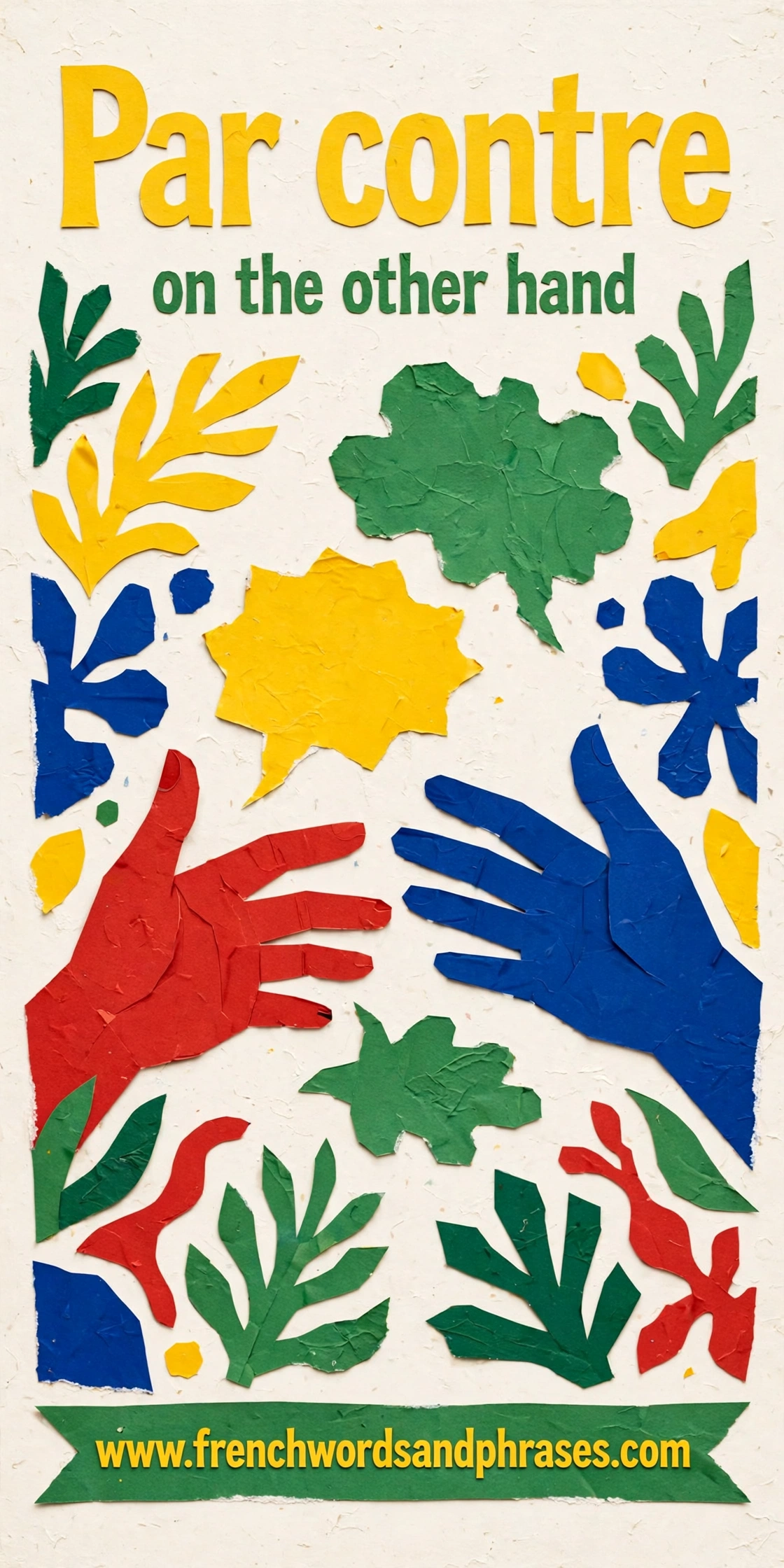
Par contre means on the other hand.
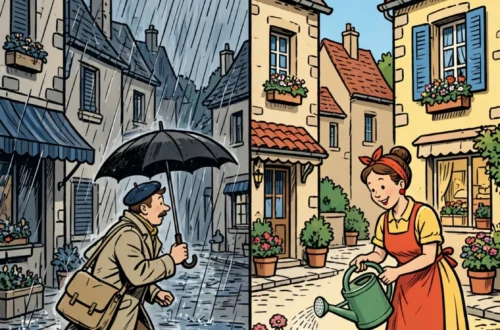
Two brothers in Marseille are choosing a flat. « Celui-ci est grand, » says the elder, walking through the sunny rooms. « Par contre, » says the younger, opening the window onto a roaring motorway, « écoute le bruit. » One phrase, and the scales tip the other way. Par contre is the other pan of the balance.
In this guide, you’ll learn what par contre means in English, how it balances one fact against an opposing one, where it sits in the sentence, and how it differs from en revanche and au contraire. Explore French examples, English translations, and practice quizzes.
Understanding the French Conjunction Par contre
Par contre is a French linking adverbial phrase of contrast — honestly, not a conjunction. It does not subordinate anything; it sets a second statement on the other side of the scales from the first, and lets the reader feel the balance shift.
It means on the other hand. One side is presented, then par contre presents the opposing side: le matin, il fait frais ; par contre, l’après-midi est brûlant — in the morning it’s cool; on the other hand, the afternoon is scorching. Two real facts, facing each other.
Type: Linking adverbial phrase — contrast (not a true conjunction)
Job: balances a fact with its opposing fact
What it links: two complete statements presenting two sides
Mood after it: No effect — the verbs stay in the indicative
One historical usage detail: purists once objected to par contre and insisted on en revanche — but the battle is long over. Par contre is fully standard today, in speech and writing alike, and you will hear it constantly.
Experience the Word
Par contre is the phrase of the fair-minded friend — the one who always shows you the other side of the coin before you spend it.
Imagine a woman describing her new job. « Le salaire est modeste, » she admits, « par contre, je finis à quatre heures et je rentre à pied. » Nothing is hidden: the minus and the plus are weighed in the open.
You have not complained, and you have not boasted. You have balanced the account.
How to Use Par contre in French: Complete Guide
Let’s explore how par contre works in French, beginning with the whole phrase on one card.
Par contre at a Glance
Before the details, here is the whole phrase on one card.
The Whole Phrase on One Card
Meaning, job, pattern and mood — par contre in four lines.
| Point | Par contre |
|---|---|
| Meaning | on the other hand |
| Job | sets the opposing side against the first |
| What it links | two complete statements, side against side |
| Mood | no effect — indicative everywhere |
Example
Il est timide ; par contre, il est très généreux.
He is shy; on the other hand, he is very generous.
How Par contre Links: One Side, Then the Other
Par contre works like a pair of scales: statement one settles into the first pan, then par contre drops statement two into the other pan and the balance moves.
| Pattern | Example |
|---|---|
| side A. Par contre, side B. | l’hiver est rude. Par contre, le printemps est doux — winter is harsh. On the other hand, spring is gentle |
| person A…, par contre, person B… | moi, je déteste la foule ; par contre, ma sœur l’adore — I hate crowds; on the other hand, my sister loves them |
| pros and cons | c’est loin ; par contre, c’est très calme — it’s far; on the other hand, it’s very quiet |
| price against quality | ce modèle coûte cher ; par contre, il dure des années — this model is expensive; on the other hand, it lasts for years |
Example
Le quartier est bruyant. Par contre, tout est à deux pas.
The neighbourhood is noisy. On the other hand, everything is two steps away.
Quick Quiz 1
What must exist before par contre can do its job — one side of a balance, or two?
Reveal the answer
Two — par contre needs a first side already on the scales before it can set down the opposing one.
C’est petit ; par contre, c’est lumineux.
It’s small; on the other hand, it’s bright.
The Mood Question: Contrast Without Subordination
Par contre is an adverbial phrase, so it governs no clause and triggers no subjunctive. The verbs on both sides of the balance keep the ordinary indicative. For a truly subordinated contrast, French uses alors que or pendant que instead.
| Pattern | Example |
|---|---|
| Present against present | il travaille vite ; par contre, il fait des erreurs — he works fast; on the other hand, he makes mistakes |
| Past tenses | nous avons payé cher ; par contre, nous avons été très bien reçus — we paid a lot; on the other hand, we were very well received |
| Future | tu partiras tôt ; par contre, tu arriveras avant la nuit — you’ll leave early; on the other hand, you’ll arrive before nightfall |
| The subordinating alternative | alors que lui dort, elle travaille — while he sleeps, she works (alors que + clause, one sentence) |
Example
Elle parle peu ; par contre, elle écoute énormément.
She speaks little; on the other hand, she listens enormously.
Where Par contre Goes: Start, Middle, Always Fenced by Commas
Par contre opens its statement or slips into the middle of it between commas — after the subject, typically. It never glues two clauses together inside a single comma-joined rush.
| Position | Example |
|---|---|
| Start of the statement | Par contre, le dimanche, tout est fermé. — On the other hand, on Sundays everything is closed. |
| Mid-sentence, between commas | elle, par contre, préfère le thé — she, on the other hand, prefers tea |
| After a semicolon | le train est rapide ; par contre, il est souvent complet — the train is fast; on the other hand, it’s often full |
| In the pair d’un côté… par contre… | d’un côté, c’est pratique ; par contre, c’est moche — on one side it’s practical; on the other hand, it’s ugly |
Example
Moi, par contre, je reste à la maison.
Me, on the other hand, I’m staying home.
Quick Quiz 2
Can par contre sit in the middle of its clause, between commas, as in « elle, par contre, refuse »?
Reveal the answer
Yes — mid-clause between commas is one of its natural homes, often right after the subject.
Elle, par contre, refuse.
She, on the other hand, refuses.
Everyday Expressions with Par contre
Par contre lives in balanced pairs and in one very common softening pattern — the yes that comes with a warning attached.
| Expression | In English |
|---|---|
| d’un côté… par contre… | on one hand… on the other hand… |
| oui, par contre… | yes, but mind you… (agreement with a caution: oui, par contre, il faut réserver) |
| en contrepartie | in return, as compensation — the noun-based cousin, more formal |
| par contre, attention… | mind you, careful… — par contre introducing a warning |
Example
Oui, par contre, n’oublie pas ton passeport.
Yes — mind you, don’t forget your passport.
Close Cousins: Par contre, En revanche, Au contraire, Mais
The contrast family has fine shades: balance, compensation, outright correction, and the plain everyday ‘but’.
| Word | The difference |
|---|---|
| par contre | on the other hand — neutral balance: two sides weighed, neither cancels the other |
| en revanche | on the other hand — with a flavour of payback: the second fact compensates for the first (a loss answered by a gain) |
| au contraire | on the contrary — stronger: the first idea is wrong, the opposite is true |
| mais | but — the plain everyday linker inside a single sentence |
| cependant | nevertheless — concession rather than balance: the second fact stands despite the first |
Example
Il n’est pas paresseux ; au contraire, il travaille trop.
He isn’t lazy; on the contrary, he works too much.
Quick Quiz 3
« Il a perdu son emploi ; ______, il a enfin le temps d’écrire son roman. » — par contre or en revanche fits best, and why?
Reveal the answer
en revanche — the second fact compensates for the loss; it is a payback, not just a balance.
Il a perdu son emploi ; en revanche, il a enfin le temps d’écrire son roman.
He lost his job; on the other hand, he finally has time to write his novel.
Par contre and Its Neighbours
Words that weigh the other side, and one that adds to the same side instead.
| French | In English |
|---|---|
| en revanche | on the other hand, in return |
| d’autre part | on the other hand (formal, paired with d’une part) |
| inversement | conversely |
| au contraire | on the contrary |
| de plus | furthermore (the opposite direction: adding, not balancing) |
Example
D’une part, c’est risqué ; d’autre part — par contre, si tu veux — les gains sont réels.
On one hand it’s risky; on the other hand — par contre, if you like — the gains are real.
Watch Out: The Traps Around Par contre
Par contre needs a genuine balance to balance — and English speakers must not let the word contre lead them astray.
| Trap | The truth |
|---|---|
| using it with only one side | par contre with no opposing fact before it sounds unfinished — the scales need both pans filled |
| reading contre as ‘against’ in a fight | contre here means ‘in return, opposite’, not hostility: par contre is calm weighing, not combat |
| choosing au contraire for a balance | au contraire corrects an error (the opposite is true); par contre weighs two true sides — do not swap them |
| dropping the commas | mid-sentence it needs its pair of commas: lui, par contre, viendra |
Example
Le nord est froid ; par contre, le sud est doux — deux faits vrais, aucun n’annule l’autre.
The north is cold; on the other hand, the south is mild — two true facts, neither cancelling the other.
Quick Quiz 4
« Il n’est pas méchant ; au contraire, il est adorable. » Why is au contraire right here and par contre wrong?
Reveal the answer
Because the second half corrects the first — he isn’t mean at all; the opposite is true. Par contre only weighs two facts that are both true.
Il n’est pas méchant ; au contraire, il est adorable.
He isn’t mean; on the contrary, he’s adorable.
Par contre in Everyday French: Real-Life Examples
Now that you know the word, let’s see how par contre appears in everyday French.
Example 1 — Choosing a flat
Le loyer est bas ; par contre, le quartier est loin du centre.
The rent is low; on the other hand, the area is far from the centre.
Example 2 — Two sisters
L’aînée adore la ville. La cadette, par contre, rêve de la campagne.
The elder sister loves the city. The younger, on the other hand, dreams of the countryside.
Example 3 — At work
Le nouveau logiciel est lent ; par contre, il ne plante jamais.
The new software is slow; on the other hand, it never crashes.
Example 4 — Weather
Le matin est gris. Par contre, l’après-midi sera ensoleillé.
The morning is grey. On the other hand, the afternoon will be sunny.
Example 5 — Shopping
Cette robe est chère ; par contre, elle te va parfaitement.
This dress is expensive; on the other hand, it suits you perfectly.
Example 6 — Travel
Le vol part très tôt. Par contre, nous arrivons avant midi.
The flight leaves very early. On the other hand, we arrive before noon.
Beyond Translation: The Meaning of Par contre
English says on the other hand for the meaning of par contre — and the two phrases secretly agree: both put the opposing fact somewhere else, on the other hand, in the other pan. Contre comes from Latin contra, ‘opposite, facing’ — two facts standing face to face, looking each other in the eye.
Par contre is the grammar of the balanced judgement — nothing praised without its price, nothing blamed without its pardon.
No wonder the phrase is everywhere in French conversation: it is the sound of a culture that weighs before it decides. Master par contre and your opinions in French will suddenly sound grown-up: measured, two-sided, fair.
How to Remember the French Conjunction Par contre
Remember it this way: Par contre is a pair of scales — before you say it, check that both pans hold a fact.
- You fill the first pan first — a true fact — then par contre sets the opposing fact in the other pan.
- You keep it calm — par contre weighs; au contraire corrects.
- You fence it with commas mid-sentence — elle, par contre, refuse.
The key idea is par contre balances two true, opposing facts on the scales.
Test Your Knowledge of Par contre
Let’s see how much you’ve learned. Try answering these questions before revealing the answers.
Question 1
What does par contre mean?
Reveal the answer
On the other hand — it introduces the opposing side of a balanced judgement.
Question 2
Is par contre a conjunction?
Reveal the answer
No — it is a linking adverbial phrase. It subordinates nothing and triggers no subjunctive.
Question 3
Translate: The house is old; on the other hand, it’s charming.
Reveal the answer
La maison est vieille ; par contre, elle est charmante.
Question 4
What is the difference between par contre and en revanche?
Reveal the answer
Par contre weighs two sides neutrally; en revanche adds a flavour of compensation — the second fact makes up for the first.
Question 5
Complete the sentence:
Il parle très vite ; ______, il explique très clairement.
Reveal the answer
par contre
Il parle très vite ; par contre, il explique très clairement.
He speaks very fast; on the other hand, he explains very clearly.
Your Final Challenge
Can You Use It?
How would you say this in French?
“The winter is long; on the other hand, the summers are magnificent.”
Reveal the answer
L’hiver est long ; par contre, les étés sont magnifiques.
The winter is long; on the other hand, the summers are magnificent.
A little French. A little curiosity. A richer everyday life.
LEARN FRENCH ONE WORD AT A TIME