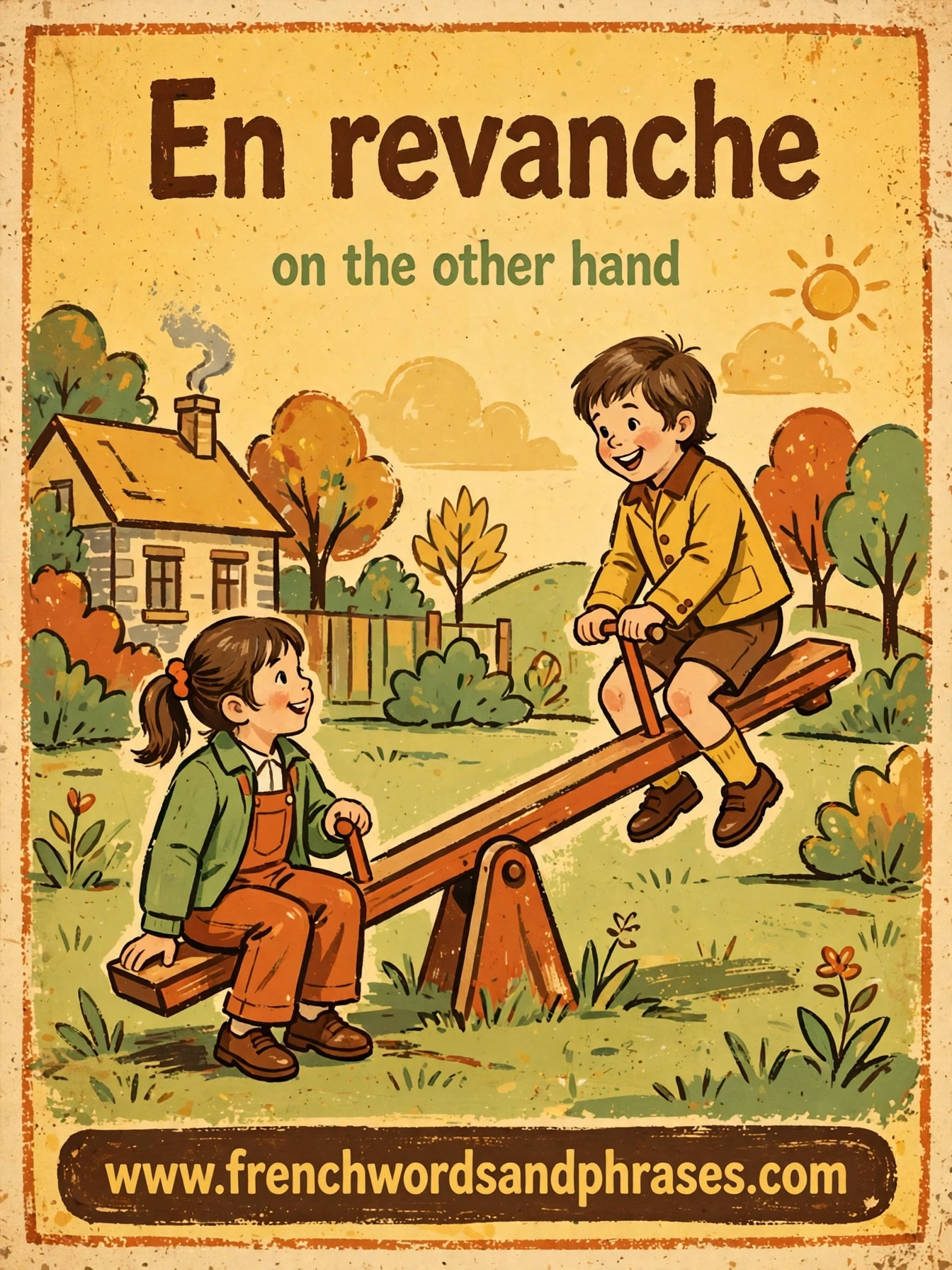
A French Word to Live By
Translate En revanche to English
/ɑ̃ ʁə.vɑ̃ʃ/
En revanche means on the other hand.
A baker in Annecy lost his best oven in a fire, the week before Christmas. « En revanche, » he tells the journalist, wiping flour from his hands, « tout le village est venu m’aider, et nous avons fait le pain dans les fours des voisins. » Something was taken; something was given back. That is the exact shape of en revanche.
In this guide, you’ll learn what en revanche means in English, how it answers a drawback with a compensating gain, where it sits in the sentence, and how it differs from its twin par contre. Explore French examples, English translations, and practice quizzes.
Understanding the French Conjunction En revanche
En revanche is a French linking adverbial phrase of contrast and compensation — honestly, not a conjunction. It does not join clauses grammatically; it answers one statement with a second that makes up for it, settling the account between loss and gain.
It means on the other hand, in return. The first statement usually carries a drawback, and en revanche introduces the fact that compensates: le voyage était épuisant ; en revanche, les paysages étaient inoubliables — the journey was exhausting; on the other hand, the landscapes were unforgettable. The gain answers the loss.
Type: Linking adverbial phrase — contrast/compensation (not a true conjunction)
Job: answers a drawback with a compensating fact
What it links: two complete statements: a loss, then its payback
Mood after it: No effect — the verbs stay in the indicative
One important usage detail: revanche on its own is also a noun meaning ‘revenge’ or ‘a rematch’ — prendre sa revanche is to get one’s own back. Inside en revanche there is no anger at all; the phrase is calm bookkeeping, not vengeance.
Experience the Word
En revanche is the phrase of life’s ledger — the word that insists every debit be read alongside its credit.
Imagine an old fisherman whose boat was wrecked in a storm. « J’ai tout perdu, » he says, « en revanche, je suis vivant, et la mer me nourrit encore. » He is not denying the wreck. He is entering the other column of the account.
You have not sugar-coated the loss. You have shown what life paid back.
How to Use En revanche in French: Complete Guide
Let’s explore how en revanche works in French, beginning with the whole phrase on one card.
En revanche at a Glance
Before the details, here is the whole phrase on one card.
The Whole Phrase on One Card
Meaning, job, pattern and mood — en revanche in four lines.
| Point | En revanche |
|---|---|
| Meaning | on the other hand, in return |
| Job | sets a compensating gain against a drawback |
| What it links | two complete statements: loss, then payback |
| Mood | no effect — indicative everywhere |
Example
Le travail est dur ; en revanche, il est passionnant.
The work is hard; on the other hand, it’s fascinating.
How En revanche Links: A Loss, Answered by a Gain
En revanche works like a ledger: the first statement writes the debit, then en revanche writes the credit underneath, and the two lines together tell the true story.
| Pattern | Example |
|---|---|
| drawback. En revanche, compensation. | elle a raté son train. En revanche, elle a rencontré un vieil ami à la gare — she missed her train. On the other hand, she met an old friend at the station |
| small but lovely | l’appartement est minuscule ; en revanche, la vue est superbe — the flat is tiny; on the other hand, the view is superb |
| expensive but worth it | le cours coûte cher ; en revanche, le professeur est remarquable — the course is expensive; on the other hand, the teacher is remarkable |
| hard season, rich harvest | l’été a été sec ; en revanche, les raisins sont magnifiques — the summer was dry; in return, the grapes are magnificent |
Example
Nous avons perdu le match ; en revanche, nous avons gagné le respect de tous.
We lost the match; on the other hand, we won everyone’s respect.
Quick Quiz 1
What flavour does en revanche add that plain contrast does not — compensation, or cause?
Reveal the answer
Compensation — the second fact makes up for the first, like a payment answering a debt.
C’est loin ; en revanche, c’est gratuit.
It’s far; on the other hand, it’s free.
The Mood Question: A Phrase Between Statements, Not Above Them
En revanche subordinates nothing, so no verb changes for it: both statements keep the ordinary indicative, in whatever tense the story needs. There is no subjunctive anywhere near this phrase.
| Tense around en revanche | Example |
|---|---|
| Present on both sides | il gagne peu ; en revanche, il a du temps libre — he earns little; on the other hand, he has free time |
| Past tenses | nous avons marché des heures ; en revanche, nous avons vu le lac — we walked for hours; in return, we saw the lake |
| Future | ce sera long ; en revanche, ce sera définitif — it will take long; on the other hand, it will be permanent |
| No subjunctive, ever | en revanche never introduces a que-clause — it opens a fresh statement instead |
Example
Elle a attendu longtemps ; en revanche, la surprise était magnifique.
She waited a long time; on the other hand, the surprise was magnificent.
Where En revanche Goes: Head of the Payback, or Mid-Sentence
En revanche usually heads the compensating statement, after a full stop or semicolon and followed by a comma. It can also settle mid-sentence between commas, right after the subject.
| Position | Example |
|---|---|
| Start of the statement | En revanche, le dessert était offert. — On the other hand, dessert was on the house. |
| After a semicolon | le vol était en retard ; en revanche, l’équipage était adorable — the flight was late; on the other hand, the crew was lovely |
| Mid-sentence, between commas | lui, en revanche, a tout de suite compris — he, on the other hand, understood at once |
| Almost always second | en revanche answers something — a drawback must come first for the payback to make sense |
Example
Le musée était fermé. En revanche, le parc était ouvert et splendide.
The museum was closed. On the other hand, the park was open and splendid.
Quick Quiz 2
Can en revanche open a conversation, before any drawback has been mentioned?
Reveal the answer
Not naturally — it is an answering phrase; the loss or drawback must be on the table before the compensation can answer it.
Il pleuvait ; en revanche, la maison était chaude et accueillante.
It was raining; on the other hand, the house was warm and welcoming.
Everyday Expressions Around En revanche
The phrase belongs to a lively family built on the noun revanche — revenge, rematch, payback — and meeting the relatives explains the flavour of the phrase itself.
| Expression | In English |
|---|---|
| prendre sa revanche | to get one’s own back / to win the rematch |
| un match de revanche | a return match, a rematch |
| la revanche de la vie | life’s way of paying you back |
| en revanche de quoi… (rare, clumsy) | avoid: en revanche does not take a complement — keep it as a free-standing linker |
Example
Battue au printemps, l’équipe a pris sa revanche en automne.
Beaten in spring, the team got its revenge in autumn.
Close Cousins: En revanche, Par contre, Au contraire, En compensation
Four phrases stand near each other — the whole art lies in the flavour: payback, balance, correction, or explicit compensation.
| Word | The difference |
|---|---|
| en revanche | on the other hand — the second fact compensates the first: a loss answered by a gain |
| par contre | on the other hand — neutral balance: two true sides weighed, with no debt between them |
| au contraire | on the contrary — correction: the first idea was wrong and the opposite is true |
| en compensation | as compensation — the payback made explicit and a little formal |
| en retour | in return — often for something given or done: je t’aide ; en retour, tu m’aides |
Example
Le loyer a augmenté ; en compensation, le propriétaire a refait la cuisine.
The rent went up; as compensation, the landlord redid the kitchen.
Quick Quiz 3
« Le ciel est gris au nord ; ______, il est bleu au sud. » — en revanche or par contre?
Reveal the answer
par contre — two regions simply differ; nothing compensates anything. En revanche needs a loss answered by a gain.
Le ciel est gris au nord ; par contre, il est bleu au sud.
The sky is grey in the north; on the other hand, it’s blue in the south.
En revanche and Its Neighbours
The answering words on one side, and the merely adding words on the other.
| French | In English |
|---|---|
| par contre | on the other hand (neutral balance) |
| en compensation | as compensation |
| en retour | in return |
| par ailleurs | moreover, besides (adds rather than answers) |
| cependant | nevertheless (concedes, without the payback flavour) |
Example
Il a tout perdu au jeu ; cependant — en revanche, dirait un optimiste — il lui reste ses amis.
He lost everything gambling; nevertheless — in return, an optimist would say — he still has his friends.
Watch Out: The Traps Around En revanche
The traps: hearing ‘revenge’ where there is only bookkeeping, using the phrase where nothing is owed, and bending its grammar.
| Trap | The truth |
|---|---|
| hearing anger in it | en revanche is calm: it means ‘in return, on the other hand’, never ‘in revenge’ — the angry word is la revanche / se venger |
| using it for a mere difference | two things simply differing (north/south, tea/coffee) call for par contre — en revanche needs a drawback and its compensation |
| adding a complement | never ‘en revanche de + noun’ in modern French — the phrase stands alone as a linker |
| spelling | revanche ends in -che: en revanche, not ‘en revange’ |
Example
Elle a raté l’examen ; en revanche, elle a découvert ce qu’elle voulait vraiment faire.
She failed the exam; on the other hand, she discovered what she really wanted to do.
Quick Quiz 4
True or false: en revanche can sound angry, like taking revenge.
Reveal the answer
False — in this phrase revanche means a balancing payback, with no anger: ‘on the other hand, in return’.
C’est fatigant ; en revanche, c’est utile.
It’s tiring; on the other hand, it’s useful.
En revanche in Everyday French: Real-Life Examples
Now that you know the word, let’s see how en revanche appears in everyday French.
Example 1 — Sport
Notre équipe a perdu deux joueurs ; en revanche, le gardien était en pleine forme.
Our team lost two players; on the other hand, the goalkeeper was in great form.
Example 2 — House and garden
Le jardin est petit. En revanche, il est ensoleillé toute la journée.
The garden is small. On the other hand, it’s sunny all day.
Example 3 — Work
Le salaire est modeste ; en revanche, les horaires sont libres.
The pay is modest; on the other hand, the hours are flexible.
Example 4 — Travel
La route était fermée. En revanche, le détour nous a fait découvrir un village charmant.
The road was closed. On the other hand, the detour led us to discover a charming village.
Example 5 — Weather
Il a plu toute la semaine ; en revanche, les champs en avaient besoin.
It rained all week; on the other hand, the fields needed it.
Example 6 — Family
Mon frère habite loin. En revanche, il téléphone tous les dimanches.
My brother lives far away. On the other hand, he phones every Sunday.
Beyond Translation: The Meaning of En revanche
English says on the other hand for the meaning of en revanche — but the French phrase keeps the receipt: revanche comes from the old verb revancher, to pay back, to settle a score. Every en revanche is a tiny settlement: the world took something in the first sentence, and the second sentence pays something back.
En revanche is the grammar of consolation — it teaches you to read a loss and its answer as one story.
French speakers reach for it constantly, and no wonder: it is optimism with its feet on the ground. It never pretends the drawback away. It simply refuses to let the drawback have the last word.
How to Remember the French Conjunction En revanche
Remember it this way: En revanche is a ledger line — debit in the first statement, credit in the second, and the account reads fair.
- You name the drawback first — en revanche is always an answer, never an opener.
- You make the second fact compensate — a gain that answers the loss, not just any other fact.
- You keep it calm — no anger in this revanche; it is bookkeeping, not revenge.
The key idea is en revanche answers a drawback with the gain that compensates for it.
Test Your Knowledge of En revanche
Let’s see how much you’ve learned. Try answering these questions before revealing the answers.
Question 1
What does en revanche mean?
Reveal the answer
On the other hand / in return — it introduces a fact that compensates for the one before.
Question 2
Is en revanche a conjunction?
Reveal the answer
No — it is a linking adverbial phrase standing between complete statements.
Question 3
Translate: The flat is dark; on the other hand, it’s very quiet.
Reveal the answer
L’appartement est sombre ; en revanche, il est très calme.
Question 4
What separates en revanche from par contre?
Reveal the answer
The payback flavour — en revanche’s second fact makes up for the first; par contre simply weighs two true sides.
Question 5
Complete the sentence:
Le voyage était long ; ______, nous avons vu des paysages magnifiques.
Reveal the answer
en revanche
Le voyage était long ; en revanche, nous avons vu des paysages magnifiques.
The journey was long; on the other hand, we saw magnificent landscapes.
Your Final Challenge
Can You Use It?
How would you say this in French?
“The job is tiring; on the other hand, it pays for my travels.”
Reveal the answer
Le travail est fatigant ; en revanche, il paie mes voyages.
The job is tiring; on the other hand, it pays for my travels.
A little French. A little curiosity. A richer everyday life.
LEARN FRENCH ONE WORD AT A TIME