
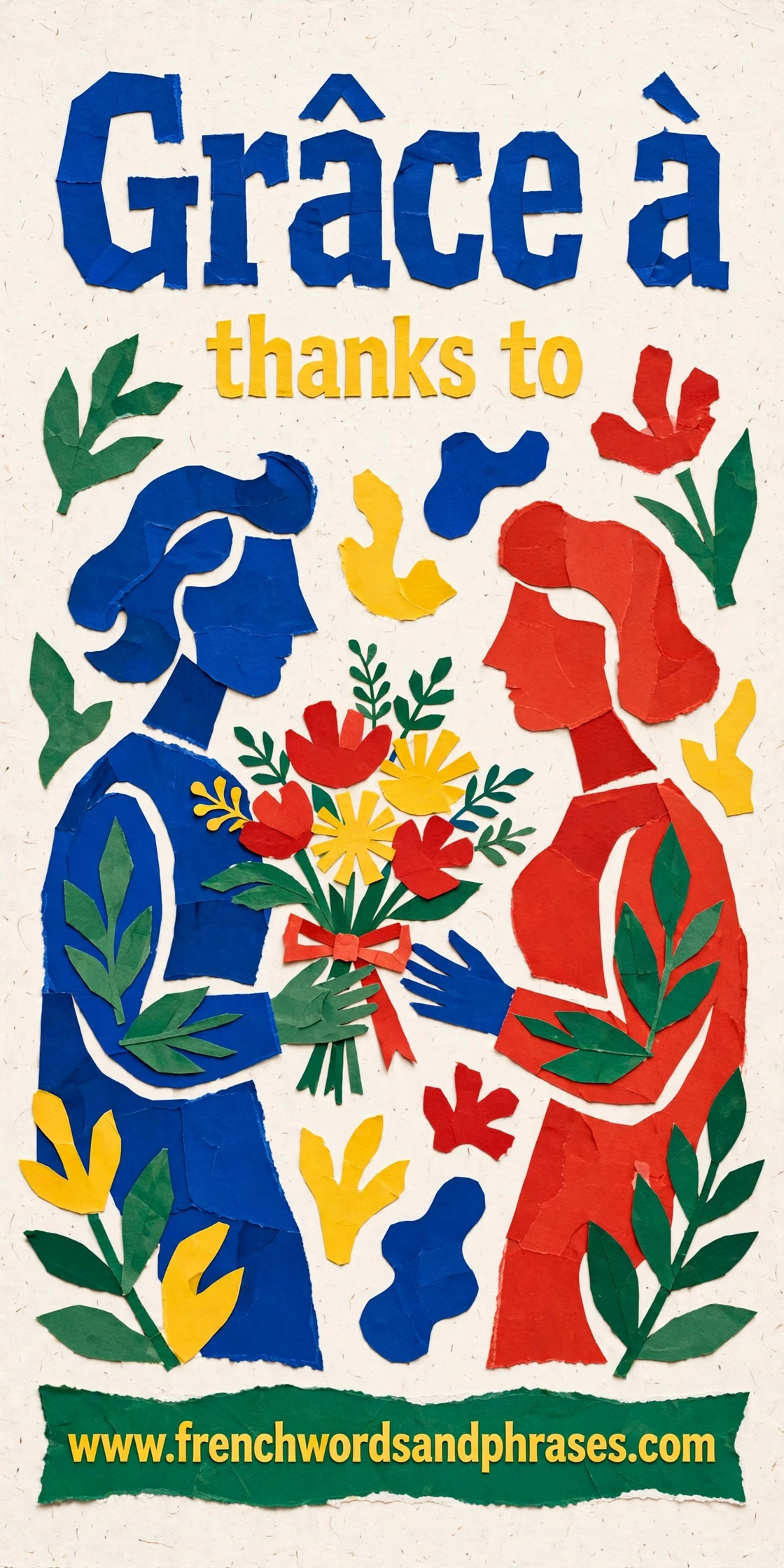
A French Word to Live By
Translate Grâce à to English
/ɡʁɑs a/
Grâce à means thanks to.
The rain is hammering the station platform, your train is late, and you are standing in the one dry corner — because a stranger with a big umbrella silently moved over to make room. « Grâce à vous, je suis sec. » Thanks to one small kindness, the whole day changes sides.
In this guide, you’ll learn what grâce à means in English, how it gives the credit for a happy outcome, why it takes a noun and never a clause, and how it differs from its gloomy cousin à cause de. Explore French examples, English translations, and practice quizzes.
Understanding the French Conjunction Grâce à
Grâce à is not a conjunction at all, strictly speaking — it is a French preposition of cause, and a grateful one. It points at the person or thing responsible for a good outcome and hands them the credit.
It means thanks to. After grâce à comes a noun or a pronoun, never a verb clause: grâce à Marie, nous avons réussi — thanks to Marie, we succeeded. The outcome is always welcome: grâce à is the smiling member of the cause family.
Type: Preposition — cause (positive)
Gives credit for: A welcome, happy result
What follows it: A noun or a pronoun
Mood after it: No clause follows — no mood
One important usage detail: for people you can say grâce à toi, grâce à vous, grâce à elle. And listen for the ironic wink — French speakers sometimes aim grâce à at a mildly annoying cause (« grâce à toi, on a raté le train »), but the smile is still built into the word.
Experience the Word
Grâce à is the preposition of gratitude — the word that stops to say who made the good thing happen.
Imagine a village baker whose oven breaks on the morning of the fête. The neighbour lends hers, the bread comes out golden, and the whole square eats. « Grâce à Madame Fabre, nous avons du pain. » The sentence itself is a thank-you note.
You have not just explained a cause. You have given the credit where it belongs.
How to Use Grâce à in French: Complete Guide
Let’s explore how grâce à works in French, beginning with the whole word on one card.
Grâce à at a Glance
Before the details, here is the whole word on one card.
The Whole Word on One Card
Meaning, job, pattern and mood — grâce à in four lines.
| Point | Grâce à |
|---|---|
| Meaning | thanks to |
| Job | credits a person or thing for a good result |
| What follows | a noun or a pronoun |
| Mood | no clause follows — no mood |
Example
Grâce à ton aide, tout est prêt.
Thanks to your help, everything is ready.
How Grâce à Links: Credit First, Result After
Grâce à names the hero of the story, then the happy result follows. The pattern never changes: grâce à + noun, and the rest of the sentence enjoys the benefit.
| Pattern | Example |
|---|---|
| grâce à + person | grâce à notre professeur, nous comprenons — thanks to our teacher, we understand |
| grâce à + thing | grâce à cette carte, nous ne sommes pas perdus — thanks to this map, we are not lost |
| grâce à + pronoun | c’est grâce à toi — it’s thanks to you |
| result first, credit after | nous avons gagné grâce à elle — we won thanks to her |
Example
Grâce au soleil, la terrasse est pleine.
Thanks to the sun, the terrace is full.
Quick Quiz 1
What follows grâce à — a full clause, or a noun?
Reveal the answer
A noun (or a pronoun).
Grâce à Marie, tout va bien.
Thanks to Marie, everything is fine.
The Mood Question: No Clause, No Mood
Grâce à never introduces a clause, so there is no verb of its own and no mood to choose. When your cause is a whole event with its own verb, switch to a true conjunction like parce que.
| Your cause is… | Use |
|---|---|
| a person | grâce à + noun — grâce à mon frère |
| a thing | grâce à + noun — grâce à la chance |
| a whole event (subject + verb) | parce que + clause — parce qu’il m’a aidé |
| a pronoun | grâce à toi, grâce à vous, grâce à eux |
Example
Il a réussi grâce à vous — et parce que vous avez cru en lui.
He succeeded thanks to you — and because you believed in him.
Where Grâce à Goes: Start, Middle or End
Grâce à is happiest at the start of the sentence, setting up the good news, with a comma after its phrase. And watch the small contraction: à + le becomes au, à + les becomes aux.
| Position | Example |
|---|---|
| Start of the sentence | grâce à ce travail, elle est libre — thanks to this work, she is free |
| Middle | nous avons, grâce à lui, tout compris — thanks to him, we understood everything |
| End of the sentence | tout est fini grâce à vous — everything is finished thanks to you |
| Contraction | grâce au soleil, grâce aux amis — never grâce à le, grâce à les |
Example
Grâce aux voisins, la fête continue.
Thanks to the neighbours, the party goes on.
Quick Quiz 2
Fill the gap: « Grâce ___ vent, le bateau avance. » — à le, or au?
Reveal the answer
au — à + le always contracts to au.
Grâce au vent, le bateau avance.
Thanks to the wind, the boat is moving.
Everyday Expressions with Grâce à
Grâce à lives in thank-yous, toasts and sighs of relief — anywhere a good result needs an author.
| Expression | In English |
|---|---|
| c’est grâce à toi | it’s thanks to you |
| grâce à Dieu | thank God (literally: thanks to God) |
| grâce au ciel | thank heavens |
| un grand merci — grâce à vous tous | a big thank you — thanks to all of you |
| grâce au hasard | thanks to chance / luck |
Example
C’est grâce à elle que le projet existe.
It’s thanks to her that the project exists.
Close Cousins: Grâce à, À cause de, Parce que, À force de
Four ways to name a cause — the difference is the flavour of the result and what follows the word.
| Word | The difference |
|---|---|
| grâce à | + noun; the result is GOOD — the credit word |
| à cause de | + noun; the result is bad or neutral — the blame word |
| parce que | + full clause; the neutral ‘because’ |
| à force de | + noun or infinitive; ‘through, by dint of’ — grâce à force de travail, through hard work |
Example
Grâce à la pluie, le jardin est beau ; à cause de la pluie, le match est annulé.
Thanks to the rain, the garden is beautiful; because of the rain, the match is cancelled.
Quick Quiz 3
The picnic was ruined by the storm. Do you say grâce à or à cause de l’orage?
Reveal the answer
à cause de — grâce à is only for welcome results.
Le pique-nique est gâché à cause de l’orage.
The picnic is ruined because of the storm.
Grâce à and Its Neighbours
Help and blame travel together in French: here are the words that keep grâce à company, and the ones that reverse it.
| French | In English |
|---|---|
| avec l’aide de | with the help of |
| à l’aide de | with the help of / using |
| du fait de | owing to, on account of (formal) |
| à cause de | because of (bad or neutral results) |
| par la faute de | because of the fault of (the blame word) |
Example
Avec l’aide de Paul et grâce à sa voiture, nous sommes rentrés.
With Paul’s help and thanks to his car, we got home.
Watch Out: The Traps Around Grâce à
Three traps: a bad result wearing the smile word, a clause where a noun belongs, and the forgotten contraction.
| Trap | The truth |
|---|---|
| grâce à for bad news | a delay is never grâce au train — bad results take à cause de |
| grâce à + clause | never: grâce à needs a noun — for a clause, use parce que |
| grâce à le / grâce à les | always contract: grâce au, grâce aux |
| merci à toi vs grâce à toi | merci à toi thanks YOU directly; grâce à toi credits you for a result |
Example
À cause du retard, nous attendons — mais grâce à ce café, nous attendons avec plaisir.
Because of the delay, we are waiting — but thanks to this café, we are waiting happily.
Quick Quiz 4
True or false: you can say « grâce à il pleut » for ‘thanks to the rain’?
Reveal the answer
False — grâce à takes a noun, never a clause.
Grâce à la pluie, les fleurs poussent.
Thanks to the rain, the flowers are growing.
Grâce à in Everyday French: Real-Life Examples
Now that you know the word, let’s see how grâce à appears in everyday French.
Example 1 — A thank-you
Grâce à toi, je ne suis plus seul.
Thanks to you, I am no longer alone.
Example 2 — At school
Grâce à ce livre, les enfants comprennent tout.
Thanks to this book, the children understand everything.
Example 3 — Good luck
Grâce au hasard, nous avons trouvé cette rue.
Thanks to luck, we found this street.
Example 4 — Teamwork
Le travail est fini grâce à vous tous.
The work is finished thanks to all of you.
Example 5 — A rescue
Grâce à son chien, le vieil homme est retrouvé.
Thanks to his dog, the old man was found.
Example 6 — Simple joy
Grâce au printemps, tout le village sourit.
Thanks to spring, the whole village is smiling.
Beyond Translation: The Meaning of Grâce à
English says thanks to for the meaning of grâce à — but the French phrase keeps an older treasure inside it: grâce, grace, the unearned gift. A cause with grâce in it is never just a cause; it is a small act of grace that somebody performed.
To say grâce à is to turn an explanation into a thank-you.
That is why the phrase warms a sentence the way à cause de cools it. One names the mechanism; the other names the benefactor. French lets you choose, every time, whether your cause deserves a bow.
How to Remember the French Conjunction Grâce à
Remember it this way: Grâce à is the credit word — it smiles, it takes a noun, and it always names the hero of a happy ending.
- You smile first — grâce à is only for good results; bad ones go to à cause de.
- You give it a noun — grâce à Marie, grâce au soleil — never a clause.
- You contract — au and aux, never à le or à les.
The key idea is grâce à credits a noun for a happy result.
Test Your Knowledge of Grâce à
Let’s see how much you’ve learned. Try answering these questions before revealing the answers.
Question 1
What does grâce à mean?
Reveal the answer
Thanks to — it credits someone or something for a good result.
Question 2
What follows grâce à?
Reveal the answer
A noun or a pronoun — grâce à Marie, grâce à toi. Never a clause.
Question 3
Translate: Thanks to the sun, the garden is beautiful.
Reveal the answer
Grâce au soleil, le jardin est beau.
Question 4
Which word names a BAD cause: grâce à or à cause de?
Reveal the answer
à cause de — grâce à is reserved for welcome results.
Question 5
Complete the sentence:
______ mes amis, je suis heureux.
Reveal the answer
Grâce à
Grâce à mes amis, je suis heureux.
Thanks to my friends, I am happy.
Your Final Challenge
Can You Use It?
How would you say this in French?
“Thanks to your help, we finished on time.”
Reveal the answer
Grâce à ton aide, nous avons fini à temps.
Thanks to your help, we finished on time.
A little French. A little curiosity. A richer everyday life.
LEARN FRENCH ONE WORD AT A TIME




