A French Word to Live By
Translate Peut-être to English
/pø.tɛtʁ/
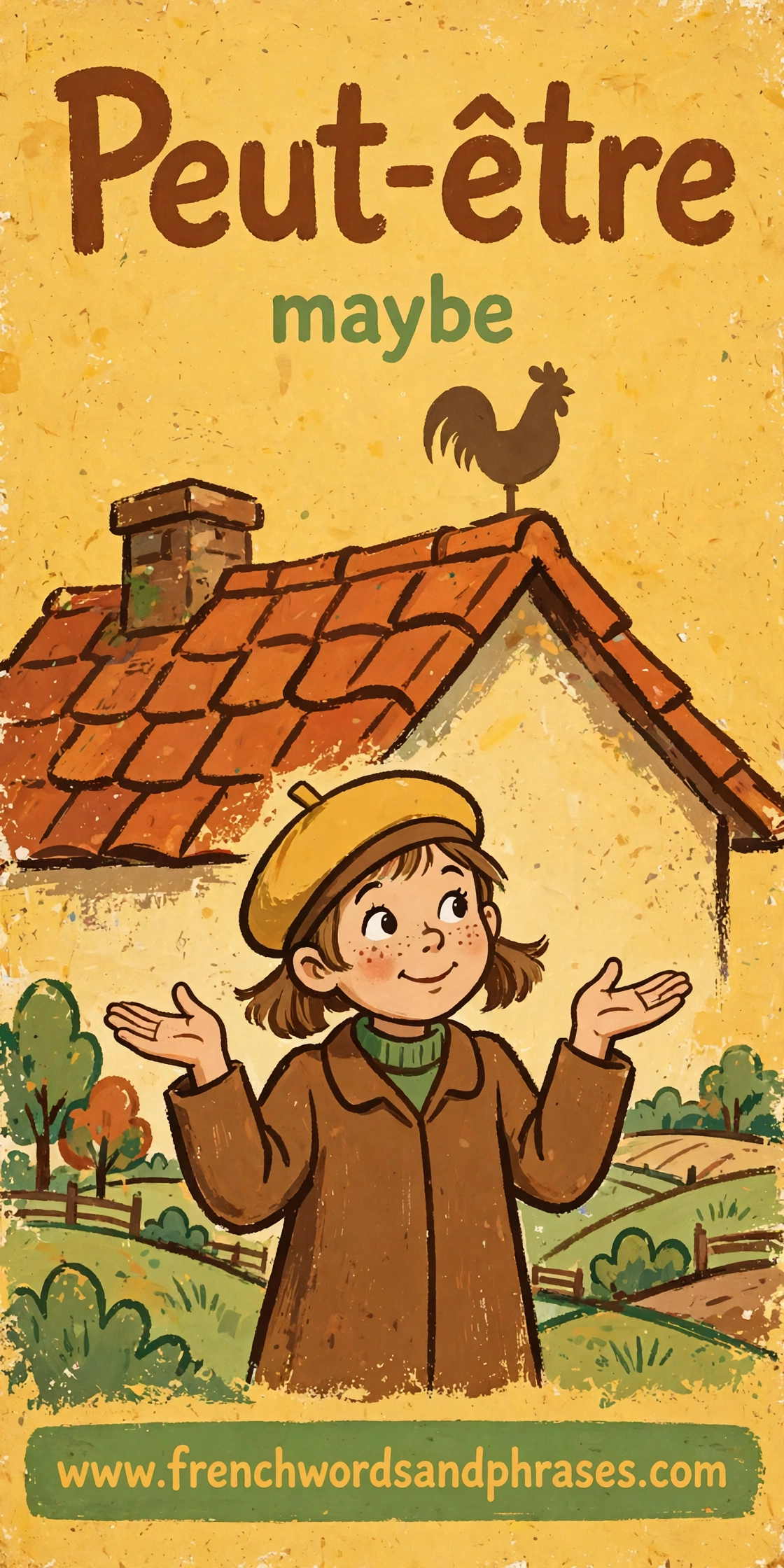
Peut-être means maybe.
« Tu viens demain ? » She looks at the sky, at her calendar, at you — and shrugs the most French shrug in the world. « Peut-être. » Maybe. Not yes, not no: a door left open, with the light on behind it.
In this guide, you’ll learn what peut-être means in English, where it sits in a sentence, why the verb after it stays in the indicative, and the elegant inversion trick formal French plays with it. Explore French examples, English translations, and practice quizzes.
Understanding the French Conjunction Peut-être
Peut-être is not a conjunction — it is a French adverb of possibility, built from peut (can) and être (be): literally ‘can-be’. It softens a whole statement, marking it as possible rather than certain.
It means maybe, perhaps. Peut-être does not join clauses; it leans on a clause and tilts it toward doubt: peut-être qu’il viendra — maybe he will come. The event is possible, the speaker is honest, and nothing is promised.
Type: Adverb — possibility and doubt
Built from: peut (can) + être (be) — ‘can-be’
What it does: Softens a statement: possible, not certain
Mood after it: Indicative — always
One important usage detail: the hyphen is not optional — it is always peut-être, never ‘peut être’ in this meaning. And in everyday speech you will constantly hear peut-être que before a clause: « peut-être qu’il pleut demain ». It is the relaxed, spoken doorway into the sentence.
Experience the Word
Peut-être is the adverb of the open door — the word that refuses to lock the future in either direction.
Imagine two friends at a café window, watching clouds gather over the rooftops. « Il va pleuvoir ? » — « Peut-être. On verra. » No forecast, no worry: just the weather, allowed to decide for itself.
You have not dodged the question. You have told the exact truth about what you know.
How to Use Peut-être in French: Complete Guide
Let’s explore how peut-être works in French, beginning with the whole word on one card.
Peut-être at a Glance
Before the details, here is the whole word on one card.
The Whole Word on One Card
Meaning, job, pattern and mood — peut-être in four lines.
| Point | Peut-être |
|---|---|
| Meaning | maybe, perhaps |
| Job | marks a statement as possible, not certain |
| What follows | a clause — often with que in speech |
| Mood | indicative, always |
Example
Peut-être qu’elle viendra demain.
Maybe she will come tomorrow.
How Peut-être Links: It Leans on a Clause
Peut-être does not glue two clauses together — it rests its weight on one clause and bends it toward possibility. The clause underneath stays a normal, complete sentence.
| Pattern | Example |
|---|---|
| peut-être + clause | peut-être il fait beau demain — maybe the weather will be nice tomorrow |
| peut-être que + clause (spoken) | peut-être qu’il fait beau demain — maybe the weather will be nice tomorrow |
| peut-être + infinitive phrase | peut-être partir tôt — maybe leave early (after a verb: je vais peut-être partir) |
| standalone answer | — Tu viens ? — Peut-être. — Are you coming? — Maybe. |
Example
Nous allons peut-être visiter Lyon.
We might visit Lyon.
Quick Quiz 1
Does peut-être join two clauses, or soften one clause?
Reveal the answer
It softens one clause — it is an adverb, not a conjunction.
Peut-être qu’il est fatigué.
Maybe he is tired.
The Mood Question: Doubt in the Meaning, Indicative in the Grammar
Here is the surprise: although peut-être expresses doubt, the verb after it stays firmly in the indicative — even in the future. The subjunctive belongs to other structures, like il est possible que.
| Structure | Mood |
|---|---|
| peut-être + present | indicative — peut-être qu’il dort, maybe he is sleeping |
| peut-être + future | indicative — peut-être qu’elle viendra, maybe she will come |
| il est possible que + clause | SUBJUNCTIVE — il est possible qu’elle vienne |
| il se peut que + clause | SUBJUNCTIVE — il se peut qu’il pleuve |
Example
Peut-être qu’ils arriveront ce soir.
Maybe they will arrive this evening.
Where Peut-être Goes — and the Inversion Trick
In ordinary French, peut-être sits at the start of the sentence or after the verb. But formal French plays an elegant trick: when peut-être opens the sentence, the verb and subject can swap places — peut-être viendra-t-il, maybe he will come.
| Position | Example |
|---|---|
| Start of the sentence (everyday) | peut-être qu’il viendra — maybe he will come |
| Start, with formal inversion | peut-être viendra-t-il — maybe he will come (written, elegant) |
| After the verb | il viendra peut-être — he will perhaps come |
| Inversion with a noun subject | peut-être Marie viendra-t-elle ? becomes: peut-être Marie viendra — in practice, inversion uses pronouns |
Example
Peut-être est-il déjà là.
Maybe he is already here. (formal inversion)
Quick Quiz 2
Which is the formal, inverted form: « peut-être il viendra » or « peut-être viendra-t-il »?
Reveal the answer
peut-être viendra-t-il — formal French inverts verb and pronoun after sentence-initial peut-être.
Peut-être viendra-t-il demain.
Maybe he will come tomorrow.
Everyday Expressions with Peut-être
Peut-être thrives in plans, predictions and polite non-answers — anywhere the future is still negotiable.
| Expression | In English |
|---|---|
| peut-être que oui | maybe yes |
| peut-être que non | maybe not |
| peut-être bien | quite possibly / very likely |
| peut-être demain | maybe tomorrow |
| peut-être pas | maybe not / perhaps not |
Example
— C’est vrai ? — Peut-être bien !
— Is that true? — Quite possibly!
Close Cousins: Peut-être, Probablement, Sans doute, Il est possible que
French grades its uncertainty carefully. Peut-être sits in the middle of the scale — here is the family, from coin-toss to near-certainty.
| Word | The difference |
|---|---|
| peut-être | maybe — a genuine fifty-fifty |
| probablement | probably — stronger than peut-être, the odds are good |
| sans doute | probably, no doubt — confident, despite its name |
| il est possible que | ‘it is possible that’ + SUBJUNCTIVE — the formal cousin |
Example
Il viendra probablement, mais peut-être pas ce soir.
He will probably come, but maybe not this evening.
Quick Quiz 3
Which cousin of peut-être demands the subjunctive: probablement or il est possible que?
Reveal the answer
il est possible que — it is followed by the subjunctive.
Il est possible qu’elle vienne.
It is possible that she may come.
Peut-être and Its Neighbours
Doubt has a whole neighbourhood in French, from a shrug to a near-promise — and one loud opposite.
| French | In English |
|---|---|
| probablement | probably |
| sans doute | probably, no doubt |
| possiblement | possibly (formal) |
| il se peut que | it may be that (+ subjunctive) |
| certainement | certainly (the opposite — full confidence) |
Example
Sans doute fatigué, peut-être malade — nous verrons demain.
Probably tired, maybe ill — we shall see tomorrow.
Watch Out: The Traps Around Peut-être
Four traps: a missing hyphen, a false friend, a stray subjunctive, and inversion where it sounds like a costume.
| Trap | The truth |
|---|---|
| peut être without the hyphen | that means ‘can be’ (il peut être fatigué, he can be tired) — the adverb maybe always has its hyphen |
| éventuellement | false friend: it means ‘possibly’, NOT ‘eventually’ (which is finalement) |
| peut-être + subjunctive | never: the verb stays indicative — peut-être qu’il vient |
| inversion in casual chat | peut-être viendra-t-il is for writing and speeches; in speech, peut-être que is your friend |
Example
Il peut être en retard ; peut-être qu’il a raté le bus.
He can be late; maybe he missed the bus.
Quick Quiz 4
« Éventuellement » — does it mean ‘eventually’ or ‘possibly’?
Reveal the answer
Possibly — it is a false friend.
Éventuellement, nous partirons jeudi.
Possibly, we will leave on Thursday.
Peut-être in Everyday French: Real-Life Examples
Now that you know the word, let’s see how peut-être appears in everyday French.
Example 1 — Plans
Peut-être que nous partirons en juin.
Maybe we will leave in June.
Example 2 — Weather
Il va peut-être neiger ce soir.
It might snow this evening.
Example 3 — A polite answer
— Tu aimes ? — Peut-être, je ne sais pas encore.
— Do you like it? — Maybe, I don’t know yet.
Example 4 — Hope
Peut-être qu’elle a reçu ma lettre.
Maybe she received my letter.
Example 5 — Formal writing
Peut-être le ministre parlera-t-il demain.
Perhaps the minister will speak tomorrow.
Example 6 — A shrug
Peut-être, peut-être pas — qui sait ?
Maybe, maybe not — who knows?
Beyond Translation: The Meaning of Peut-être
English says maybe for the meaning of peut-être — and the two words are secretly twins: may-be, peut-être, ‘it can be’. Both languages built their word for uncertainty out of pure possibility.
Peut-être is the most honest word in a plan — it promises nothing and excludes nothing.
French culture wears this word comfortably. A peut-être is not a failure to decide; it is respect for a future that has not yet shown its hand. Learn to say it with a small shrug, and you are already speaking more French than the grammar books teach.
How to Remember the French Conjunction Peut-être
Remember it this way: Peut-être is the ‘can-be’ word — a hyphen, a shrug, and an indicative verb, with inversion kept for best occasions.
- You keep the hyphen — peut-être, always; without it, it means ‘can be’.
- You keep the verb ordinary — indicative, even for the future: peut-être qu’il viendra.
- You save the inversion for writing — peut-être viendra-t-il is the formal party trick.
The key idea is peut-être means maybe, keeps its hyphen, and takes the indicative.
Test Your Knowledge of Peut-être
Let’s see how much you’ve learned. Try answering these questions before revealing the answers.
Question 1
What does peut-être mean?
Reveal the answer
Maybe, perhaps — it marks a statement as possible, not certain.
Question 2
Which mood follows peut-être?
Reveal the answer
The indicative — always, even in the future: peut-être qu’elle viendra.
Question 3
Translate: Maybe he is at home.
Reveal the answer
Peut-être qu’il est à la maison.
Question 4
What is the formal trick after sentence-initial peut-être?
Reveal the answer
Inversion — verb and pronoun swap: peut-être viendra-t-il, maybe he will come.
Question 5
Complete the sentence:
______ qu’il fait froid demain, nous resterons.
Reveal the answer
Peut-être
Peut-être qu’il fait froid demain, nous resterons.
Maybe it will be cold tomorrow, we will stay in.
Your Final Challenge
Can You Use It?
How would you say this in French?
“Maybe she will come tomorrow.”
Reveal the answer
Peut-être qu’elle viendra demain.
Maybe she will come tomorrow.
A little French. A little curiosity. A richer everyday life.
LEARN FRENCH ONE WORD AT A TIME