A French Word to Live By
Translate Triste to English
/tʁist/
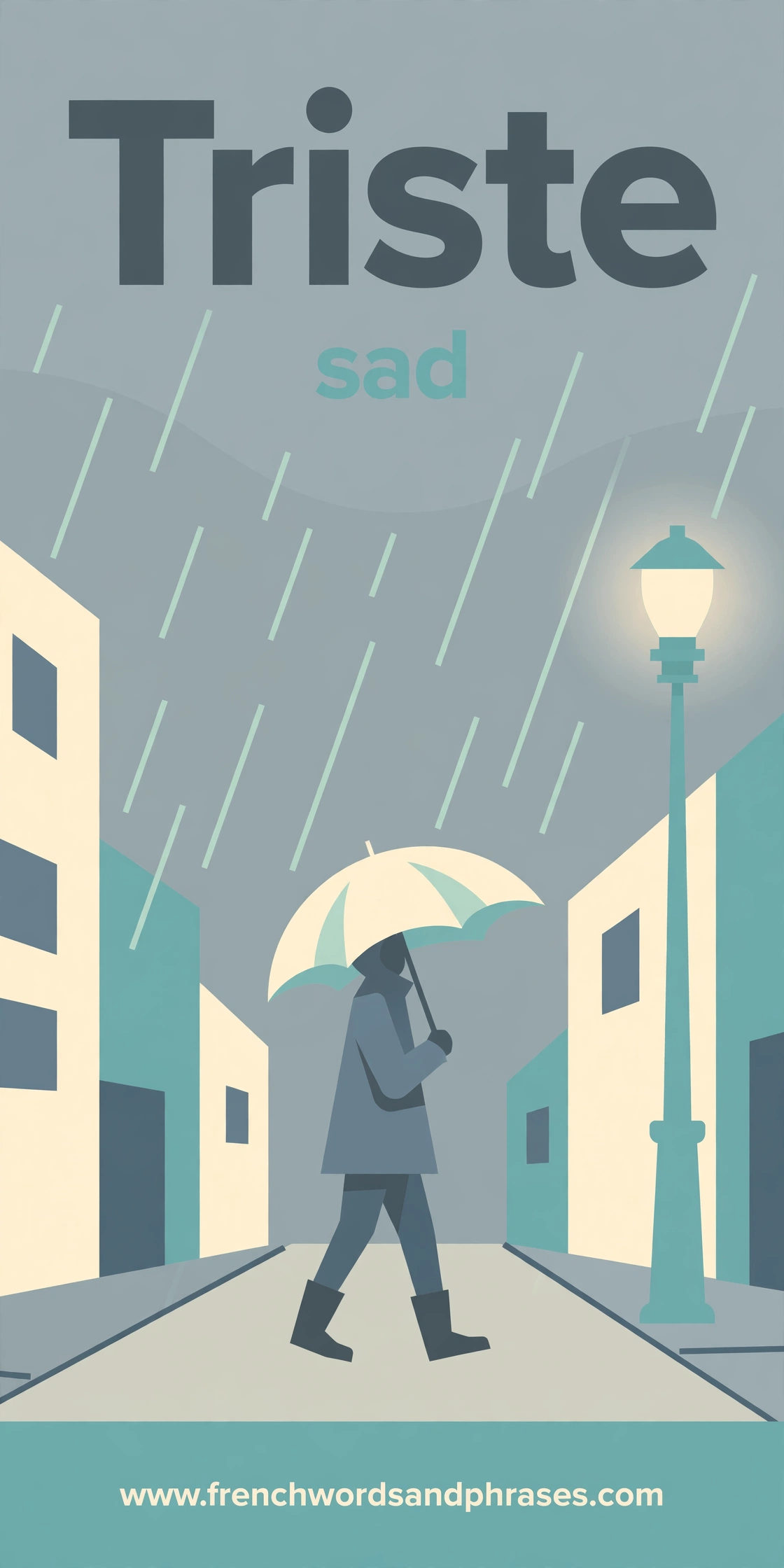
Triste means sad.
The platform again, but the other kind of departure: a train pulling away slowly, a hand still raised at the window, getting smaller. Nobody speaks on the way back to the car. Some journeys end in a wordless drive home. That silence is triste.
In this guide, you’ll learn what triste means in English, why its form never changes between masculine and feminine, how it describes weather and faces alike, and why un triste individu is not simply a sad man. Explore French examples, English translations, and practice quizzes.
Understanding the French Adjective Triste
Triste is a French adjective of quality — the adjective of sadness. It already ends in -e, so masculine and feminine share one form; the plural adds a silent -s. It describes people, news, films, weather — anything the light has gone out of.
It means sad — the feeling, and everything that carries it: une nouvelle triste, sad news; un film triste, a sad film; avoir l’air triste, to look sad. French also gives it to the weather: un temps triste is a dull, grey day, sad in sympathy with us.
Type: Adjective of quality — sadness
Answers the question: What is it like? — sad, gloomy
Changes form: Barely — triste for him and her; tristes in the plural
English equivalents: Sad; gloomy; sorry (before the noun).
One important usage detail: triste normally follows the noun — une histoire triste. In front of the noun it changes flavour and means sorry, pathetic: un triste individu is not a sad man but a sorry specimen. Handle that position with care.
Experience the Word
Triste is the adjective of the minor key — of the song that slows down, the letter that begins « je suis désolé de t’apprendre… ».
Imagine an old dog waiting by a door that will not open today, head on his paws, eyes following every passer-by. Nobody taught him the word, but the whole street understands: il a l’air triste.
You have not just named an emotion. You have noticed the exact moment the light went out of something.
How to Use Triste in French: Complete Guide
Let’s explore how triste works in French, beginning with the whole word on one card.
Triste at a Glance
Before the details, here is the whole word on one card.
The Whole Word on One Card
Meaning, type, position and forms — triste in four lines.
| Point | Triste |
|---|---|
| Meaning | sad |
| Type | adjective of quality — sadness |
| Usual position | after the noun — une histoire triste |
| Form | triste / triste / tristes / tristes — one form for him and her |
Example
C’est une histoire triste mais belle.
It’s a sad but beautiful story.
The Four Forms of Triste
Triste ends in -e, so the feminine costs nothing; the plural adds a silent -s, for him and for her alike.
| Form | Triste | Example |
|---|---|---|
| Masculine singular | triste | un film triste — a sad film |
| Feminine singular | triste | une nouvelle triste — sad news |
| Masculine plural | tristes | des films tristes — sad films |
| Feminine plural | tristes | des nouvelles tristes — sad news (items) |
Example
Des chansons tristes et un film triste : quelle soirée mélancolique !
Sad songs and a sad film: what a melancholy evening!
Quick Quiz 1
Which form of triste goes with nouvelle (feminine)?
Reveal the answer
triste — the same as the masculine; the word already ends in -e.
Une nouvelle triste.
Sad news.
The Feminine: Nothing to Add
Triste already ends in -e, so the feminine is the same quiet word. The plural -s is your only task.
| Situation | Example |
|---|---|
| Masculine singular | un regard triste — a sad look |
| Feminine singular | une voix triste — the same word, nothing added |
| Both plurals | des regards tristes, des voix tristes — just add -s |
| After être | elle est triste — she is sad |
Example
Il est triste et elle est triste aussi.
He is sad and she is sad too.
Where Triste Goes: After for Sad, Before for Sorry
After the noun or être, triste is the honest feeling. Before the noun, it hardens into a judgement — sorry, pathetic, dismal — though a few set phrases, like une triste nouvelle, keep the feeling.
| Pattern | Example |
|---|---|
| After the noun — sad | une histoire triste — a sad story |
| After être — sad | il est triste — he is sad |
| Before the noun — sorry | un triste individu — a sorry individual |
| Before the noun, set phrase | une triste nouvelle — sad news |
Example
Ce triste spectacle a rendu tout le monde triste.
That sorry sight made everyone sad.
Quick Quiz 2
Un triste individu — a sad man, or a sorry individual?
Reveal the answer
A sorry individual — before the noun, triste judges rather than describes.
Un triste individu — a sorry individual.
Sadder: Comparing with Triste
Triste compares in the regular way, and its superlative is a headline nobody wants to read.
| Degree | Example |
|---|---|
| As sad as | aussi triste que — as sad as |
| Sadder | plus triste — sadder |
| Less sad | moins triste — less sad |
| The saddest (masc.) | le plus triste — le jour le plus triste |
| The saddest (fem.) | la plus triste — la nouvelle la plus triste |
Example
C’est la nouvelle la plus triste de l’année.
It’s the saddest news of the year.
Everyday Expressions with Triste
Triste lends its gloom to faces, weather and long afternoons — and offers a phrase for cheering all three up.
| Expression | In English |
|---|---|
| avoir l’air triste | to look sad |
| une triste nouvelle | sad news |
| faire triste mine | to look gloomy, to pull a long face |
| un temps triste | dull, grey weather |
| triste à mourir | deadly dull, sad enough to die of |
| rendre triste | to make sad |
Example
Ne fais pas cette triste mine, tout va s’arranger.
Don’t look so gloomy, everything will work out.
Quick Quiz 3
What does avoir l’air triste mean?
Reveal the answer
To look sad
Tu as l’air triste aujourd’hui.
You look sad today.
Triste and Its Neighbours
Sadness shades from the wistful mélancolique to the heavy déprimé — and heureux waits, patient as ever, at the other end.
| French | In English |
|---|---|
| malheureux | unhappy, miserable |
| mélancolique | melancholy, wistful |
| déprimé | depressed, down |
| morose | gloomy, sullen |
| heureux | happy — the opposite |
| joyeux | joyful — the opposite |
Example
Malheureux hier, il semble moins triste aujourd’hui.
Unhappy yesterday, he seems less sad today.
Watch Out: The Traps Around Triste
Triste’s traps are all about tone: a judgement hiding in front of the noun, and a sky that borrows our feelings.
| Trap | The truth |
|---|---|
| un triste individu | a sorry specimen, not a man feeling sad — position changes the meaning |
| un temps triste | dull weather: the sky is gloomy, not emotional |
| a sad state of affairs | English matches the French front position here: un triste état des choses |
| triste à mourir | means deadly dull as often as very sad — read the context |
Example
Quel triste temps ! Tout le monde a l’air triste.
What dull weather! Everyone looks sad.
Quick Quiz 4
Un temps triste — is the weather sad, or dull and grey?
Reveal the answer
Dull and grey — triste lends its gloom to the sky.
Un temps triste — dull weather.
Triste in Everyday French: Real-Life Examples
Now that you know the word, let’s see how triste appears in everyday French.
Example 1 — Feelings
Elle est triste depuis le départ de son frère.
She has been sad since her brother left.
Example 2 — News
J’ai une triste nouvelle : le concert est annulé.
I have sad news: the concert is cancelled.
Example 3 — A film
Le film est beau mais triste, j’ai pleuré à la fin.
The film is beautiful but sad, I cried at the end.
Example 4 — Weather
Un temps triste aujourd’hui : gris, froid, sans un rayon de soleil.
Dull weather today: grey, cold, not a ray of sunshine.
Example 5 — Comforting
Tu as l’air triste — viens, on va prendre un café.
You look sad — come on, let’s have a coffee.
Example 6 — A judgement
Quel triste spectacle, cette gare abandonnée !
What a sorry sight, this abandoned station!
Beyond Translation: The Meaning of Triste
English says sad for the meaning of triste — but where sad stays close to the heart, triste wanders further: into the weather, the landscape, the sorry state of things. French sadness is atmospheric.
To call something triste is to say the world itself feels it a little.
Perhaps that is why the word is so gentle. Elle est triste is never an accusation; it is an observation made softly, the way you would close a door without a sound.
How to Remember the French Adjective Triste
Remember it this way: Triste is the adjective of the grey day — one quiet form for everyone, and a harder edge when it steps in front of the noun.
- You see the pair standing still — triste, triste — masculine and feminine identical.
- You park it after the noun — une histoire triste, un film triste.
- You respect its front seat — un triste individu is a judgement, not a feeling.
The key idea is triste follows the noun and never changes for gender; before the noun it means sorry, pathetic.
Test Your Knowledge of Triste
Let’s see how much you’ve learned. Try answering these questions before revealing the answers.
Question 1
What does triste mean?
Reveal the answer
Sad — also gloomy, dull.
Question 2
What are the forms of triste?
Reveal the answer
triste, triste, tristes, tristes — the same for masculine and feminine.
Question 3
Translate: a sad film.
Reveal the answer
Un film triste.
Question 4
What does un triste individu mean?
Reveal the answer
A sorry individual — before the noun, triste judges: pathetic, not sad.
Question 5
Complete the sentence:
Tu as l’air ______ aujourd’hui.
Reveal the answer
triste
Tu as l’air triste aujourd’hui.
You look sad today.
Your Final Challenge
Can You Use It?
How would you say this in French?
“You look sad — come on, let’s have a coffee.”
Reveal the answer
Tu as l’air triste — viens, on va prendre un café.
You look sad — come on, let’s have a coffee.
A little French. A little curiosity. A richer everyday life.
LEARN FRENCH ONE WORD AT A TIME