A French Word to Live By
Translate Pauvre to English
/povʁ/
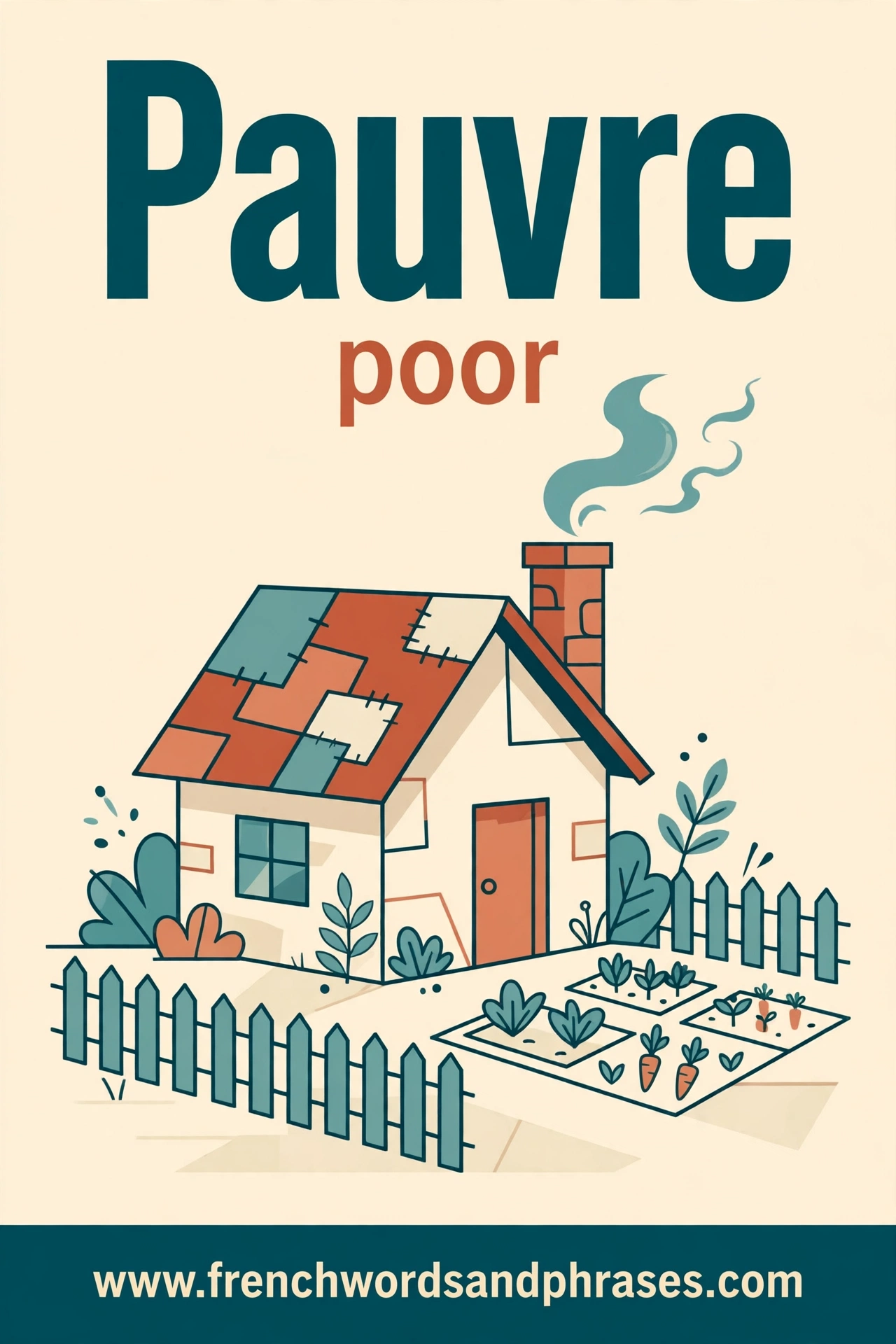
Pauvre means poor.
Rain over the city, and under the bridge an old man shares his bread with a thinner, older dog. Two coats between them, one umbrella, and a dignity that no passer-by would dare to pity too loudly. Some words change their heart depending on where they stand. Pauvre is the first of them.
In this guide, you’ll learn what pauvre means in English, why it has two forms instead of four, and the most elegant trick in French adjectives: how pauvre changes its meaning completely by moving from one side of the noun to the other. Explore French examples, English translations, and practice quizzes.
Understanding the French Adjective Pauvre
Pauvre is a French adjective of quality — but a double agent. After the noun it talks about money; before the noun it talks about pity. And since it already ends in -e, masculine and feminine share a single form: pauvre serves everyone.
It means poor — without money: un homme pauvre, a poor man; un pays pauvre, a poor country. But move it in front of the noun and it melts into sympathy: le pauvre homme — the poor man, now meaning the unfortunate man, the one you feel sorry for. Same word, same man, two different stories.
Type: Adjective of quality — money, and pity
Answers the question: What is he like? — poor (no money) / poor thing (pity)
Changes form: Barely — pauvre for masculine and feminine; pauvres for both plurals
English equivalents: Poor; unfortunate, poor thing (before the noun).
One important usage detail: position is everything. Un homme pauvre has no money; un pauvre homme has your sympathy. Before the noun, pauvre almost never talks about money — it is the adjective of a hand on a shoulder.
Experience the Word
Pauvre is the adjective of the hand on the shoulder — the word French adds to any name, any creature, any broken thing, to say: life has been hard on this one.
Imagine a child showing you a bird with a broken wing, wrapped in a scarf in a shoebox. She looks up with enormous seriousness: « le pauvre oiseau ». The bird is not short of money. The word was never about money.
You have not just said poor. You have taken sides with the unfortunate.
How to Use Pauvre in French: Complete Guide
Let’s explore how pauvre works in French, beginning with the whole word on one card.
Pauvre at a Glance
Before the details, here is the whole word on one card.
The Whole Word on One Card
Meaning, type, position and forms — pauvre in four lines.
| Point | Pauvre |
|---|---|
| Meaning | poor |
| Type | adjective of quality — money and pity |
| Usual position | both — the meaning changes with the position |
| Form | pauvre / pauvre / pauvres / pauvres |
Example
Le pauvre chat attend sous la pluie.
The poor cat is waiting in the rain.
The Four Forms of Pauvre
Pauvre is the easiest agreement in French: it already ends in -e, so masculine and feminine are identical, and only the plural adds an -s.
| Form | Pauvre | Example |
|---|---|---|
| Masculine singular | pauvre | un homme pauvre — a poor man (no money) |
| Feminine singular | pauvre | une femme pauvre — a poor woman (no money) |
| Masculine plural | pauvres | des gens pauvres — poor people |
| Feminine plural | pauvres | des familles pauvres — poor families |
Example
Dans ce quartier pauvre, les gens s’entraident beaucoup.
In this poor neighbourhood, people help each other a lot.
Quick Quiz 1
Does pauvre change its form for the feminine?
Reveal the answer
No
Pauvre already ends in -e, so it serves masculine and feminine alike. Only the plural changes: pauvres.
Un homme pauvre, une femme pauvre. — A poor man, a poor woman.
Forming the Feminine: pauvre Stays pauvre
No swap, no doubling, no waking consonant: pauvre belongs to the peaceful family of adjectives that already end in -e, like riche, triste and calme.
| Step | Example |
|---|---|
| Masculine | pauvre — un homme pauvre |
| Feminine | pauvre — une femme pauvre, exactly the same |
| Plurals | pauvres — des hommes pauvres, des femmes pauvres |
| Same family | riche, triste, calme — adjectives in -e never change for the feminine |
Example
C’est une famille pauvre mais très généreuse.
It’s a poor family but a very generous one.
Where Pauvre Goes: The Position That Changes Everything
This is the most famous position trick in French. After the noun, pauvre counts money. Before the noun, it counts sorrows — and the same man becomes two different men.
| Position | Example |
|---|---|
| After the noun (money) | un homme pauvre — a poor man, he has no money |
| Before the noun (pity) | un pauvre homme — a poor man, you feel sorry for him |
| After the noun (money) | un pays pauvre — a poor country |
| Before the noun (pity) | le pauvre enfant ! — the poor child! |
Example
Le pauvre homme ! Il a perdu son travail et sa voiture le même jour.
The poor man! He lost his job and his car on the same day.
Quick Quiz 2
In « un pauvre chien », is the dog short of money — or does the speaker feel sorry for it?
Reveal the answer
The speaker feels sorry for it
Before the noun, pauvre means pity, never money.
Le pauvre chien attend devant la porte. — The poor dog is waiting in front of the door.
Poorer and Poorest: Comparing with Pauvre
Pauvre compares the regular way, with plus, moins and aussi — in its money sense. The pity sense rarely compares: misfortune is not a competition.
| Degree | Example |
|---|---|
| As poor as | aussi pauvre que — as poor as |
| Poorer | plus pauvre — poorer |
| Less poor | moins pauvre — less poor |
| The poorest (masc.) | le plus pauvre — le plus pauvre du village |
| The poorest (fem.) | la plus pauvre — la plus pauvre du village |
Example
C’est le village le plus pauvre de la région.
It’s the poorest village in the region.
Everyday Expressions with Pauvre
From the sigh of sympathy to the comic complaint about oneself, pauvre softens and sharpens all over daily French.
| Expression | In English |
|---|---|
| le pauvre ! | poor thing! — said with a sigh |
| pauvre de moi ! | poor me! — half comic, half sincere |
| un pauvre type | a poor guy, a nobody — pity with an edge |
| pauvre en | poor in — un sol pauvre en eau, soil poor in water |
| un repas pauvre | a meagre meal — pauvre for thin, poor-quality things |
| les pauvres | the poor — pauvre working as a noun |
Example
Pauvre de moi, j’ai encore oublié mes clés !
Poor me, I’ve forgotten my keys again!
Quick Quiz 3
What does pauvre de moi ! mean?
Reveal the answer
Poor me!
A small comic sigh at your own misfortune.
Pauvre de moi, il pleut encore ! — Poor me, it’s raining again!
Pauvre and Its Neighbours
Around pauvre gathers the vocabulary of hard times and kind hearts — from destitution to the generosity that so often keeps it company.
| French | In English |
|---|---|
| riche | rich — the opposite |
| démuni | destitute, without resources |
| misérable | wretched, miserable |
| malheureux | unhappy, unfortunate |
| pitoyable | pitiful |
| généreux | generous — the poor are often the first to be it |
Example
Il est pauvre mais généreux, riche de cœur.
He is poor but generous, rich in heart.
Watch Out: The Traps Around Pauvre
One word, two meanings, and the only thing separating them is a few centimetres of word order — plus a noun hiding inside the adjective.
| Trap | The truth |
|---|---|
| position is meaning | before the noun = pity; after the noun = money. The whole page in one line |
| poor quality | for bad quality French often prefers mauvais — but un pauvre repas, a meagre meal, is perfect French |
| as a noun | les pauvres = poor people; un pauvre = a poor person |
| the feminine | never changes: une femme pauvre, with the same pauvre as the masculine |
Example
Un pauvre repas pour un homme pauvre : quelle journée !
A meagre meal for a poor man: what a day!
Quick Quiz 4
You want to say ‘the poor woman’ meaning she has no money. Does pauvre go before or after femme?
Reveal the answer
After
Une femme pauvre has no money. Une pauvre femme would be ‘the poor thing’.
Une femme pauvre — a poor woman.
Pauvre in Everyday French: Real-Life Examples
Now that you know the word, let’s see how pauvre appears in everyday French.
Example 1 — Pity
Le pauvre chien attend son maître sous la pluie depuis une heure.
The poor dog has been waiting for its owner in the rain for an hour.
Example 2 — Money
C’est un pays pauvre, mais les marchés sont pleins de couleurs.
It’s a poor country, but the markets are full of colour.
Example 3 — Poor me
Pauvre de moi, encore un lundi matin !
Poor me, another Monday morning!
Example 4 — Helping
L’association distribue des repas aux familles pauvres du quartier.
The charity gives out meals to the poor families of the neighbourhood.
Example 5 — A meagre meal
Après la longue marche, un pauvre repas de pain et de fromage nous attendait.
After the long walk, a meagre meal of bread and cheese awaited us.
Example 6 — Rich in heart
Ils sont pauvres, mais leur porte est toujours ouverte aux voisins.
They are poor, but their door is always open to the neighbours.
Beyond Translation: The Meaning of Pauvre
English says poor for the meaning of pauvre — and English quietly does the same double trick: ‘the poor man’ can be penniless or pitiable. But French has made the trick official, and written it into the word order.
To move pauvre in front of the noun is to move it from the wallet to the heart.
It is a small grammar lesson in compassion: what a person has is described after their name; what we feel for them comes first.
How to Remember the French Adjective Pauvre
Remember it this way: Pauvre is one word with two addresses — after the noun it counts coins, before the noun it counts sorrows.
- You see the empty wallet — un homme pauvre, after the noun.
- You feel the hand on the shoulder — le pauvre homme, before the noun.
- You relax about agreement — pauvre never changes for her; only the plural adds an s.
The key idea is pauvre after the noun = no money; pauvre before the noun = poor thing, pity.
Test Your Knowledge of Pauvre
Let’s see how much you’ve learned. Try answering these questions before revealing the answers.
Question 1
What does pauvre mean after the noun?
Reveal the answer
Poor — without money.
Question 2
What does pauvre mean before the noun?
Reveal the answer
Poor thing — unfortunate, deserving pity.
Question 3
Translate: a poor woman (no money).
Reveal the answer
Une femme pauvre.
Question 4
What are the forms of pauvre?
Reveal the answer
pauvre, pauvre, pauvres, pauvres — the feminine is identical to the masculine.
Question 5
Complete the sentence:
Le ______ enfant, il est tombé de vélo !
Reveal the answer
pauvre
Le pauvre enfant, il est tombé de vélo !
The poor child, he fell off his bike!
Your Final Challenge
Can You Use It?
How would you say this in French?
“The poor child! But the family is poor and very generous.”
Reveal the answer
Le pauvre enfant ! Mais la famille est pauvre et très généreuse.
The poor child! But the family is poor and very generous.
A little French. A little curiosity. A richer everyday life.
LEARN FRENCH ONE WORD AT A TIME