A French Word to Live By
Translate Occupé to English
/ɔ.ky.pe/
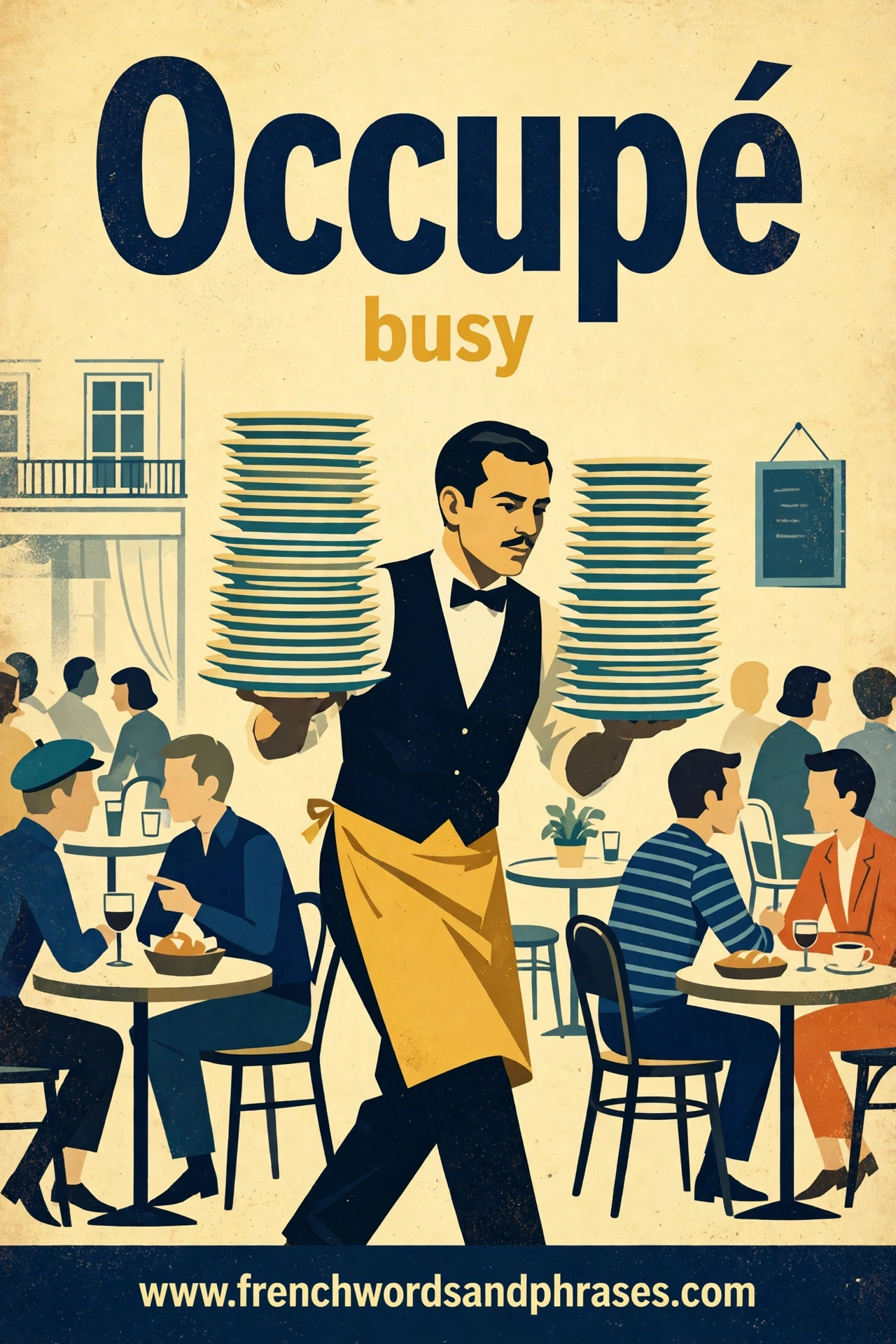
Occupé means busy.
Six o’clock at the little office above the bakery: the phone rings, the printer blinks, three emails arrive at once, and the calendar on the wall has no white space left at all. Some evenings have no room in them for one more thing. Those evenings are occupé.
In this guide, you’ll learn what occupé means in English, its four forms, why it lives after the noun and after être, and the little family secret behind it — it is a verb in disguise. Explore French examples, English translations, and practice quizzes.
Understanding the French Adjective Occupé
Occupé is a French adjective of state — it describes how full a person’s time is, or how taken a place is. It agrees with its noun like every adjective. But it began life as something else: it is the past participle of the verb occuper, ‘to occupy’, borrowed to describe our days.
It means busy — full, taken, with no time free: je suis occupé, I’m busy; une journée occupée, a busy day. And for places and things it keeps its older sense of ‘taken’: une place occupée, a taken seat; la ligne est occupée, the line is busy — engaged, as the British say.
Type: Adjective of state — fullness of time
Answers the question: What is he/she like right now? — busy
Changes form: Yes — occupé, occupée, occupés, occupées
English equivalents: Busy; taken, engaged (for seats and phone lines).
One important usage detail: occupé is mostly found after être or after the noun — elle est occupée, un homme occupé. It rarely stands before the noun. And because it is a past participle, it agrees exactly like one.
Experience the Word
Occupé is the adjective of the full diary — the word that stands guard over the busiest hours of the day and says, politely but firmly: no entry.
Imagine calling a friend at the exact wrong moment: the baby crying, the pasta boiling over, a delivery man at the door. She laughs down the phone, breathless: « rappelle-moi plus tard, je suis très occupée là ! » You can hear the whole scene in one word.
You have not just said busy. You have shown a life with every chair taken.
How to Use Occupé in French: Complete Guide
Let’s explore how occupé works in French, beginning with the whole word on one card.
Occupé at a Glance
Before the details, here is the whole word on one card.
The Whole Word on One Card
Meaning, type, position and forms — occupé in four lines.
| Point | Occupé |
|---|---|
| Meaning | busy |
| Type | adjective of state — time fully taken |
| Usual position | after être or after the noun — elle est occupée |
| Form | occupé / occupée / occupés / occupées |
Example
Je suis occupé jusqu’à midi.
I’m busy until midday.
The Four Forms of Occupé
Occupé agrees like the past participle it is: add -e for the feminine, -s for the masculine plural, and both for the feminine plural.
| Form | Occupé | Example |
|---|---|---|
| Masculine singular | occupé | un homme occupé — a busy man |
| Feminine singular | occupée | une femme occupée — a busy woman |
| Masculine plural | occupés | des gens occupés — busy people |
| Feminine plural | occupées | des journées occupées — busy days |
Example
Ce sont des gens très occupés, ils travaillent même le dimanche.
They are very busy people, they work even on Sundays.
Quick Quiz 1
Which form of occupé goes with journée (feminine)?
Reveal the answer
occupée
Une journée occupée.
A busy day.
Forming the Feminine: occupé → occupée
Occupé forms its feminine the gentle way — add -e. The written word gains an extra ée, but the sound does not change at all: occupé and occupée are twins to the ear.
| Step | Example |
|---|---|
| Masculine | occupé — il est occupé |
| Add -e | occupée — elle est occupée |
| Same sound | the extra e is written, not heard |
| Plurals | occupés / occupées — ils sont occupés, elles sont occupées |
Example
Elle est très occupée cette semaine.
She is very busy this week.
Where Occupé Goes: After Être, After the Noun
Occupé is a state, not a label, so it lives after être and after the noun. Before the noun you will almost never meet it.
| Pattern | Example |
|---|---|
| After être | je suis occupé — I’m busy |
| After the noun | une journée occupée — a busy day |
| Very busy | très occupé — and débordé, snowed under |
| Before the noun | almost never — occupé follows |
Example
C’est un médecin très occupé, il faut prendre rendez-vous tôt.
He’s a very busy doctor, you have to book early.
Quick Quiz 2
Where does occupé usually live — before the noun, or after être and the noun?
Reveal the answer
After
Elle est occupée, une journée occupée.
She is busy, a busy day.
Busier and Busiest: Comparing with Occupé
Occupé compares the regular way, with plus, moins and aussi — and its superlative agrees: le plus occupé, la plus occupée.
| Degree | Example |
|---|---|
| As busy as | aussi occupé que — as busy as |
| Busier | plus occupé — busier |
| Less busy | moins occupé — less busy |
| The busiest (masc.) | le plus occupé — le plus occupé de l’équipe |
| The busiest (fem.) | la plus occupée — la plus occupée de l’équipe |
Example
Le matin, elle est plus occupée que l’après-midi.
In the morning, she is busier than in the afternoon.
Everyday Expressions with Occupé
Occupé guards diaries, seats and telephone lines — and its parent verb, s’occuper de, turns the same root into one of the kindest phrases in French.
| Expression | In English |
|---|---|
| je suis occupé | I’m busy — the classic polite shield |
| une place occupée | a taken seat |
| la ligne est occupée | the line is busy — engaged |
| les toilettes sont occupées | the toilets are engaged |
| occupé à + infinitive | busy doing something — occupée à préparer le dîner |
| s’occuper de | to take care of, to look after — the verb behind the adjective |
Example
Elle est occupée à préparer le repas, rappelle dans une heure.
She’s busy preparing the meal, call back in an hour.
Quick Quiz 3
What does la ligne est occupée mean, on the phone?
Reveal the answer
The line is busy — engaged
Someone is already on the call.
La ligne est occupée, je rappellerai plus tard. — The line is busy, I’ll call back later.
Occupé and Its Neighbours
French measures full diaries finely, from the packed schedule to the glorious opposite — libre, free. Occupé is the everyday middle of the scale.
| French | In English |
|---|---|
| débordé | snowed under, overwhelmed with work |
| chargé | full, packed — un emploi du temps chargé, a packed schedule |
| actif | active |
| disponible | available |
| libre | free, available — the opposite |
| oisif | idle — the far opposite |
Example
Son emploi du temps est chargé, il est débordé cette semaine.
His schedule is packed, he’s snowed under this week.
Watch Out: The Traps Around Occupé
A participle in disguise, a word that serves people and places alike, and an agreement that hides after être — the traps are small but daily.
| Trap | The truth |
|---|---|
| a participle in disguise | occupé comes from the verb occuper — it always agrees like a participle |
| people and places | occupé works for both: un homme occupé, une place occupée |
| agreement after être | elles sont occupées — never forget the feminine plural, even after être |
| busy, not ‘occupied’ first | in daily life occupé means busy; the military sense exists but comes second |
Example
Les places près de la fenêtre sont déjà occupées.
The seats near the window are already taken.
Quick Quiz 4
Occupé is really the past participle of which verb?
Reveal the answer
occuper
Occupé is occuper’s past participle, borrowed to describe full diaries and taken seats.
S’occuper des enfants — to look after the children.
Occupé in Everyday French: Real-Life Examples
Now that you know the word, let’s see how occupé appears in everyday French.
Example 1 — On the phone
Je te rappelle ce soir, je suis occupé en ce moment.
I’ll call you back this evening, I’m busy at the moment.
Example 2 — At the office
La directrice est occupée jusqu’à quinze heures.
The manager is busy until three o’clock.
Example 3 — A seat
Pardon, cette place est occupée ? — Non, elle est libre.
Excuse me, is this seat taken? — No, it’s free.
Example 4 — A busy day
Quelle journée occupée ! Je n’ai pas eu une minute à moi.
What a busy day! I didn’t have a minute to myself.
Example 5 — The phone line
J’ai essayé trois fois, la ligne est toujours occupée.
I tried three times, the line is still busy.
Example 6 — Looking after
Elle est occupée à aider ses parents dans le jardin.
She is busy helping her parents in the garden.
Beyond Translation: The Meaning of Occupé
English says busy for the meaning of occupé — but the French word tells you why you are busy: your time is occupied, taken up, filled like a room with furniture.
To say je suis occupé is to say: there is no chair left free in my day.
And the word turns kind in its verb form: s’occuper de quelqu’un — to occupy yourself with someone, to look after them. The fullest days, in French, are often full of other people.
How to Remember the French Adjective Occupé
Remember it this way: Occupé is a verb wearing an adjective’s coat — the past participle of occuper, standing guard over your diary.
- You see the diary with no white space — « je suis occupé ».
- You hear the engaged tone — la ligne est occupée, the line is busy.
- You agree it like a participle — il est occupé, elle est occupée, elles sont occupées.
The key idea is occupé lives after être and after the noun, agrees like a past participle, and means busy — or taken.
Test Your Knowledge of Occupé
Let’s see how much you’ve learned. Try answering these questions before revealing the answers.
Question 1
What does occupé mean?
Reveal the answer
Busy — and taken, engaged, for seats and phone lines.
Question 2
What are the forms of occupé?
Reveal the answer
occupé, occupée, occupés, occupées.
Question 3
Translate: I’m busy at the moment.
Reveal the answer
Je suis occupé en ce moment — a woman says occupée, with the same sound.
Question 4
What does cette place est occupée mean?
Reveal the answer
This seat is taken.
Question 5
Complete the sentence:
Elles sont très ______ cette semaine.
Reveal the answer
occupées
Elles sont très occupées cette semaine.
They are very busy this week.
Your Final Challenge
Can You Use It?
How would you say this in French?
“I’m busy until midday, but this seat is free.”
Reveal the answer
Je suis occupé jusqu’à midi, mais cette place est libre.
I’m busy until midday, but this seat is free.
A little French. A little curiosity. A richer everyday life.
LEARN FRENCH ONE WORD AT A TIME