A French Word to Live By
Translate Normal to English
/nɔʁ.mal/
Normal means normal.
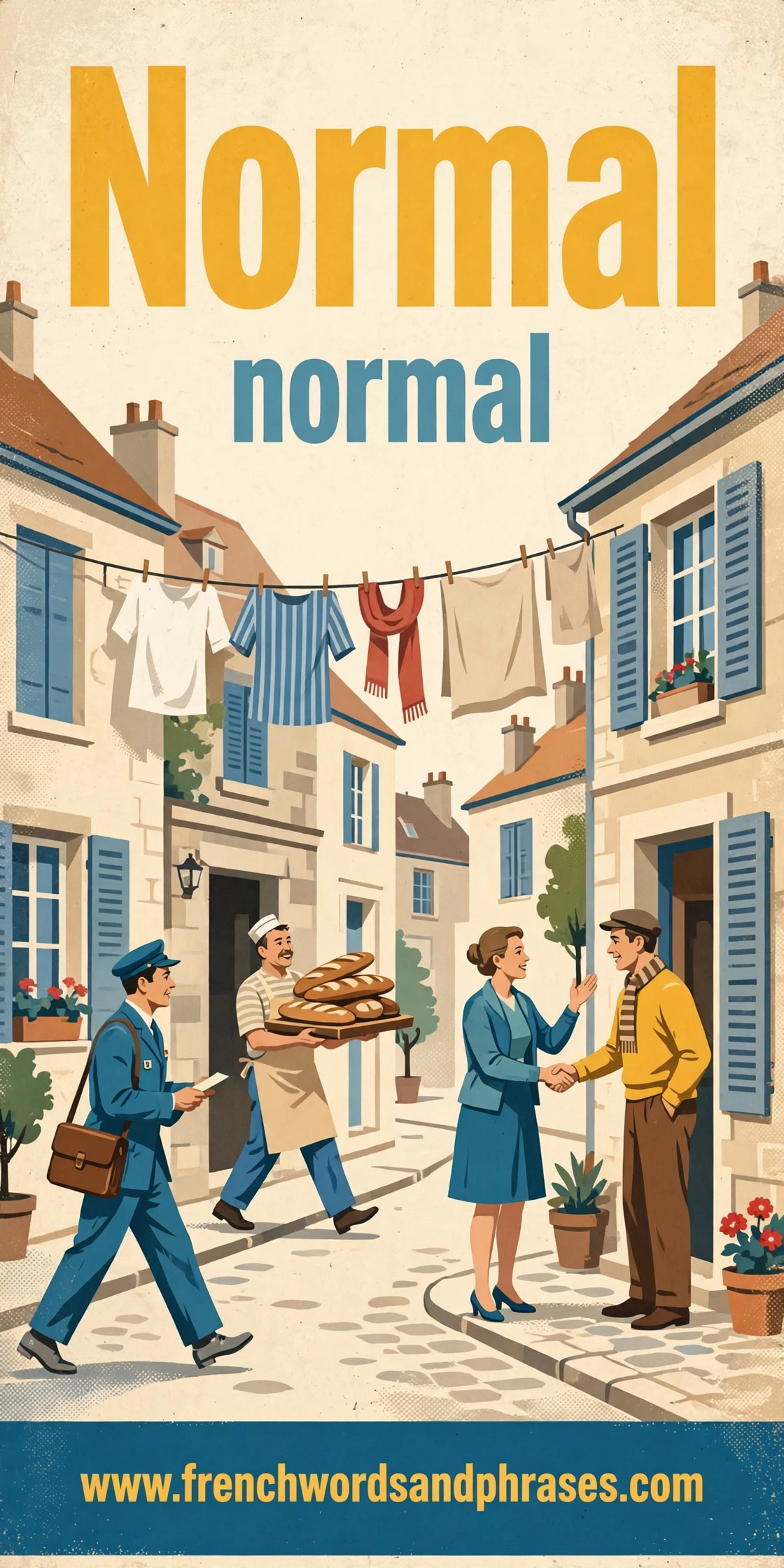
Monday morning at the café, and everything is in its place: the same cups, the same croissants, the same Monsieur Lefèvre at the same table with the same newspaper. After the noise and colour of the weekend, the town has settled back into its shape. C’est normal.
In this guide, you’ll learn what normal means in English, its four forms — including the plural that changes its ending completely — why it follows the noun, and how « c’est normal » became one of the most useful sentences in France. Explore French examples, English translations, and practice quizzes.
Understanding the French Adjective Normal
Normal is a French adjective of quality — the adjective of the ordinary, the expected, the way things are supposed to be. It agrees with its noun like every adjective, and it hides one surprise in its wardrobe: its masculine plural is not normals but normaux.
It means normal — ordinary, usual, as expected: une journée normale, a normal day; un prix normal, a normal price. And standing after c’est, it becomes the great French phrase of acceptance: c’est normal — it’s normal, of course, that’s just how it is.
Type: Adjective of quality — the ordinary
Answers the question: What is it like? — normal, as expected
Changes form: Yes — normal, normale, normaux, normales
English equivalents: Normal; usual; standard.
One important usage detail: normal FOLLOWS the noun — une situation normale. And watch the masculine plural: adjectives ending in -al usually swap that ending for -aux — des prix normaux, never ‘des prix normals’.
Experience the Word
Normal is the adjective of things settling back into place — the first ordinary day after the holidays, the train running on time, the shop open at its usual hour.
Imagine a small boy asking his grandmother why the sky is blue, why dogs bark, why soup is hot. She smiles at every question and gives the same answer, the answer that ends all arguments in France: « c’est normal, mon chéri. »
You have not just said normal. You have said: the world is working as it should.
How to Use Normal in French: Complete Guide
Let’s explore how normal works in French, beginning with the whole word on one card.
Normal at a Glance
Before the details, here is the whole word on one card.
The Whole Word on One Card
Meaning, type, position and forms — normal in four lines.
| Point | Normal |
|---|---|
| Meaning | normal |
| Type | adjective of quality — the ordinary |
| Usual position | after the noun — une journée normale |
| Form | normal / normale / normaux / normales |
Example
C’était une journée normale au bureau.
It was a normal day at the office.
The Four Forms of Normal
Normal agrees with the noun it describes. The feminine adds a simple -e — but look at the masculine plural, where -al turns into -aux.
| Form | Normal | Example |
|---|---|---|
| Masculine singular | normal | un prix normal — a normal price |
| Feminine singular | normale | une taille normale — a normal size |
| Masculine plural | normaux | des prix normaux — normal prices |
| Feminine plural | normales | des tailles normales — normal sizes |
Example
À des heures normales, la rue est calme.
At normal hours, the street is quiet.
Quick Quiz 1
Which form of normal goes with prix (masculine plural)?
Reveal the answer
normaux
Des prix normaux.
Normal prices. The ending -al becomes -aux.
Forming the Feminine — and the Plural That Changes
The feminine is regular: add -e. The adventure is in the masculine plural, where -al becomes -aux — a souvenir of very old French that a whole family of adjectives still carries.
| Step | Example |
|---|---|
| Feminine singular | normale — une vie normale |
| Masculine plural | normaux — des horaires normaux |
| Feminine plural | normales — des vies normales |
| Same family | national → nationaux, idéal → idéaux |
Example
Ce sont des horaires normaux pour un magasin de village.
These are normal opening hours for a village shop.
Where Normal Goes: After the Noun
Normal is a describing adjective and follows its noun. Its favourite home of all, though, is the little sentence c’est normal, said a hundred times a day across France.
| Pattern | Example |
|---|---|
| noun + normal | une situation normale — a normal situation |
| After être | c’est normal — it’s normal, of course |
| With an adverb | tout à fait normal — completely normal |
| Before the noun | rare and bookish — everyday French keeps it after |
Example
Tu es fatigué après ce voyage ? C’est tout à fait normal.
You’re tired after that trip? That’s completely normal.
Quick Quiz 2
Where does normal stand — before or after the noun?
Reveal the answer
After
Une situation normale, un prix normal.
A normal situation, a normal price.
More Normal: Comparing with Normal
Normal compares the regular way, with plus, moins and aussi — and its superlative agrees as always: le plus normal, la plus normale.
| Degree | Example |
|---|---|
| As normal as | aussi normal que — as normal as |
| More normal | plus normal — more normal |
| Less normal | moins normal — less normal |
| The most normal (masc.) | le plus normal — le plus normal des deux |
| The most normal (fem.) | la plus normale — la plus normale des deux |
Example
Cette année, la météo est plus normale que l’année dernière.
This year, the weather is more normal than last year.
Everyday Expressions with Normal
Normal carries one of the most useful sentences in France on its back — and its negative twin is the standard way to say that something is wrong.
| Expression | In English |
|---|---|
| c’est normal | it’s normal / of course — the great phrase of acceptance |
| c’est pas normal | that’s not right — something is wrong (informal) |
| en temps normal | in normal times, usually |
| à la normale | back to normal — le retour à la normale |
| un temps normal pour la saison | normal weather for the season |
| l’école normale | a teacher-training college — a famous French institution |
Example
Après la tempête, la vie revient peu à peu à la normale.
After the storm, life slowly returns to normal.
Quick Quiz 3
What does c’est normal often mean in conversation?
Reveal the answer
Of course / it’s only natural
It is the French way of saying: that’s just how things are.
Il a peur des chiens ? C’est normal, il est petit. — He’s afraid of dogs? Of course, he’s little.
Normal and Its Neighbours
Around normal gathers the vocabulary of the ordinary day — and at the far end, its direct opposite, anormal, stands waiting for everything that breaks the pattern.
| French | In English |
|---|---|
| ordinaire | ordinary |
| habituel | usual |
| classique | classic, typical |
| exceptionnel | exceptional |
| étrange | strange |
| anormal | abnormal — the direct opposite |
Example
Un jour ordinaire, tout à fait normal, sans rien d’exceptionnel.
An ordinary day, completely normal, with nothing exceptional.
Watch Out: The Traps Around Normal
The plural that changes its ending, the school that is not ordinary, and the little negative that means trouble — three traps and a reminder.
| Trap | The truth |
|---|---|
| masculine plural | normaux, never ‘normals’ — remember the -al → -aux swap |
| normal schools | l’École normale is a teacher-training college, not an ‘ordinary school’ |
| c’est pas normal | signals a problem to fix, not just something unusual |
| agreement after être | elle est normale, ils sont normaux — normal agrees even after être |
Example
Ces résultats sont normaux, rien d’anormal.
These results are normal, nothing abnormal.
Quick Quiz 4
How do you say ‘normal prices’ — des prix normals or des prix normaux?
Reveal the answer
des prix normaux
Adjectives in -al form their masculine plural in -aux.
Des prix normaux — normal prices.
Normal in Everyday French: Real-Life Examples
Now that you know the word, let’s see how normal appears in everyday French.
Example 1 — At work
Rien de spécial aujourd’hui, une journée normale au bureau.
Nothing special today, a normal day at the office.
Example 2 — Acceptance
Il pleure parce qu’il a perdu son chien ? C’est normal, il l’adorait.
He’s crying because he lost his dog? It’s normal, he adored it.
Example 3 — Something wrong
Ce bruit dans le moteur, ce n’est pas normal, va voir le garagiste.
That noise in the engine, that’s not right, go and see the mechanic.
Example 4 — The weather
Pour un mois de novembre, ces températures sont normales.
For the month of November, these temperatures are normal.
Example 5 — At the doctor’s
Votre tension est normale, tout va bien.
Your blood pressure is normal, everything is fine.
Example 6 — Back to normal
Après les travaux, la rue retrouve son calme normal.
After the roadworks, the street gets back its normal calm.
Beyond Translation: The Meaning of Normal
English says normal for the meaning of normal — the words are twins. But French has given its twin a second job: c’est normal is the nation’s philosophy in two words, the answer to every surprise, every complaint, every small mystery of daily life.
To say c’est normal is to forgive the world for being exactly as it is.
And when something truly goes wrong, French simply turns the phrase around: c’est pas normal — and everyone understands that it is time to act.
How to Remember the French Adjective Normal
Remember it this way: Normal is the adjective of the world working properly — and of the little plural that swaps its ending: normaux.
- You hear the grandmother’s answer to everything — « c’est normal ».
- You swap the plural ending — des prix normaux, never normals.
- You keep it after the noun — une journée normale, des horaires normaux.
The key idea is normal follows the noun; the masculine plural is normaux; c’est normal means of course.
Test Your Knowledge of Normal
Let’s see how much you’ve learned. Try answering these questions before revealing the answers.
Question 1
What does normal mean?
Reveal the answer
Normal — ordinary, usual, as expected.
Question 2
What are the forms of normal?
Reveal the answer
normal, normale, normaux, normales.
Question 3
Translate: a normal day.
Reveal the answer
Une journée normale.
Question 4
How do you say ‘that’s not right, something is wrong’ (informal)?
Reveal the answer
C’est pas normal.
Question 5
Complete the sentence:
Des horaires ______ pour un petit magasin.
Reveal the answer
normaux
Des horaires normaux pour un petit magasin.
Normal hours for a small shop.
Your Final Challenge
Can You Use It?
How would you say this in French?
“Don’t worry, it’s completely normal — everything will go back to normal.”
Reveal the answer
Ne t’inquiète pas, c’est tout à fait normal — tout va revenir à la normale.
Don’t worry, it’s completely normal — everything will go back to normal.
A little French. A little curiosity. A richer everyday life.
LEARN FRENCH ONE WORD AT A TIME