A French Word to Live By
Translate Neuf to English
/nœf/
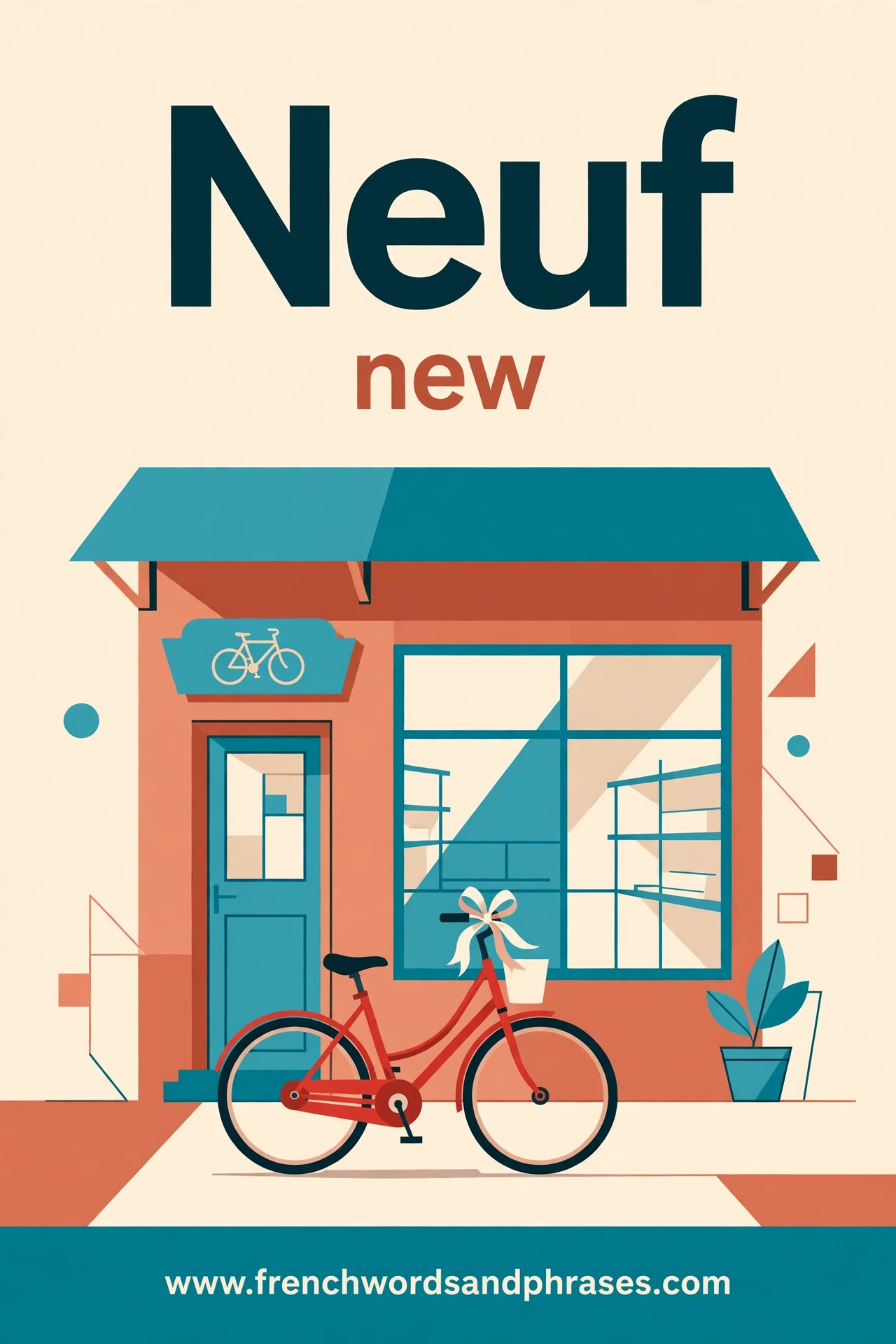
Neuf means new.
The shoe shop on the first morning of the sales: boxes stacked to the ceiling, tissue paper crackling, and that smell — leather and cardboard and beginnings — that no second-hand shop ever has. Everything here is untouched. Everything here is neuf.
In this guide, you’ll learn what neuf means in English, its four forms, why it follows the noun, and the famous trap that catches every learner: neuf or nouveau? Explore French examples, English translations, and practice quizzes.
Understanding the French Adjective Neuf
Neuf is a French adjective of quality — the adjective of brand-new things. It agrees with its noun, and its feminine, neuve, changes the f into a v, one of the classic French spelling swaps. Neuf says one precise thing: this object has never been used.
It means new — but only in the sense of brand new, fresh from the shop: une voiture neuve, a brand-new car; des chaussures neuves, new shoes. For ‘new’ in the sense of different, another, or new to you, French uses a different word entirely: nouveau. Neuf is about the object’s age, not yours.
Type: Adjective of quality — condition (unused)
Answers the question: What condition is it in? — brand new
Changes form: Yes — neuf, neuve, neufs, neuves
English equivalents: Brand new; new (unused).
One important usage detail: neuf FOLLOWS the noun — une voiture neuve. And never use it for a new job, a new friend or a new idea: those are nouveau. If it still has its price tag, it is neuf; if it is simply new in your life, it is nouveau.
Experience the Word
Neuf is the adjective of the first day — the notebook with no mark on its first page, the bicycle waiting by the door with its bell untested.
Imagine a child opening the box on Christmas morning. The toy is lifted out slowly, the plastic still shining, nothing scratched, nothing missing. The adults smile and say the word that means the whole ceremony: « il est neuf ».
You have not just said new. You have said untouched, unused, begun by no one.
How to Use Neuf in French: Complete Guide
Let’s explore how neuf works in French, beginning with the whole word on one card.
Neuf at a Glance
Before the details, here is the whole word on one card.
The Whole Word on One Card
Meaning, type, position and forms — neuf in four lines.
| Point | Neuf |
|---|---|
| Meaning | new — brand new |
| Type | adjective of quality — condition |
| Usual position | after the noun — une voiture neuve |
| Form | neuf / neuve / neufs / neuves |
Example
Elle a acheté une voiture neuve.
She bought a brand-new car.
The Four Forms of Neuf
Neuf agrees with the noun it describes. Watch the feminine: the f of neuf melts into a v, giving neuve — one of the classic swaps of French spelling.
| Form | Neuf | Example |
|---|---|---|
| Masculine singular | neuf | un livre neuf — a brand-new book |
| Feminine singular | neuve | une chemise neuve — a brand-new shirt |
| Masculine plural | neufs | des livres neufs — brand-new books |
| Feminine plural | neuves | des chemises neuves — brand-new shirts |
Example
Ces chaussures neuves me font un peu mal aux pieds.
These new shoes hurt my feet a little.
Quick Quiz 1
Which form of neuf goes with chemise (feminine)?
Reveal the answer
neuve
Une chemise neuve.
A brand-new shirt.
Forming the Feminine: neuf → neuve
Neuf belongs to the small f → v family: the feminine swaps the final f for a v, then adds -e. Actif and sportif do exactly the same dance.
| Step | Example |
|---|---|
| Masculine | neuf — un manteau neuf |
| f becomes v, add -e | neuve — une robe neuve |
| Same family | actif → active, sportif → sportive |
| Plurals | neufs / neuves — des manteaux neufs, des robes neuves |
Example
Sa voiture neuve brille dans la cour.
Her brand-new car shines in the yard.
Where Neuf Goes: After the Noun
Neuf is a describing adjective, so it follows its noun — and in one happy pattern it can share a sentence with its rival nouveau, each in its proper place.
| Pattern | Example |
|---|---|
| noun + neuf | un téléphone neuf — a brand-new phone |
| After être | ce livre est neuf — this book is brand new |
| Before the noun | never in everyday French — neuf follows |
| With nouveau | un nouveau téléphone tout neuf — a new phone, brand new |
Example
Il a un nouveau vélo, tout neuf, encore avec l’étiquette.
He has a new bike, brand new, still with the label on.
Quick Quiz 2
Where does neuf stand — before or after the noun?
Reveal the answer
After
Une voiture neuve, un livre neuf.
A brand-new car, a brand-new book.
Comparing with Neuf: As Good As New
Things are rarely ‘newer’ than each other, so French compares neuf sideways — with tout neuf for the freshest possible, and comme neuf for the beautifully restored.
| Degree | Example |
|---|---|
| Brand new | tout neuf / toute neuve — tout neuf, fresh out of the box |
| As good as new | comme neuf — il marche comme neuf, it works like new |
| Restored to new | remis à neuf — un appartement remis à neuf |
| More worn | plus usé — the slide away from neuf |
| The newest | le plus neuf — le plus neuf des deux vélos |
Example
Après la réparation, la machine marche comme neuve.
After the repair, the machine works like new.
Everyday Expressions with Neuf
Neuf renovates houses, greets friends and describes the most joyful purchases — it is one of the hardest-working small words in French.
| Expression | In English |
|---|---|
| tout neuf | brand new, spanking new |
| comme neuf | as good as new |
| remettre à neuf | to renovate, to restore to new condition |
| quoi de neuf ? | what’s new? — the everyday greeting |
| à neuf | back to new — refait à neuf, redone from scratch |
| flambant neuf | brand spanking new (informal and joyful) |
Example
Quoi de neuf chez toi ? — J’ai une voiture neuve !
What’s new with you? — I have a brand-new car!
Quick Quiz 3
What does quoi de neuf ? mean?
Reveal the answer
What’s new?
It is the everyday French greeting between friends.
Quoi de neuf ? — Rien de spécial. — What’s new? — Nothing special.
Neuf and Its Neighbours
Around neuf gathers the whole family of age and condition — from its great rival nouveau to the second-hand world of d’occasion.
| French | In English |
|---|---|
| nouveau | new — new to you, another, different: the great rival |
| récent | recent |
| d’occasion | second-hand, used |
| usagé | used, worn |
| ancien | old, former |
| vieux | old — the opposite |
Example
Ce n’est pas un vélo neuf, c’est un vélo d’occasion en bon état.
It’s not a brand-new bike, it’s a second-hand bike in good condition.
Watch Out: Neuf or Nouveau?
The most famous choice between two French words. One question settles it almost every time: has it been used before, or is it just new in someone’s life?
| Trap | The truth |
|---|---|
| brand new from the shop | neuf — une voiture neuve |
| new to you, another one | nouveau — un nouveau travail, a new job |
| people | always nouveau — un nouveau professeur, never neuf |
| ideas and news | nouveau — une nouvelle idée, a new idea |
Example
Elle a un nouveau bureau et un ordinateur tout neuf.
She has a new office and a brand-new computer.
Quick Quiz 4
A friend starts a different job. Do you call it un travail neuf or un nouveau travail?
Reveal the answer
un nouveau travail
A job is new to you, not fresh from a shelf. Neuf is only for unused things.
Un nouveau travail — a new job.
Neuf in Everyday French: Real-Life Examples
Now that you know the word, let’s see how neuf appears in everyday French.
Example 1 — At the shop
Je préfère un ordinateur neuf, avec une garantie de deux ans.
I prefer a brand-new computer, with a two-year guarantee.
Example 2 — Shoes
Mes chaussures neuves sont belles mais un peu serrées.
My new shoes are beautiful but a bit tight.
Example 3 — A greeting
Salut Marc, quoi de neuf ? — Rien de spécial, et toi ?
Hi Marc, what’s new? — Nothing special, and you?
Example 4 — A house
Ils ont refait la cuisine à neuf pendant l’été.
They redid the kitchen from scratch during the summer.
Example 5 — A car
Cette voiture a cinq ans mais elle marche comme neuve.
This car is five years old but it runs like new.
Example 6 — A book
J’adore l’odeur d’un livre neuf, avant la première page.
I love the smell of a brand-new book, before the first page.
Beyond Translation: The Meaning of Neuf
English says new for the meaning of neuf — but French refuses to let one word do two jobs. Nouveau welcomes the new arrival; neuf certifies the untouched object.
To call something neuf is to promise it has no past — no owner, no scratch, no story before you.
And then, in the most everyday greeting in France, the word turns playful: « quoi de neuf ? » — what’s new? — where neuf means news itself.
How to Remember the French Adjective Neuf
Remember it this way: Neuf is the word with the price tag still on — if it has never been used, it is neuf; if it is simply new in your life, it is nouveau.
- You see the label still attached — une voiture neuve, des chaussures neuves.
- You swap f for v for her — neuf becomes neuve, like actif becomes active.
- You keep it after the noun and away from people — un professeur is nouveau, never neuf.
The key idea is neuf = brand new and unused, after the noun; nouveau = new to you.
Test Your Knowledge of Neuf
Let’s see how much you’ve learned. Try answering these questions before revealing the answers.
Question 1
What does neuf mean, exactly?
Reveal the answer
Brand new — never used, fresh from the shop.
Question 2
What are the forms of neuf?
Reveal the answer
neuf, neuve, neufs, neuves.
Question 3
Translate: a brand-new car.
Reveal the answer
Une voiture neuve.
Question 4
Which word for a new job — neuf or nouveau?
Reveal the answer
nouveau
Un nouveau travail. Jobs are new to you, not fresh from a shelf.
Question 5
Complete the sentence:
Quoi de ______ ?
Reveal the answer
neuf
Quoi de neuf ?
What’s new?
Your Final Challenge
Can You Use It?
How would you say this in French?
“What’s new? I bought a brand-new bike, still with the label on!”
Reveal the answer
Quoi de neuf ? J’ai acheté un vélo tout neuf, encore avec l’étiquette !
What’s new? I bought a brand-new bike, still with the label on!
A little French. A little curiosity. A richer everyday life.
LEARN FRENCH ONE WORD AT A TIME