A French Word to Live By
Translate Méchant to English
/me.ʃɑ̃/
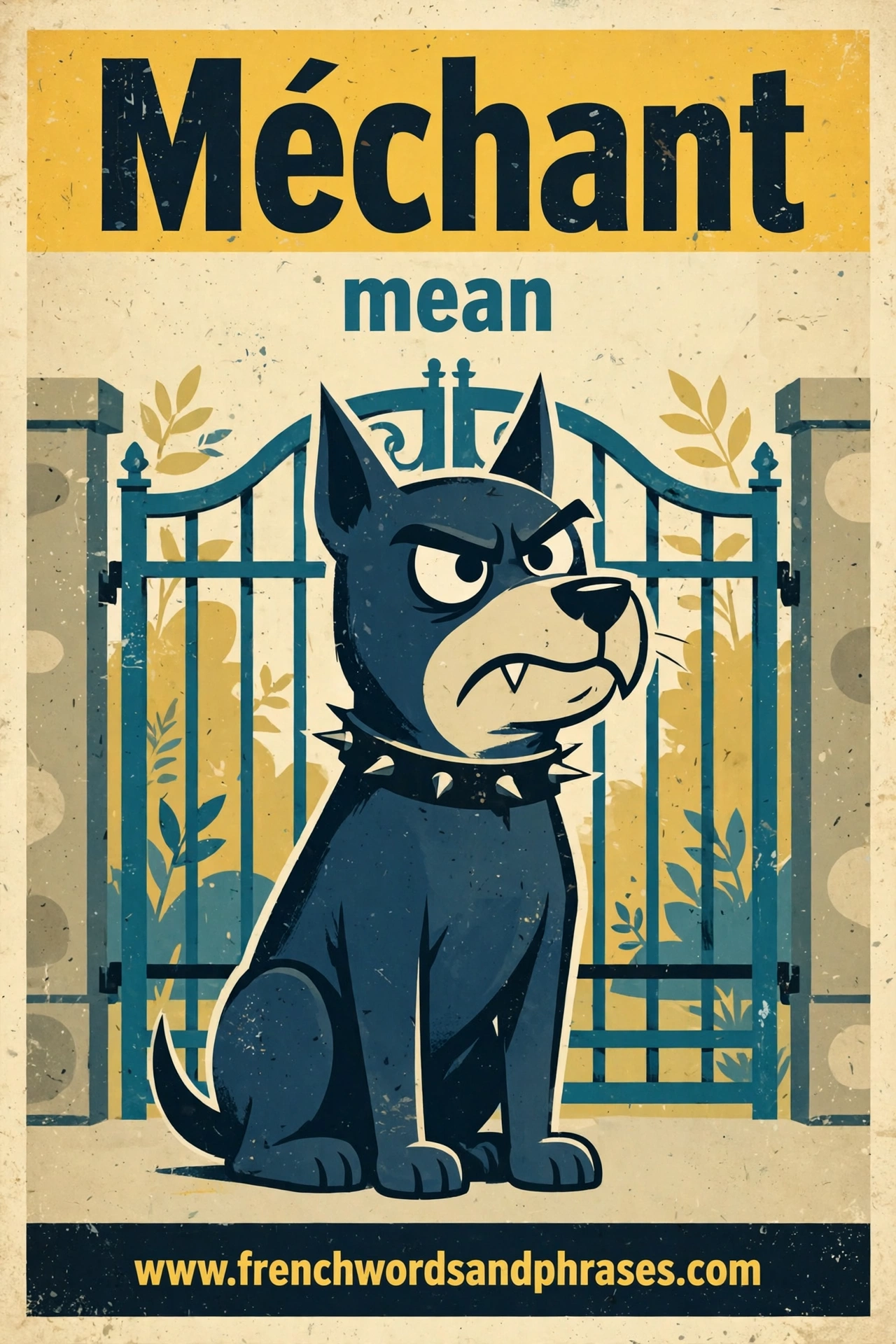
Méchant means mean.
The village dog has a reputation. It waits behind the baker’s gate, ears flat, watching the street with deep suspicion — and every child in the village crosses to the other side, whispering the word as they pass: méchant.
In this guide, you’ll learn what méchant means in English, its four forms, why it follows the noun, and how the same word that calls a dog dangerous calls a small child naughty. Explore French examples, English translations, and practice quizzes.
Understanding the French Adjective Méchant
Méchant is a French adjective of quality — the adjective of bad character. It agrees with the noun it describes, and its feminine, méchante, adds a simple -e. It is a word with two faces: genuinely nasty for adults and animals, gently scolding for children.
It means mean — nasty, unkind, wicked: un chien méchant, a mean, dangerous dog; un homme méchant, a mean man. But say it to a child — tu es méchant ! — and it softens into ‘naughty’: the word French parents reach for a hundred times a day.
Type: Adjective of quality — character
Answers the question: What is he/she like? — mean, nasty
Changes form: Yes — méchant, méchante, méchants, méchantes
English equivalents: Mean; nasty; naughty (for children); fierce (for dogs).
One important usage detail: méchant FOLLOWS the noun — un chien méchant, une femme méchante. Placed before the noun it belongs to stories and songs; in everyday French, after the noun is its home.
Experience the Word
Méchant is the adjective of the fairy tale — the méchant loup, the big bad wolf, has been frightening and delighting French children for centuries.
Imagine a grandmother reading aloud at bedtime, doing all the voices. The hero is brave, the princess is kind, and then the page turns and her voice drops: « et le méchant loup arriva… » Every child in the room knows exactly what kind of wolf this is.
You have not just said mean. You have cast the villain of the story.
How to Use Méchant in French: Complete Guide
Let’s explore how méchant works in French, beginning with the whole word on one card.
Méchant at a Glance
Before the details, here is the whole word on one card.
The Whole Word on One Card
Meaning, type, position and forms — méchant in four lines.
| Point | Méchant |
|---|---|
| Meaning | mean |
| Type | adjective of quality — character |
| Usual position | after the noun — un chien méchant |
| Form | méchant / méchante / méchants / méchantes |
Example
Attention, ce chien est méchant.
Careful, that dog is mean.
The Four Forms of Méchant
Méchant agrees with the noun it describes: masculine or feminine, singular or plural. The feminine simply adds -e — and the sleeping t wakes up, as you will see below.
| Form | Méchant | Example |
|---|---|---|
| Masculine singular | méchant | un homme méchant — a mean man |
| Feminine singular | méchante | une femme méchante — a mean woman |
| Masculine plural | méchants | des chiens méchants — mean dogs |
| Feminine plural | méchantes | des paroles méchantes — mean, hurtful words |
Example
Il a dit des paroles méchantes à sa sœur.
He said mean things to his sister.
Quick Quiz 1
Which form of méchant goes with paroles (feminine plural)?
Reveal the answer
méchantes
Des paroles méchantes.
Mean, hurtful words.
Forming the Feminine: méchant → méchante
Méchant forms its feminine the regular way — add -e. The final t, silent at the end of méchant, steps forward and speaks in méchante.
| Step | Example |
|---|---|
| Masculine | méchant — un garçon méchant |
| Add -e | méchante — une fille méchante |
| The t wakes up | méchante ends with a clear t sound |
| Plurals | méchants / méchantes — des garçons méchants, des filles méchantes |
Example
Elle n’est pas méchante, elle est triste.
She isn’t mean, she’s sad.
Where Méchant Goes: After the Noun
In real life méchant follows its noun. Its one famous exception lives in storybooks, where the villain always arrives before his wolf.
| Pattern | Example |
|---|---|
| noun + méchant | un chien méchant — a mean dog |
| After être | il est méchant — he is mean |
| To a child | tu es méchant ! — you’re naughty! |
| Before the noun (stories) | le méchant loup — the big bad wolf |
Example
Le méchant loup souffle sur la maison des petits cochons.
The big bad wolf blows on the little pigs’ house.
Quick Quiz 2
Where does méchant usually stand — before or after the noun?
Reveal the answer
After
Un chien méchant, une femme méchante.
A mean dog, a mean woman.
Meaner and Meanest: Comparing with Méchant
Méchant compares the regular way, with plus, moins and aussi — and its superlative keeps the agreement: le plus méchant, la plus méchante.
| Degree | Example |
|---|---|
| As mean as | aussi méchant que — as mean as |
| Meaner | plus méchant — meaner |
| Less mean | moins méchant — less mean |
| The meanest (masc.) | le plus méchant — le plus méchant des frères |
| The meanest (fem.) | la plus méchante — la plus méchante des sœurs |
Example
C’est le chien le plus méchant du quartier.
It’s the meanest dog in the neighbourhood.
Everyday Expressions with Méchant
From the wolf of the fairy tales to the cold that ruins a holiday, méchant works hard in daily French — and its negative form is pure reassurance.
| Expression | In English |
|---|---|
| le méchant loup | the big bad wolf |
| tu es méchant ! | you’re naughty! — said to a child |
| un méchant rhume | a nasty cold — méchant means nasty for illnesses too |
| pas méchant | harmless — ce chien n’est pas méchant, this dog is harmless |
| une méchante langue | a sharp, gossiping tongue |
| méchant comme une teigne | as mean as they come (informal) |
Example
Ne t’inquiète pas, ce chien n’est pas méchant.
Don’t worry, that dog is harmless.
Quick Quiz 3
A parent says « tu es méchant ! » to a small child. What does it mean here?
Reveal the answer
You’re naughty!
Said to a child, méchant softens into a scolding, not an accusation.
Tu es méchant avec ton frère ! — You’re naughty with your brother!
Méchant and Its Neighbours
French shades unkindness carefully, from the gentle vilain of the nursery to the full weight of cruel. Méchant sits in the middle — and gentil waits at the other end.
| French | In English |
|---|---|
| gentil | kind — the opposite |
| vilain | naughty — the gentlest word for a naughty child |
| égoïste | selfish |
| dur | hard, harsh |
| cruel | cruel |
| agressif | aggressive |
Example
Il peut être dur, mais il n’est jamais méchant.
He can be harsh, but he is never mean.
Watch Out: The Traps Around Méchant
Three traps and one kindness: the English word ‘mean’ has other jobs, the nursery softens this word, and its position belongs to real life, not storybooks.
| Trap | The truth |
|---|---|
| mean ≠ average | ‘mean’ as an average is la moyenne — never méchant |
| to children it softens | méchant said to a child means naughty, not evil |
| after the noun | un méchant chien sounds like a storybook — in real life say un chien méchant |
| pas méchant | reassures: harmless, not nasty at all |
Example
Attention au chien ? Non, il n’est pas méchant du tout.
Mind the dog? No, he’s not mean at all.
Quick Quiz 4
How do you say ‘a mean dog’ in everyday French — un méchant chien or un chien méchant?
Reveal the answer
un chien méchant
Méchant follows the noun in real life. Un méchant chien belongs to the storybooks — like le méchant loup.
Un chien méchant — a mean dog.
Méchant in Everyday French: Real-Life Examples
Now that you know the word, let’s see how méchant appears in everyday French.
Example 1 — At the park
Attention, le chien du gardien est méchant avec les étrangers.
Careful, the caretaker’s dog is mean with strangers.
Example 2 — To a child
Tu es méchant avec ta petite sœur, demande pardon.
You’re naughty with your little sister, say sorry.
Example 3 — At work
Le nouveau directeur est strict mais jamais méchant.
The new manager is strict but never mean.
Example 4 — A story
Dans ce conte, le méchant loup finit toujours perdant.
In this tale, the big bad wolf always ends up losing.
Example 5 — An illness
Elle a attrapé un méchant rhume avant les vacances.
She caught a nasty cold before the holidays.
Example 6 — Reassurance
Approche, ce chat n’est pas méchant, il adore les enfants.
Come closer, this cat is harmless, it loves children.
Beyond Translation: The Meaning of Méchant
English says mean for the meaning of méchant — but méchant lives two lives. In the street it warns you about a dog; at the dinner table it scolds a child, and there it is almost tender.
To call someone méchant is to judge their heart, not their actions — which is why the word stings.
And in every French childhood it wears a wolf’s ears: le méchant loup, the villain who loses in the end, every single time.
How to Remember the French Adjective Méchant
Remember it this way: Méchant is the villain’s word — after the noun for real life, and in front of the wolf in every story ever told.
- You see the wolf arrive — le méchant loup, the villain of every bedtime story.
- You keep it after the noun in real life — un chien méchant, une voisine méchante.
- You soften it for children — « tu es méchant ! » means naughty, not nasty.
The key idea is méchant follows the noun; méchante for her; naughty for children, nasty for the rest.
Test Your Knowledge of Méchant
Let’s see how much you’ve learned. Try answering these questions before revealing the answers.
Question 1
What does méchant mean?
Reveal the answer
Mean, nasty — and naughty, when said to a child.
Question 2
What are the forms of méchant?
Reveal the answer
méchant, méchante, méchants, méchantes.
Question 3
Translate: a mean dog.
Reveal the answer
Un chien méchant.
Question 4
Who is le méchant loup?
Reveal the answer
The big bad wolf — the villain of the fairy tales.
Question 5
Complete the sentence:
Tu es ______ avec ton frère, excuse-toi !
Reveal the answer
méchant
Tu es méchant avec ton frère, excuse-toi !
You’re naughty with your brother, say sorry!
Your Final Challenge
Can You Use It?
How would you say this in French?
“Careful, that dog is mean — but this one is harmless.”
Reveal the answer
Attention, ce chien est méchant — mais celui-ci n’est pas méchant du tout.
Careful, that dog is mean — but this one is harmless.
A little French. A little curiosity. A richer everyday life.
LEARN FRENCH ONE WORD AT A TIME