A French Word to Live By
Translate Difficile to English
/di.fi.sil/
Difficile means difficult.
A blackboard at the end of the school day, one maths problem left standing in chalk while the class files out. It defeated thirty children and one teacher’s whole afternoon. Every language has a word that gets pointed at that blackboard. In French it is difficile — and every learner of French has aimed it at French itself.
In this guide, you’ll learn what difficile means in English, why it never changes between masculine and feminine, where it stands in the sentence, and the difference between difficile de and difficile à that unlocks its hardest sentences. Explore French examples, English translations, and practice quizzes.
Understanding the French Adjective Difficile
Difficile is a French adjective of quality — the adjective of difficulty. It already ends in -e, so masculine and feminine are identical: un exercice difficile, une question difficile. Only the plural adds an s.
It means difficult — difficult exams and difficult languages, difficult decisions and, sometimes, difficult people: un enfant difficile, a difficult child. It also builds one of the most useful frames in French: il est difficile de…, it is difficult to…, for everything from saying goodbye to choosing a cheese.
Type: Adjective of quality — difficulty
Answers the question: What is it like? — difficult
Changes form: Only in the plural — difficile / difficiles, the same for masculine and feminine
English equivalents: Difficult; hard; tough.
One important usage detail: difficile stands AFTER the noun — un exercice difficile. And watch its two companions: il est difficile de choisir (de before the verb, general statement), but ce livre est difficile à lire (à when the thing itself receives the action).
Experience the Word
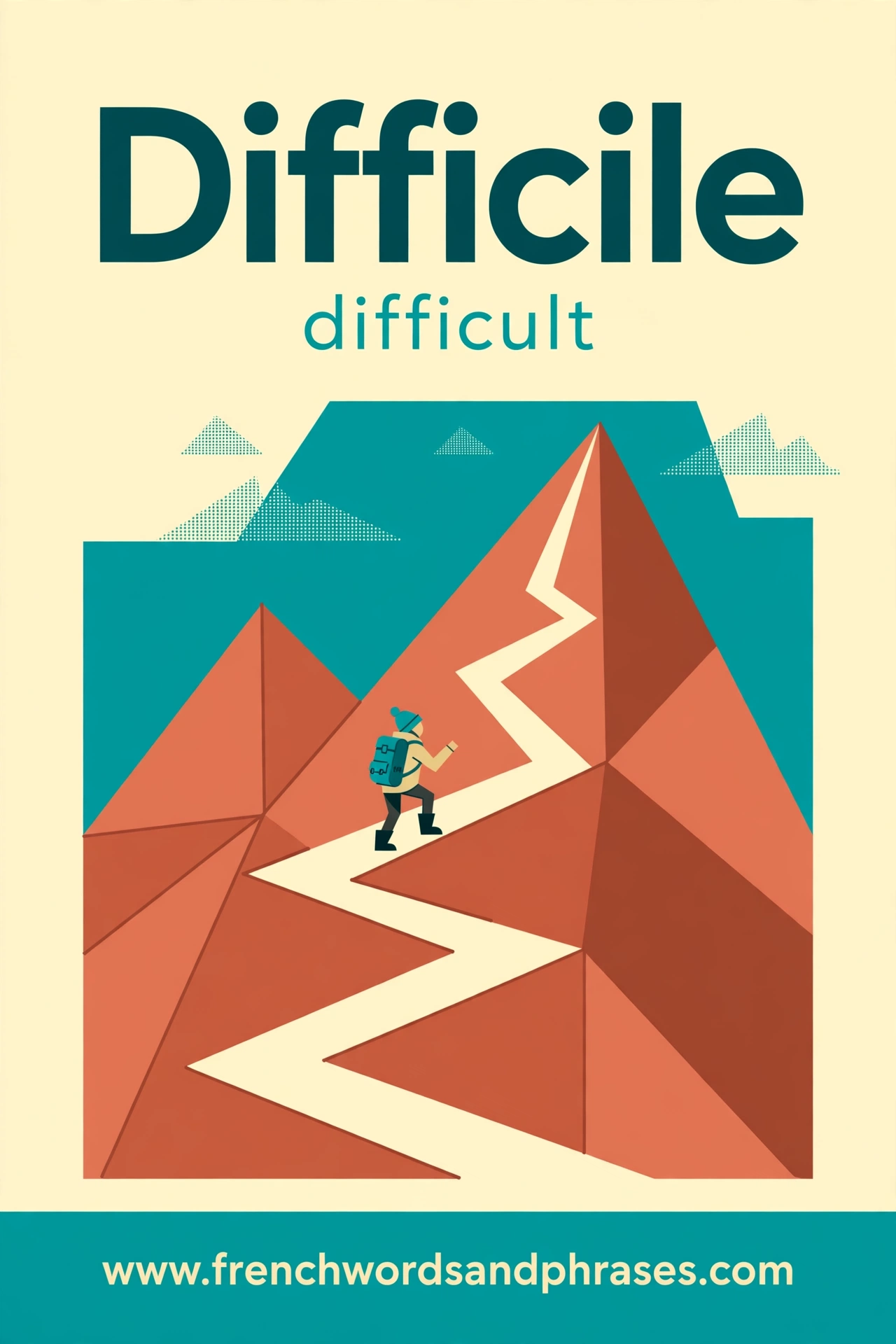
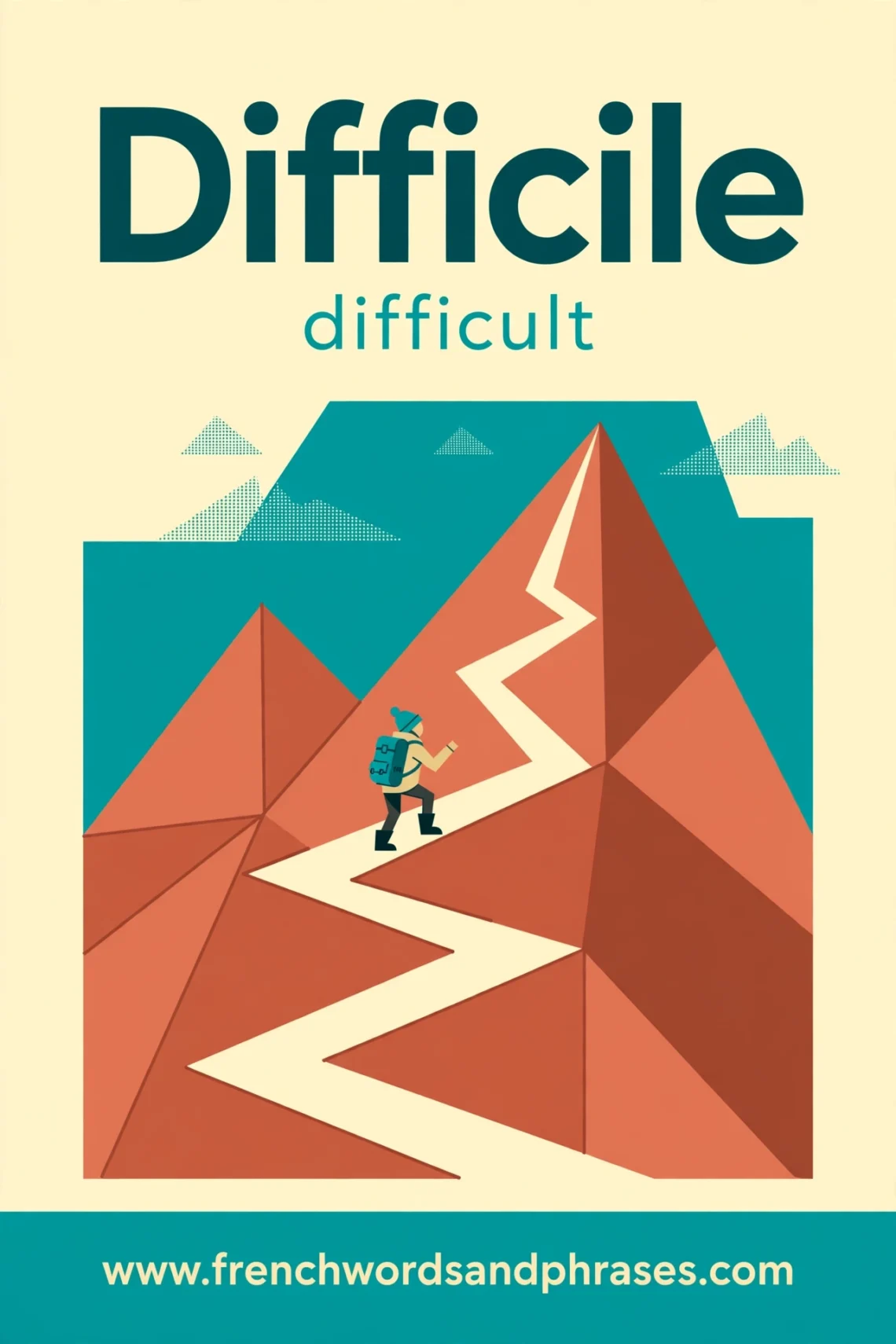
Difficile is the adjective of the steep path and the last page of the exam — the word that names the slope without ever doubting the climber.
Imagine a class of beginners staring at their first French dictation. The teacher smiles and says the sentence that has started a million lessons: « Le français n’est pas difficile, il est différent ». Half the fear in the room quietly leaves.
You have not just judged a task. You have described the path, never the traveller.
How to Use Difficile in French: Complete Guide
Let’s explore how difficile works in French, beginning with the whole word on one card.
Difficile at a Glance
Before the details, here is the whole word on one card.
The Whole Word on One Card
Meaning, type, position and forms — difficile in four lines.
| Point | Difficile |
|---|---|
| Meaning | difficult |
| Type | adjective of quality — difficulty |
| Usual position | after the noun — un texte difficile |
| Form | difficile for everyone — difficiles in the plural |
Example
Cet exercice est difficile.
This exercise is difficult.
The Four Forms of Difficile
The easiest agreement in the family: difficile already ends in -e, so the feminine changes nothing. Only the plural adds an s.
| Form | Difficile | Example |
|---|---|---|
| Masculine singular | difficile | un problème difficile — a difficult problem |
| Feminine singular | difficile | une question difficile — a difficult question |
| Masculine plural | difficiles | des mots difficiles — difficult words |
| Feminine plural | difficiles | des règles difficiles — difficult rules |
Example
Les questions sont difficiles et le texte est difficile aussi.
The questions are difficult and the text is difficult too.
Quick Quiz 1
Does difficile change for a feminine noun?
Reveal the answer
No
Un problème difficile, une question difficile — the form is identical.
A difficult problem, a difficult question.
The Feminine of Difficile: Nothing Changes
Like calme and drôle, difficile was born ending in -e, so the feminine has nothing to add. The only spelling work in this word’s whole life is the plural s.
| Situation | Example |
|---|---|
| Masculine | un examen difficile — a difficult exam |
| Feminine | une langue difficile — identical |
| Why | difficile already ends in -e, so the feminine adds nothing |
| The plural | add s — des temps difficiles, hard times |
Example
Elle traverse une période difficile.
She is going through a difficult period.
Where Difficile Goes: After the Noun
Difficile follows the noun and sits after être. Its real artistry begins afterwards, in the two little words that can follow it: de for general truths, à when the thing itself is being acted on.
| Pattern | Example |
|---|---|
| After the noun | un choix difficile — a difficult choice |
| After être | cet exercice est difficile — this exercise is difficult |
| With de + infinitive | il est difficile de choisir — it is difficult to choose |
| With à + infinitive | difficile à comprendre — difficult to understand |
Example
Il est difficile de dire au revoir.
It’s difficult to say goodbye.
Quick Quiz 2
Where does difficile stand — un difficile exercice or un exercice difficile?
Reveal the answer
un exercice difficile
Difficile stands after the noun.
A difficult exercise.
Harder Still: Comparing with Difficile
Difficile compares the regular way, with plus, moins and aussi — and the superlative agrees as usual: le plus difficile, la plus difficile.
| Degree | Example |
|---|---|
| As difficult as | aussi difficile que — as difficult as |
| More difficult | plus difficile — more difficult |
| Less difficult | moins difficile — less difficult |
| The most difficult (masc.) | le plus difficile — le plus difficile des exercices |
| The most difficult (fem.) | la plus difficile — la plus difficile des questions |
Example
Le deuxième exercice est plus difficile que le premier.
The second exercise is more difficult than the first.
Everyday Expressions with Difficile
Difficile builds the phrases French uses for hard times and hard people — and for the small kindness of not making life harder than it is.
| Expression | In English |
|---|---|
| il est difficile de… | it is difficult to… — the great general frame |
| difficile à dire | hard to say |
| des temps difficiles | hard times |
| un enfant difficile | a difficult child |
| se rendre la vie difficile | to make life hard for oneself |
| rendre difficile | to make (something) difficult |
Example
Ne te rends pas la vie difficile, demande de l’aide.
Don’t make life hard for yourself, ask for help.
Quick Quiz 3
How do you say ‘hard times’ in French?
Reveal the answer
Des temps difficiles
Nous traversons des temps difficiles.
We are going through hard times.
Difficile and Its Neighbours
Around difficile stand the other words of effort — dur for toughness, compliqué for tangles — and across the valley, its sunny opposite: facile.
| French | In English |
|---|---|
| dur | hard, tough — of work, bread and winters |
| compliqué | complicated — difficult because tangled |
| pénible | painful, gruelling — difficult and wearying |
| facile | easy — the direct opposite |
| simple | simple — easy because untangled |
Example
Ce travail est dur et compliqué, mais pas impossible.
This work is hard and complicated, but not impossible.
Watch Out: The Traps Around Difficile
The one great trap is the choice between de and à — get that right, and difficile holds no other dangers.
| Trap | The truth |
|---|---|
| difficile de | after il est, for general statements — il est difficile de choisir |
| difficile à | when the thing receives the action — ce livre est difficile à lire |
| Agreement | only the plural moves: des règles difficiles, with an s |
| Not a noun | difficile is only an adjective — there is no ‘le difficile’ |
Example
Ce roman est difficile à lire, mais il est difficile de s’arrêter.
This novel is hard to read, but it’s hard to stop.
Quick Quiz 4
‘This text is difficult to read’ — difficile de lire or difficile à lire?
Reveal the answer
difficile à lire
The text receives the action, so French uses à.
Ce texte est difficile à lire.
Difficile in Everyday French: Real-Life Examples
Now that you know the word, let’s see how difficile appears in everyday French.
Example 1 — At school
La dictée d’aujourd’hui est vraiment difficile.
Today’s dictation is really difficult.
Example 2 — Learning French
Le français n’est pas difficile, il est différent.
French isn’t difficult, it’s different.
Example 3 — A decision
C’est un choix difficile, prends ton temps.
It’s a difficult choice, take your time.
Example 4 — At work
Nous traversons des temps difficiles cette année.
We are going through difficult times this year.
Example 5 — Cooking
Cette recette est difficile à suivre.
This recipe is difficult to follow.
Example 6 — Encouragement
C’est difficile, mais tu vas réussir.
It’s difficult, but you will succeed.
Beyond Translation: The Meaning of Difficile
English says difficult for the meaning of difficile — the two words are cousins, both descended from Latin, both pointed daily at exams, recipes and foreign languages.
Difficile describes the path, never the traveller: it says the slope is steep, and says nothing at all about your legs.
Perhaps that is why French teachers repeat their kind sentence — le français n’est pas difficile, il est différent. The word, used well, is not a verdict. It is a weather report on the road ahead.
How to Remember the French Adjective Difficile
Remember it this way: Difficile is the honest adjective — one form for him and her, an s for the plural, and a small two-letter choice that does all the clever work.
- You use one form for everyone — un problème difficile, une question difficile.
- You add only an s in the plural — des temps difficiles.
- You choose the companion carefully — difficile de choisir, but difficile à lire.
The key idea is difficile never changes except in the plural, stands after the noun, and takes de or à with care.
Test Your Knowledge of Difficile
Let’s see how much you’ve learned. Try answering these questions before revealing the answers.
Question 1
What does difficile mean?
Reveal the answer
Difficult — hard, tough.
Question 2
What is the feminine of difficile?
Reveal the answer
difficile — identical. The word already ends in -e.
Question 3
Translate: a difficult question.
Reveal the answer
Une question difficile.
Question 4
Complete the sentence:
Ce livre est difficile ______ lire.
Reveal the answer
à
Ce livre est difficile à lire.
This book is difficult to read.
Question 5
What is the plural of difficile?
Reveal the answer
difficiles — just add an s.
Your Final Challenge
Can You Use It?
How would you say this in French?
“This exercise is difficult, but the questions are easy.”
Reveal the answer
Cet exercice est difficile, mais les questions sont faciles.
This exercise is difficult, but the questions are easy.
A little French. A little curiosity. A richer everyday life.
LEARN FRENCH ONE WORD AT A TIME