
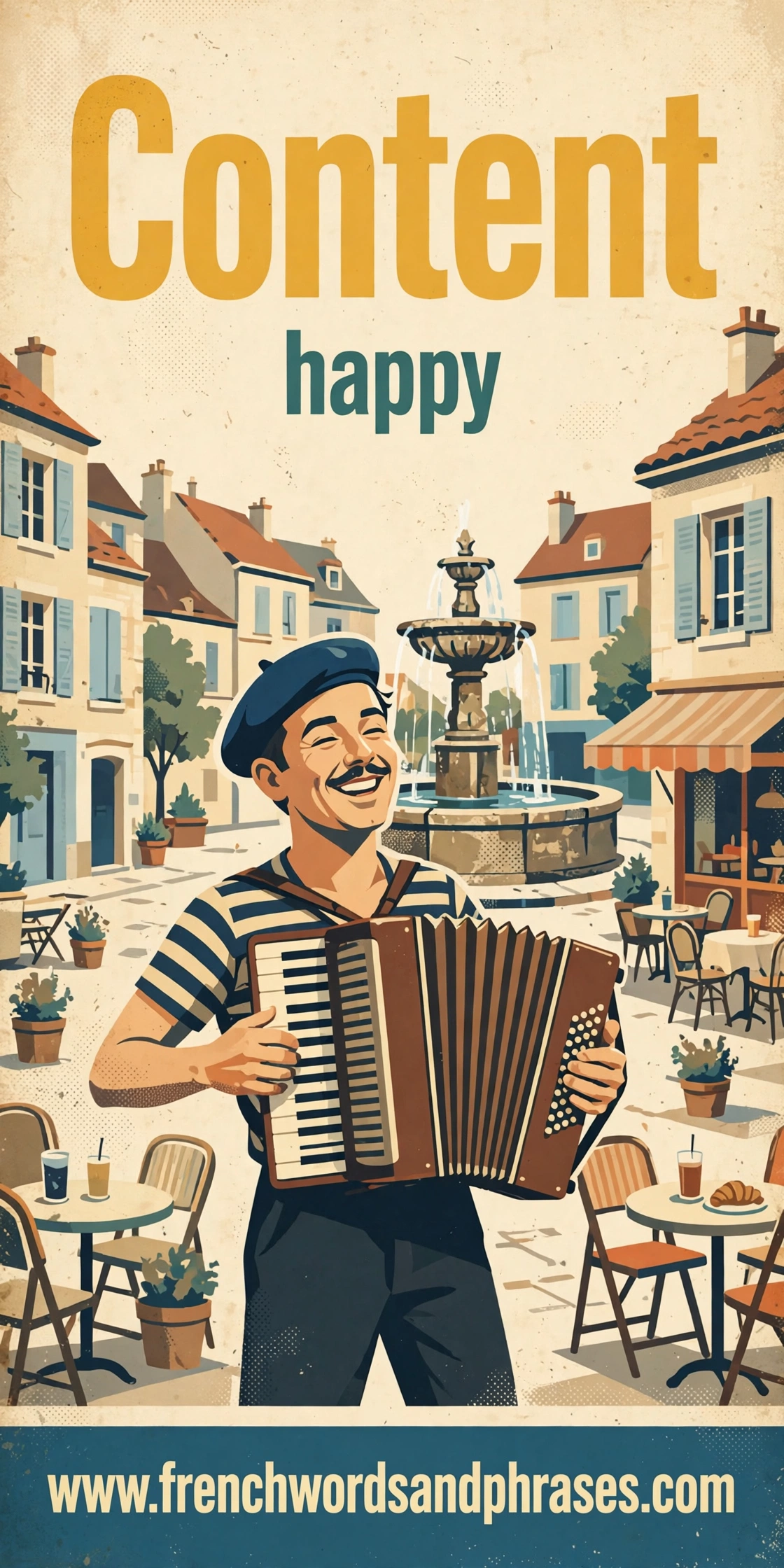
A French Word to Live By
Translate Content to English
/kɔ̃.tɑ̃/
Content means happy.
A small boy at a birthday table, tearing the paper off a parcel with both hands. He lifts out exactly the red truck he had pointed at in a shop window a month ago — and his whole face changes. Nobody would call it the happiness of a lifetime. It is better than that: it is the happiness of right now, and French calls it content.
In this guide, you’ll learn what content means in English, how its feminine wakes up a silent t, why it travels everywhere with the little word de, and how it differs from its deeper cousin heureux. Explore French examples, English translations, and practice quizzes.
Understanding the French Adjective Content
Content is a French adjective of feeling — the adjective of being pleased. It agrees with the person who feels it: content, contente, contents, contentes. It lives mostly after the verb être, and it is almost always followed by de and the reason for the smile.
It means happy — but the happiness of the moment: pleased, glad, satisfied with something. Tu es content de ton cadeau ? Its cousin heureux names the deeper, longer happiness of a life. Content is the smile; heureux is the state. French keeps both, and uses content a hundred times a day.
Type: Adjective of feeling — pleasure and satisfaction
Answers the question: How does someone feel? — happy, pleased
Changes form: Yes — content, contente, contents, contentes
English equivalents: Happy; pleased; glad; satisfied.
One important usage detail: content is followed by de — content de son travail, contente de partir. And watch the feminine: contente adds -te, and the t that sleeps in content wakes up and is pronounced.
Experience the Word
Content is the adjective of the parcel opened, the exam passed, the friend arrived early at the station — happiness with a reason attached.
Imagine the boy again, an hour later, pushing the red truck along the kitchen floor while the adults are still at the table. He is not thinking about happiness. He is simply, completely, content de son cadeau.
You have not just described a mood. You have named the exact size of an ordinary joy.
How to Use Content in French: Complete Guide
Let’s explore how content works in French, beginning with the whole word on one card.
Content at a Glance
Before the details, here is the whole word on one card.
The Whole Word on One Card
Meaning, type, position and forms — content in four lines.
| Point | Content |
|---|---|
| Meaning | happy, pleased |
| Type | adjective of feeling — pleasure of the moment |
| Usual position | after être and after the noun — elle est contente |
| Form | content / contente / contents / contentes |
Example
Je suis content de te voir.
I’m happy to see you.
The Four Forms of Content
Content agrees with the person who is happy. Watch the feminine: it adds -te, and the final t comes alive.
| Form | Content | Example |
|---|---|---|
| Masculine singular | content | un homme content — a happy man |
| Feminine singular | contente | une femme contente — a happy woman |
| Masculine plural | contents | des enfants contents — happy children |
| Feminine plural | contentes | des clientes contentes — happy customers |
Example
Il est content de son vélo, et elle est contente de sa robe.
He is happy with his bike, and she is happy with her dress.
Quick Quiz 1
Which form of content goes with femme?
Reveal the answer
contente
Une femme contente.
A happy woman.
Contente: The Feminine with a T
In content, the final t is silent — the word ends in a soft nasal sound. Add the feminine e and everything changes: the t wakes up, and contente ends with a clear, ringing /t/.
| Situation | Example |
|---|---|
| The rule | content becomes contente — the silent t wakes up |
| The sound | content /kɔ̃.tɑ̃/, but contente /kɔ̃.tɑ̃t/ — you hear the t |
| Masculine plural | contents — des garçons contents |
| Feminine plural | contentes — des filles contentes |
Example
Elle est contente de son nouveau travail.
She is happy with her new job.
Where Content Goes: After Être, with De
Content rarely stands in front of a noun. Its home is after être, and its inseparable companion is de, which introduces the reason — a thing, or an action.
| Pattern | Example |
|---|---|
| After être | je suis content — I am happy |
| With de + noun | content de son cadeau — happy with his present |
| With de + infinitive | contente de partir — happy to be leaving |
| Before the noun | un content homme — not French; content stays after |
Example
Nous sommes contents de nos résultats.
We are happy with our results.
Quick Quiz 2
Which little word follows content before a noun or a verb?
Reveal the answer
de
Content de son cadeau, contente de partir.
Happy with his present, happy to leave.
Happier Still: Comparing with Content
Content compares the regular way, with plus, moins and aussi — and the superlative keeps the agreement: le plus content, la plus contente.
| Degree | Example |
|---|---|
| As happy as | aussi content que — as happy as |
| Happier | plus content — happier |
| Less happy | moins content — less happy |
| The happiest (masc.) | le plus content — le plus content des élèves |
| The happiest (fem.) | la plus contente — la plus contente des sœurs |
Example
Elle est plus contente que jamais.
She is happier than ever.
Everyday Expressions with Content
Content is the small change of French happiness — spent all day long in greetings, compliments and good news.
| Expression | In English |
|---|---|
| content de te voir | happy to see you |
| être bien content | to be really glad — je suis bien content que tu sois là |
| content pour toi | happy for you |
| avoir l’air content | to look happy |
| être content de soi | to be pleased with oneself |
| content comme tout | happy as can be (informal) |
Example
Je suis bien content que tu sois là.
I’m really glad you’re here.
Quick Quiz 3
How do you say ‘I’m happy to see you’?
Reveal the answer
Je suis content de te voir
(A woman writes: je suis contente de te voir.)
I’m happy to see you.
Content and Its Neighbours
French grades happiness finely. Content is the everyday smile; ravi and enchanté shine brighter; heureux goes deepest of all.
| French | In English |
|---|---|
| heureux | happy — the deeper, lasting happiness of a life |
| ravi | delighted — stronger than content |
| enchanté | delighted — also ‘pleased to meet you’ |
| satisfait | satisfied — pleased with a result |
| déçu | disappointed — the smile reversed |
| triste | sad — the opposite |
Example
Elle est ravie et heureuse dans sa nouvelle maison.
She is delighted and happy in her new house.
Watch Out: The Traps Around Content
The traps: an English look-alike with a different meaning, a forgotten -te, and the wrong little word after the adjective.
| Trap | The truth |
|---|---|
| English ‘content’ | the contents of a book or a box are le contenu — content the adjective means happy |
| Agreement | she is contente, with -te — elle est contente |
| content de, not avec | the reason follows with de: content de son cadeau |
| content vs heureux | content = pleased in the moment; heureux = deep, lasting happiness |
Example
Elle est contente du contenu du colis.
She is happy with the contents of the parcel.
Quick Quiz 4
Which word names the deeper happiness — content or heureux?
Reveal the answer
heureux
Content is the smile of the moment; heureux is the happiness of a life.
Une vie heureuse — a happy life.
Content in Everyday French: Real-Life Examples
Now that you know the word, let’s see how content appears in everyday French.
Example 1 — Meeting a friend
Je suis content de te voir, ça fait longtemps !
I’m happy to see you, it’s been a long time!
Example 2 — Good news
Elle est contente de ses résultats à l’examen.
She is happy with her exam results.
Example 3 — A gift
Les enfants sont contents de leurs cadeaux.
The children are happy with their presents.
Example 4 — At work
Mon patron est content de mon rapport.
My boss is happy with my report.
Example 5 — A plan
Nous sommes contentes de partir en vacances.
We are happy to be going on holiday.
Example 6 — A compliment
Tu as l’air content aujourd’hui.
You look happy today.
Beyond Translation: The Meaning of Content
English says happy for the meaning of content — but content is a modest, well-sized happiness. It does not promise forever; it reports on the present, and finds the present good.
Content asks for nothing more than what is already here.
French keeps heureux for the great word of a life — un homme heureux, une vie heureuse — and spends content generously, every day, on parcels, results, visits and cups of tea. A language that grades its happiness this carefully is a language that takes it seriously.
How to Remember the French Adjective Content
Remember it this way: Content is the smile of the moment — it follows être, travels with de, and wakes its sleeping t for the feminine.
- You wake the t for her — il est content, elle est contente.
- You always give the reason with de — content de son cadeau, contente de partir.
- You keep it for the moment — heureux is the happiness of a whole life.
The key idea is content for pleased in the moment, contente for her, and always content de.
Test Your Knowledge of Content
Let’s see how much you’ve learned. Try answering these questions before revealing the answers.
Question 1
What does content mean?
Reveal the answer
Happy — pleased, glad, satisfied with something.
Question 2
What is the feminine of content?
Reveal the answer
contente — the silent t wakes up.
Question 3
Translate: I am happy to see you.
Reveal the answer
Je suis content de te voir.
(A woman: je suis contente de te voir.)
Question 4
Complete the sentence:
Elle est ______ de son cadeau.
Reveal the answer
contente
Elle est contente de son cadeau.
She is happy with her present.
Question 5
Which word means the deeper, lasting happiness?
Reveal the answer
heureux — content is for the pleasure of the moment.
Your Final Challenge
Can You Use It?
How would you say this in French?
“The children are happy with their presents.”
Reveal the answer
Les enfants sont contents de leurs cadeaux.
The children are happy with their presents.
A little French. A little curiosity. A richer everyday life.
LEARN FRENCH ONE WORD AT A TIME




