A French Word to Live By
Translate Ensuite to English
/ɑ̃.sɥit/
Ensuite means then (next).
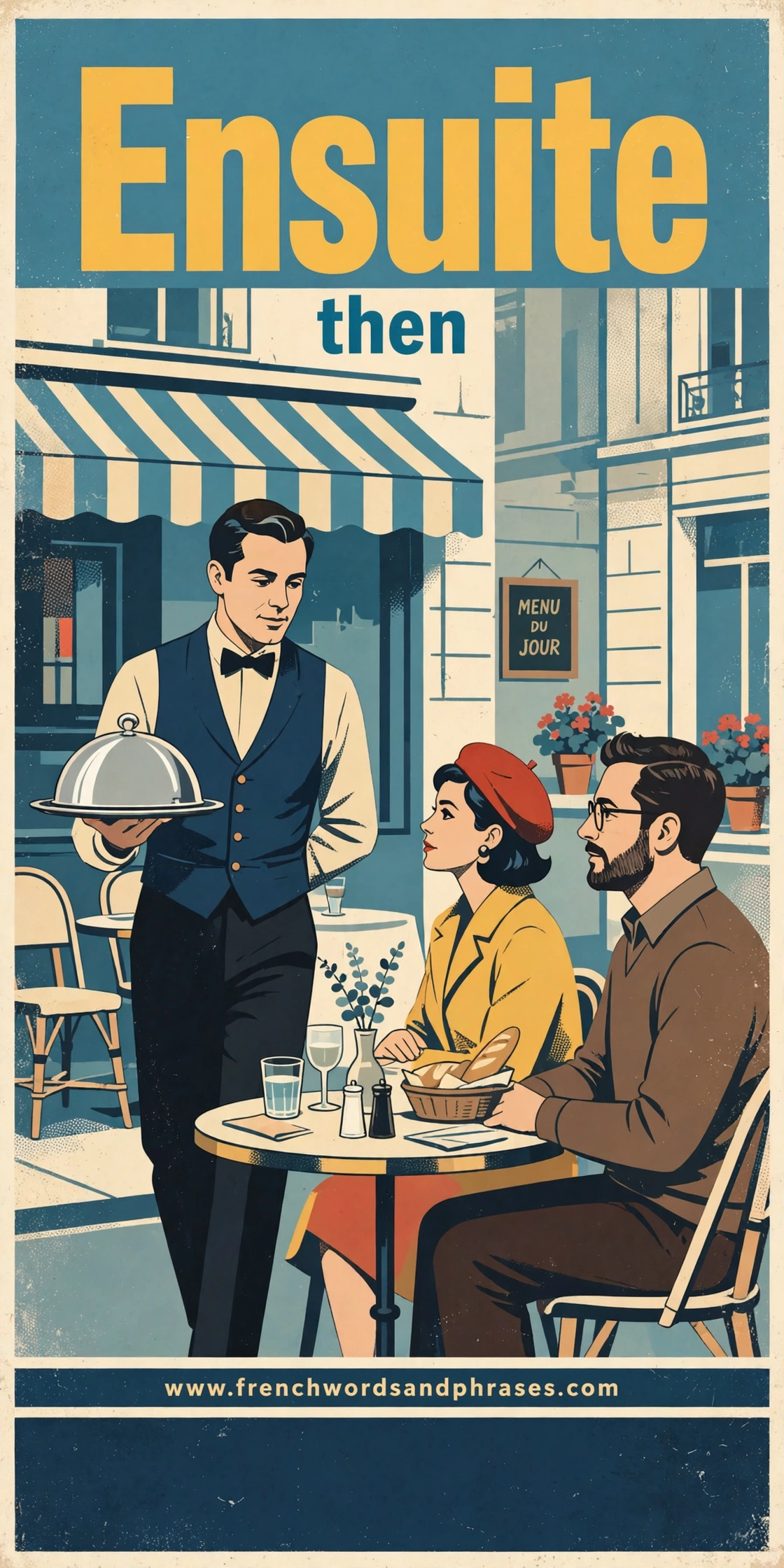
The waiter takes the starter plates away, a small pause falls over the table, and then the main course arrives in its silver dish. First one thing, then the next — the whole meal, the whole day, moves by ensuite. That is ensuite.
In this guide, you’ll learn what ensuite means in English, how it carries a story from step to step, how it differs from its lighter cousin puis, and how it runs every recipe and instruction in France. Explore French examples, English translations, and practice quizzes.
Understanding the French Adverb Ensuite
Ensuite is a French adverb of sequence. Inside it you can still hear suite — the continuation, what follows — which is exactly its job: ensuite announces the step that comes after the one you have just finished. Like every adverb, it never changes its form.
It means then, next, afterwards: the following step in an order of events. Je me lève, ensuite je me douche — I get up, then I shower. Ensuite is the workhorse of French storytelling and instruction: patient, clear, and always pointing one step forward.
Type: Adverb of sequence (ordering actions in time)
Answers the question: In what order? — what comes next?
Changes form: Never — ensuite is invariable
English equivalents: Then; next; afterwards.
One important usage detail: ensuite loves the head of its clause — Ensuite, on ajoute le lait — and it needs a step before it: something must come first (often with d’abord) for ensuite to follow. A story that begins with ensuite has lost its first page.
Experience the Word
Ensuite is the adverb of patient order. It is the word of teachers, cooks and grandmothers — of everyone who knows that good things happen one step at a time, in the right order.
Imagine the village baker training an apprentice before dawn: first the flour, ensuite the water, ensuite the long kneading, each stage waiting for the last to finish. No hurry, no chaos — ensuite keeps the whole bakery calm.
You have not just continued a story. You have taken the next step in its proper place.
How to Use Ensuite in French: Complete Guide
Let’s explore how ensuite works in French, beginning with the word on one card.
Ensuite: The Next Step, In Its Proper Place
If d’abord starts the journey, ensuite is every step after the first — the quiet engine of recipes, routines and stories.
Ensuite at a Glance
Before the details, here is the whole word on one card.
| Point | Ensuite |
|---|---|
| Meaning | then, next, afterwards |
| Type | adverb of sequence |
| Usual position | at the head of its clause |
| Form | invariable — never changes |
Example
Je rentre à la maison, ensuite je prépare le dîner.
I come home, then I make dinner.
Where Ensuite Goes in the Sentence
Ensuite stands at the front of its step, like a chapter heading — in sentences, in questions, and right after a comma or a full stop.
| Situation | Pattern |
|---|---|
| Opening a clause | Ensuite, + sentence — Ensuite, nous visitons le château |
| After a first action | verb…, ensuite + verb — il mange, ensuite il part |
| In a question | Et ensuite ? — And then what? |
| Chaining several steps | ensuite…, ensuite… — ensuite on tourne, ensuite on attend |
Example
Elle a fini ses devoirs ; ensuite, elle a joué dans le jardin.
She finished her homework; then, she played in the garden.
Quick Quiz 1
Can a story begin with ensuite?
Reveal the answer
Not really
Ensuite means « the next step », so something must come first — usually introduced by d’abord.
Telling a Story in Order
Ensuite is step two — and three, and four — of the great sequence family. Here is the whole staircase in one view.
| Step | You Say |
|---|---|
| Step one | d’abord — first |
| Step two | ensuite — then, next |
| Another step | puis — then |
| The last step | enfin — finally |
| A full routine | D’abord le café, ensuite la douche, enfin le départ |
Example
D’abord, il s’est habillé, ensuite il a pris son petit déjeuner, enfin il est parti.
First, he got dressed, then he had breakfast, finally he left.
Ensuite in Instructions and Recipes
No French recipe or instruction leaflet lives without ensuite: it is the hinge between every pair of steps.
| Context | Example |
|---|---|
| A recipe | Ensuite, ajoutez les oeufs un à un. |
| Flat-pack furniture | Ensuite, fixez la planche avec quatre vis. |
| Directions | Ensuite, traversez le pont et tournez à gauche. |
| A science lesson | Ensuite, observez la couleur du liquide. |
| A board game | Ensuite, le joueur suivant lance le dé. |
Example
Faites fondre le chocolat ; ensuite, mélangez-le à la crème.
Melt the chocolate; then, mix it into the cream.
Quick Quiz 2
Which word would a recipe use between « melt the butter » and « add the flour »?
Reveal the answer
Ensuite
Faites fondre le beurre ; ensuite, ajoutez la farine.
Melt the butter; then add the flour.
Ensuite or Puis?
Puis and ensuite are the two « then » words of French, and most of the time they are interchangeable — but each has its flavour.
| Point | The Difference |
|---|---|
| ensuite | then, next — marks a real next step, a little weightier |
| puis | then — a lighter link, often mid-sentence, very conversational |
| Ensuite, on est rentrés. | Then (after that), we went home. |
| On a mangé, puis on est rentrés. | We ate, then we went home. |
| In instructions | ensuite is the teacher’s choice; puis hurries a story along |
Example
Nous avons visité le marché, puis la cathédrale ; ensuite, nous avons déjeuné.
We visited the market, then the cathedral; next, we had lunch.
Ensuite with Different Tenses
Ensuite steps through any tense the story needs — this morning’s routine, yesterday’s journey, tomorrow’s plan.
| Tense | Example |
|---|---|
| Present | Je déjeune, ensuite je travaille. |
| Passé composé | Il a téléphoné, ensuite il est sorti. |
| Imparfait | Ensuite, nous marchions jusqu’au village. |
| Future | Nous arriverons à midi ; ensuite, nous déjeunerons. |
| Infinitive (instructions) | verser l’eau, ensuite remuer doucement |
Example
D’abord, ils ont visité Paris ; ensuite, ils sont allés en Provence.
First, they visited Paris; then, they went to Provence.
Quick Quiz 3
What is the small difference between puis and ensuite?
Reveal the answer
Puis is lighter and more conversational; ensuite marks the next step with a little more weight
In most sentences the two can swap places safely.
Ensuite and Its Neighbours
Learn ensuite with the whole sequence family and its near-synonyms, and no French story can lose you.
| French | In English |
|---|---|
| d’abord | first (the step before ensuite) |
| puis | then (its lighter twin) |
| après | after, afterwards (après le dîner — after dinner) |
| alors | then, so (often a consequence: alors, on part ?) |
| enfin | finally (the last step of the family) |
| ensuite seulement | only then, not until afterwards |
Example
Après le dîner, nous avons fait une promenade ; alors, la nuit est tombée.
After dinner, we went for a walk; then, night fell.
Watch Out: Common Mistakes with Ensuite
Two traps: gluing ensuite to the wrong partner, and starting a story in the middle.
| Mistake | Correct French |
|---|---|
| Beginning a narrative with ensuite | open with d’abord — D’abord…, ensuite… |
| Writing « en suite » as two words | ensuite is one word (une suite is a different word: a sequel, a suite) |
| Using ensuite de in France French | ensuite stands alone — ensuite, on part (ensuite de is regional, heard in Belgium and Canada) |
| Translating every English « then » with ensuite | for « well then / so » use alors — alors, on commence ? |
Example
D’abord, écoutez bien ; ensuite, répétez après moi.
First, listen carefully; then, repeat after me.
Quick Quiz 4
What does a child mean by « Et ensuite ? »
Reveal the answer
« And then what? »
It is the storyteller’s favourite question — the demand for the next step.
Ensuite in Everyday French: Real-Life Examples
Now that you know the word, let’s see how ensuite appears in everyday French.
Example 1 — Morning routine
Je bois un café, ensuite je me douche et je m’habille.
I drink a coffee, then I shower and get dressed.
Example 2 — A recipe
Mélangez la farine et le sucre ; ensuite, ajoutez le beurre.
Mix the flour and the sugar; then add the butter.
Example 3 — Storytelling
Ils ont pris le train ; ensuite, tout a changé.
They took the train; then, everything changed.
Example 4 — A child’s question
Et ensuite, papa, qu’est-ce qui se passe ?
And then, Daddy, what happens?
Example 5 — Travel plans
Nous visitons Lyon ; ensuite, nous descendons vers Marseille.
We are visiting Lyon; then we head down towards Marseille.
Example 6 — At work
Finissons cette lettre ; ensuite, nous parlerons du budget.
Let’s finish this letter; then we will talk about the budget.
Beyond Translation: The Meaning of Ensuite
English says then for the meaning of ensuite — but ensuite is built on suite, the continuation, the thing that follows in an unbroken line. French hears a story in it: every ensuite is a link in a chain, a step on a staircase that quelqu’un — someone — is climbing in the right order.
To say ensuite is to promise the story is going somewhere.
It evokes the cook turning the page of the recipe, the teacher’s « et ensuite ? » to a classroom of raised hands, the grandmother whose tales never jump a step — because in France, how one thing follows another is half the pleasure of the tale.
How to Remember the French Adverb Ensuite
Remember it this way: Ensuite means then, next — the step that follows, always standing at the head of its clause, with d’abord before it and enfin at the end of the road.
- You climb the staircase — d’abord, ensuite, puis, enfin.
- You follow the recipe — ensuite, ajoutez les oeufs.
- You beg for the story — et ensuite ?
The key idea is ensuite = the next step; it follows d’abord and leads the sequence with puis and enfin.
Test Your Knowledge of Ensuite
Let’s see how much you’ve learned. Try answering these questions before revealing the answers.
Question 1
What does ensuite mean?
Reveal the answer
Then, next, afterwards — the step that follows.
Question 2
Which word must usually come before ensuite in a story?
Reveal the answer
D’abord — ensuite needs a first step to follow.
Question 3
Translate: First the flour, then the eggs.
Reveal the answer
D’abord la farine, ensuite les oeufs.
Question 4
How does ensuite differ from puis?
Reveal the answer
Only in weight — puis is lighter and more conversational; ensuite marks the next step more deliberately. They usually swap safely.
Question 5
Complete the sentence:
D’abord, lisez le texte ; ______, répondez aux questions.
Reveal the answer
ensuite
Ensuite, répondez aux questions.
Then, answer the questions.
Your Final Challenge
Can You Use It?
How would you say this in French?
“I get up, then I have breakfast, and finally I leave.”
Reveal the answer
Je me lève, ensuite je prends mon petit déjeuner, et enfin je pars.
I get up, then I have breakfast, and finally I leave.
A little French. A little curiosity. A richer everyday life.
LEARN FRENCH ONE WORD AT A TIME