A French Word to Live By
Translate Père to English
/pɛʁ/
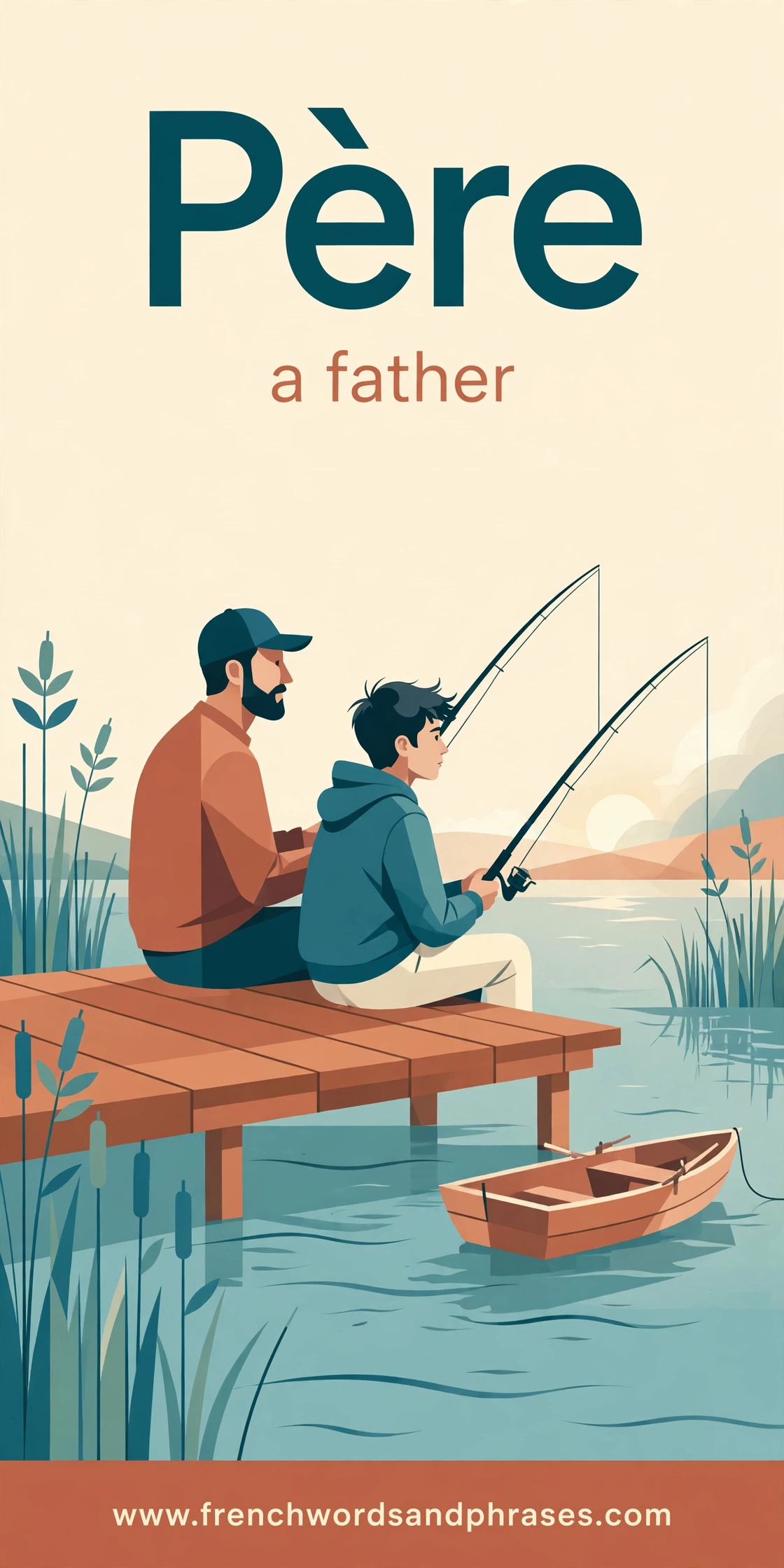
Un père means a father.
A name on a birth certificate, a chair at the head of the table, a silhouette in old photographs standing a little apart and very straight — when French speaks formally of the man who made the family, it uses a word with weight: le père.
In this guide, you’ll learn what père means in English, how to use it with its articles, how to form its plural, and how it appears in everyday French. Explore French examples, English translations, and practice quizzes.
Understanding the French Noun Père
Père is a masculine French noun. Like every French noun, it has a gender, and it is learned together with its article: le père.
It means a father — the full, neutral word, used in documents, in stories, and whenever you speak about a father rather than to him. A child running down the hall shouts papa; the word for a father as a person in the world is père. It also names God the Father, and the priests addressed as Père.
Gender: Masculine
Definite article: le — le père (the father)
Indefinite article: un — un père (a father)
Plural: les pères (the fathers)
English equivalents: A father.
One important usage detail: French has two words where English has one. Père is the neutral, slightly formal word — the one for certificates, novels and introductions: voici mon père. Papa is the home word, the one you actually call out. Use père to talk ABOUT a father, and papa to talk TO your own.
Experience the Word
Père is more than a parent. It is a title of respect — the word French reaches for when it speaks seriously about the man at the family’s origin.
Imagine a christening in a stone village church: a young man holding his first child with enormous care, while his own father watches from the end of the pew, remembering.
You have not just described a relative. You have named the line that continues.
How to Use Père in French: Complete Guide
Let’s explore how père works in French, beginning with its articles.
Père and Its Articles
French nouns are almost never used alone. The small word in front of the noun — the article — does a great deal of work.
Père with the Definite Article (Le, Les)
Used for a particular father both speakers know about, or for fathers in general.
| Number | French |
|---|---|
| Singular | le père |
| Plural | les pères |
Example
Le père de Marie est ingénieur.
Marie’s father is an engineer.
Père with the Indefinite Article (Un, Des)
Used for a father not yet identified — one father, or some fathers.
| Number | French |
|---|---|
| Singular | un père |
| Plural | des pères |
Example
C’est un père de trois enfants.
He is a father of three children.
Counting with Père: Quantities
Père is a count noun, so it has no partitive article. To talk about amounts, French uses numbers and quantity words instead.
| Meaning | French |
|---|---|
| one father | un père |
| two fathers | deux pères |
| several fathers | plusieurs pères |
| many fathers | beaucoup de pères |
| each father | chaque père |
| all the fathers | tous les pères |
Example
Chaque père connaît son enfant par coeur.
Every father knows his child by heart.
Quick Quiz 1
How do you say a father in French?
Reveal the answer
un père
C’est un père de trois enfants.
He is a father of three children.
The Plural of Père
Like most French nouns, père simply adds an -s in the plural — a letter you see but do not hear.
| Number | French |
|---|---|
| Singular | le père |
| Plural | les pères |
Example
Les pères attendent devant l’école.
The fathers are waiting in front of the school.
Père with Possessive Adjectives (Mon, Ton, Son…)
Possessives agree with the noun, not with the owner — and père is masculine, so it takes mon, ton, son.
| Owner | French |
|---|---|
| my | mon père |
| your (tu) | ton père |
| his / her | son père |
| our | notre père |
| your (vous) | votre père |
| their | leur père |
Example
Mon père répare les vélos dans le garage.
My father repairs bicycles in the garage.
Quick Quiz 2
Complete the sentence:
______ père travaille à Paris.
Reveal the answer
Mon
Mon père travaille à Paris.
My father works in Paris.
Père with Demonstrative Adjectives (Ce, Ces)
Used to point: this father here, those fathers there.
| Number | French |
|---|---|
| Singular | ce père |
| Plural | ces pères |
Example
Ce père a quatre enfants.
This father has four children.
Père with Adjectives
Most French adjectives come after the noun and agree with it — père is masculine, so: un père gentil, un père fier.
| Adjective | With Père |
|---|---|
| gentil (kind) | un père gentil |
| patient (patient) | un père patient |
| fier (proud) | un père fier |
| occupé (busy) | un père occupé |
| drôle (funny) | un père drôle |
| formidable (wonderful) | un père formidable |
Example
C’est un père fier de ses enfants.
He is a father who is proud of his children.
Quick Quiz 3
Complete the sentence:
C’est un père très ______ (patient).
Reveal the answer
patient
C’est un père très patient.
He is a very patient father. (The adjective agrees with père, masculine.)
Everyday Expressions with Père
Père appears in expressions of family, celebration and inheritance.
| Expression | In English |
|---|---|
| la fête des pères | Father’s Day |
| de père en fils | from father to son |
| un père de famille | a family man, a father |
| le Père Noël | Father Christmas |
| le père de Marie | Marie’s father |
Example
Le Père Noël arrive le 24 décembre.
Father Christmas comes on 24 December.
Words from the Same Family as Père
Learn these together and the whole family falls into place.
| French | In English |
|---|---|
| papa | dad (the family word) |
| un grand-père | a grandfather |
| un arrière-grand-père | a great-grandfather |
| un beau-père | a stepfather / a father-in-law |
| la paternité | fatherhood |
| paternel | paternal, fatherly |
Example
Son beau-père habite à côté.
Her father-in-law lives next door.
Quick Quiz 4
What does de père en fils mean?
Reveal the answer
From father to son
L’entreprise passe de père en fils.
The business passes from father to son.
Père in Everyday French: Real-Life Examples
Now that you know the word, let’s see how père appears in everyday French.
Example 1 — In the garage
Mon père répare les vélos dans le garage.
My father repairs bicycles in the garage.
Example 2 — His job
Son père travaille à Paris.
Her father works in Paris.
Example 3 — At the park
Les pères jouent avec leurs enfants au parc.
The fathers are playing with their children in the park.
Example 4 — Every week
Il téléphone à son père chaque semaine.
He phones his father every week.
Example 5 — In the garden
Mon père aime le jardinage.
My father likes gardening.
Example 6 — At Christmas
Le Père Noël arrive le 24 décembre.
Father Christmas comes on 24 December.
Beyond Translation: The Meaning of Père
English says father for the meaning of père — but the French word carries a particular solemnity. It names God the Father, the priest you address in church, and the ancestor at the top of the family tree: few words in French stand quite so straight.
To say père is to speak of origins and authority.
It evokes respect, distance and continuity — everything that the playful word papa wraps in affection, père states with dignity. A complete French speaker needs both: one for the heart, one for the world.
How to Remember the French Noun Père
Remember it this way: Père is the neutral word for a father — masculine, learned with le, and used to talk about him rather than to him.
- You introduce him to the world — voici mon père.
- You call him down the hall — papa, never père.
- You celebrate him in June — la fête des pères.
The key idea is père is for talking about a father; papa is for talking to him.
Test Your Knowledge of Père
Let’s see how much you’ve learned. Try answering these questions before revealing the answers.
Question 1
Is père masculine or feminine?
Reveal the answer
Masculine — le père.
Question 2
How do you say a father in French?
Reveal the answer
un père
C’est un père de trois enfants.
He is a father of three children.
Question 3
Translate: My father works in Paris.
Reveal the answer
Mon père travaille à Paris.
Question 4
Who is le Père Noël?
Reveal the answer
Father Christmas — the French Santa Claus.
Question 5
Complete the sentence:
Mon ______ répare les vélos dans le garage.
Reveal the answer
père
Mon père répare les vélos dans le garage.
My father repairs bicycles in the garage.
Your Final Challenge
Can You Use It?
How would you say this in French?
“My father works in Paris.”
Reveal the answer
Mon père travaille à Paris.
My father works in Paris.
A little French. A little curiosity. A richer everyday life.
LEARN FRENCH ONE WORD AT A TIME