A French Word to Live By
How to Conjugate Emménager in French
/ɑ̃.me.na.ʒe/
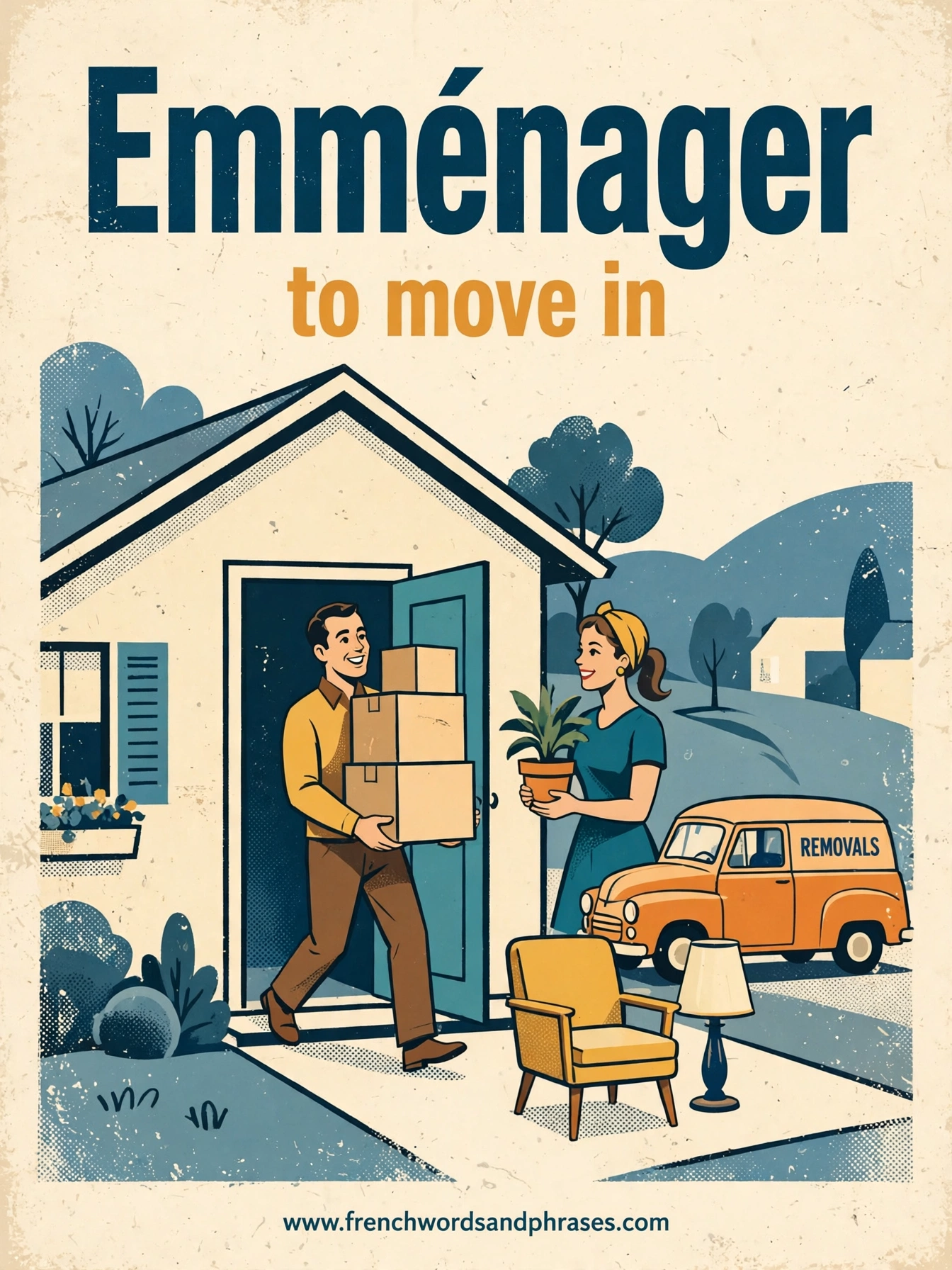
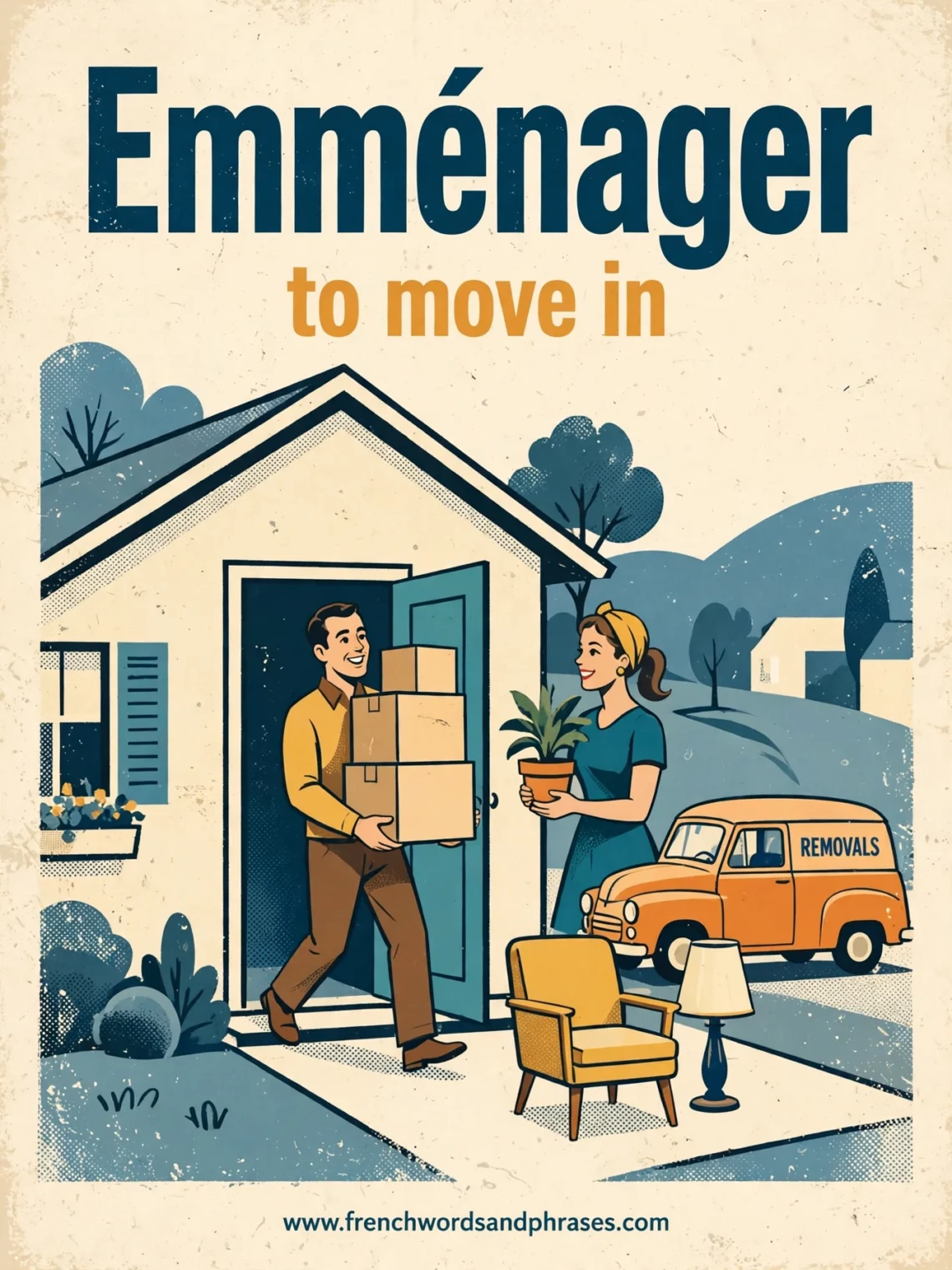
Emménager means to move in — to arrive with the boxes, the furniture and the kettle, and to settle into a new home; the joyful opposite of déménager, to move out, which is also, confusingly, the word for the whole operation of moving house.
Cardboard boxes in the stairwell, a mattress against the wall, pizza on a packing case at midnight — emménager is the verb of the first evening in a new home, when everything is chaos and everything is beginning.
In this guide, you’ll learn how to conjugate emménager in all the major French tenses and moods. Explore complete conjugation tables, French examples, English translations, and practice quizzes.
Understanding the French Verb Emménager
Emménager is a regular French verb belonging to the first group of verbs, those ending in-er.
It means to move in. French divides moving house into its two doors: déménager, to move out (and, in everyday speech, to move house altogether), and emménager, to move in — the arrival, the settling. The noun is un emménagement, a moving in, and the housewarming that blesses it is la pendaison de crémaillère, the hanging of the chimney-hook, a party every new home deserves.
Verb classification: First group (-er)
Auxiliary verb: Avoir
Past participle: emménagé
Present participle: emménageant
English equivalents: To move in, to settle in; emménager dans un appartement — to move into a flat; emménager chez quelqu’un — to move in with someone; ils viennent d’emménager — they have just moved in.
One important detail: emménager is a -ger verb — it keeps its e before a and o: nous emménageons, j’emménageais. Unlike espérer, its é NEVER changes to è: j’emménage, ils emménagent, with é throughout the present. Mind the double m at the start: em-ménager, to carry one’s household in.
Experience the Word
Emménager is the verb of the threshold — boxes behind you, a whole new life in front, and the kettle found first, always.
Imagine the young couple at midnight in the new flat: the bed is built, nothing else is; the neighbours have brought soup; a chair still wears its removal blanket like a cloak. Ils ont emménagé aujourd’hui, et déjà la lampe du salon fait de l’appartement un chez-eux — they moved in today, and already the living-room lamp makes the flat a home. Emménager is not the lorry; it is the lamp.
First the kettle, then the lamp, then a life. That is emménager — moving in, and meaning it.
How to Conjugate Emménager: Complete French Conjugation Guide
Let’s explore every major conjugation of emménager, beginning with the indicative mood.
How to Conjugate Emménager in the Indicative Mood
The indicative mood is used to express facts, observations, actions, and events.
How to Conjugate Emménager in the Present Tense (Présent)
Used for actions happening now, habitual actions, and general truths.
| Subject | Conjugation |
|---|---|
| je | emménage |
| tu | emménages |
| il / elle | emménage |
| nous | emménageons |
| vous | emménagez |
| ils / elles | emménagent |
Example
Nous emménageons dans notre nouvel appartement samedi.
We are moving into our new flat on Saturday.
Quick Quiz 1
Complete the sentence:
Nous ______ samedi dans le nouvel appartement.
Reveal the answer
emménageons
Nous emménageons samedi dans le nouvel appartement.
We are moving into the new flat on Saturday.
How to Conjugate Emménager in the Passé Composé
Used for completed actions in the past. Emménager takes the auxiliary verb avoir.
| Subject | Conjugation |
|---|---|
| j’ | ai emménagé |
| tu | as emménagé |
| il / elle | a emménagé |
| nous | avons emménagé |
| vous | avez emménagé |
| ils / elles | ont emménagé |
Example
Ils ont emménagé au printemps dernier.
They moved in last spring.
How to Conjugate Emménager in the Imparfait (Imperfect Tense)
Used for habitual past actions, descriptions, and ongoing situations in the past.
| Subject | Conjugation |
|---|---|
| je | emménageais |
| tu | emménageais |
| il / elle | emménageait |
| nous | emménagions |
| vous | emménagiez |
| ils / elles | emménageaient |
Example
À l’époque, on emménageait souvent sans ascenseur.
In those days, people often moved in without a lift.
Quick Quiz 2
Choose the correct form:
They have just moved in.
Ils viennent d’______ . (emménager / déménager)
Reveal the answer
emménager
Ils viennent d’emménager.
Emménager is moving in; déménager is moving out.
How to Conjugate Emménager in the Plus-que-parfait
Used to describe an action that had already been completed before another past event.
| Subject | Conjugation |
|---|---|
| j’ | avais emménagé |
| tu | avais emménagé |
| il / elle | avait emménagé |
| nous | avions emménagé |
| vous | aviez emménagé |
| ils / elles | avaient emménagé |
Example
Elle avait emménagé avant la rentrée des classes.
She had moved in before the school term started.
How to Conjugate Emménager in the Passé Simple
Primarily used in formal writing, literature, and historical narratives. It is rarely used in everyday conversation.
| Subject | Conjugation |
|---|---|
| je | emménageai |
| tu | emménageas |
| il / elle | emménagea |
| nous | emménageâmes |
| vous | emménageâtes |
| ils / elles | emménageèrent |
Example
La famille emménagea dans la maison en une journée.
The family moved into the house in one day.
How to Conjugate Emménager in the Passé Antérieur
A literary tense used to express an action completed immediately before another past action, generally in the passé simple.
| Subject | Conjugation |
|---|---|
| j’ | eus emménagé |
| tu | eus emménagé |
| il / elle | eut emménagé |
| nous | eûmes emménagé |
| vous | eûtes emménagé |
| ils / elles | eurent emménagé |
Example
Quand ils eurent emménagé, ils invitèrent les voisins.
When they had moved in, they invited the neighbours.
How to Conjugate Emménager in the Future Tense (Futur Simple)
Used to describe actions that will take place in the future.
| Subject | Conjugation |
|---|---|
| je | emménagerai |
| tu | emménageras |
| il / elle | emménagera |
| nous | emménagerons |
| vous | emménagerez |
| ils / elles | emménageront |
Example
Tu emménageras près de ton travail.
You will move in near your work.
How to Conjugate Emménager in the Futur Antérieur (Future Perfect)
Used for an action that will have been completed before a particular point in the future.
| Subject | Conjugation |
|---|---|
| j’ | aurai emménagé |
| tu | auras emménagé |
| il / elle | aura emménagé |
| nous | aurons emménagé |
| vous | aurez emménagé |
| ils / elles | auront emménagé |
Example
À la fin du mois, nous aurons emménagé complètement.
By the end of the month, we will have moved in completely.
How to Conjugate Emménager in the Near Future (Futur Proche)
Used to describe something that is going to happen soon. Formed with aller + infinitive.
| Subject | Conjugation |
|---|---|
| je | vais emménager |
| tu | vas emménager |
| il / elle | va emménager |
| nous | allons emménager |
| vous | allez emménager |
| ils / elles | vont emménager |
Example
Je vais emménager chez ma sœur en septembre.
I am going to move in with my sister in September.
How to Conjugate Emménager in the Conditional Mood
The conditional mood expresses what would happen under certain circumstances. It is also frequently used to make polite requests or express wishes.
How to Conjugate Emménager in the Present Conditional
| Subject | Conjugation |
|---|---|
| je | emménagerais |
| tu | emménagerais |
| il / elle | emménagerait |
| nous | emménagerions |
| vous | emménageriez |
| ils / elles | emménageraient |
Example
J’emménagerais demain si le loyer était moins cher.
I would move in tomorrow if the rent were cheaper.
How to Conjugate Emménager in the Past Conditional
| Subject | Conjugation |
|---|---|
| j’ | aurais emménagé |
| tu | aurais emménagé |
| il / elle | aurait emménagé |
| nous | aurions emménagé |
| vous | auriez emménagé |
| ils / elles | auraient emménagé |
Example
Elle aurait emménagé plus tôt sans les travaux.
She would have moved in earlier without the building work.
Emménager in the Literary Past Conditional Form
This less common literary form uses the imperfect subjunctive of avoir.
| Subject | Conjugation |
|---|---|
| j’ | eusse emménagé |
| tu | eusses emménagé |
| il / elle | eût emménagé |
| nous | eussions emménagé |
| vous | eussiez emménagé |
| ils / elles | eussent emménagé |
Example
Les colons eussent emménagé avant l’hiver.
The settlers would have moved in before winter.
How to Conjugate Emménager in the Subjunctive Mood
The subjunctive is used to express wishes, emotions, doubts, necessity, and uncertainty. It frequently follows expressions such as il faut que (it is necessary that) or bien que (although).
How to Conjugate Emménager in the Present Subjunctive
| Subject | Conjugation |
|---|---|
| que je | emménage |
| que tu | emménages |
| qu’il / qu’elle | emménage |
| que nous | emménagions |
| que vous | emménagiez |
| qu’ils / qu’elles | emménagent |
Example
Il faut que vous emménagiez avant le premier.
You must move in before the first.
Quick Quiz 3
Complete the sentence using the subjunctive:
Il faut que vous ______ avant le premier.
Reveal the answer
emménagiez
Il faut que vous emménagiez avant le premier.
You must move in before the first.
How to Conjugate Emménager in the Imperfect Subjunctive
A literary tense, rarely encountered in modern spoken French.
| Subject | Conjugation |
|---|---|
| que je | emménagasse |
| que tu | emménagasses |
| qu’il / qu’elle | emménagât |
| que nous | emménagassions |
| que vous | emménagassiez |
| qu’ils / qu’elles | emménagassent |
Example
Je doutais qu’il emménageât si vite.
I doubted he would move in so quickly.
How to Conjugate Emménager in the Pluperfect Subjunctive
A literary construction used to express an action completed before another past action.
| Subject | Conjugation |
|---|---|
| que j’ | eusse emménagé |
| que tu | eusses emménagé |
| qu’il / qu’elle | eût emménagé |
| que nous | eussions emménagé |
| que vous | eussiez emménagé |
| qu’ils / qu’elles | eussent emménagé |
Example
On espérait qu’ils eussent emménagé avant la neige.
People hoped they had moved in before the snow.
How to Conjugate Emménager in the Past Subjunctive
| Subject | Conjugation |
|---|---|
| que j’ | aie emménagé |
| que tu | aies emménagé |
| qu’il / qu’elle | ait emménagé |
| que nous | ayons emménagé |
| que vous | ayez emménagé |
| qu’ils / qu’elles | aient emménagé |
Example
Je suis ravi que tu aies emménagé près de chez nous.
I am delighted you moved in near us.
How to Conjugate Emménager in the Imperative
The imperative is used to give commands, instructions, invitations, or suggestions. Subject pronouns are omitted.
How to Conjugate Emménager in the Present Imperative
| Person | Conjugation |
|---|---|
| (tu) | emménage |
| (nous) | emménageons |
| (vous) | emménagez |
Example
Emménage quand tu veux, la chambre est prête !
Move in whenever you like, the room is ready!
Quick Quiz 4
How would you say Move in whenever you like (tu form)?
Reveal the answer
Emménage quand tu veux !
French Participles of Emménager
Participles are verb forms that can be used in compound tenses and other grammatical constructions.
Present Participle of Emménager
emménageant
En emménageant tôt, ils ont évité la pluie.
By moving in early, they avoided the rain.
Past Participle of Emménager
emménagé
Emménagée depuis une semaine, elle connaît déjà les voisins.
Moved in for a week, she already knows the neighbours.
Emménager in Everyday French: Real-Life Examples
Now that you know the conjugations, let’s see how emménager appears in everyday French.
Example 1 — Present
Nous emménageons dans notre nouvel appartement samedi.
We are moving into our new flat on Saturday.
Example 2 — Passé composé
Ils ont emménagé au printemps dernier.
They moved in last spring.
Example 3 — Imparfait
On emménageait souvent sans ascenseur, à l’époque.
People often moved in without a lift, in those days.
Example 4 — Future
Tu emménageras près de ton travail.
You will move in near your work.
Example 5 — Conditional
J’emménagerais demain si le loyer était moins cher.
I would move in tomorrow if the rent were cheaper.
Example 6 — Imperative
Emménage quand tu veux, la chambre est prête !
Move in whenever you like, the room is ready!
Beyond Translation: The Meaning of Emménager
Emménager is déménager’s mirror: the same household goods, the opposite direction. Déménager undoes a home (and lends its name to the whole move); emménager, from ménage, the household itself, carries the ménage in and sets it down. French even keeps the blessing separate: la pendaison de crémaillère, the housewarming, named for hanging the pot-hook in the new fireplace — the first fire, the first meal, the home begun.
To move in, in French, is to install a household, not just furniture.
Learn emménager beside déménager, and every French move has its two doors named.
How to Remember the French Verb Emménager
Remember it this way: Emménager is about the lamp lit on the first evening — moving in is the lamp, not the lorry.
- -ger spelling: nous emménageons, j’emménageais — the e keeps the g soft; the é never becomes è.
- The two doors: déménager, to move out; emménager, to move in.
- Regular -er: past participle emménagé; the housewarming is la pendaison de crémaillère.
The key idea is the lamp lit on the first evening — moving in is the lamp, not the lorry.
Test Your Knowledge of Emménager
Let’s see how much you’ve learned. Try answering these questions before revealing the answers.
Question 1
What is the opposite door of emménager?
Reveal the answer
Déménager — to move out; emménager is to move in.
Question 2
How do you say They moved in last spring in French?
Reveal the answer
Ils ont emménagé au printemps dernier.
Question 3
Translate: I am going to move in with my sister in September.
Reveal the answer
Je vais emménager chez ma sœur en septembre.
Question 4
What is the past participle of emménager?
Reveal the answer
Emménagé.
Question 5
Complete the sentence:
Nous ______ dans notre nouvel appartement samedi.
Reveal the answer
emménageons
Nous emménageons dans notre nouvel appartement samedi.
We are moving into the new flat on Saturday — emménageons keeps the e.
Your Final Challenge
Can You Use It?
How would you say this in French?
They moved in today, and already the lamp makes the flat a home.
Reveal the answer
Ils ont emménagé aujourd’hui, et déjà la lampe fait de l’appartement un chez-eux.
They moved in today, and already the lamp makes the flat a home.
A little French. A little curiosity. A richer everyday life.
LEARN FRENCH ONE WORD AT A TIME