
A French Word to Live By
Translate Chose to English
/ʃoz/
La Chose means a thing.
You are telling a story and the word you need simply will not come. French has a rescue word for exactly that moment — the humble, tireless chose, the word that can mean anything you are pointing at.
In this guide, you’ll learn what chose means in English, how to use it with its articles, how to form its plural, and how it appears in everyday French. Explore French examples, English translations, and practice quizzes.
Understanding the French Noun Chose
Chose is a feminine French noun. Like every French noun, it has a gender, and it is learned together with its article: la chose.
It means a thing. Chose is the great all-purpose noun of French: a physical object, an idea, something you say, something you do. With its partners it builds the sentences of every day — quelque chose, something; autre chose, something else; la même chose, the same thing.
Gender: Feminine
Definite article: la — la chose (the thing)
Indefinite article: une — une chose (a thing)
Plural: les choses (the things)
English equivalents: A thing.
One important usage detail: chose rarely appears all alone. It lives in partnerships — quelque chose (something), autre chose (something else), la même chose (the same thing), pas grand-chose (not much). Learn chose inside these phrases and you can say almost anything.
Experience the Word
Chose is more than a thing. It is the word that keeps a conversation alive when every other word has gone missing.
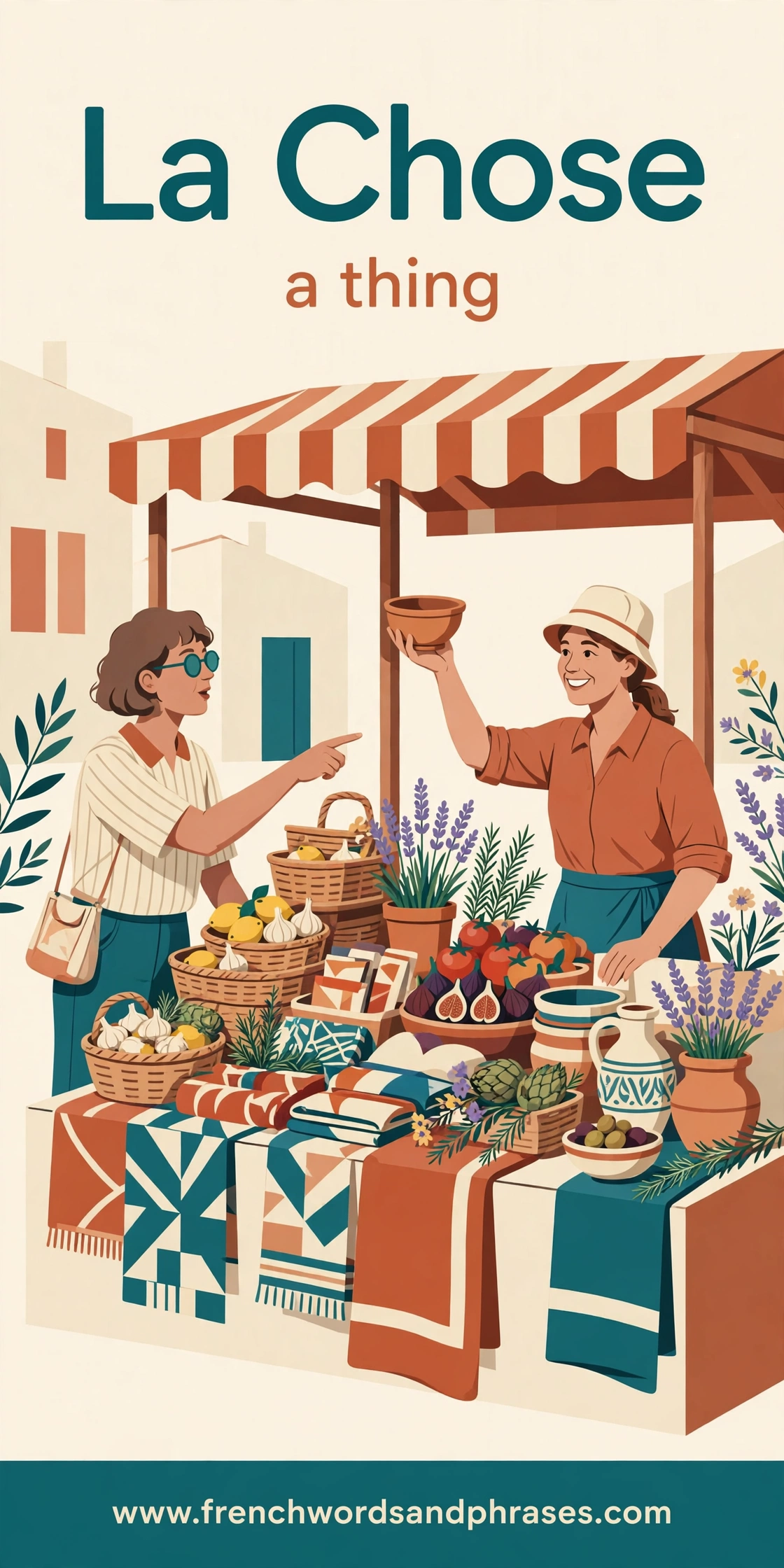
Imagine a market stall in Provence. The customer points, smiles, and asks for ‘la chose, là, la rouge’ — and the seller understands perfectly, because chose carries the pointing finger inside it.
You have not just forgotten a word. You have kept talking, and chose carried you through.
How to Use Chose in French: Complete Guide
Let’s explore how chose works in French, beginning with its articles.
Chose with the Definite Article (La, Les)
Used for a particular thing both speakers have in mind — often ‘the thing’ in explanations: la chose, c’est que… (the thing is that…).
| Number | French |
|---|---|
| Singular | la chose |
| Plural | les choses |
Example
La chose est claire : il faut partir.
The thing is clear: we have to leave.
Chose with the Indefinite Article (Une, Des)
Used for a thing you introduce for the first time: a thing to say, a thing to do.
| Number | French |
|---|---|
| Singular | une chose |
| Plural | des choses |
Example
Il y a une chose que je ne comprends pas.
There is one thing I don’t understand.
The Partners of Chose (Quelque chose, Autre chose…)
Chose almost never works alone — it goes everywhere with its partners. These are the phrases to learn by heart.
| Expression | In English |
|---|---|
| quelque chose | something |
| autre chose | something else |
| la même chose | the same thing |
| pas grand-chose | not much |
| une chose à la fois | one thing at a time |
| la chose, c’est que… | the thing is that… |
Example
Tu veux quelque chose à boire ?
Do you want something to drink?
Quick Quiz 1
How do you say something in French?
Reveal the answer
quelque chose
Tu veux quelque chose ?
Do you want something?
The Plural of Chose
Like most French nouns, chose simply adds an -s in the plural — a letter you see but do not hear.
| Number | French |
|---|---|
| Singular | la chose |
| Plural | les choses |
Example
Les choses changent vite.
Things change quickly.
Chose with Possessive Adjectives (Ma, Ta, Sa…)
Possessives agree with the noun, not with the owner — and chose is feminine, so it takes ma, ta, sa.
| Owner | French |
|---|---|
| my | ma chose |
| your (tu) | ta chose |
| his / her | sa chose |
| our | notre chose |
| your (vous) | votre chose |
| their | leur chose |
Example
C’est ma chose préférée.
It’s my favourite thing.
Quick Quiz 2
Complete the sentence:
C’est ______ chose préférée. (my)
Reveal the answer
ma
C’est ma chose préférée.
It’s my favourite thing.
Chose with Demonstrative Adjectives (Cette, Ces)
Used to point: this thing here, those things there.
| Number | French |
|---|---|
| Singular | cette chose |
| Plural | ces choses |
Example
Cette chose ne me plaît pas.
I don’t like this thing.
Chose with Adjectives
Chose collects adjectives on both sides: bonne, petite, grande and même come before it, most others after. All of them agree with feminine chose.
| Adjective | With Chose |
|---|---|
| bonne (good) | une bonne chose |
| mauvaise (bad) | une mauvaise chose |
| petite (little) | une petite chose |
| grande (great) | une grande chose |
| même (same) | la même chose |
| drôle (funny) | une drôle de chose |
Example
La même chose, s’il vous plaît.
The same thing, please.
Quick Quiz 3
Complete the sentence:
La ______ chose, s’il vous plaît. (same)
Reveal the answer
même
La même chose, s’il vous plaît.
The same thing, please. (Même comes before the noun.)
Everyday Expressions with Chose
Chose plus a partner makes the phrases French people say a hundred times a day.
| Expression | In English |
|---|---|
| avant toute chose | first of all, before anything else |
| entre autres choses | among other things |
| faire les choses bien | to do things properly |
| les choses de la vie | the things of life, life’s little things |
| la moindre des choses | the least one can do |
| peu de chose | very little, next to nothing |
Example
Avant toute chose, merci à tous.
First of all, thank you, everyone.
Words from the Same Family as Chose
Chose keeps company with the words of choosing and pointing — learn them as one family.
| French | In English |
|---|---|
| choisir | to choose |
| un choix | a choice |
| quelque chose | something |
| autre chose | something else |
| la même chose | the same thing |
| grand-chose | much (in pas grand-chose: not much) |
Example
Tu dois choisir entre les deux choses.
You have to choose between the two things.
Quick Quiz 4
What does pas grand-chose mean?
Reveal the answer
Not much
Il n’a pas dit grand-chose.
He didn’t say much.
Chose in Everyday French: Real-Life Examples
Now that you know the word, let’s see how chose appears in everyday French.
Example 1 — Something to ask
Attends, j’ai une chose à te demander.
Wait, I have something to ask you.
Example 2 — Something to drink
Tu veux quelque chose à boire ?
Do you want something to drink?
Example 3 — The same thing
La même chose pour moi, merci.
The same for me, thank you.
Example 4 — One thing at a time
Une chose à la fois, s’il te plaît.
One thing at a time, please.
Example 5 — Something else
Tu veux autre chose ?
Do you want anything else?
Example 6 — Things change
Les choses ont beaucoup changé ici.
Things have changed a lot here.
Beyond Translation: The Meaning of Chose
English has thing — and so, almost exactly, does French: chose, from the Latin causa, a matter, a case. It may be the most useful noun in the language precisely because it means so little on its own: an object, an idea, a remark, an event — chose stretches to cover whatever you are talking about.
Chose is the word that lets you keep talking while you think.
French people lean on it constantly: quelque chose to begin, autre chose to continue, la même chose to agree. Master chose and its partners, and you hold the skeleton keys of everyday conversation.
How to Remember the French Noun Chose
Remember it this way: Chose is the little word for everything — feminine, and almost always with quelque, autre or même in front of it.
- You point at the market stall — je voudrais quelque chose comme ça.
- The waiter asks if you are finished — tu veux autre chose ?
- You order your usual coffee — la même chose, merci.
The key idea is quelque chose for something, autre chose for something else, la même chose for the same thing.
Test Your Knowledge of Chose
Let’s see how much you’ve learned. Try answering these questions before revealing the answers.
Question 1
Is chose masculine or feminine?
Reveal the answer
Feminine — la chose.
Question 2
How do you say something in French?
Reveal the answer
Quelque chose.
Question 3
Translate: The same thing, please.
Reveal the answer
La même chose, s’il vous plaît.
Question 4
What does pas grand-chose mean?
Reveal the answer
Not much.
Question 5
Complete the sentence:
______ chose à la fois ! (One)
Reveal the answer
Une
Une chose à la fois !
One thing at a time!
Your Final Challenge
Can You Use It?
How would you say this in French?
“There is something I need to tell you.”
Reveal the answer
Il y a une chose que je dois te dire.
There is something I need to tell you.
A little French. A little curiosity. A richer everyday life.
LEARN FRENCH ONE WORD AT A TIME




