A French Word to Live By
Translate Part to English
/paʁ/
La Part means a piece.
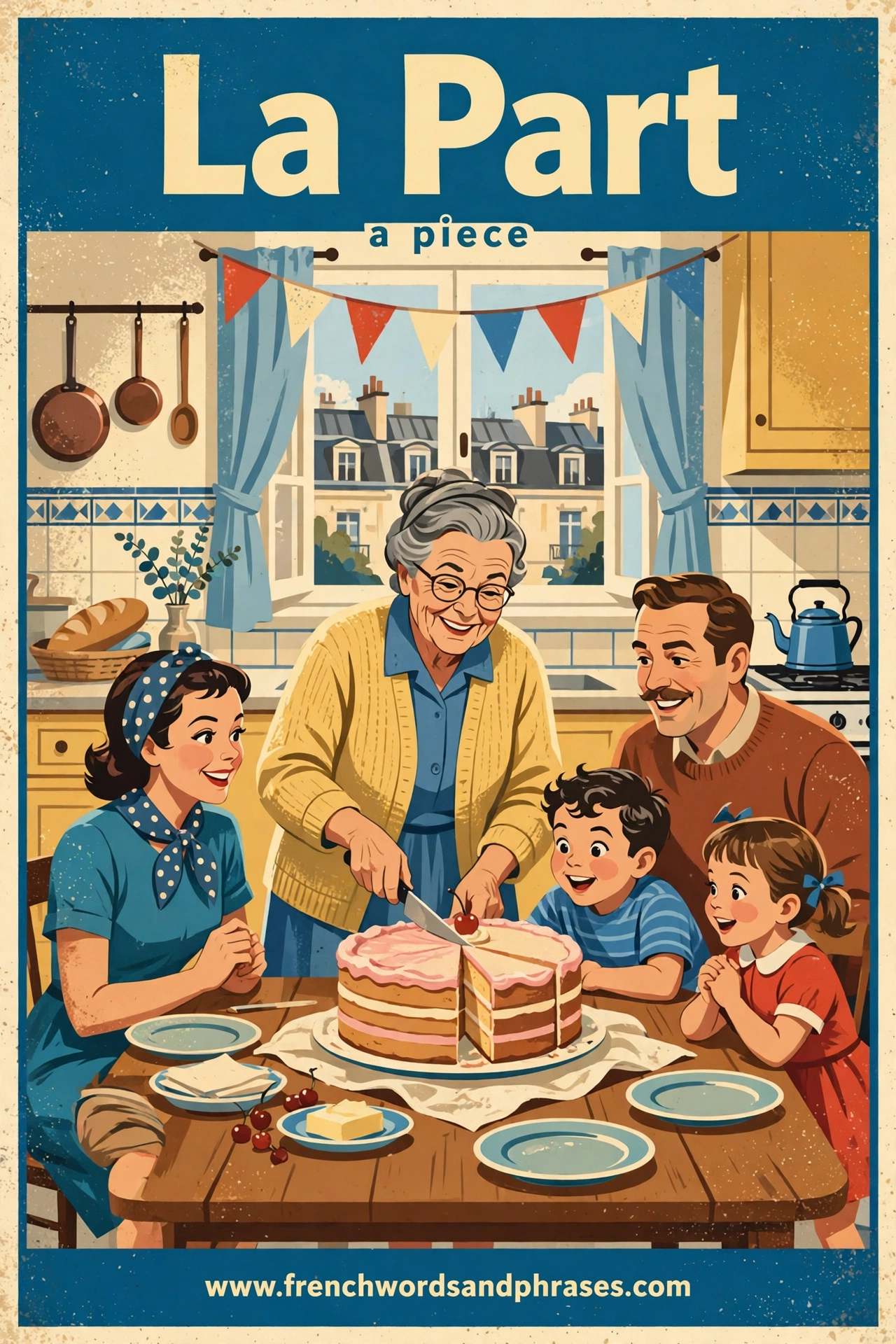
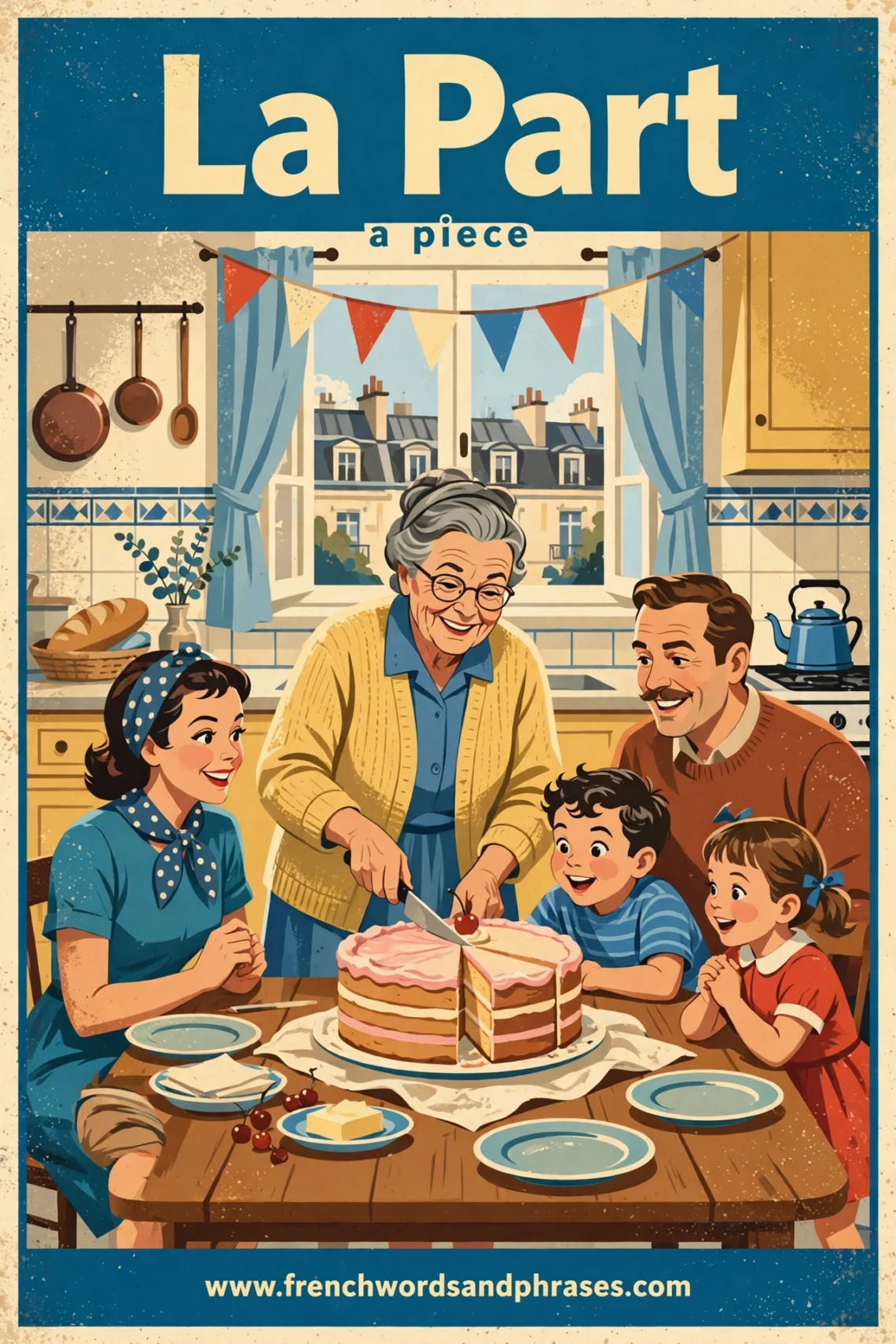
The cake comes out of the oven and every eye follows the knife. Who gets the first slice, and how big will it be? Around a French table, that small ceremony of sharing is la part.
In this guide, you’ll learn what part means in English, how to use it with its articles, how to form its plural, and how it appears in everyday French. Explore French examples, English translations, and practice quizzes.
Understanding the French Noun Part
Part is a feminine French noun. Like every French noun, it has a gender, and it is learned together with its article: la part.
It means a piece, a share, a part. It is the word for your slice of the cake and your share of the work — the portion that falls to you when something is divided. Joined with de, it also carries messages: de la part de Marie means that a gift or a word comes from Marie.
Gender: Feminine
Definite article: la — la part (the share)
Indefinite article: une — une part (a piece, a share)
Plural: les parts (the pieces, the shares)
English equivalents: A piece; a share; a part.
One important usage detail: part almost never travels alone. It loves company — une part de gâteau (a piece of cake), la part de quelqu’un (someone’s share), de la part de (from, on behalf of). Learn the little phrase prendre part à too: it means to take part in something.
Experience the Word
Part is more than a slice. It is the promise that everyone at the table will be thought of — that the whole will be divided with care.
Imagine a birthday in a small kitchen in Lyon. The knife pauses over the cake while six people negotiate with their eyes, and the smallest child, somehow, receives the biggest piece.
You have not just cut a cake. You have shared it fairly, part by part.
How to Use Part in French: Complete Guide
Let’s explore how part works in French, beginning with its articles.
Part with the Definite Article (La, Les)
Used for a particular share, or for the share each person receives.
| Number | French |
|---|---|
| Singular | la part |
| Plural | les parts |
Example
La part de Marie est plus grande.
Marie’s share is bigger.
Part with the Indefinite Article (Une, Des)
Used to offer or count portions: one piece, some shares.
| Number | French |
|---|---|
| Singular | une part |
| Plural | des parts |
Example
Je voudrais une part de tarte.
I would like a slice of pie.
Part in Portions (Une part de…)
Part is a counting word: it measures the whole into portions. Here it is with de, doing its favourite job.
| French | In English |
|---|---|
| une part de gâteau | a piece of cake |
| une part de tarte | a slice of pie |
| une part du marché | a share of the market |
| la part du lion | the lion’s share |
| une part des bénéfices | a share of the profits |
| sa part du travail | his / her share of the work |
Example
Une part de gâteau, s’il vous plaît.
A piece of cake, please.
Quick Quiz 1
Complete the sentence:
Je voudrais ______ part de tarte, s’il vous plaît.
Reveal the answer
une
Je voudrais une part de tarte, s’il vous plaît.
I would like a slice of pie, please.
The Plural of Part
Like most French nouns, part simply adds an -s in the plural — a letter you see but do not hear.
| Number | French |
|---|---|
| Singular | la part |
| Plural | les parts |
Example
Les parts sont égales.
The shares are equal.
Part with Possessive Adjectives (Ma, Ta, Sa…)
Possessives agree with the noun, not with the owner — and part is feminine, so it takes ma, ta, sa.
| Owner | French |
|---|---|
| my | ma part |
| your (tu) | ta part |
| his / her | sa part |
| our | notre part |
| your (vous) | votre part |
| their | leur part |
Example
C’est ma part du gâteau.
This is my piece of the cake.
Quick Quiz 2
Complete the sentence:
Chacun prend ______ part.
Reveal the answer
sa
Chacun prend sa part.
Everyone takes their share. (Part is feminine, so sa.)
Part with Demonstrative Adjectives (Cette, Ces)
Used to point: this piece here, those shares there.
| Number | French |
|---|---|
| Singular | cette part |
| Plural | ces parts |
Example
Cette part est pour toi.
This piece is for you.
Part with Adjectives
Adjectives agree with part, a feminine noun. Favourites like petite, grande and belle come before it; most others follow.
| Adjective | With Part |
|---|---|
| petite (small) | une petite part |
| grande (big) | une grande part |
| belle (generous) | une belle part |
| égale (equal) | des parts égales |
| juste (fair) | une part juste |
| entière (whole) | la part entière |
Example
Les enfants ont reçu des parts égales.
The children received equal shares.
Quick Quiz 3
Complete the sentence:
Les enfants ont reçu des parts ______ (equal).
Reveal the answer
égales
Les enfants ont reçu des parts égales.
The children received equal shares.
Everyday Expressions with Part
Part hides inside phrases about sharing, sending and joining — the social life of the word.
| Expression | In English |
|---|---|
| faire sa part | to do one’s share |
| prendre part à | to take part in |
| la part du lion | the lion’s share |
| de la part de | from, on behalf of |
| quelque part | somewhere |
| nulle part | nowhere |
Example
Ce cadeau est de la part de Marie.
This gift is from Marie.
Words from the Same Family as Part
Learn these together and the whole family of sharing falls into place.
| French | In English |
|---|---|
| partager | to share |
| une partie | a part; a game (of cards, of tennis) |
| le partage | sharing, dividing up |
| un partenaire | a partner |
| participer (à) | to take part (in) |
| partiel / partielle | partial |
Example
Ils vont partager le gâteau en huit parts.
They are going to share the cake into eight pieces.
Quick Quiz 4
What does de la part de mean in: Ce cadeau est de la part de Marie ?
Reveal the answer
From (on behalf of)
Ce cadeau est de la part de Marie.
This gift is from Marie.
Part in Everyday French: Real-Life Examples
Now that you know the word, let’s see how part appears in everyday French.
Example 1 — At dessert
Je peux avoir une part de tarte aux pommes ?
Can I have a slice of apple pie?
Example 2 — Sharing fairly
Chacun a reçu une part égale.
Everyone received an equal share.
Example 3 — The biggest piece
Je prends la plus grande part.
I’ll take the biggest piece.
Example 4 — On behalf of
Ce message est de la part de ton frère.
This message is from your brother.
Example 5 — Somewhere
Il habite quelque part près de Lyon.
He lives somewhere near Lyon.
Example 6 — Taking part
Elle prend part au projet.
She is taking part in the project.
Beyond Translation: The Meaning of Part
English reaches for three words — piece, share, part — where French keeps one: part, the portion that falls to each person when the whole is divided. It is a deeply social word. La Fontaine gave it its most famous moment: in his fable, the lion takes la part du lion, the lion’s share, and the phrase has meant the biggest, greediest portion ever since.
To receive your part is to be counted — to have your place at the table.
And the word travels in the other direction too: de la part de turns a simple gift into a message from someone, and quelque part — literally ‘some part’ — is how French says somewhere, as if every place were a part of the world waiting to be named.
How to Remember the French Noun Part
Remember it this way: Part is a slice of the whole — always feminine, always une part.
- You cut the cake at a birthday — chacun reçoit une part.
- A parcel arrives from your sister — c’est de la part de ta sœur.
- You join the school play — tu prends part au spectacle.
The key idea is une part for a piece, la part for the share, de la part de for ‘from someone’.
Test Your Knowledge of Part
Let’s see how much you’ve learned. Try answering these questions before revealing the answers.
Question 1
Is part masculine or feminine?
Reveal the answer
Feminine — la part.
Question 2
How do you say a piece of cake in French?
Reveal the answer
Une part de gâteau.
Question 3
Translate: Everyone takes their share.
Reveal the answer
Chacun prend sa part.
Question 4
What does de la part de mean?
Reveal the answer
From, on behalf of.
Question 5
Complete the sentence:
Il habite ______ part, près de Paris. (somewhere)
Reveal the answer
quelque
Il habite quelque part, près de Paris.
He lives somewhere, near Paris.
Your Final Challenge
Can You Use It?
How would you say this in French?
“I’ll take a piece of cake, please.”
Reveal the answer
Je prendrai une part de gâteau, s’il vous plaît.
I’ll take a piece of cake, please.
A little French. A little curiosity. A richer everyday life.
LEARN FRENCH ONE WORD AT A TIME