A French Word to Live By
How to Conjugate Répondre in French
IPA: /ʁe.pɔ̃dʁ/
Répondre means “to answer,” “to reply,” or “to respond” in French.
Every conversation begins with an exchange. A question is asked, a thought is shared, and someone responds. The French verb répondre captures this essential part of communication, whether you are answering a friend, replying to a message, or responding to an important question.
In this guide, you will learn how to conjugate répondre in all the major French tenses and moods. Explore complete conjugation tables, useful expressions, practical examples, pronunciation guidance, and quizzes to help you use the verb naturally.
Understanding the French Verb Répondre
Répondre is an irregular third-group French verb ending in -re. Although it follows a recognizable conjugation pattern shared by several -re verbs, its endings differ from those of regular first-group -er verbs.
- Infinitive: répondre
- Meaning: to answer, to reply, to respond
- Verb group: Third group (-re)
- Auxiliary verb: avoir
- Past participle: répondu
- Present participle: répondant
How Répondre Is Used
One important feature of répondre is that it is generally followed by the preposition à when identifying the person or thing being answered.
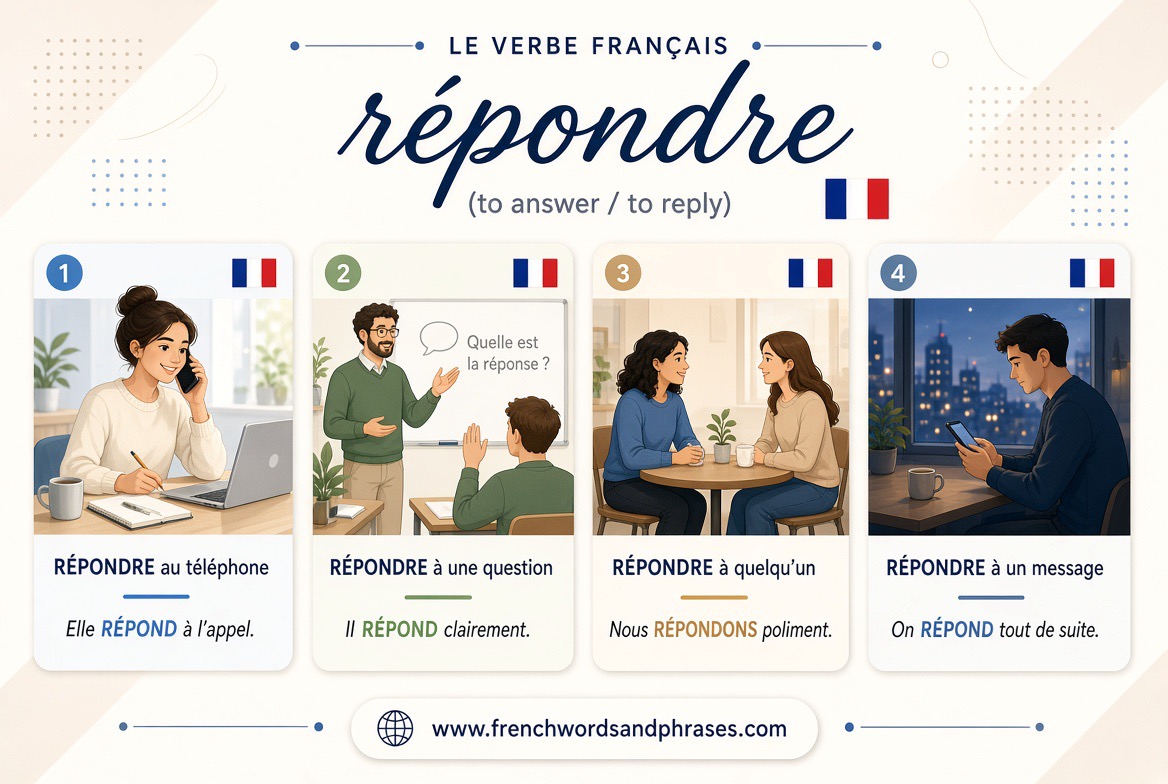
- Répondre à une question – to answer a question
- Répondre à quelqu’un – to reply to someone
- Répondre à un message – to reply to a message
- Répondre au téléphone – to answer the phone
- Répondre à une lettre – to reply to a letter
Notice the difference between English and French word order. English says “answer a question,” while French generally says répondre à une question.
Répondre vs. Répliquer
Both verbs can involve responding, but they are not always interchangeable:
- Répondre is the everyday verb for answering or replying.
- Répliquer often means to retort or answer back, sometimes with a sharp or argumentative tone.
Elle a répondu calmement à la question.
She answered the question calmly.
Il a répliqué avec colère.
He retorted angrily.
Past Participle Agreement
Répondre uses avoir in compound tenses. Its past participle, répondu, does not agree with the subject. However, it agrees with a preceding direct object when the rules of French past participle agreement require it.
For example:
Les questions auxquelles j’ai répondu étaient difficiles.
The questions that I answered were difficult.
In this example, the relative pronoun auxquelles is the object of the preposition à, not a preceding direct object. Therefore, répondu does not change.
Experience the Word
Imagine receiving a message from a friend in Paris. You read it, think about what they have written, and send a reply. In French, you are répondre à un message.
From a simple oui or non to a thoughtful explanation, répondre is a verb that belongs in everyday French conversation. Learning it will help you participate more naturally in discussions, correspondence, and daily interactions.
How to Conjugate Répondre: Complete French Conjugation Guide
Indicatif (Indicative Mood)
How to Conjugate Répondre in the Présent
The present tense describes actions happening now, habitual activities, and general facts. The verb répondre follows the characteristic present-tense pattern of many third-group -re verbs.
| Subject | Conjugation |
|---|---|
| je | réponds |
| tu | réponds |
| il / elle | répond |
| nous | répondons |
| vous | répondez |
| ils / elles | répondent |
Je réponds toujours aux messages de mes amis.
I always reply to my friends’ messages.
Quick Quiz
How do you say “We answer the questions” in French?
Show answer
Nous répondons aux questions.
How to Conjugate Répondre in the Passé Composé
The passé composé describes completed actions in the past. It is formed with the present tense of avoir followed by the past participle répondu.
| Subject | Conjugation |
|---|---|
| j’ | ai répondu |
| tu | as répondu |
| il / elle | a répondu |
| nous | avons répondu |
| vous | avez répondu |
| ils / elles | ont répondu |
Elle a répondu à toutes mes questions.
She answered all my questions.
How to Conjugate Répondre in the Imparfait
The imparfait describes ongoing or repeated actions in the past, habits, and background situations. It can often be translated as “was answering” or “used to answer.”
| Subject | Conjugation |
|---|---|
| je | répondais |
| tu | répondais |
| il / elle | répondait |
| nous | répondions |
| vous | répondiez |
| ils / elles | répondaient |
Quand j’étais jeune, je répondais rarement aux lettres.
When I was young, I rarely replied to letters.
How to Conjugate Répondre in the Plus-que-parfait
The plus-que-parfait expresses an action that had already been completed before another past action. It is formed with the imparfait of avoir and the past participle répondu.
| Subject | Conjugation |
|---|---|
| j’ | avais répondu |
| tu | avais répondu |
| il / elle | avait répondu |
| nous | avions répondu |
| vous | aviez répondu |
| ils / elles | avaient répondu |
J’avais déjà répondu à son invitation avant de recevoir son deuxième message.
I had already replied to his invitation before receiving his second message.
How to Conjugate Répondre in the Passé Simple
The passé simple is a literary past tense used primarily in novels, historical accounts, and formal written narratives. In everyday spoken French, the passé composé is generally used instead.
| Subject | Conjugation |
|---|---|
| je | répondis |
| tu | répondis |
| il / elle | répondit |
| nous | répondîmes |
| vous | répondîtes |
| ils / elles | répondirent |
Le roi répondit sans hésitation.
The king answered without hesitation.
How to Conjugate Répondre in the Passé Antérieur
The passé antérieur is a literary tense used to describe an action completed immediately before another action in the passé simple. It is formed with the passé simple of avoir and the past participle.
| Subject | Conjugation |
|---|---|
| j’ | eus répondu |
| tu | eus répondu |
| il / elle | eut répondu |
| nous | eûmes répondu |
| vous | eûtes répondu |
| ils / elles | eurent répondu |
Dès qu’il eut répondu, le silence retomba dans la salle.
As soon as he had answered, silence fell over the room again.
How to Conjugate Répondre in the Futur Simple
The futur simple describes actions that will happen in the future. For répondre, the future stem is répondr-, to which the standard future endings are added.
| Subject | Conjugation |
|---|---|
| je | répondrai |
| tu | répondras |
| il / elle | répondra |
| nous | répondrons |
| vous | répondrez |
| ils / elles | répondront |
Je répondrai à votre courriel demain matin.
I will reply to your email tomorrow morning.
Quick Quiz
How do you say “They will answer” in French?
Show answer
Ils répondront.
How to Conjugate Répondre in the Futur Antérieur
The futur antérieur describes an action that will have been completed before a particular moment or another future action. It is formed with the future simple of avoir and the past participle répondu.
| Subject | Conjugation |
|---|---|
| j’ | aurai répondu |
| tu | auras répondu |
| il / elle | aura répondu |
| nous | aurons répondu |
| vous | aurez répondu |
| ils / elles | auront répondu |
Avant la fin de la journée, nous aurons répondu à tous les courriels.
Before the end of the day, we will have answered all the emails.
How to Conjugate Répondre in the Futur Proche
The futur proche, or near future, describes something that is going to happen soon. It is formed with the present tense of aller followed by the infinitive répondre.
| Subject | Conjugation |
|---|---|
| je | vais répondre |
| tu | vas répondre |
| il / elle | va répondre |
| nous | allons répondre |
| vous | allez répondre |
| ils / elles | vont répondre |
Je vais répondre à ton message tout de suite.
I am going to reply to your message right away.
Conditionnel (Conditional Mood)
How to Conjugate Répondre in the Conditionnel Présent
The present conditional expresses what someone would do under certain circumstances. It is also useful for polite requests, suggestions, and hypothetical situations.
| Subject | Conjugation |
|---|---|
| je | répondrais |
| tu | répondrais |
| il / elle | répondrait |
| nous | répondrions |
| vous | répondriez |
| ils / elles | répondraient |
Je répondrais à sa question si je connaissais la réponse.
I would answer his question if I knew the answer.
How to Conjugate Répondre in the Conditionnel Passé
The past conditional describes what would have happened under different circumstances in the past. It is formed with the conditional present of avoir followed by the past participle répondu.
| Subject | Conjugation |
|---|---|
| j’ | aurais répondu |
| tu | aurais répondu |
| il / elle | aurait répondu |
| nous | aurions répondu |
| vous | auriez répondu |
| ils / elles | auraient répondu |
J’aurais répondu plus tôt si j’avais vu ton message.
I would have replied earlier if I had seen your message.
How to Conjugate Répondre in the Conditionnel Passé: Literary Alternative
This alternative form uses the pluperfect subjunctive of avoir with the past participle. It is literary and rarely encountered in modern everyday French.
| Subject | Conjugation |
|---|---|
| j’ | eusse répondu |
| tu | eusses répondu |
| il / elle | eût répondu |
| nous | eussions répondu |
| vous | eussiez répondu |
| ils / elles | eussent répondu |
Il eût répondu autrement s’il avait connu la vérité.
He would have answered differently if he had known the truth.
Subjonctif (Subjunctive Mood)
How to Conjugate Répondre in the Subjonctif Présent
The present subjunctive is used after expressions of doubt, emotion, necessity, desire, and uncertainty. It commonly appears after que.
| Subject | Conjugation |
|---|---|
| que je | réponde |
| que tu | répondes |
| qu’il / qu’elle | réponde |
| que nous | répondions |
| que vous | répondiez |
| qu’ils / qu’elles | répondent |
Il faut que tu répondes à cette question.
You must answer this question.
How to Conjugate Répondre in the Subjonctif Imparfait
The imperfect subjunctive is a literary tense found mainly in older literature and formal writing. In modern everyday French, the present subjunctive is generally used instead.
| Subject | Conjugation |
|---|---|
| que je | répondisse |
| que tu | répondisses |
| qu’il / qu’elle | répondît |
| que nous | répondissions |
| que vous | répondissiez |
| qu’ils / qu’elles | répondissent |
Il souhaitait qu’elle répondît avec sincérité.
He wished that she would answer sincerely.
How to Conjugate Répondre in the Subjonctif Plus-que-parfait
The pluperfect subjunctive is a literary tense expressing an action that had been completed before another past action or situation. It is formed with the pluperfect subjunctive of avoir and the past participle.
| Subject | Conjugation |
|---|---|
| que j’ | eusse répondu |
| que tu | eusses répondu |
| qu’il / qu’elle | eût répondu |
| que nous | eussions répondu |
| que vous | eussiez répondu |
| qu’ils / qu’elles | eussent répondu |
Elle regrettait que nous n’eussions pas répondu à son invitation.
She regretted that we had not replied to her invitation.
How to Conjugate Répondre in the Subjonctif Passé
The past subjunctive describes an action that has already happened but is connected to a feeling, doubt, judgment, or necessity. It is formed with the present subjunctive of avoir and the past participle répondu.
| Subject | Conjugation |
|---|---|
| que j’ | aie répondu |
| que tu | aies répondu |
| qu’il / qu’elle | ait répondu |
| que nous | ayons répondu |
| que vous | ayez répondu |
| qu’ils / qu’elles | aient répondu |
Je suis content que vous ayez répondu si rapidement.
I am glad that you replied so quickly.
Impératif (Imperative Mood)
How to Conjugate Répondre in the Impératif Présent
The imperative is used to give commands, instructions, or advice. It uses the tu, nous, and vous forms without the subject pronoun.
| Subject | Conjugation |
|---|---|
| (tu) | réponds |
| (nous) | répondons |
| (vous) | répondez |
Réponds-moi franchement !
Answer me honestly!
Quick Quiz
How would you tell a group of people, “Answer the question!”?
Show answer
Répondez à la question !
French Participles: Répondre
French participles are used to form compound tenses and can also function as adjectives or describe ongoing actions.
Présent Participe
The present participle of répondre is répondant. It can describe an action taking place at the same time as another action.
répondant
En répondant à la question, il a compris son erreur.
While answering the question, he understood his mistake.
Passé Participe
The past participle of répondre is répondu. It is used with avoir to form compound tenses such as the passé composé.
répondu
répondus
répondue
répondues
These written forms show possible gender and number agreement when a preceding direct object requires it. Remember that répondre is normally constructed with à, so the person or thing being answered is usually an indirect object. In ordinary examples such as J’ai répondu à la question, the past participle remains unchanged.
Les questions auxquelles elle a répondu étaient difficiles.
The questions she answered were difficult.
Répondre in Everyday French: Six Useful Examples
Here are six examples showing how répondre appears in everyday French.
1. Présent
Je réponds à mon professeur avec respect.
I answer my teacher respectfully.
2. Passé composé
Il a répondu à mon courriel hier.
He replied to my email yesterday.
3. Imparfait
Nous répondions toujours aux lettres de nos amis.
We always used to reply to our friends’ letters.
4. Futur simple
Vous répondrez à cette question demain.
You will answer this question tomorrow.
5. Conditionnel présent
Je répondrais volontiers si je connaissais la réponse.
I would gladly answer if I knew the answer.
6. Subjonctif présent
Je souhaite qu’ils répondent rapidement.
I hope that they respond quickly.
Beyond Translation: Understanding Répondre
Learning répondre means learning how French speakers exchange information, express opinions, and keep conversations moving.
One of the most useful things to remember is the preposition à. In French, you generally say répondre à une question, répondre à quelqu’un, or répondre à un message.
Also remember the distinction between répondre and répliquer. The first is the ordinary verb for answering or replying, while the second often suggests a retort or sharp response.
With regular practice, the conjugations and expressions will become easier to recognize and use.
How to Remember Répondre
- Remember the ending: Répondre belongs to the third group of French verbs and ends in -re.
- Learn the present forms: Pay particular attention to réponds, répond, répondons, répondez, and répondent.
- Remember the auxiliary: Compound tenses use avoir.
- Learn the past participle: The form is répondu.
- Practice the preposition: Remember to use à when identifying the person or thing being answered.
- Use everyday expressions: Practice with répondre à une question, répondre au téléphone, and répondre à un message.
Test Your Knowledge: Répondre
Try these five questions to see how well you understand the verb répondre.
Question 1
What is the correct present-tense form for “nous”?
Show answer
Nous répondons.
Question 2
Which auxiliary verb is used to form the passé composé of répondre?
Show answer
Avoir. For example: J’ai répondu.
Question 3
How do you say “I will answer” in French?
Show answer
Je répondrai.
Question 4
Which preposition is normally used with répondre when identifying the person or thing being answered?
Show answer
À. For example: répondre à une question.
Question 5
Complete the sentence: “We are going to reply to the message.”
Show answer
Nous allons répondre au message.
Your Final Challenge
Translate the following sentence into French:
“Tomorrow, I will answer all your questions.”
Reveal the translation
Demain, je répondrai à toutes vos questions.
Tomorrow, I will answer all your questions.
Well done! You have explored the major tenses and moods of répondre, from everyday conversation to literary French. Keep practicing, and soon you will be answering questions in French with confidence.
A little French. A little curiosity. A richer everyday life.
LEARN FRENCH ONE WORD AT A TIME