A French Word to Live By
Translate Engagement to English
/ɑ̃.ɡaʒ.mɑ̃/
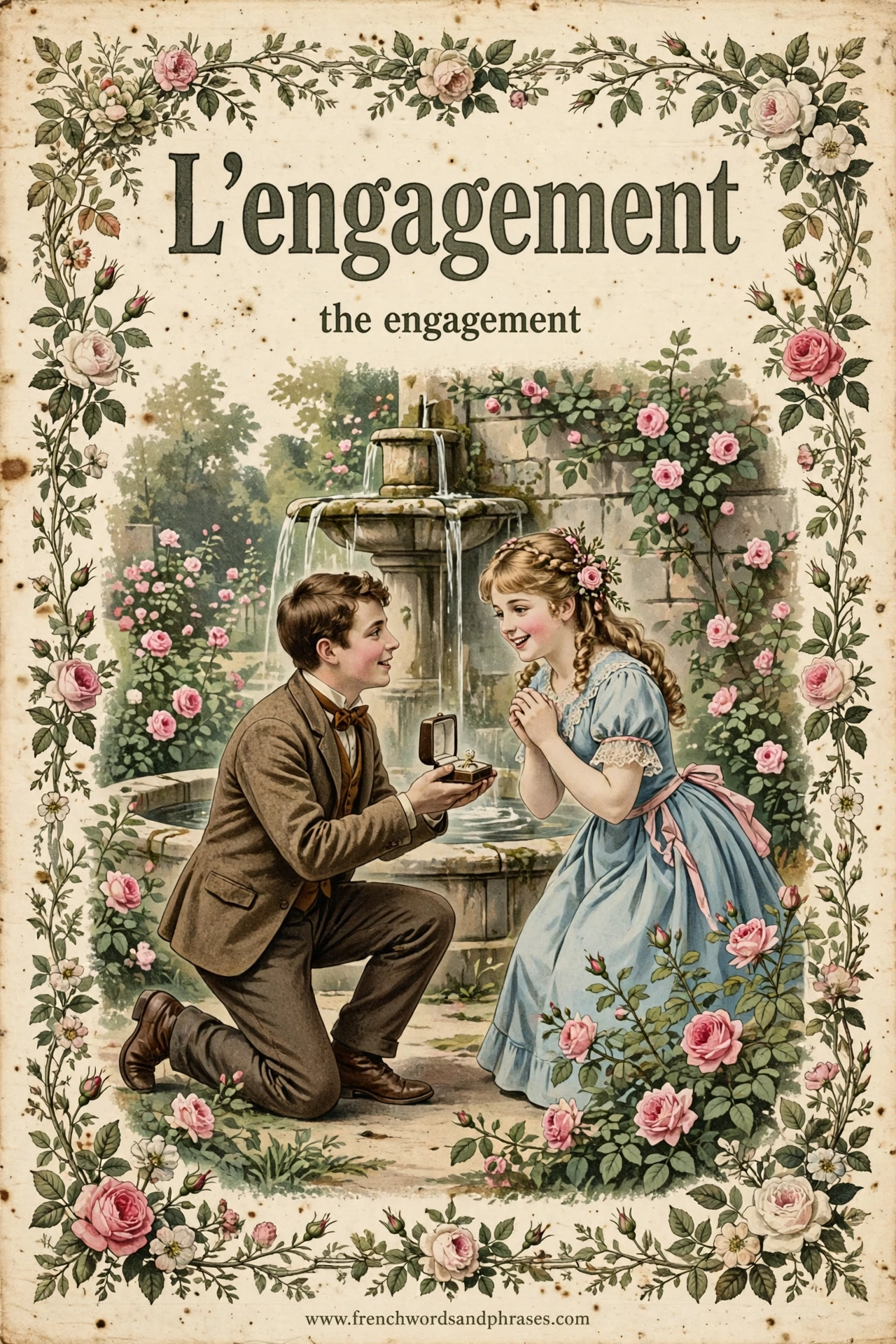
L’engagement means the engagement.
A ring catches the light at a family dinner, two hands are held up, and the table erupts: l’engagement — wait. French pauses here, because this word, borrowed back from English-looking cloth, does NOT mean the betrothal. Les fiançailles are the engagement to marry; l’engagement is the commitment — the promise, the pledge, the signing-up. A false friend wearing a ring.
In this guide, you’ll learn what engagement means in English, how to use it with its articles, how to form its plural, and how it appears in everyday French. Explore French examples, English translations, and practice quizzes.
Understanding the French Noun Engagement
Engagement is a masculine French noun, learned with its article: l’engagement, un engagement. It is built on engager — from en + gage, a pledge: to put something in pledge. Plural: les engagements. Its heart is commitment in every field: un engagement professionnel, a professional commitment; l’engagement d’un soldat, a soldier’s enlistment; tenir ses engagements, to keep one’s commitments. For the ring and the promise to marry, French says les fiançailles.
It means engagement in the sense of commitment, pledge, involvement: un engagement sérieux, a serious commitment; sans engagement, with no commitment, no strings (the phone contract’s favourite phrase); l’engagement politique, political involvement; prendre un engagement, to make a commitment. What it never means in careful French is the betrothal period: the couple celebrating their engagement are celebrating leurs fiançailles, and the ring is une bague de fiançailles.
Gender: Masculine — l’engagement
Definite article: l’ — l’engagement (the commitment)
Indefinite article: un — un engagement (a commitment)
Plural: les engagements — regular, with a simple -s
False friend: engagement to marry = les fiançailles, not l’engagement
Key phrase: sans engagement — with no commitment, no strings attached
English equivalents: The commitment; the pledge; the involvement.
Contracts love this word: un abonnement sans engagement is a subscription you can leave freely — the opposite of being engaged. Soldiers sign un engagement (they enlist); citizens show leur engagement (they get involved); and everyone is urged to tenir ses engagements, to honour their commitments. When the heart is engaged to be married, switch shelves: les fiançailles, se fiancer, la bague de fiançailles.
Experience the Word
Engagement is the word of the given word — the pledge laid on the table, whether it is a soldier’s signature, an activist’s evenings, or a promise you intend to keep.
Imagine the young recruit at the desk, pen above the line, the officer waiting in silence. Trois ans, cinq ans — il choisit, il signe : c’est un engagement. The word weighs exactly what the signature weighs.
You have not just named a promise. You have named the act of binding yourself — l’engagement.
How to Use Engagement in French: Complete Guide
Let’s explore how engagement works in French, beginning with its articles — l’engagement, un engagement, sans engagement.
Engagement with the Definite Article (L’, Les)
The article elides before the vowel: l’engagement — the commitment on the table.
| Form | French |
|---|---|
| Masculine singular | l’engagement |
| Plural | les engagements |
Example
L’engagement du soldat dure cinq ans.
The soldier’s enlistment lasts five years.
Engagement with the Indefinite Article (Un, Des)
Used for a commitment in general — one being made, kept or refused.
| Form | French |
|---|---|
| Masculine singular | un engagement |
| Plural | des engagements |
Example
C’est un engagement sérieux, pas un jeu.
It is a serious commitment, not a game.
Engagement with Quantities (Un, Deux, Assez de…)
Engagements are counted on calendars and consciences — too many is a diagnosis.
| Quantity | French |
|---|---|
| one commitment | un engagement |
| two commitments | deux engagements |
| several commitments | plusieurs engagements |
| too many commitments | trop d’engagements |
| no commitment | aucun engagement |
Example
Elle a trop d’engagements cette semaine.
She has too many commitments this week.
Quick Quiz 1
Complete the sentence:
______ engagement politique de ce parti est clair. (the)
Reveal the answer
L’
L’engagement politique de ce parti est clair.
The political commitment of this party is clear — the article elides before the vowel.
The Plural of Engagement
Engagement takes a regular plural in -s — commitments multiply easily.
| Number | French |
|---|---|
| Singular | l’engagement |
| Plural | les engagements |
Example
Il tient toujours ses engagements.
He always keeps his commitments.
Engagement with Possessive Adjectives (Mon, Ton, Son…)
Possessives agree with the noun: engagement is masculine and starts with a vowel, so mon, ton, son.
| Owner | French |
|---|---|
| my | mon engagement |
| your (tu) | ton engagement |
| his / her | son engagement |
| our | notre engagement |
| your (vous) | votre engagement |
| their | leur engagement |
Example
Mon engagement finit en décembre.
My commitment ends in December.
Quick Quiz 2
Complete the sentence:
Elle respecte ______ engagement envers l’association. (her)
Reveal the answer
son
Elle respecte son engagement envers l’association.
She honours her commitment to the association — son, because engagement is masculine.
Engagement with Demonstrative Adjectives (Cet, Ces)
Before a vowel, ce becomes cet: cet engagement, this commitment — the one being signed.
| Form | French |
|---|---|
| Masculine singular | cet engagement |
| Plural | ces engagements |
Example
Cet engagement-là change sa vie.
That commitment changes his life.
Engagement with Adjectives
Adjectives agree with engagement — masculine; they measure the weight of the pledge.
| Adjective | With Engagement |
|---|---|
| sérieux (serious) | un engagement sérieux |
| politique (political) | l’engagement politique |
| personnel (personal) | un engagement personnel |
| sans (none — the golden phrase) | sans engagement |
| nombreux (many, plural) | de nombreux engagements |
Example
Un abonnement sans engagement, c’est la liberté.
A subscription with no commitment, that’s freedom.
Quick Quiz 3
A couple announces their engagement to marry. Do you congratulate them on their engagement?
Reveal the answer
No — on their fiançailles. L’engagement is commitment in general; the betrothal is les fiançailles.
Félicitations pour vos fiançailles ! — Congratulations on your engagement!
Everyday Expressions with Engagement
Contracts, causes and calendars — the engagement phrases of daily life.
| Expression | In English |
|---|---|
| sans engagement | with no commitment, no strings attached |
| tenir ses engagements | to keep one’s commitments |
| prendre un engagement | to make a commitment |
| l’engagement citoyen | civic involvement |
| s’engager | to commit oneself, to enlist, to get involved |
Example
Ce forfait est sans engagement, tu peux partir quand tu veux.
This plan has no commitment, you can leave whenever you want.
Words from the Same Family as Engagement
Pledges and promises — engagement’s shelf of French words.
| French | In English |
|---|---|
| les fiançailles | the engagement (to marry) — the false friend’s correction |
| engager | to hire; to pledge; to start |
| s’engager | to commit oneself; to enlist |
| un gage | a pledge, a pawn — the root of the word |
| une promesse | a promise |
Example
Leurs fiançailles ont lieu en mai, le mariage en septembre.
Their engagement is in May, the wedding in September.
Quick Quiz 4
What does sans engagement promise on a phone contract?
Reveal the answer
No commitment — you can leave freely, no fixed term.
Sans engagement, sans souci. — No commitment, no worry.
Engagement in Everyday French: Real-Life Examples
Now that you know the word, let’s see how engagement appears in everyday French.
Example 1 — The contract
Ce téléphone est sans engagement.
This phone has no commitment attached.
Example 2 — Keeping promises
Il tient toujours ses engagements.
He always keeps his commitments.
Example 3 — The army
Son engagement dans l’armée dure trois ans.
His enlistment in the army lasts three years.
Example 4 — Involvement
Son engagement pour l’environnement est connu.
Her involvement in the environment is well known.
Example 5 — The calendar
J’ai un engagement samedi, je ne peux pas venir.
I have a commitment on Saturday, I can’t come.
Example 6 — The correction
Leurs fiançailles, pas leur engagement : le mariage est en septembre.
Their engagement (fiançailles), not engagement: the wedding is in September.
Beyond Translation: The Meaning of Engagement
Engagement is a pledge-word from the start: gage was the object you handed over as security — the glove, the coin — and engager meant to put in pledge. English borrowed engagement and narrowed it towards the ring; French kept the whole field of binding oneself, from the soldier’s signature to the activist’s evenings, and borrowed back nothing. The two languages now trip over the word daily.
To say engagement in French is to speak of the pledged word — commitment, not betrothal.
For the ring, French kept its own older jewel: fiançailles, from fiance, trust — the promise built on faith.
How to Remember the French Noun Engagement
Remember it this way: Engagement is the commitment, not the betrothal — masculine, and sans engagement is the phrase of freedom.
- Always masculine — l’engagement, un engagement, mon engagement.
- False friend — le mariage promis, ce sont les fiançailles ; l’engagement, c’est l’implication.
- The golden phrase — sans engagement, libre de partir.
The key idea is l’engagement — the commitment, pledge, involvement; NOT betrothal (les fiançailles); sans engagement = no strings.
Test Your Knowledge of Engagement
Let’s see how much you’ve learned. Try answering these questions before revealing the answers.
Question 1
Is engagement masculine or feminine?
Reveal the answer
Masculine — l’engagement, un engagement.
Question 2
How do you say with no commitment?
Reveal the answer
Sans engagement.
Question 3
Translate: He always keeps his commitments.
Reveal the answer
Il tient toujours ses engagements.
Question 4
What is the French for an engagement to marry?
Reveal the answer
Les fiançailles — l’engagement is commitment in general.
Question 5
Complete the sentence:
______ engagements de cette semaine sont nombreux. (the)
Reveal the answer
Les
Les engagements de cette semaine sont nombreux.
This week’s commitments are many.
Your Final Challenge
Can You Use It?
How would you say this in French?
“He always keeps his commitments.”
Reveal the answer
Il tient toujours ses engagements.
He always keeps his commitments.
A little French. A little curiosity. A richer everyday life.
LEARN FRENCH ONE WORD AT A TIME