A French Word to Live By
Translate Époux to English
/e.pu/
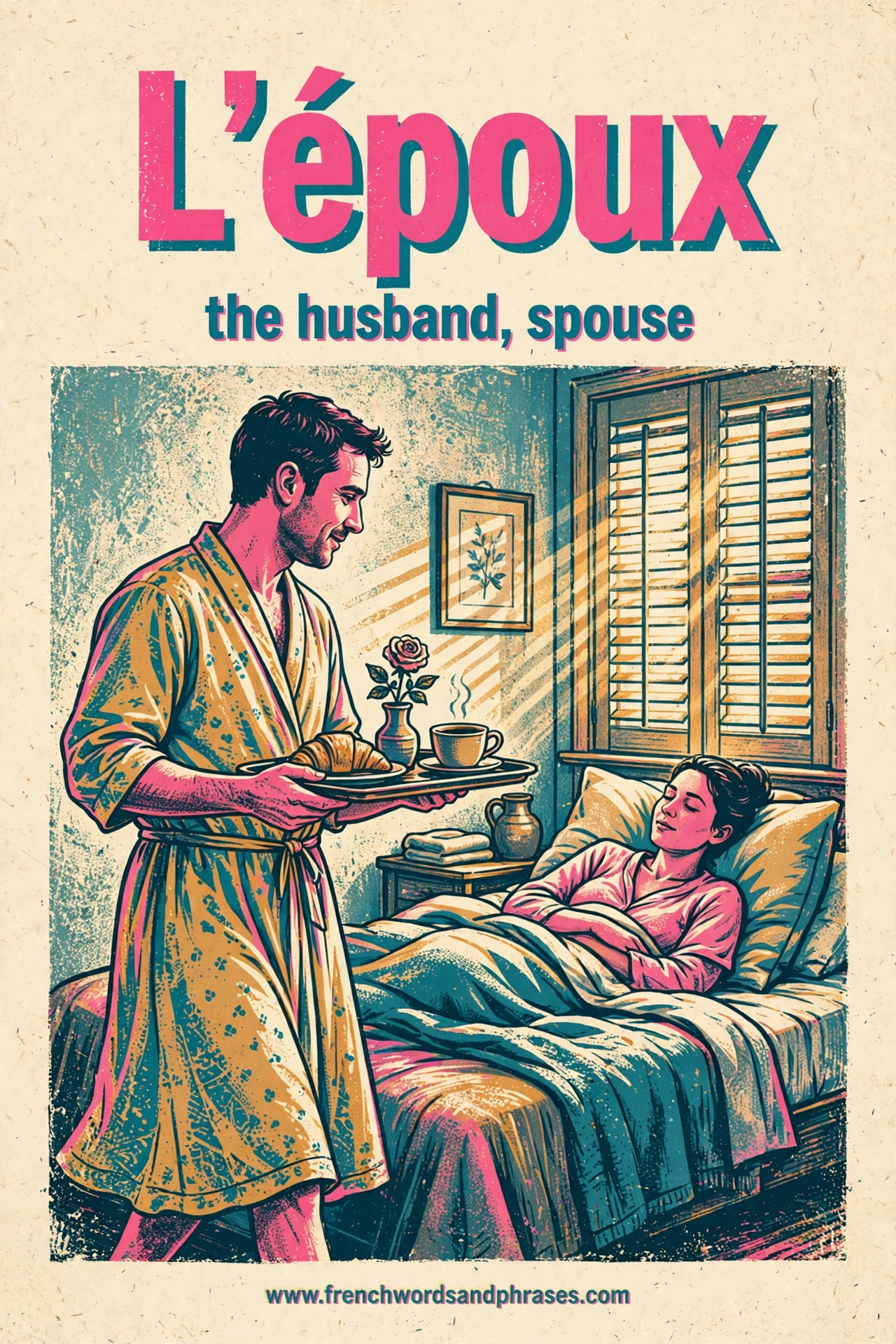
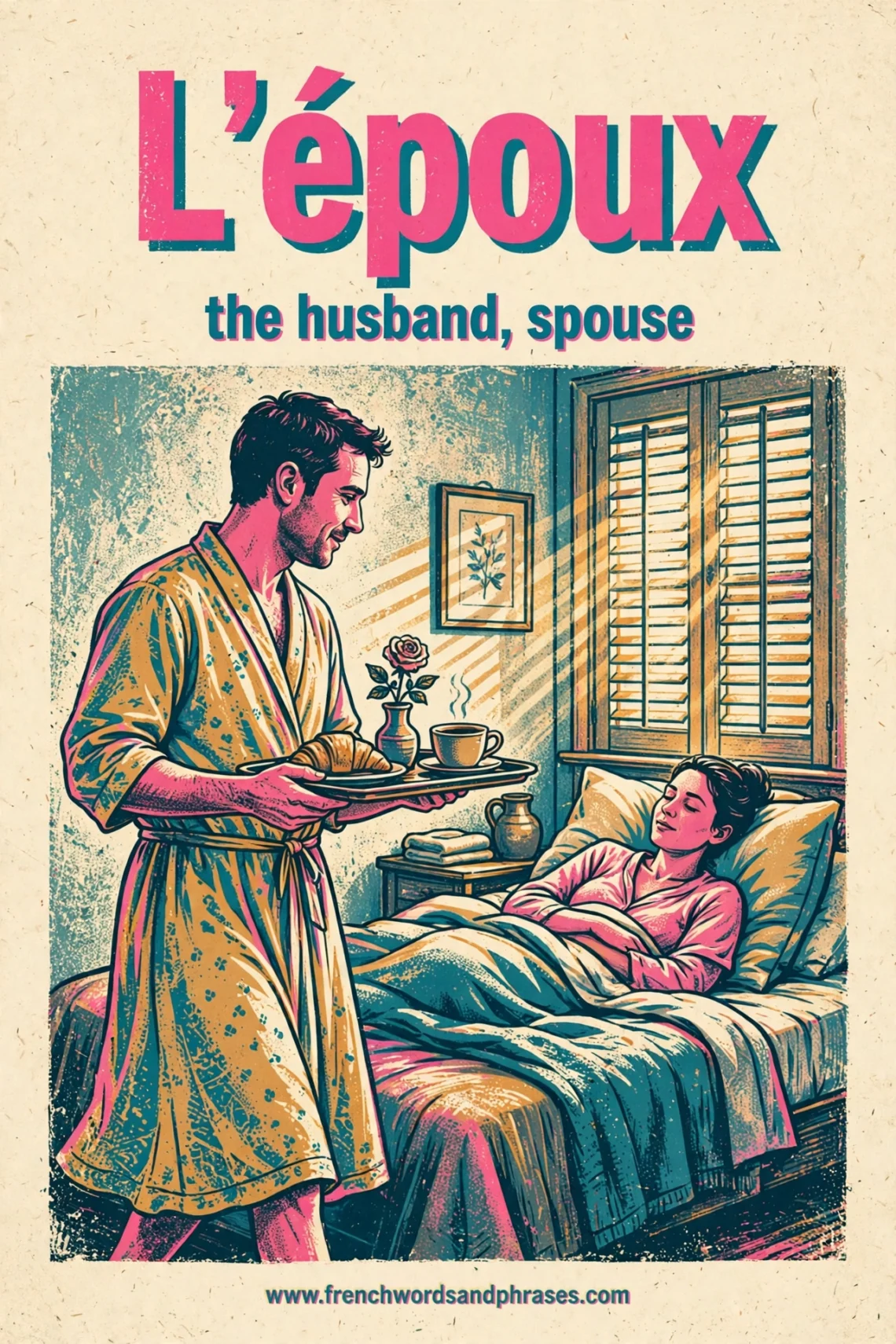
L’époux means the husband, spouse.
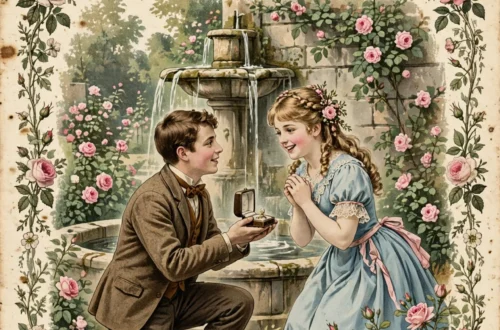
The mayor rises, the register opens, and the formal words ring out over the flowers: « les futurs époux » — the future spouses. Époux is the solemn word for a husband: not the mari of everyday chat, but the husband of ceremonies, documents and vows — the man in his married dignity.
In this guide, you’ll learn what époux means in English, how to use it with its articles, how to form its plural, and how it appears in everyday French. Explore French examples, English translations, and practice quizzes.
Understanding the French Noun Époux
Époux is a masculine French noun, learned with its article: l’époux, un époux (the article elides before the vowel). It descends from the Latin sponsus, the promised one — the same root as épouse and English spouse. Two traps live in it: the plural is identical to the singular, les époux, and in the plural the word usually means the married couple together, husband and wife as a pair. The feminine is l’épouse, the wife.
It means husband, spouse — in a formal, legal or ceremonial key: les époux se sont dit oui, the couple said yes to each other; son époux est décédé, her husband has passed away (the obituary’s word); les futurs époux, the bride and groom to be. Everyday French says mari for a husband and femme for a wife; époux and épouse belong to the mairie, the church, the notaire and the novel.
Gender: Masculine — l’époux
Definite article: l’ — l’époux (the husband)
Indefinite article: un — un époux (a husband)
Plural: les époux — identical spelling; usually means the married couple
Feminine: l’épouse — the wife, spouse
Register: formal, legal, ceremonial — everyday French says mari
English equivalents: The husband; the spouse.
Address and paperwork split the word’s life: a form asks for le nom de l’époux (the husband’s name), a mayor marries les futurs époux, and an obituary honours son époux. Between the two of them, couples say mari and femme, or mon homme in jest — never époux across the breakfast table. And remember: les époux in the plural almost always means the pair — les jeunes époux, the newlyweds.
Experience the Word
Époux is the husband in his Sunday clothes — the same man who burns toast on Tuesdays, raised by one word to the dignity of the vow.
Imagine the small mairie on a Saturday morning: flowers, a borrowed suit, the mayor’s tricolour sash. « Je vous déclare unis… » — and the register records not two sweethearts but deux époux, a legal fact wrapped in a celebration.
You have not just named a husband. You have named him as the vow sees him — l’époux.
How to Use Époux in French: Complete Guide
Let’s explore how époux works in French, beginning with its articles — l’époux, un époux, les époux.
Époux with the Definite Article (L’, Les)
The article elides before the vowel: l’époux — and the plural opens the couple’s story.
| Form | French |
|---|---|
| Masculine singular | l’époux |
| Plural | les époux (the married couple) |
Example
L’époux de Madame Perret est notaire.
Mrs Perret’s husband is a notary.
Époux with the Indefinite Article (Un, Des)
Used for a husband in the formal key — one being recorded, announced or honoured.
| Form | French |
|---|---|
| Masculine singular | un époux |
| Plural | des époux (couples) |
Example
C’était un époux dévoué, dit l’éloge funèbre.
He was a devoted husband, says the eulogy.
Époux with Quantities (Un, Deux, Assez de…)
Époux are counted in registers and romances — and les époux counts couples, two hearts per unit.
| Quantity | French |
|---|---|
| one husband | un époux |
| the two spouses | les deux époux |
| the future spouses | les futurs époux |
| the young spouses | les jeunes époux |
| many couples | de nombreux époux (couples) |
Example
Les futurs époux choisissent les fleurs du mariage.
The future spouses are choosing the wedding flowers.
Quick Quiz 1
Complete the sentence:
______ époux signe le registre. (the)
Reveal the answer
L’
L’époux signe le registre.
The husband signs the register — the article elides before the vowel é.
The Plural of Époux
Époux never changes its spelling — and les époux usually names the couple, husband and wife together.
| Number | French |
|---|---|
| Singular | l’époux (the husband) |
| Plural | les époux (the married couple) |
Example
Les époux partent en voyage de noces.
The newlyweds are leaving on their honeymoon.
Époux with Possessive Adjectives (Mon, Ton, Son…)
Possessives agree with the noun: époux is masculine and starts with a vowel, so mon, ton, son.
| Owner | French |
|---|---|
| my | mon époux |
| your (tu) | ton époux |
| his / her | son époux |
| our | notre époux (rare — legal style) |
| your (vous) | votre époux |
| their | leur époux (rare) |
Example
Son époux l’attend à la sortie de la mairie.
Her husband is waiting for her outside the town hall.
Quick Quiz 2
Complete the sentence:
Elle présente ______ époux aux invités. (her)
Reveal the answer
son
Elle présente son époux aux invités.
She introduces her husband to the guests — son, because époux is masculine.
Époux with Demonstrative Adjectives (Cet, Ces)
Before a vowel, ce becomes cet: cet époux, this husband — of novels and speeches.
| Form | French |
|---|---|
| Masculine singular | cet époux |
| Plural | ces époux (these couples) |
Example
Cet époux-là a attendu dix ans avant le mariage.
That husband waited ten years before the wedding.
Époux with Adjectives
Adjectives agree with époux — masculine; in the plural they describe the couple as one.
| Adjective | With Époux |
|---|---|
| futur (future) | le futur époux |
| jeune (young) | un jeune époux |
| dévoué (devoted) | un époux dévoué |
| feu (late, deceased) | feu son époux — her late husband |
| heureux (happy, plural) | des époux heureux |
Example
Le futur époux choisit les alliances.
The groom-to-be is choosing the wedding rings.
Quick Quiz 3
What do les époux usually mean — two husbands, or a married couple?
Reveal the answer
A married couple — husband and wife together: les jeunes époux, the newlyweds.
Les époux se sont dit oui. — The couple said yes to each other.
Everyday Expressions with Époux
Mairies, obituaries and wedding speeches — the époux phrases of formal life.
| Expression | In English |
|---|---|
| les futurs époux | the future spouses, the couple to be married |
| les jeunes époux | the newlyweds |
| son époux / son épouse | her husband / his wife (formal) |
| les époux X | Mr and Mrs X (in formal announcements) |
| prendre pour époux | to take as one’s husband (the vow’s wording) |
Example
Les jeunes époux ouvrent le bal du mariage.
The newlyweds open the wedding ball.
Words from the Same Family as Époux
The marriage shelf — époux’s family of French words.
| French | In English |
|---|---|
| l’épouse | the wife, spouse (formal) |
| le mari | the husband (everyday word) |
| le mariage | marriage, the wedding |
| épouser | to marry (the verb) — épouser quelqu’un |
| les fiançailles | the engagement (the period and the party) |
Example
Il va épouser sa meilleure amie au printemps.
He is going to marry his best friend in the spring.
Quick Quiz 4
At the breakfast table, does a French wife call her husband mon époux or mon mari?
Reveal the answer
Mon mari — époux belongs to ceremonies and documents; mari is the everyday word.
Mon mari, passe-moi le beurre. — My husband, pass me the butter.
Époux in Everyday French: Real-Life Examples
Now that you know the word, let’s see how époux appears in everyday French.
Example 1 — At the mairie
Les futurs époux arrivent à onze heures.
The future spouses arrive at eleven.
Example 2 — The announcement
Les époux Lambert annoncent leur mariage.
Mr and Mrs Lambert announce their wedding.
Example 3 — The obituary
Son époux est décédé l’an dernier.
Her husband passed away last year.
Example 4 — The speech
Aux jeunes époux, santé et bonheur !
To the newlyweds, health and happiness!
Example 5 — Paperwork
Nom de l’époux, nom de l’épouse : le formulaire est complet.
Husband’s name, wife’s name: the form is complete.
Example 6 — Honeymoon
Les époux partent demain pour Venise.
The couple leaves tomorrow for Venice.
Beyond Translation: The Meaning of Époux
Époux and épouse descend from Latin sponsus and sponsa — the promised ones, from spondere, to pledge. English took the same pair and made spouse; French kept the pledge audible in the verb épouser, to marry, which everyday speech still uses for the act itself while mari and femme took over the kitchen table.
To say époux is to name the husband as the ceremony sees him — pledged, recorded, and dressed for the photograph.
And its invariable plural holds a small poem: les époux, one word for two people, because in the register’s eyes they are one entry.
How to Remember the French Noun Époux
Remember it this way: Époux is the formal husband — masculine, elided article, a plural that means the couple, and mari for everyday life.
- Always masculine — l’époux, un époux, son époux.
- Plural = the couple — les époux, ce sont mari et femme ensemble.
- Register test — époux à la mairie, mari à la maison.
The key idea is l’époux — the husband, spouse (formal); feminine l’épouse; les époux = the married couple.
Test Your Knowledge of Époux
Let’s see how much you’ve learned. Try answering these questions before revealing the answers.
Question 1
Is époux masculine or feminine?
Reveal the answer
Masculine — l’époux, un époux; the feminine is l’épouse.
Question 2
How do you say the newlyweds?
Reveal the answer
Les jeunes époux.
Question 3
Translate: The future spouses are choosing the flowers.
Reveal the answer
Les futurs époux choisissent les fleurs.
Question 4
What is the everyday word for a husband?
Reveal the answer
Le mari — époux is the formal, ceremonial word.
Question 5
Complete the sentence:
______ époux partent en voyage de noces. (the)
Reveal the answer
Les
Les époux partent en voyage de noces.
The couple leaves on their honeymoon.
Your Final Challenge
Can You Use It?
How would you say this in French?
“To the newlyweds, health and happiness!”
Reveal the answer
Aux jeunes époux, santé et bonheur !
To the newlyweds, health and happiness!
A little French. A little curiosity. A richer everyday life.
LEARN FRENCH ONE WORD AT A TIME