A French Word to Live By
Translate Raison to English
/ʁɛ.zɔ̃/
La raison means the reason.
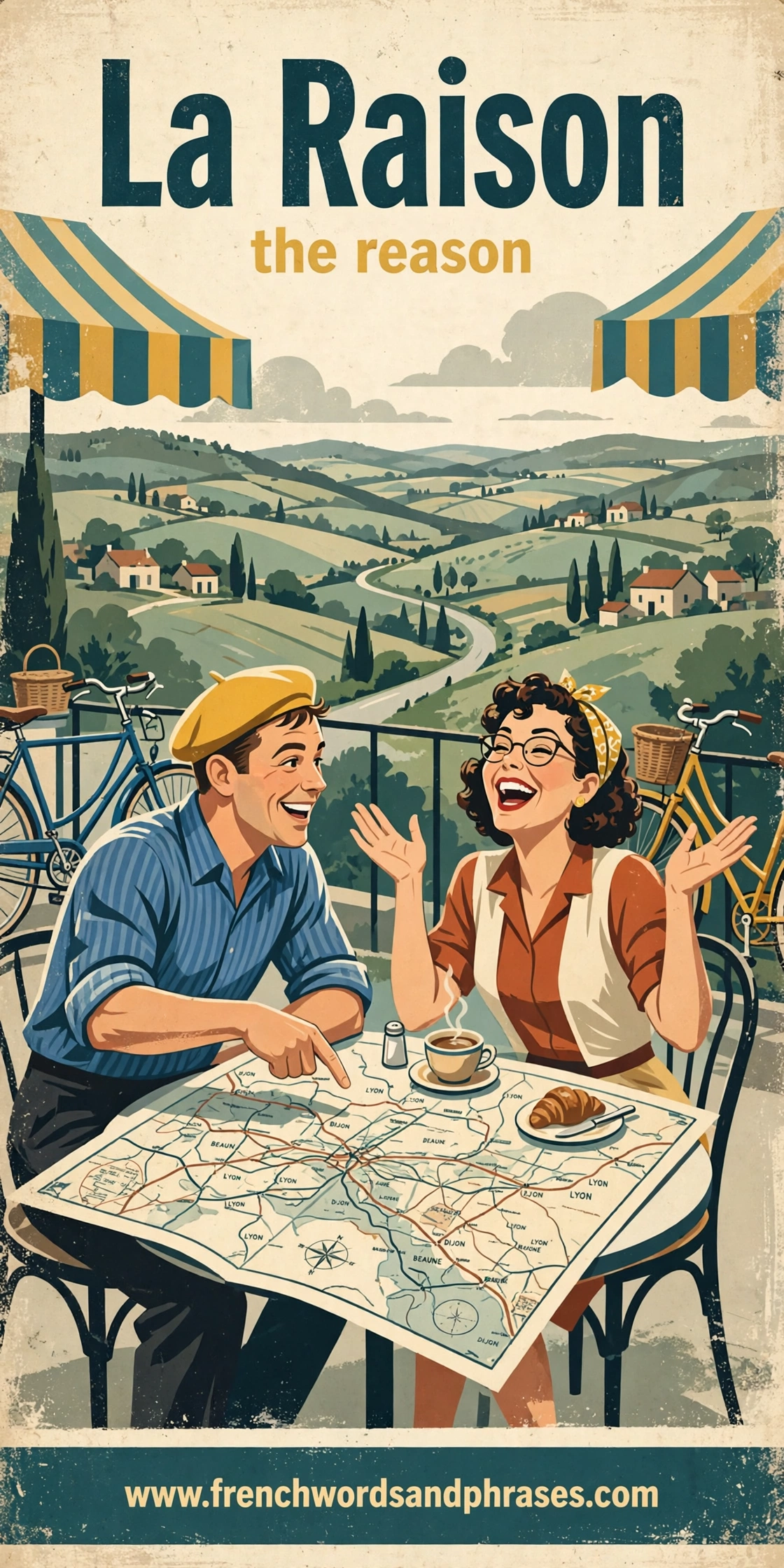
Two friends, one map, and a cheerful argument about the road to take. Ten minutes later one of them laughs and surrenders the map: tu as raison. Behind the laugh stands the word itself — la raison.
In this guide, you’ll learn what raison means in English, how to use it with its articles, how to form its plural, and how it appears in everyday French. Explore French examples, English translations, and practice quizzes.
Understanding the French Noun Raison
Raison is a feminine French noun. Like every French noun, it has a gender, and it is learned together with its article: la raison.
It means the reason — the why behind things. But raison is also the mind that reasons, and with the verb avoir it makes one of the most useful phrases in French: avoir raison, to be right. Elle a raison — she is right — is something you will say and hear every day.
Gender: Feminine
Definite article: la — la raison (the reason)
Indefinite article: une — une raison (a reason)
Plural: les raisons (the reasons)
English equivalents: The reason; (with avoir) to be right.
One essential phrase: raison joins the verb avoir to say to be right — j’ai raison, tu as raison. Its opposite is avoir tort, to be wrong. Learn raison together with avoir from the start, and you will use it every day.
Experience the Word
Raison is more than a cause. It is the quiet voice that asks why — and the satisfaction of the moment someone finally says: tu as raison.
Imagine two friends arguing happily over a map at a café table. One traces the road, the other shakes her head — until the answer appears, and they laugh: you were right all along.
You have not just explained something. You have been right — tu as raison.
How to Use Raison in French: Complete Guide
Let’s explore how raison works in French, beginning with its articles.
Raison and Its Articles
French nouns are almost never used alone. The small word in front of the noun — the article — does a great deal of work.
Raison with the Definite Article (La, Les)
Used for a particular reason — or for reason itself, the faculty of thinking clearly.
| Number | French |
|---|---|
| Singular | la raison |
| Plural | les raisons |
Example
La raison de son départ est simple.
The reason for his departure is simple.
Raison with the Indefinite Article (Une, Des)
Used to count reasons: one reason, several reasons.
| Number | French |
|---|---|
| Singular | une raison |
| Plural | des raisons |
Example
Donne-moi une bonne raison de rester.
Give me one good reason to stay.
Raison with Avoir (Avoir Raison — To Be Right)
Raison’s most famous partner is the verb avoir. Avoir raison means to be right; its opposite, avoir tort, means to be wrong.
| Meaning | French |
|---|---|
| I am right | j’ai raison |
| you are right (tu) | tu as raison |
| he / she is right | il / elle a raison |
| we are right | nous avons raison |
| they are wrong | ils ont tort |
Example
Elle a raison : le train part à neuf heures.
She is right: the train leaves at nine.
Quick Quiz 1
How do you say They are right in French?
Reveal the answer
Ils ont raison
Ils ont raison : le musée est fermé aujourd’hui.
They are right: the museum is closed today.
The Plural of Raison
Raison adds an -s in the plural like most nouns — des raisons, several reasons.
| Number | French |
|---|---|
| Singular | la raison |
| Plural | les raisons |
Example
Il a donné trois raisons.
He gave three reasons.
Raison with Possessive Adjectives (Ma, Ta, Sa…)
Possessives agree with the noun, not with the owner — and raison is feminine, so it takes ma, ta, sa.
| Owner | French |
|---|---|
| my | ma raison |
| your (tu) | ta raison |
| his / her | sa raison |
| our | notre raison |
| your (vous) | votre raison |
| their | leur raison |
Example
Ma raison de vivre, c’est la musique.
My reason for living is music.
Quick Quiz 2
Complete the sentence:
Il écoute la voix de la ______.
Reveal the answer
raison
Il écoute la voix de la raison.
He listens to the voice of reason.
Raison with Demonstrative Adjectives (Cette, Ces)
Used to point: this reason here, those reasons there.
| Number | French |
|---|---|
| Singular | cette raison |
| Plural | ces raisons |
Example
Cette raison ne suffit pas.
This reason is not enough.
Raison with Adjectives
Adjectives agree with raison, and most follow it — une raison valable, une raison personnelle.
| Adjective | With Raison |
|---|---|
| valable (valid) | une raison valable |
| personnelle (personal) | une raison personnelle |
| médicale (medical) | une raison médicale |
| familiale (family) | une raison familiale |
| professionnelle (work-related) | une raison professionnelle |
| suffisante (sufficient) | une raison suffisante |
Example
Ce n’est pas une raison valable.
That is not a valid reason.
Quick Quiz 3
Complete the sentence:
Elles ______ raison de partir tôt.
Reveal the answer
ont
Elles ont raison de partir tôt.
They are right to leave early.
Everyday Expressions with Raison
Raison stands behind some of the most useful phrases in French.
| Expression | In English |
|---|---|
| avoir raison | to be right |
| la raison d’être | the reason for being, the purpose |
| pour quelle raison ? | why? for what reason? |
| sans raison | for no reason |
| perdre la raison | to lose one’s mind |
| écouter la voix de la raison | to listen to the voice of reason |
Example
Écoute la voix de la raison, pour une fois.
Listen to the voice of reason, for once.
Words from the Same Family as Raison
Learn these together and the whole argument makes sense.
| French | In English |
|---|---|
| raisonner | to reason, to think things through |
| raisonnable | reasonable |
| le raisonnement | reasoning |
| la cause | the cause |
| le motif | the motive, the grounds |
| la logique | logic |
Example
Sois raisonnable, il est tard.
Be reasonable, it’s late.
Quick Quiz 4
What does la raison d’être mean?
Reveal the answer
The reason for existing, the purpose
Quelle est la raison d’être de cette règle ?
What is the reason behind this rule?
Raison in Everyday French: Real-Life Examples
Now that you know the word, let’s see how raison appears in everyday French.
Example 1 — Looking for the cause
Elle cherche la raison de ce retard.
She is looking for the reason for this delay.
Example 2 — Agreeing
Vous avez raison : ce chemin est plus court.
You are right: this path is shorter.
Example 3 — Good advice
Il a raison de se reposer.
He is right to rest.
Example 4 — Asking why again
Pour quelle raison est-il parti ?
Why did he leave?
Example 5 — No reason at all
Elle a ri sans raison.
She laughed for no reason.
Example 6 — The deep reason
Quelle est la raison d’être de cette règle ?
What is the reason behind this rule?
Beyond Translation: The Meaning of Raison
English says reason for the meaning of raison — the cause of things. The French word does double duty: it is both the why of the world and the clear head that finds it, and it lends itself to the most satisfying sentence in the language.
Elle a raison — she is right.
It evokes café debates and family arguments, all of them ending the same way: with somebody right, somebody wrong, and raison standing quietly between them.
How to Remember the French Noun Raison
Remember it this way: Raison is the reason — and with avoir, it is how you say you are right.
- You ask for one — quelle est la raison ?
- You agree warmly — vous avez raison.
- You lose it completely — il perd la raison.
The key idea is la raison for the reason, avoir raison for being right.
Test Your Knowledge of Raison
Let’s see how much you’ve learned. Try answering these questions before revealing the answers.
Question 1
Is raison masculine or feminine?
Reveal the answer
Feminine — la raison.
Question 2
How do you say He is right in French?
Reveal the answer
Il a raison.
Question 3
Translate: He gave three reasons.
Reveal the answer
Il a donné trois raisons.
Question 4
What is the opposite of avoir raison?
Reveal the answer
Avoir tort — to be wrong.
Question 5
Complete the sentence:
Nous cherchons la ______ de cette décision.
Reveal the answer
raison
Nous cherchons la raison de cette décision.
We are looking for the reason behind this decision.
Your Final Challenge
Can You Use It?
How would you say this in French?
“Maria is right: the train leaves at nine.”
Reveal the answer
Maria a raison : le train part à neuf heures.
Maria is right: the train leaves at nine.
A little French. A little curiosity. A richer everyday life.
LEARN FRENCH ONE WORD AT A TIME